On reading, 2018 and 2019

Alternate title: In which I write about something else. This was originally going to be a saleswanking post, which I haven’t done in quite a while and I wanted to do mostly for my own information and share with you guys because someone out there has to love spreadsheets as much as I do, but once I went through everything on Amazon and Squarespace just to figure out where I was at for 2018 and where (roughly) I might be for my sales since Benevolence Archives 1 came out in 2014, this was what my desktop looked like:

I’m still gonna do it, don’t get me wrong– I want this information, and I am exactly the kind of geek for whom “spend a couple of hours sorting through spreadsheets and pulling together an overall data set” actually describes a fun couple of hours. But I’m not doing this shit tonight. So, instead, since I’m no more than a day or two away from doing my 10 Best Books list, let’s talk about what I read this year. Which still involves spreadsheets. 🙂

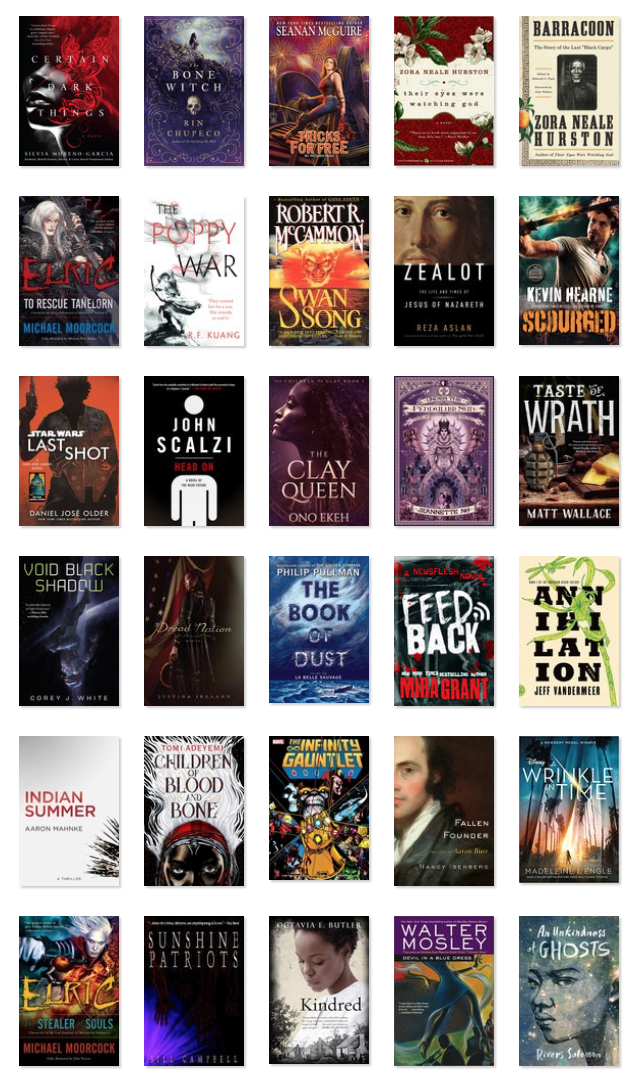
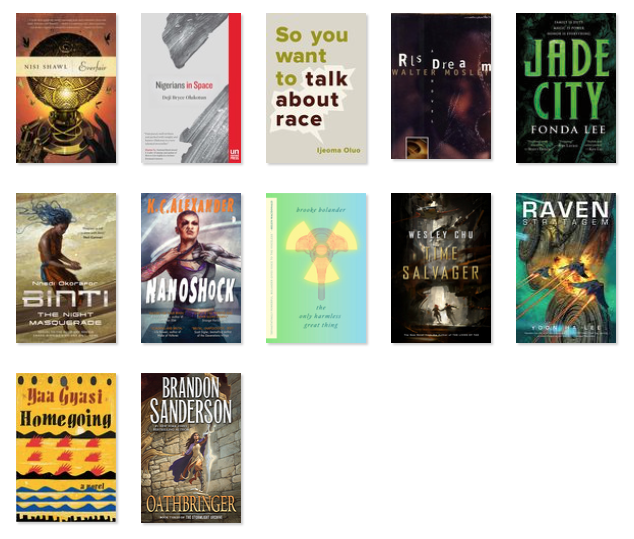
Assuming I finish the book I’m reading right now in the next three days, I’ll have read 104 books in 2018, which was four more than my goal of 100. Here they are, excepting only S. A. Chakraborty’s City of Brass, which I’m reading right now:
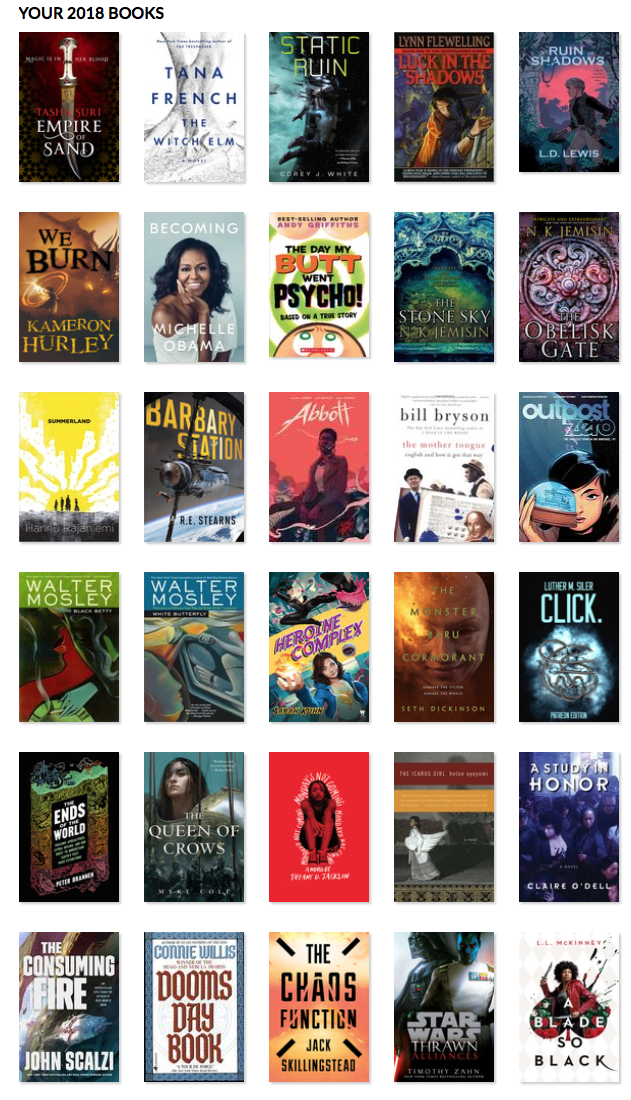
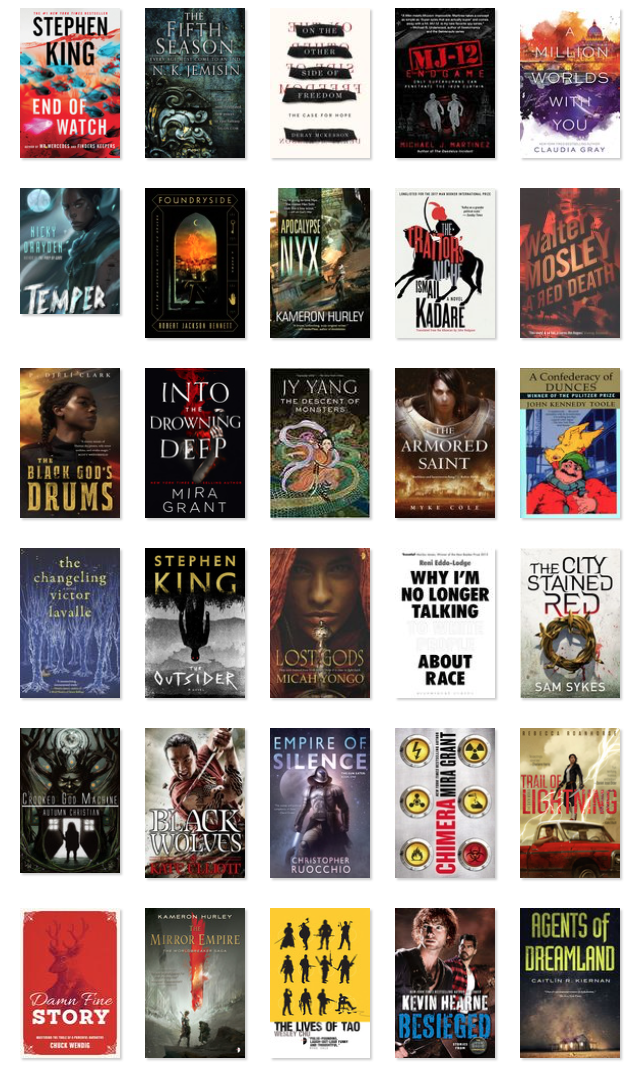
For the last several years I’ve been working on aggressively diversifying my reading after discovering that I was reading far more white men than I felt like I ought to be. I’ve had different goals for different years, but this year I decided to focus on making sure half of my books were from people of color. And, in fact, exactly half of them ended up being by PoC: 52 of the 104. In previous years I’ve set goals to read books by, basically, anyone other than white men, but I noticed last year that white women seemed to be the beneficiary of that policy so I decided to focus more on people of color this year. I did not specifically track books by women vs books by men, but a quick count indicates that I did pretty well there too– and, if anything, I think I read slightly more books by women than by men. 50 of these books were by authors I hadn’t previously read anything by, too.

The interesting thing is, while my 10 best list isn’t finalized yet– again, sometime this week– I have reason to believe that a substantial majority of the books on it will be by women of color, and this was a phenomenal year for reading. I read some fucking amazing books this year, and choosing the top 10 from this list is gonna be hard.

Damn near every book on the list– upwards of 90%, and probably above 95%– was read in print. Which is why next year I’m gonna pull back a little bit, and the only things I plan to track all year long, other than new authors, are rereads. My bookshelves are about to collapse on me, y’all, and they are on every wall in the damn house. I think I’m going to set a goal of 90 books, with 30 of those being books that I already own. At the end of the year, I’ll take a look at how I did in reading from diverse authors when I wasn’t specifically tracking it. I haven’t been doing a ton of rereading lately because it doesn’t really mix well with the notion of broadening the authors I’m reading work by.

What did you read this year?
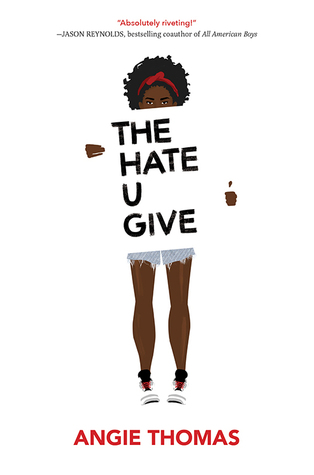
#REVIEW: The Hate U Give, by Angie Thomas

32075671One of our local radio stations does a bit called Group Therapy in the morning, which is usually airing just as I’m driving the boy to school.  The general pattern is this: they pose a problem, submitted by a listener, that should generally be easily dealt with by anyone with an average middle schooler’s level of sophistication and emotional intelligence.  They do not provide enough information about the problem to allow listeners to give useful advice, and people who like hearing their voices or names on the radio submit useless advice on Facebook or on the air so that the person involved can do whatever they were going to do anyway.

I’m going to start listening to Pandora more in the morning, is what I’m saying.

This morning’s problem was as follows: a parent’s 11-year-old has stolen their credit card, for the second time.  It wasn’t made perfectly clear, but it seems that as of the time of the advice-asking, the boy still had the card.  He had used it to buy $50 worth of drinks and snacks from a local convenience store and not to, say, order hundreds of dollars worth of electronics from somewhere, which is what you’d think most kids would do with a credit card they’d stolen.  Anyway, this parent had reported the card stolen, and apparently under the (incorrect) idea that the police would show up if the kid attempted to use the card again– which, yeah, right— was wondering if he/she should just talk to his/her kid or let the police “scare him straight.”

And all I could think of, listening to this, was that the person asking for advice and every single one of the dumb motherfuckers providing (generally approving) advice for the latter piece of advice had to be white.  Because every black parent in America knows that you do not let the police anywhere near your child unless someone is guaranteed to die if you don’t.  There are no optional encounters with the police.  Fuck, I’m white and I live in a nice neighborhood and I’m never calling the police again unless somebody is under serious immediate physical threat.  And you’re gonna call the police on your baby because of a $50 credit card bill?  Your privilege is not only showing, it’s leaking out of the dashboard of my car, and I ought to be able to charge somebody to clean that shit up.

(Leave aside the ridiculous notions that 1) the police care about a $50 fraudulent credit card charge because they have nothing else to do and 2) they have time to help you with relatively routine parenting decisions.)

Which brings me to Angie Thomas’ The Hate U Give, or THUG for short.  The title of the book is a Tupac reference; Pac was fond of the backronym, explaining, for example, that “nigga” stood for “Never Ignorant, Getting Goals Accomplished.”  “Thug Life,” to Tupac, meant “The Hate U Give Little Infants Fucks Everybody,” and the meaning of that phrase is discussed throughout the book.

The story is told through the eyes of Starr Carter, a sixteen-year-old black girl.  Starr is the sole witness when a policeman murders one of her oldest friends during a traffic stop.  Her friend, Khalil, was unarmed and unresisting when he was shot.  The rest of the book spins out from that one moment; the different sections are even dated by it: “Three Weeks After It Happens,” and such.

You can probably predict the overall story beats from the premise, right?  America knows this story pretty Goddamn well by now, and the tension here is less from what happens (anybody want to put money down on whether the cop is exonerated by the grand jury or not?) than how the people in the book react to it.  Starr herself is a fascinating character; she lives in a rough neighborhood but her parents scrape and save to send her to a private school 45 minutes away, so many of her best friends aren’t black and she thinks of herself as being two different people, one at school and one at home.    Her uncle is a police officer, her father a former gang member.  Khalil himself has a complicated backstory, and the book dives into the inevitable attempt by the media and the police to slander him and make him responsible for his own murder.  For a large portion of the story Starr’s school friends and her (white) boyfriend aren’t aware that she’s the anonymous witness the news keeps referring to, and the way she reacts to their treatment of Khalil’s death is complex and fascinating.  Her navigation through the web of relationships and identities she’s struggling with throughout the book is a pleasure to read.

I recommend books here all the time; I rarely bother to review anything I didn’t love unless I think I can hate it in an entertaining way, but it’s not terribly often that I use the word important to describe a book that I’ve read.  You need to read THUG, and you need to get THUG into the hands of as many other people as you can, particularly young people.  Angie Thomas’ writing is crisp and clear, Starr herself is a wonderful character, and I can’t wait to get my hands on more work by this author.  Go read this book.  Do it right now.

Pre-review: THE HATE U GIVE, by Angie Thomas

I hav32075671.jpgen’t been around much lately– I’ve had a distinct lack of things to say, to be honest– and this post isn’t going to change things all that much, but at the moment I’m halfway through Angie Thomas’ The Hate U Give and I figure I may as well start right now: this book is a big fucking deal, and a whole goddamn lot of people who aren’t reading it need to be.   This book is fucking important in a way that nothing I’ve read in a while really has been, and I know I’m frequently all sorts of ebullient whenever I write about a book around here, but take this seriously.

Full post incoming once I finish it, of course.  I can imagine a world where the back half goes pear-shaped, but I don’t know that it even matters.  I can’t imagine it going sour enough that I wouldn’t be recommending this to everyone I could find when I was done with it.

In which I’ve been reading

img_4968One of the more underrated aspects of the recent Netflix Luke Cage miniseries was the attention it paid to black literature.  In particular, a conversation about author Donald Goines during one episode instantly sold me four of his books– and by instantly, I mean I literally opened the Amazon app on my phone and ordered the books in between scenes.  Goines’ Kenyatta series– Crime Partners, Death List, Kenyatta’s Escape, and Kenyatta’s Last Hit, have been sitting on my bookshelf for a couple of weeks now waiting for me to finish the Hamilton biography and get to them.
I read all four of them today and yesterday.  It sounds like an accomplishment, but they’re not very long– only Last Hit tops 200 pages– and I’ve been off from work.

Imagine Conan, but written in the 1970s– dear God, there is nothing more 1970s than these books– and set in the ghettos of Detroit and Los Angeles instead of Cimmeria, and you actually have a pretty good idea of what these books are like.  The prose is occasionally, to put it mildly, terrible– see the excerpt above– but the books have so much energy and passion to them that I couldn’t put any of them down.  Goines’ literary career lasted something like five years and he released over a dozen books during that time before being found shot to death in his home.  I hate to bring in a Hamilton reference again, but it’s appropriate: the man wrote like he was running out of time, and his Wikipedia entry speculates that he wrote to stave off heroin addiction.  The Kenyatta series is frantically-paced in the best way; it’s as if Goines physically needed to get the story out of him as best he could and barely glanced at it before moving on to the next one.

Think about checking them out, is what I’m saying, even if the page above makes you cringe.  Do it anyway.

#Review, sorta, maybe? MR. FOX, by Helen Oyeyemi

41y023A+qtL._SX318_BO1,204,203,200_.jpgMy dirty little secret is that I’m not actually a very good reader.

It’s true: for someone who reads as much as I do (I’ll start my 12th book of 2016 tonight, although a bunch of them have been graphic novels) I have terrible recall of what I’ve read and little ability to pick up on subtext.  I am godawful at the types of things that English majors do and say and think about books; I can barely tell you what they are.

I have, and this is related, never been a good reading teacher.

What this means is that when I read fiction I prefer books with strong and clear central narratives.  Things like unreliable narrators and books where you have to hunt to find the plot drive me crazy, and I have to be careful sometimes to make sure I’m distinguishing between a book that is genuinely bad and a book that just isn’t “my” kind of book.  And the last two books I’ve read have both been books where you sorta have to hunt around to figure out what was going on.  A Brief History of Seven Killings was all multiple-narrator first person where a lot of stuff happened between the lines and sometimes he’d go off on a stream-of-consciousness tear and have three pages where there was no punctuation, especially if a character was high or terrified or dying during the events they were describing– which happened more often than you’d guess.

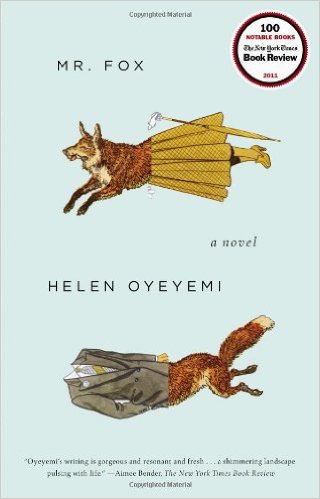
Mr. Fox, by Helen Oyeyemi, does something a little different, where she’s playing with narrative more than James was in Killings, and while the overall arc of the book is a little murky what’s going on at any given moment in a chapter is always pretty clear.  I loved this book, which sort of surprises me; the three main characters are a writer, the titular Mr. Fox; his wife, and his muse, who is only real for bits and pieces of the book.  Sometimes she’s a ghost.  Sometimes she’s clearly physical and can be seen and interacted with by people who are not the three central characters.  Sometimes the three central characters show up as characters in a story it turns out Mr. Fox is writing, and his habit of killing off his female characters at the end of his stories can be a little jarring.  It lends the whole book this weirdly dreamy quality; you’re never sure whether anything going on in a given section is “real” or not and sometimes even the bits that are clearly fairy tales or fiction-within-the-fiction have characters who turn out to have been “real” but fictionalized when they show up later.

One way or another, I started the thing before bed last night and I just finished it about an hour ago despite this being a weekend and me having, like, stuff to do.  So I devoured the crap outta this book.  S’good.  I promise.

So … if you read like me, and you like your narratives straightforward?  Believe me that this turns out fascinatingly anyway, and just roll with it.  If you’re an English Lit Sort of Person, knock a motherfucker down to get your hands on this if you need to, because I suspect you’ll love it.  I five-starred it at Goodreads; it may end up on my 2016 shortlist but I’m going to give it a couple of weeks first to see how my thoughts of it hold up over a bit of time.

Now, I’m going to go read some YA to clear my brain, because there’s a China Miéville novella sitting on my TBR shelf and my ass is not ready.  

While I’m lecturing all the white people…

Had this conversation on Facebook yesterday, regarding this story, in my Bruce Banner alter ego, which is why it’s all censored to hell.  I’m in blue and she, a former student, is in black.  This is why representation is important, guys.  This is why #weneeddiversebooks is important.  Right here:

Screen_Shot_2015-11-07_at_7_38_20_AM

Just sayin’.  And now I gotta find a way for Jayashree to survive that fight.  🙂

Ignore this post

Being moderately serious here– I’m not really in the mood that someone reading this might reasonably conclude me to be in, it’s more like I’m writing this to get it out of my system.  Encouragement in comments is not necessary; in fact, feel free to make fun of me for my nonsense if you want.  Also, this is vaguebooking to a degree that actually offends me, as I’m not giving either of the people involved a chance to Google their way to finding this.


So anyway.  Once upon a time I did NaNoWriMo for the first time, and lo, I was successful.  And terribly proud of myself, even though I suspected that the manuscript itself wasn’t good enough for prime time– hey, I’d written a book, which is precisely the awesome feeling that NaNo wants to engender in its participants.  I was buddies with a few other people who were also doing NaNo, and me and one of the other people exchanged manuscripts after we were done.

I have no idea what she did with mine.  She never mentioned it to me again.  I read about half of hers and decided I didn’t deserve that kind of pain any longer and stopped, also never mentioning it again.  We lost touch.  We were online buddies; it happens, right?  No biggie.

I ran into her a few years later in a book group on Facebook.  Turns out she’d managed to both find an agent and a publisher, and her debut novel (not this book, another one) was coming out in the very near future.  Go you!  I bought the book.  I have a policy: if people I know write books, I buy them.  It’s not a policy that comes up a whole hell of a lot, but a policy is a policy.  (Exception is if your book costs a hundred damn dollars.  Sorry, Bill, I love you, but not that much.)

It was fucking terrible.  Her previous manuscript I just couldn’t get through.  This one was awful.  It was so bad that I was literally insisting that other people I know read it (I actually photocopied most of a chapter for the other teachers on my team at one point) to confirm that it wasn’t me being a jealous asshole, but that it really truly was that bad.

Not only was it terrible, it was getting glowing reviews, and I believe even won a couple of actual book awards.  The cognitive dissonance was unmanageable.  I have good taste, goddammit!  I know how to read!  What the fuck are you people thinking?

Well, I found her second book, just released, on the shelf at Barnes and Noble yesterday.  And I read the first couple of pages in the store, and I almost bought the thing, because Jesus Christ it was the exact same shit.  Her writing itself is terrible, waaay before you get to any considerations like characterization and story.  It was unbelievable.

I did calm myself down a bit when I got home and looked the second book up on Amazon, which had several pre-release Vine reviews that all started with “I loved (previous book), but this one is (complain complain complain)” and then gave the book three stars that you felt like someone put a gun to their head to make them award.


I encountered a free book listing on Twitter the other day.  For some reason, it triggered an immediate “Ooh!  Buy!” reaction from me.  I can only assume that the author’s name made me think of someone else, in retrospect, but my first thought was holy shit free book by XXXX and I downloaded it immediately.  Today, amazingly, another book by XXXX became free and I downloaded that one instantly too.

This afternoon, I got around to reading them.  And then got really confused.  They were terrible too.  Now, this first author, she can put a sentence together.  If she wrote a newspaper article or a blog post or hell an email to a colleague you’d never have reason to criticize her.  She just puts on this I’m Doing Litratcher hat when she’s writing fiction that sends everything straight to hell.

This second dude had a two-page foreword to one of his books that spelled the name of the book wrong, in the first sentence of the foreword, and not only that but left a capital letter out.  And that was not atypical of what I saw during the next two or three pages, after which I deleted both of his books from my Kindle and muted his Twitter feed.  THAT bad.  So clearly I was thinking about somebody else.

He has eight books available on Amazon, all of which have multiple five-star reviews.  Most of his books are better reviewed than mine, and the worst-reviewed one has a 3.4 star average, which is not exactly garbage.


And, y’know, at this point, I think I’ll just let you imagine where the rest of this post is going to go, because, again, I’m not really in this mood and I know how reviews on Amazon work and I know how individual tastes work and all that rot.  But… gah.  I kinda wish taste actually was objective, y’know?  Because that way somebody could point at me and either yell “Sucks!” or “Rules!” and one way or another I wouldn’t have to worry about it anymore.

(Incidentally, GISing the phrase “objectively bad” is hella entertaining.)

Parenting fail of the day

ghwbwedding

True fact:  George H. W. Bush is my favorite Republican president of my lifetime.  Which, I admit, isn’t saying a whole lot, but unlike Ford, Reagan, and Bush II I at least feel like the evil old nut-cutting CIA sumbitch had a little bit of a soul.    (Well, OK, I’ve got nothing against Ford.  But he was only president for a couple of months of my life anyway so I can safely disregard him.)  “George H. W. Bush is witness at gay wedding” means precisely nothing meaningful to anybody who wasn’t at the wedding.  It doesn’t really signal any change in the zeitgeist that wasn’t already happening no matter how much I want it to– Republicans have always been for rights for their people, and some of them– like, say, Satan— are pro gay marriage because there are acknowledged gay people in their family.  This has been true for a while.

I really only posted the picture because I want someone to explain the socks.  There is no way the former President of the United States leaves the house in mismatched socks unless he wants to, and I want to know why. Someone tell me.


Long intro to a very short anecdote, but I think it’s funny anyway:  I had to put the boy in his high chair earlier, and decided before I did so that I would lift him way above my head.  He loves this, like all little kids do.  I’m never doing it again, because this time he chose to take advantage of his added height by kicking me in the chest with both feet.  For which he was nearly dropped on his head.  Which would somehow have been my fault.  I think I have bruises.


Pointless griping time– As anyone who knows me IRL is already aware, I started a stupid little project on January 1 where I decided to keep track of all the books I read for a year.  I’m using Facebook to track everything– in fact, book posts are the only thing that I let stick around on Facebook for more than a couple of days.  I’m also keeping track in a spreadsheet, which you would think would make Facebook irrelevant but it’s not.

You knew I was a data nerd, right?  So of course I have numbers.  I have, as of right now, September 26th, reading my 145th book of the year.  That’s not a typo.  145 books, at an average of 336 pages each.  Sometime in the next few weeks I’ll cross 50,000 pages on the year; I read approximately 175 pages a day.  This does not count comic books (at least four or five a week, sometimes more) or anything online, although it’s included a handful of ebooks.  That’s every day.

I’m not bragging.  I suspect this may qualify as mental illness.

At some point, it became clear that it was within the realm of possibility for me to read 200 books in 2013.  I am, right now, five books off that pace– I’d need to have read 150 by the end of September; there are four days left to read those five books– which is actually possible if I’m careful about what books I choose, but probably won’t happen.

Here’s the problem:  As soon as I realized I could conceivably read 200 books in a year, the list became about reading 200 books in a year, and despite my respectable per-book average, I’m really starting to tilt my reading toward shorter books and rereads that I can get through quickly so that I can get “caught up” to this meaningless goal that only I know about and absolutely no one cares about so that at the end of the year I can brag to no one at all about how I read 200 books a year.  This even though I could easily justify telling people I read 175 books a year without fear of contradiction and without altering my reading habits.  The median number of books read by Americans?  Six.  The average is twelve, but that’s inflated by psychotics like myself.  Either way, right now I’ve squared the number of books the average American read last year and I still have three months left in 2013.  200 is not more impressive than 175; it’s just rounder.

I have a problem.  I have four or five hefty nonfiction books and Gone with the Wind (did you know that book is a thousand goddamn pages long?) on my shelf waiting for me and I’m not reading them because I know I can’t finish them in a day or two.  That’s fucked up, and the fact that I want to do something about it but apparently can’t is weird even for me.