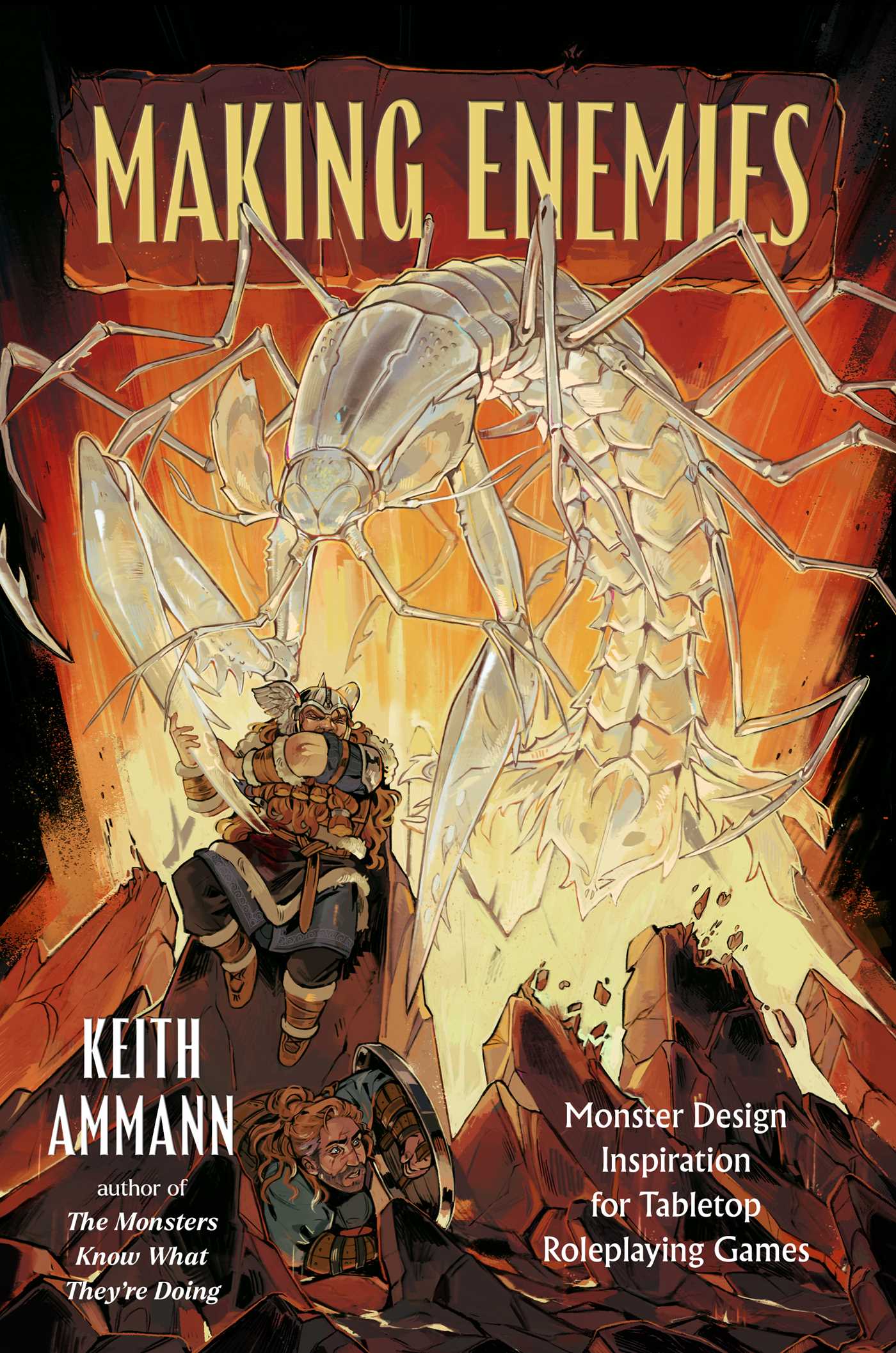
#REVIEW: Making Enemies: Monster Design Inspiration for Tabletop Roleplaying Games, by Keith Ammann

We’ll begin with my absolute favorite thing for book reviews: Disclaimers! First, that I got a copy of this book for free (it comes out on Tuesday) and second, that I’ve known the author for a vaguely shocking twenty-two years, and not in the usual parasocial Internet way that I know a fair number of authors but in a “he’s been in my apartment and we’ve worked on grad school projects together” sort of way. There’s a review of his book The Monsters Know What They’re Doing here; this is actually his fifth book, technically part of a series but, given that they’re all roleplaying sourcebooks dedicated to helping game masters for TTRPGs do their jobs better, there’s no reason to feel like you need to read them in order. I admit it; I have not read the books in between, although I intend to.

Here’s the thing about Keith, guys: Keith is one of the smartest motherfuckers guys I’ve ever met. He’s ludicrously well-read and he’s got a mind like a steel trap. If he had been born seven hundred years ago he would have been a monk and would have discovered something that we all take for granted by now; if he’d been born in the 1810s instead of the 1970s you would never have heard of Gregor Mendel. However, he was born in the 1970s, so instead of more or less inventing genetics as we know it, he writes about roleplaying games.

Making Enemies is, ostensibly, about creating home-brew monsters for your TTRPG campaign. He doesn’t limit himself to Dungeons & Dragons with this one; attention is paid to Pathfinder, Shadowdark and Call of Cthulhu, along with another system that I have to admit I’ve never heard of called the Cypher System. Each section of the book begins with a more generic introduction to/discussion of the aspect of monster design being discussed, such as morphology, abilities, size and number, quirks and weaknesses, etc; and then there will be sections afterward dedicated to the differences you’d see among each of the specific systems. I felt like Call of Cthulhu got a little shorted, as it doesn’t quite work the same way as the rest of the systems (You Are Fucking Doomed is more or less Call of Cthulhu’s entire thing, and this book is about making good enemies for your players, not killing them in seconds) and of course D&D gets a bit more attention than the others, but there’s good stuff here for everybody who plays TTRPGs.

Nothing I’ve just said is sufficient to prepare you for just how deep this book gets, over and over and over again. The chapter called Weird Nature, about monster type and morphology, could be copied and pasted into a biology textbook with barely a sentence changed. The book interrogates the entire concept of “monster” over and over again in a way that is completely fascinating and yet in some ways entirely unnecessary to a book about TTRPGs, which are generally much more lowbrow than this. There are interviews scattered throughout the book with professional game designers, and it’s stunning how high-level, no pun intended, some of these discussions get. I would love to know how much actual research went into this book that had no direct relationship to TTRPGs. My guess is: lots.

(Memo to Keith: go whole-hog on your next book. I want four hundred pages on your theory of game design. Do it.)

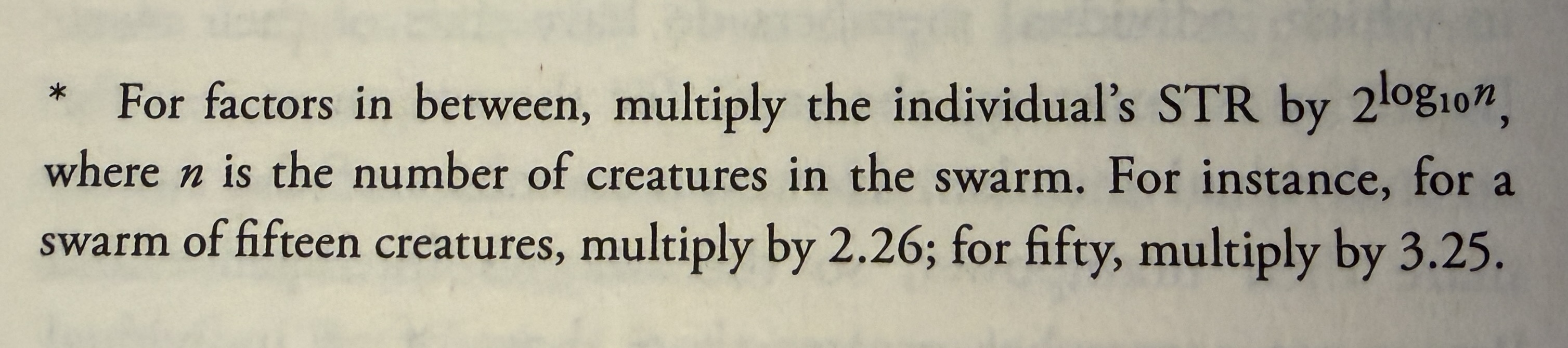
But seriously. I feel like I should have been taking notes and adding Post-Its into the book while I was reading it, and the reader of this book should be prepared to see the occasional quotes from genuine academic works of philosophy and then less than a page later an anecdote about The Muppet Show. That’s not to say that this book doesn’t have a ton of good old-fashioned in-the-weeds nerd math, because it does. Witness:
I’ve talked about this before: I love enthusiasm. My favorite thing about TikTok is how great of a vehicle it is for people to share activities they love with other people. And the reason I feel so comfortable recommending what by rights ought to be a very niche book to literally everyone I know who reads is that Keith’s incredible enthusiasm for game design and TTRPGs shines through every page of this book. I enjoyed The Monsters Know What They’re Doing quite a bit and recommended it, but I was clear (and so was the book!) that it was a book for people who ran TTRPG games. I think there are people out there who would enjoy this regardless of what they’ve done in the TTRPG space; if you consider yourself an autodidact and an intellectual (dare I say “polymath”?) you may find yourself skipping the weedier sections here and there that get into specifics about the systems, but the interviews and the beginnings of every chapter and the relentless attention to careful thinking throughout are going to bring a smile to your face.

Making Enemies comes out October 7th. Check it out.
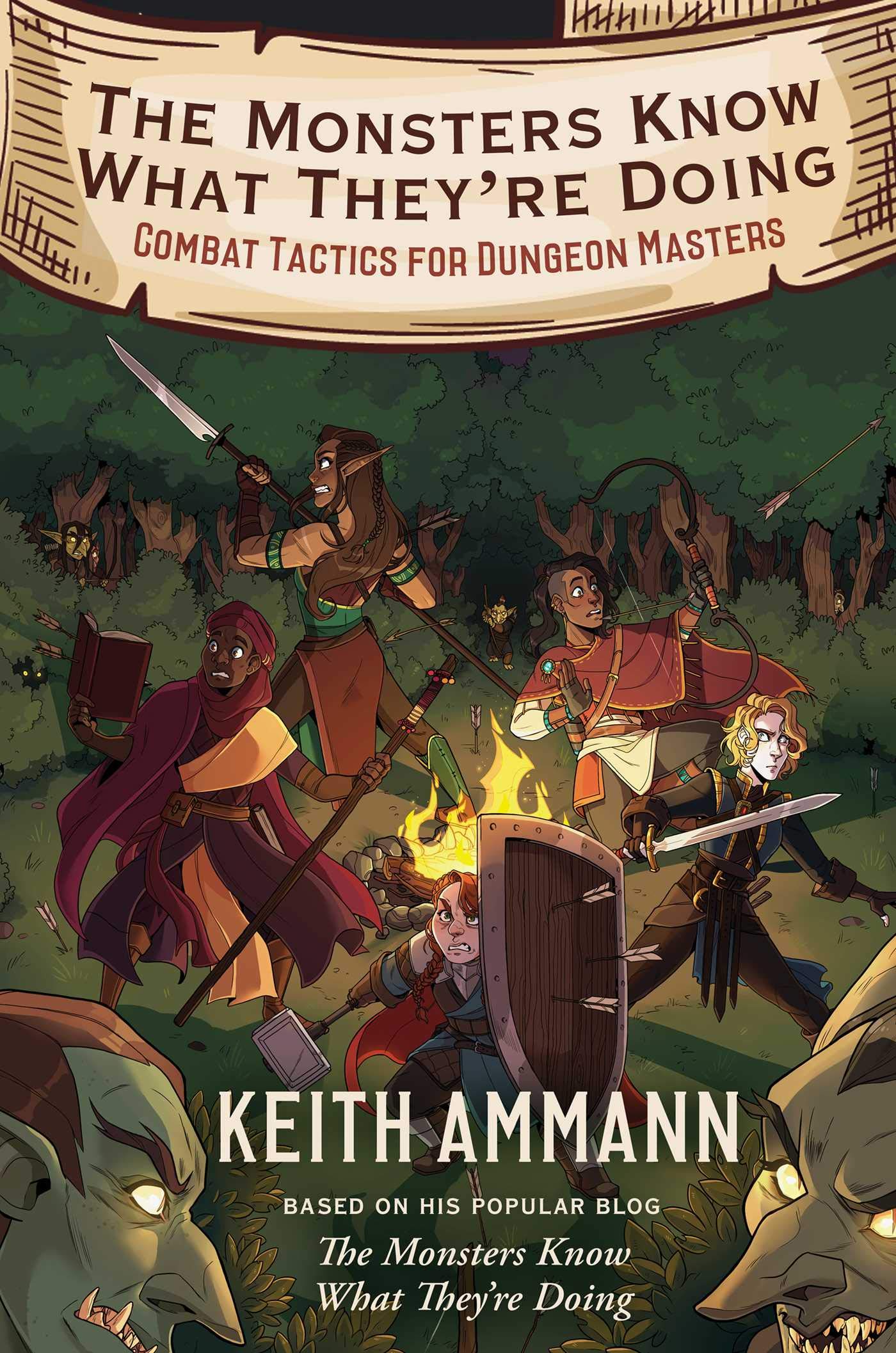
#REVIEW: The Monsters Know What They’re Doing: Combat Tactics for Dungeon Masters, by Keith Ammann

This is a new one: I’ve started reviews before by pointing out that I know the author, but in this case, I really know the author, as in “he knows my real name, was in my ed school grad program, and he’s been to my apartment.” Keith and I essentially had the exact same day-to-day schedule for two solid years, and while we’ve fallen out of touch other than occasional social media interactions since graduating in 2005, it’s simply not possible for me to leave my relationship with him aside while talking about this book. The Monsters Know is, in a lot of ways, possibly the Keith Ammanniest thing Keith Ammann could possibly have written, and while that’s a compliment, it’s very likely not one that’s going to be salient to anyone other than me.

Here’s the tl;dr: If you play Dungeons & Dragons, and especially if you’re a DM, you’re highly likely to really enjoy this book. If you do any sort of fantasy roleplaying that isn’t exactly D&D but is D&D adjacent, it’s probably going to be useful anyway. The book– five hundred-plus pages– is filled with essays on what feels like the entire Monster Manual (it probably isn’t, but still) breaking down various fantasy monsters based on their provided stat blocks, and providing suggestions on how they might act, what tactics they might use, and how they might react to any number of possible actions by your player characters.

There is also math. I’ll get to that in a bit.

Now, to be clear, I did not read this entire book. Why? Because it’s more of a sourcebook than something you sit down and read straight through, and if I have a criticism of it it’s not of the writing or the subject matter but the physical format of the book, which looks like a novel or, like, a “regular” book, when I really feel like it ought to be formatted more like a roleplaying sourcebook of some sort. I probably read … half of the entire thing, skipping around to different monsters I was interested in and occasionally occasionally passing over sections that were a little more power gamey than I’m interested in. Ordinarily I wouldn’t review something if I hadn’t read all of it, unless it was an actual DNF, but again: that’s not what this book is. The section on the kuo-toa will be there whenever you actually decide to include kuo-toa in your game; you don’t really need to read every word of that to appreciate what the book is doing. I am fairly certain that if I told Keith, word for word, “I liked your book but I didn’t read all of it,” he would not be a bit surprised, nor should he be.

Let’s be a touch more specific, though: based on, for example, the description of a species as being high Dexterity but low Strength and medium Intelligence, and the different combat abilities that a species or monster might have, The Monsters Know might suggest that this species prefers to attack from ambush, using sniping tactics and a high likelihood of retreat once injured. From there the section might move more specifically into D&D language, suggesting that Dash and Disengage actions might be used frequently in combat, and sometimes it’ll go so far as to map out a model encounter of sorts. A lot of the time it’ll then get into the actual mathematics behind various attacks, spells, etc, using those numbers to suggest which abilities a monster might prefer to use and which would provide a bit more utility and a higher reward to risk ratio. A lot of the time it’ll suggest a hit point threshold at which point a monster might retreat, too. I haven’t DMed much at all, really, but this was still fascinating to read and to think about, and I may suggest my son look through it, as he’s starting his first homebrew campaign soon. The book loses me a bit when it gets super granular about the numbers behind the abilities, but that’s the beauty of a sourcebook; you can ignore the stuff you aren’t as interested in. I was never a power gamer, and was always more interested in the abilities that felt fun or cool than whatever might be strictly the most effective move at any given time, so that stuff isn’t for me as much.

So yeah. My buddy wrote a book. If you’re into the same kind of nerdery we are, you should definitely check it out, and you can also go to Keith’s blog (the source of a lot of this material) at themonstersknow.com. If you’re in, he’s on his … fourth or fifth book by now, I think, so there’s a lot more where this came from.

The goal next week

Everybody is healthy for four days.

Why four days? Because both the boy and I have Friday off(*), so either of us can be sick that day. I was a mess yesterday and last night, and lazed around all day, and am going to attempt to have a useful and productive Saturday leading in to four days of productive teaching and learning. We will see if I can pull that off.

Spent most of the non-lazing parts of the day assisting the boy with a D&D campaign he’s planning that is loosely based on Elden Ring, only to discover afterward that there are a ton of people out there who have already done a lot of the legwork necessary for that project. Unsurprisingly, when I mentioned it to him he said he wanted to do things his way, which scans with my role in the “assisting” project, which was to propose ideas for him to shoot down. I’ve told him that he can actually have people over next weekend to put characters together if he– you guessed it– attends school all four days this week, after attending school for a total of five days in January and February thus far.

2025 has sucked, y’all, even by the insanely low standards I had for it going in. We will see if this low bar for next week can be climbed over or not. Cross your fingers for me.

(*) Thank the Lord Jesu for this, because Valentine’s Day is reliably the worst day of the year to be a middle school teacher.

My new best friend

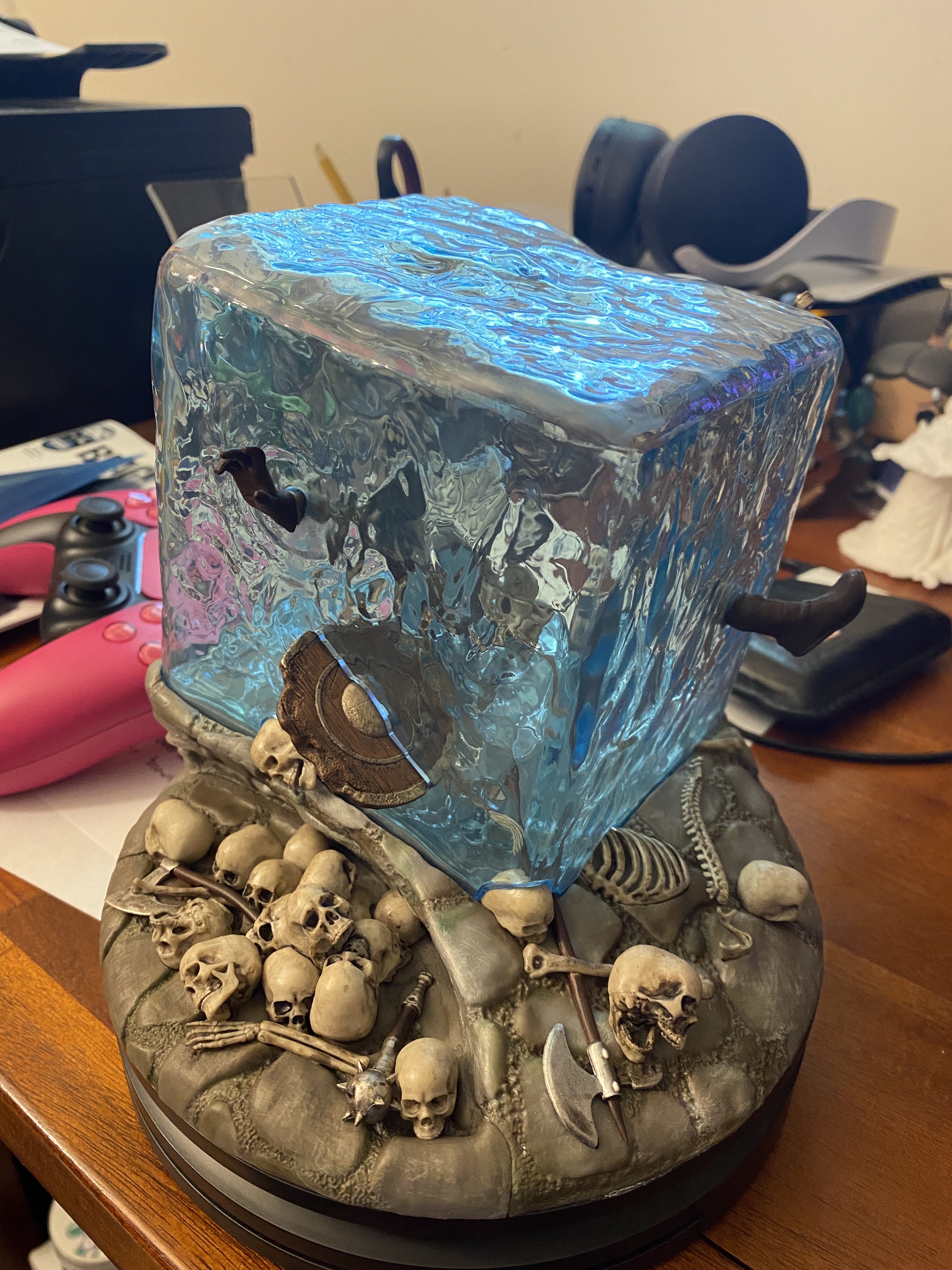
This isn’t tonight’s post, but it’s not going to fit with tonight’s post, so it gets its own entry: the Gelatinous Cube is probably my favorite D&D monster of all time, and if it isn’t it’s super close, and the fact that the absolutely fantastic Gelatinous Cube Funko Pop is virtually impossible to get one’s hands on without expending ruinous amounts of money has been and continues to be deeply depressing. But yesterday? Yesterday I discovered of the existence of this beauty, and today it’s in my office, where it belongs. (Forgive the messy desk. Or not. I guess I don’t actually care what you think of my desk.)

Fun fact: I got this from GameStop, where it’s apparently an exclusive product, and they offered either free 3-6 day shipping or $10 for overnight, which would have been same-day if I’d ordered when it wasn’t already nighttime. Normally I don’t worry about shipping speed, but for some reason I shrugged and went ahead and paid for it, only to discover that what they mean by “overnight shipping” is that they look to see if they have any at the stores in your area, and if they do, they fucking DoorDash the thing to you. Only they don’t tell you that right away, and there’s no way to tip the driver, nor is there any real indication of how much of that $10 goes to the driver who, in this case, had to drive all the way across town to bring me my stupid Gelatinous Cube statue. So I got her CashApp from her and tipped her that way.

But anyway. I now have a Mimic and a Gelatinous Cube in my office. Now I need a Hook Horror and I’ll be all set.

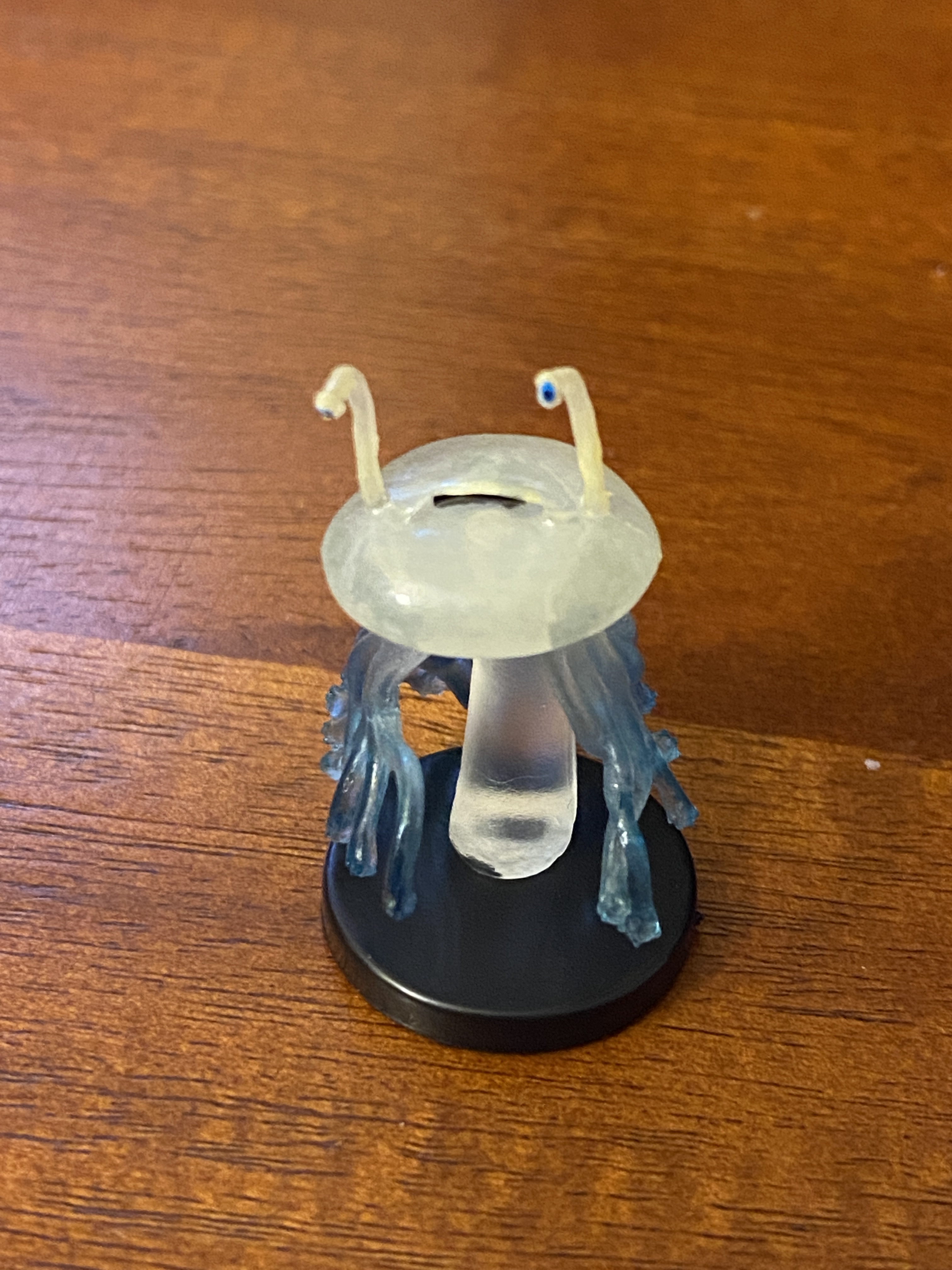
Flumph found!

He’s probably not even an inch tall, guys. He’s so, SO small. But he’s a flumph and he’s mine.

Honestly, out of a possible 32 unique figures in the brick I got 30, which for blind boxes really isn’t bad. I still don’t know what the hell I’m going to do with these– they’re sort of sitting awkwardly on my desk right now, as I type this– but I was kind of hoping that I’d have killed the bug with this first brick and I don’t think I did, which is deeply Goddamned alarming.

In search of serotonin

I want a Goddamn flumph.

Please understand the following about my relationship with Dungeons & Dragons:

  • That, first of all, I have never been the type to use miniatures when playing D&D. I started playing 35 years ago, so this is a well-ingrained habit by now.
  • That, second, I have nowhere to put a collection of D&D miniatures.
  • That, third, I have played D&D maybe twice in the last year and while I think about it a lot it has not become something that I do a lot recently. If it did, I would talk about it more!

Now understand something about how WizKids does their miniature booster packs:

  • They’re blind boxes, so you have no idea what is inside other than that there are going to be four things, and therefore the more you purchase the more you are guaranteed to have repeats of some figures while you are still missing others, and that short of buying them on eBay or some shit there is no way to ensure that anything in particular is in the box.
  • That they are fucking expensive. Like, $5 a figure unless you get them at a steep discount. Some of them are pretty large, so it evens out, but some of them are tiny. Witness the little frog-thing on the right side of the box there.
  • That they are not generally packaged well, and lots of times things like weapons are bent or broken out of the box. This is just … tolerated, apparently.

Now understand the following about my social media habit:

  • I follow two– two!!— different TikTok accounts whose main function appears to be to open one of these fucking blind boxes every day, searching for a specific figure. One account has gone through thirty boxes looking for a goblin cart. $400 is not an unreasonable estimate for what those boxes cost. In fact, it’s probably low. Another lady is looking for a tyrannosaurus zombie– which, okay, who can blame her– and she’s on, like, box #21.
  • That the main reason I put TikTok back on my phone was because I wanted to know if that lady had found the goblin cart yet.

Understand also that:

  • I understand that all of this makes purchasing these Goddamned things a terrible fucking idea.
  • That nonetheless I have a brick– a fucking brick, eight Goddamned boxes– showing up at my house tomorrow, because I want a fucking flumph.
  • That despite the flumph being listed as a “common” figure, there isn’t going to be a fucking flumph in the boxes.

My ability to adult is simply gone this week, and I don’t know what the fuck to do about it.

Shit.

Nerd project!

Yesterday, I had too many dice.

Today, I have too many dice and they are displayed on my wall in what is technically two nail polish racks, but who’s counting? Not me.

There is room for more, which is good, because I still have about seven or eight sets of dice that need to be displayed.

It is difficult to put into words just how happy this stupid little project has made me. My office is so much nerdier now.

I can make this work

I finally broke down and bought a new bookshelf for the office, so I’m rearranging a few things. I think it needs some LED lighting. The statues are too dark right now.

(The rulebook on the shelf that you have Questions about is a real thing that exists and I bought it for novelty value. It is exactly as ridiculous as you think it is.)