On outerwear

Screen Shot 2016-01-14 at 9.40.35 AM.pngI have recently found myself in need of a new winter coat.  I was not aware of how particular I was on what constituted a “winter coat” until going through this process just now.  Complicating things: I need a new winter coat because, as someone who has spent most of the last several months sitting on my ass and/or battling depression, I am probably as fat as I have ever been in my life– fat enough that I am legitimately frightened to get on my scale and find out how bad it is.

So not only do I need a new coat, I need what is euphemistically called a “Big and Tall” coat.  I’ll say the same thing here that I say whenever I have to use that phrase: I have never seen a tall guy in the local fat man store.  Only motherfuckers who make me look skinny.  As someone who is currently most comfortable in XXXL shirts and 38″x29″ pants, I am one of the smallest people in that place.

My current winter coats (I have two; a nice leather coat that falls down a bit in the “warm” department and what I refer to as my Beast Coat) fit fine with a T-shirt underneath them, but they’re winter wear.  They’re supposed to be worn over layers.  If I’m wearing more than a T-shirt, my range of motion gets really constricted in the leather coat (which is cut like a sport coat) and the Beast Coat gets difficult to zip.

The Beast Coat is the type of coat where if you don’t need to be zipping it up, you probably ought not to have it on.  You may recall that the last few years have featured Polar Vortices and -50° temperatures.  Yesterday was the first subzero day of the year, but there will be more.

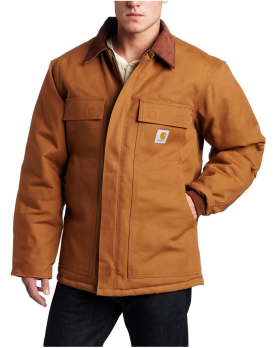
I actually ended up ordering my coat– that’s it, up there, although mine’s black– from Amazon, which may or may not have been a wise decision but will keep me from having to leave the house.  I learned some things along the way.  Here are some important facts about winter coats that you should know:

  • There is no such thing as a “winter jacket.”  Jackets are worn during fall and spring.  If you can describe something as a “winter jacket,” it’s not really winter.  I don’t care if it’s January and the northern hemisphere.  It ain’t winter.  The jury is still out on the phrase “heavy-duty jacket;” I picture such a garment as something to be worn on a shit-ass driving rainstorm sort of day, but not when it’s thirty below.
  • Again, winter clothing is supposed to be worn layered.  So an XXL winter coat needs to be a winter coat that fits an XXL torso wearing an XXL t-shirt and probably an XXL hoodie or sweater, too.  In other words, they should wear big compared to what’s written on the label.  A winter coat should be able to zip and/or button (preferably both) over several layers of clothing, at least one of those layers being thick on its own.  I see reviews complaining that things are wearing larger than their size claims. Yes, Texas, they are.  They’re supposed to.
  • Reviews of winter clothing of all types should be required by law to include where the silly sumbitch doing the review lives.  The garment above claims to be “Arctic Quilt Lined” and many of the reviewers mentioned being sweaty when they took it off.  I see this as a good sign.  But if I’m buying a winter coat I want to see reviews from motherfuckers in North Dakota or Minnesota or Chicago.  I want people who know cold reviewing these things.  If you live in California I give no shits about your opinion of winterwear and I should be able to filter your nonsense out.
  • Per BunKaryudo in the comments: I also want a section for what the reviewer does for a living.  Do you work outside?  I wanna know your opinion about winter coats.  If you just need to wear the thing to get from your car to your office, hell, I can make that trip in a hoodie and be OK.
  • This is more of a specific gripe about that coat, but winter coats should have hoods.  That one actually does, but it’s a snap-on and a separate purchase.  I don’t mind so much because Carhartt’s shit is basically indestructible and I’ll get more than my money’s worth out of the thing even with the extra expense.  But it should have been included.   No one who needs something that is “Arctic Quilt Lined” doesn’t need a hood.
  • If you are asking questions like “Is it okay to wear XXX type of pants with this coat” you need to go lie down or something.  If you are actually in need of a winter coat you are not worrying about how you look in it.  You are worrying about not dying because we are in God Doesn’t Love You season.  The lady seriously wanted to know if it was okay to wear jeans with the coat.  Shut up, California.
  • Temperature ratings are really nice.  I suspect if I looked closely into it I’d find that the methodology generating them was sloppy, but “this coat is supposed to be good for thirty degrees colder than this coat” is still useful information if I’m shopping online and can’t touch the thing.  More sites should do that.

After all that, of course, the coat’s going to show up on Saturday and I’m not going to like it and want to send it back.  Nonetheless.  You have the rules now.  You may begin doing things correctly at any time.

Two things

First, this image, which is more of a Facebook post than a blog post, but I laughed like a hyena so you get to see it:

11046817_912424068797887_6152464712424606738_o

The British makes it funnier.

Second, that the largest of our local high schools had their Prom last night, and we had a group of about a dozen kids attending that prom show up to play miniature golf in all of their finery last night.  I am now old enough that kids dressed up for Prom generally all look like charmingly awkward dorks to me, which may sound like it’s an insult but really isn’t supposed to be.  Prom is going to be one of the first times you’ve ever worn clothes like that and kids that age aren’t really all that used to inhabiting their bodies in the first place so there’s just going to be a bit of a mismatch from most of them in the grace and poise department most of the time.  It’s not their fault.

That said, this particular group of kids looked good.  Startlingly so.  The girls in particular impressed me; my understanding is that the trend in prom dresses lately has been toward the…we’ll say minimalistic, but the six of them had all picked dresses that were dresses and not excuses to show off a bunch of skin.  Several of the guys had white tuxes on, and– particularly when paired with the right color vest (I always preferred vests to cummerbunds)– white can be really striking.

At any rate, I’d just commented to my co-worker about how the kids looked quite a bit classier than several of the Prom groups we’d had in the past when I happened to look up and see one of the girls cup both hands under her breasts and jump, adjusting her dress in some not-entirely-clear and probably none of my business fashion while in midair.

And in spike heels, which made the whole thing quite a bit more impressive.

So yeah.  Still teenagers.

On school clothes (part two of two)

school_kidsTold you I’d get around to this sometime.  This is the second part of what I really hope is going to be only a two-part piece on school clothing; part one is here if you missed it the first time around.  Before I begin, I’m going to quote myself from the first piece.  This rule still applies, and in fact it applies more, because I’m more likely to trip up given the specific nature of this post when compared to the first.  So, without further ado:

Lemme make this crystal clear right now: women are not, under any circumstances, responsible for the reactions of men or boys to their clothing.  Period.  Point-blank.  If at any point in this piece I say anything that appears to contradict that statement, I should be called on it and I am wrong.

I’m probably gonna screw that up at least once.  I’m not kidding about you guys calling me out on it if it happens.  Do it.

I’ll start with a story.  I don’t feel like sagging pants was a huge thing when I was in middle school and high school, but it was certainly a thing that was around and that some people did. I have, in fact, one story about sagging pants that dates to seventh or eighth grade.

Actually, this isn’t much of a story:  one of the kids in my class was sagging, and the teacher’s response was to call him out in front of the entire room with the words “Mark, I don’t wanna see the color of your underwear.”  Now, she was a Japanese immigrant, so to properly enunciate it you have to say it with a Japanese accent and stretch out Mark into Maaahk.

It’s actually the quintessential “you had to be there” thing– but people I know who were in the room at the time still say that to each other every once in a while despite the fact that I haven’t seen the Mark involved since graduating high school.  I’m pretty sure he’s a pastor now, which is hilarious.

So let’s begin our discussion of sexism and gender in the middle school with what I’ll call the Maahk rule:  I don’t want to see the color of your underwear.  This is, refreshingly, a gender-neutral rule: it means that the boys have to keep their pants at their waists (and I don’t know if I pointed this out, but telling boys to pull their pants up and boys and girls to tuck in their shirts are easily my #1 and #2 uniform corrections, and they are miles above whatever #3 might be.) and it means that if the girls wear skirts, they have to wear them long enough that flashing isn’t going to be an issue.

If it were up to me, I’d simply ban skirts entirely unless a family could provide a bona fide religious requirement to wear them– if only because those families never also produce length-of-skirt issues.  Why?  Skirts are hideous, not in terms of how they look or the function they provide but because everything involved in dealing with them quickly becomes either unfair or creepy as hell.   Monitoring skirt length sucks.  The fingertip rule depends on how long a girl’s arms are, which seems stupid.  “Knee length” requires you to define where the knee is.  I have actually seen staff members (none male, thank God) require girls to kneel in order to determine whether their skirts are the right length.

Uh-uh.  No. Never.  Under no circumstances, this sucks and it’s shaming and fucked up and it should never ever happen in a school, particularly and especially if it’s a male staffer.  When I worked in the Catholic school I made it perfectly clear to both the principal and the pastor that there were no circumstances under which I was ever saying a single word to a student about the length of her skirt.  Period.  Surprisingly, I got no pushback on that.  Are there girls who just really like wearing skirts?  I’m sure there are.  I like wearing jeans.  Can’t wear ’em to work.  Too bad.  This is where the “professional atmosphere/this is your job” aspect of dress codes kick in.

The other problem with skirts?  Teenage and tween-age girls have a habit of growing.  Which means that a skirt that was entirely appropriate at the beginning of sixth grade might be oh holy shit short by the middle of sixth grade.  More on this in a bit.

So, yeah: the Maahk rule.  I don’t want to see the color of your underwear.  And if it were up to me, we’d just do away with skirts altogether.

(Alternatively, and I’m going to modify my own rules in the previous post: allow skirts, but require all skirts regardless of length to be paired with leggings.  The main thing is, I never want to get sucked into the skirt-length debate.  I’d much rather just ban the damned things.)

On to the other sexualizing aspect of dress codes: tight and/or revealing clothing.

(Actually, let’s get this out of the way first:  I don’t think there’s ever much of a reason to have dress codes before fifth grade or so.  If you do have a dress code before fifth grade, none of this should matter, because a nine year old in a sundress is not trying to attract male attention by showing her shoulders and you should stop being a creepy asshole if you think so.  Have a descriptive dress code if you like, but the idea that eight-year-old girls should have to worry about clothes being tight or revealing is ridiculous and if you are worrying about that yourself as an adult there is something wrong with you.)

Here are some reasons why a young woman might wish to wear tight and/or revealing clothing:

  1. It’s comfortable; to hell with what anybody else thinks.  As a fat man, I can’t relate to this, because it is impossible for me to be comfortable in tight clothes.  However, I’m willing to believe it’s true.   Aren’t I charitable?
  2. You want people to look at you.  True of many girls.  Also true of many boys, obviously, but in boys this rarely leads to tight or revealing clothes.  Important: it is okay to want to be looked at.  It just may not be appropriate for school.
  3. Picking a fight.  This is closely related to #2, but adds a level of aggressiveness to the whole thing.  There exists a subset of young women who appear to wear tight clothes  specifically so that they can bark “Why are you looking?” at the first staff member to challenge them on it.  In some ways, it’s garden-level predetermined insubordination, with a nice soupçon of creepiness and assholery to go with it.
  4. You have no idea that you’re even doing it.  And here, you see, especially at the middle school, lies the problem.

I don’t give a single shit about the “distraction to boys” angle of the dress code, folks.  Boys need to grow into men, and part of growing into a man involves learning how to not turn into a slavering halfwit every time a bare shoulder or a bra strap floats across your field of vision.  If you’re really concerned about the girls’ clothing screwing up the boys’ ability to learn, well, allow me to introduce you to a little thing called gender based education.  You don’t solve the distraction issue, assuming that is even possible, by corralling the girls.  You solve it, if you care to do so, by corralling the boys.

Also true: there’s literally no level to which women’s clothing can be controlled that will remove sexual distraction from teenage boys.  It’s fucking impossible.  Boys that age– probably girls too, to at least some extent, but I’ve never been a teenage girl so I can’t be sure– are perpetually distracted by sex.  It’s fucking unavoidable.  Much like Shaquille O’Neal, you cannot stop it, you can only hope to contain it.

Let’s talk about this picture for a bit, taken from Gretchen Kelly’s original piece about this:

tumblr_n4plbcsvlz1rtlw8ro3_1280

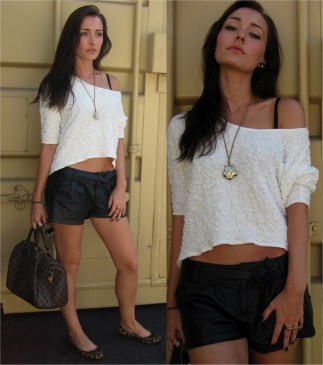
This is almost cute in its naivete.  I have thought at least four of those things.  I’ve thought at least one of them this week.  Shoulders and collarbones, ladies, are awesome.  This look?  Insanely sexy:
1666527_Lookbook-10-23

Note both a shoulder and a bra strap.

But anyway.  I’m getting– heh– distracted.  But here’s the point: teenage boys can be distracted by ridiculous things, and expecting the girls to be even a little responsible for them when they are barely responsible for themselves is offensive on a number of levels.  You cannot allow male distraction to determine female clothing.  It’s fucked up and wrong and it needs to stop.  If you’re seriously concerned about it, go gender-based and get the sexes separated entirely.  You will still have seventh grade boys adamantly refusing to stand up every once in a while and will have to deal with the oh shit he has a boner moment as a teacher and decide what to do about it.  That would happen if you put him alone in a room, too.  Welcome to puberty.

(At this point, I realize that this post is likely to be longer than part one.)

(HA!  That’s a reason for boys to not wear tight clothing!  Boner prominence!)

The reasons that dress codes should worry about tightness and/or revealingness are Reasons 2 through 4 up there.  Why?  Because intent matters.  Because we do need to worry about people who are going to school for reasons other than academics– and intentionally dressing to “show off the goods,” so to speak, is a problem– and because one important aspect of dealing with particularly middle-school aged girls is that they frequently have no idea what they’re doing.  

This is where I start dancing around violating the “women are not responsible for men’s reactions to their clothing” rule, but I really do think there’s a difference here: if you’re wearing yoga pants because they’re comfortable, I don’t have a problem with you.  If you’re wearing them to get Billy in 3rd hour (or, for that matter, Jenny in 4th) to look at your ass, you’re deliberately disrupting the educational process– or at least aiming to– which is an actual and distinctly different problem.  This is not the same as demanding girls be responsible for boys’ reactions.    It’s expecting girls to be responsible for their own actions.  You aren’t at school to catch a boyfriend.  You’re at school to learn.

This may be a distinction without a difference, and I’m interested to hear people’s reactions to it.  It does mean that schools do have a non-sexism-related reason to police tight and/or revealing clothing– because it’s not as if you can institute a rule that if you think something is comfortable it’s okay.

And, honestly, I’m much more concerned with #4 anyway.  The maturity level of middle-school aged kids in a single cohort (and this is true for boys and girls) is incredibly variable, and can vary insanely over the course of the year.  Ask any sixth grade teacher, in particular: they are, by and large, teaching children in August and September and right around March they start getting caught making out and grabbing each other’s asses.  And frequently they have no idea that something is showing off too much chest or too much butt or too much leg.  Why?  Because those legs have grown six inches in the last five months, because those boobs weren’t there a year ago, and because what do you mean I have a butt.  Go into any middle school in America and you will find eighth grade girls who look like they’re ten and eighth grade girls who could walk into a bar and not get carded until they opened their mouths.  And just because a girl looks like she could walk into a bar and not get carded does not mean that she has remotely the emotional, physical, and, yes, sexual maturity to be able to deal with what has happened to her body over the last few years.

Schools take on a lot of responsibilities beyond reading and ‘rithmetic, guys.  One of them is trying to guide these kids through adolescence– trying to literally keep them comfortable in their own skins.  And rules about tight and revealing clothing need to be there, for two separate reasons: to keep the ones who legitimately are showing off from deliberately screwing up what is supposed to be a professional atmosphere, and to help those who have no idea from doing it accidentally.  At some point, somebody– and generally it needs to be a female staffer– needs to pull Susie aside and make sure she realizes that it might be time to think about a new pair of pants, or to call her parents and suggest that they do it.  Because it seriously might be that three months ago those pants fit just fine and she doesn’t realize that they look like they were applied with a spray can this morning.

True story: I had an eighth-grade girl walk up to me once while I was at the front of a school bus.  I had my hand on the top of the seat in front of her.  The girl dropped her entire rack– and she was probably a C-cup– onto the top of my hand and my arm.  She had no idea that she was doing it.  If you’re sitting at a desk, they’ll come over and lean over the desk to show you something, with, again, no idea what they may or may not be showing off.  If an adult woman lets me look down her shirt, or pushes her boobs into my hands, ten will get you twenty that she’s doing it on purpose.  Teenage girls don’t all have that awareness of what they’re doing yet; they may legitimately have no idea.  Or they might.  Either is a problem, yes?

Here’s the problem (he said, 2200 words in):  All of the last, oh, six paragraphs or so can end up in practice looking exactly like Girls are Temptresses Who Must Be Controlled to Save the Boys. As I said earlier, a distinction without a difference.  And I’m not into that.  I think it’s offensive and ridiculous.  But how do we insert a difference in there so that it’s clear that this is coming from a place where 1) the most important thing about being in school is the learning part, and 2) when someone breaks tight/revealing dress code rules, keeping the focus on education, and making sure that the kids are aware of how they might be perceived?

Enforcement, of course.  The focus should never be on making someone wearing inappropriate clothing feel bad about it.  I understand the reason behind, say, making uniform violators wear a bright pink 4XL I’m Out of Uniform shirt, but it’s not my job to make kids feel bad, and in most circumstances if a disciplinary intervention produces shame it’s probably one that should be avoided.

And it’s here, unfortunately, where I kinda run out of ideas.  While I don’t much like the Shame Shirt, the advantage of it is that it keeps the kids in class.  I don’t like the idea of keeping Jenny out of class because her pants are too tight or her shirt is too short (left unsaid so far: an operational definition of “too tight,” which is virtually impossible) and I also don’t like the idea of letting her know that if she doesn’t want to go to class all she has to do is wear a miniskirt to school and bam she gets to sit in ISS all day.

The best solution, it seems, is for the school too keep a lot of spare uniform-appropriate clothes on hand, in a wide variety of sizes, and require uniform violators to put those on.  Problem is, that’s expensive and difficult and those clothes are going to go home and not come back a lot, which is why most schools go with the Shame Shirt solution– or just locking kids in ISS– instead.  I suppose schools could go the same route my kid’s day care goes with and require parents to send a spare set of clothes to school with their kids, but that’s ridiculous on a lot of levels too, chief among which that– yep– they’re gonna grow out of the spare clothes too.

I’m stopping at 2748 words, guys, and I hope I’m not breaking my own rules anywhere.  Let me know how I did in comments.

Well, that was fail

Two things:

  1. Are trench coats out of style now?  I thought trench coats were for old people and old people don’t have style for things to go out of.  Have I been misinformed?  (I did find one I liked.  It was $450.  HmmmmmmNO.)
  2. I found a hat whose style I liked and placed it on my head. An approximation of how it looked:

category117

I checked the size:  XXL.  I am starting to wonder why it is that children who see me do not scream in fear and run away, because apparently I have the largest head in the universe.

On the plus side, the Apple Store replaced my frayed Lightning cable for twenty-five cents. I did not have the energy to even look for shoes.  So: Fail.

On school clothes (part one of two)

school_kidsYou may have noticed– and hopefully you clicked through and read the whole thing– my reblog of a piece Gretchen Kelly did for Feminist Friday about school dress codes.  All in all, it’s a really good piece, and I popped up a couple of times in the comments to address stuff that I thought was worth discussing, all the while going I will not blog about dress codes in my head.

Well, fail, I guess, because here we go.   A couple of words of warning: first, I currently expect this to be a bit on the long side, and second, I think I’m probably just going to stream-of-consciousness the whole thing rather than try and organize it in a way that makes sense, because it’s Sunday night and this is a complicated subject and I still don’t feel like thinking as hard as it probably deserves.  So if you catch me contradicting myself or something doesn’t seem quite consistent, that’s why.  Like I said: complicated subject.  Feel free to point out what I got wrong in comments; I suspect that this might generate a bit of lively discussion, as Gretchen’s piece has attracted nearly sixty comments so far.  You should read her piece before you read mine, but I don’t necessarily plan on addressing her directly.

You guys know that I teach, or at least until this year I was a teacher.  What you may not be aware of is that every school I’ve ever taught at has at least nominally had a uniform.  I started off at a Catholic school, of the jumpers-and-skirts variety, moved to a Chicago Public Schools school that had a loose one, and then to my current district, where we’ve always had uniforms of some sort but of a looser definition than the Catholic schools do.

I have been to many, many faculty meetings about dress code in one way or another.  I have made an ass of myself at many, many faculty meetings by trying to address some of the questions that I’m going to raise here.  No one but me is ever interested in discussing them.  Which is stupid, because you shouldn’t have a dress code if you don’t have some idea of why you have a dress code.

Here, for example, are several reasons to have a dress code:

  1. Control.  You want to be in charge of the decisions of your students, and to let them know that you, as the administration and the teachers, are in charge.  One of the ways you let them know that you run their lives is by controlling what they are allowed to wear.
  2. Modesty/”Distraction”.  Note that this one is generally girls-only, and is closely related to #1.  Girls’ bodies are inherently dangerous, particularly to boys, and the best way to make sure that the boys’ days aren’t ruined by the girls’ bodies is to cover up the girls’ bodies as much as humanly possible.  It is critical to make certain that at no time is it possible for a girl bit to make a boy bit any more rigid than it ordinarily is.  Note that “distraction” is not always sexual in nature; things like pink hair or piercings can be deemed “distracting.”
  3. Professionalism.  Going to school is a kid’s job.  Adults are expected to dress in certain ways for their jobs; kids may as well get used to this idea right now.  Also something about promoting habits of mind to go with the orderly atmosphere you are creating by requiring everyone to dress similarly.
  4. Social leveling.  If the kids are all wearing the same thing, it makes it more difficult for the rich kids to show off their money or for the poor kids to look like they don’t have as much.  Also, conformity issues: it’s harder to single out kids for not joining the crowd and wearing the New Cool Brand (which they may or may not be able to afford) if everyone has to wear the same shirt.
  5. Gang affiliations.  This only applies to certain schools, obviously, but if you have a gang presence in your neighborhood frequently you want to do your best to make certain that kids can’t outwardly display gang affiliation.  This is hideously tricky; keep reading.

You may have already figured out from my phrasing that the two I have the most comfort with are #3 and #4; #1 is wildly unnecessary and #2 doesn’t always have to be problematic but very frequently is, particularly when you add religion into the mix.  #5 is essential if you’re in a school with a gang problem but requires an ever-evolving list of things to ban as the symbols and signs evolve.  Most of the school uniform drama-outbursts that make their way into the media is from people trying to shove the first two in where they don’t belong; for example, a chaperone father being turned on by a prom dress and trying to slut-shame the girl wearing it.

In fact, lemme make this crystal clear right now: women are not, under any circumstances, responsible for the reactions of men or boys to their clothing.  Period.  Point-blank.  If at any point in this piece I say anything that appears to contradict that statement, I should be called on it and I am wrong.

See, nearly 800 words already and I’ve barely gotten started.

Anyway: your reasoning for why you’re controlling your students’ attire should inform the level of control that you’re exerting over that attire.  If you are interested in controlling your students, and control itself is the virtue, then you’re going to be worried about things like belt buckles and shoelaces and hairstyles and all sorts of nonsense.  You’re also setting yourself up for an immense number of fights.   If you just want your kids to look professional, then maybe the fact that Brittany has pink shoelaces on one shoe and green on the other isn’t a problem.

So let’s talk about how you control clothing.  There are two ways.  A proscriptive dress code is a thou shalt not dress code.  Don’t wear this, don’t wear that; you can wear this in this way but not in that way.  These dress codes tell you what not to do or, frequently, what not to show, and are often actually referred to as “dress codes.”  A descriptive dress code specifically tells the kids what to wear, and is less concerned with “nots.”  The most extreme version of this is the classic Catholic school uniform, where every boy and every girl in the building are going to be basically wearing the exact same thing, often bought from the same vendor.   These are often not called dress codes; they’re called school uniforms.

These things can bleed into each other, obviously, but the more alike the kids look when you walk into a building the more likely it is that you’re dealing with a descriptive dress code rather than a proscriptive one.

I don’t like proscriptive dress codes.  The reason: the more rules you have for what can and can’t be done, the more fights you’re going to have with your students, and every second of arguing about dress code is a second I’m not spending instructing.  Just for example: yoga pants.  I’m a grown-ass man, right?  And I don’t have a daughter, and my wife prefers to wear jeans.

I don’t know what the fuck a “yoga pant” is, I have no intention of learning, and I’m not about to waste my time arguing with a  twelve-year-old about whether she’s wearing them or not.  Kids become lawyers awful goddamn fast when they think their pants are capris and you think they’re yoga pants.  (Is that combination possible?  Hell, I have no idea, but one school I worked at officially laid down a rule that if the pants had rivets anywhere on them then they were jeans, regardless of color, fabric, fit, or any other consideration.  Rivets=jeans=against dress code, period.)

Any and every rule can be made obnoxious in this way.  For example: say you don’t want your kids dying their hair.  So you make a rule saying you can’t dye your hair.  Then Brittany, who was a blonde last year, starts the year as a brunette.  Do you make her go change her hair back to her normal color?  No, that’s ridiculous, and you’d have to ask her what her natural hair color is.  Maybe she was breaking the rules all last year!

Okay, so you modify the rule: you can’t dye your hair unnatural colors, because kids with blue hair are distracting.  You just made it against the rules for every black and Hispanic kid in your building to go blonde.  Did you mean to do that?  Or do you ban specific colors, and then get into bullshit about whether someone’s hair is mauve or turquoise or blue, and this specific shade of blue isn’t actually prohibited on your list of “unnatural” colors.

(The solution is to not give a fuck about hair color.  Yes, Damien’s blue hair will be distracting– for an hour.  So will his next haircut.   So will your next haircut.  I shaved my beard off once and was fending off questions about it for a week.)

I find that the best way to handle a dress code is to set general rules that are clear and easy to follow and to expect the kids to stick by them– if you make a rule, it is critical that you stick by that rule.  If not, get the hell rid of it.

For example, I see no reason at all to ever care about any of the following things:  hair, ears, noses, lips, feet, shoes, shoelaces, belts, accessories of any kind, including necklaces, rings, bracelets, or other forms of jewelry.  We once mandated that all students wear belts. It was pointed out that some kinds of girls’ pants don’t have belt loops.  Okay; we modified the rule that if your pants had belt loops then you had to wear a belt.

Can you guess what happened?  The kids started cutting off their belt loops.

This is fucking ridiculous.

And, see, again: I’m coming at dress codes from #3 and #4.  I want the kids to look reasonably clean and neat, because they’re at work, and I would like there to be some social leveling going on.  #4 never really works, but it does help a bit.  The kids just find other things to signify status with.  This is a particular problem with gang affiliations; you’ll discover midyear that all the kids who are 2-6ers have been wearing a rubber band on their left ankle or something like that.  Ban that, and they start wearing their collars a certain way.  You can never really get rid of it.

Here, to my mind, is how to do a dress code: either go whole-hog, like the Catholic schools, and specify a certain shirt, pants, belt, skirt, jumper, and type of shoe for every kid in your building, and then provide a specific local vendor who provides those items at a reasonable cost and vouchers for your families who can’t afford the uniforms, or go descriptive but simple, and don’t stress out about the things you don’t cover in your dress code.

For example, if I wrote my school’s dress code, it would look like this:

  1. Polo or button-up shirt with a collar (boys and girls).  Long or short sleeve, colors to be determined by the school.  Most in my area have settled on blue, with some allowing other colors.
  2. Dress pants.  Dress pants do not have rivets, are not made from denim, and are not form-fitting.  (Note: never ban a specific style of clothing. You will fight for years about what cut a pair of pants are or whether pants are “yoga pants” or “stretch pants” or “leggings” or “jeggings,” which I think might actually be a thing, and whether that matters.)
  3. In colder weather, a plain one-color sweater (define colors as necessary) may be worn.  The sweater must be one piece and not have a zipper.
  4. Skirts of XXX color may be worn by either gender.  Skirts above the knee should be paired with leggings of XX color.  (Skirt length rules are hideous and horrible.  I’d honestly just insist on everyone wearing pants all the time just to avoid debates about skirts.  This is the best I can do; I’ll get more into it tomorrow.)
  5. Shoes must have a back to them; IE, no flip-flops.  (I know I said earlier that I don’t care about shoes.  This rule could be rephrased as “Shoes should actually be shoes.”)
  6. Shirts shall be tucked in at all times, and pants shall be worn at the waist.  Shoes with laces should be tied.  Y’know, screw that last rule.  I mean, it’s true, but it doesn’t need to be part of a dress code.
  7. And that’s it.  I give no shits about anything else. Everything else is up to the kid.  Glory in yo’ spunk, as BB King might say.

That’s already 2000+ words, and I haven’t gotten into talking about sexism yet.  So I guess I’ll continue this later this week.  Maybe tomorrow, but no promises.