
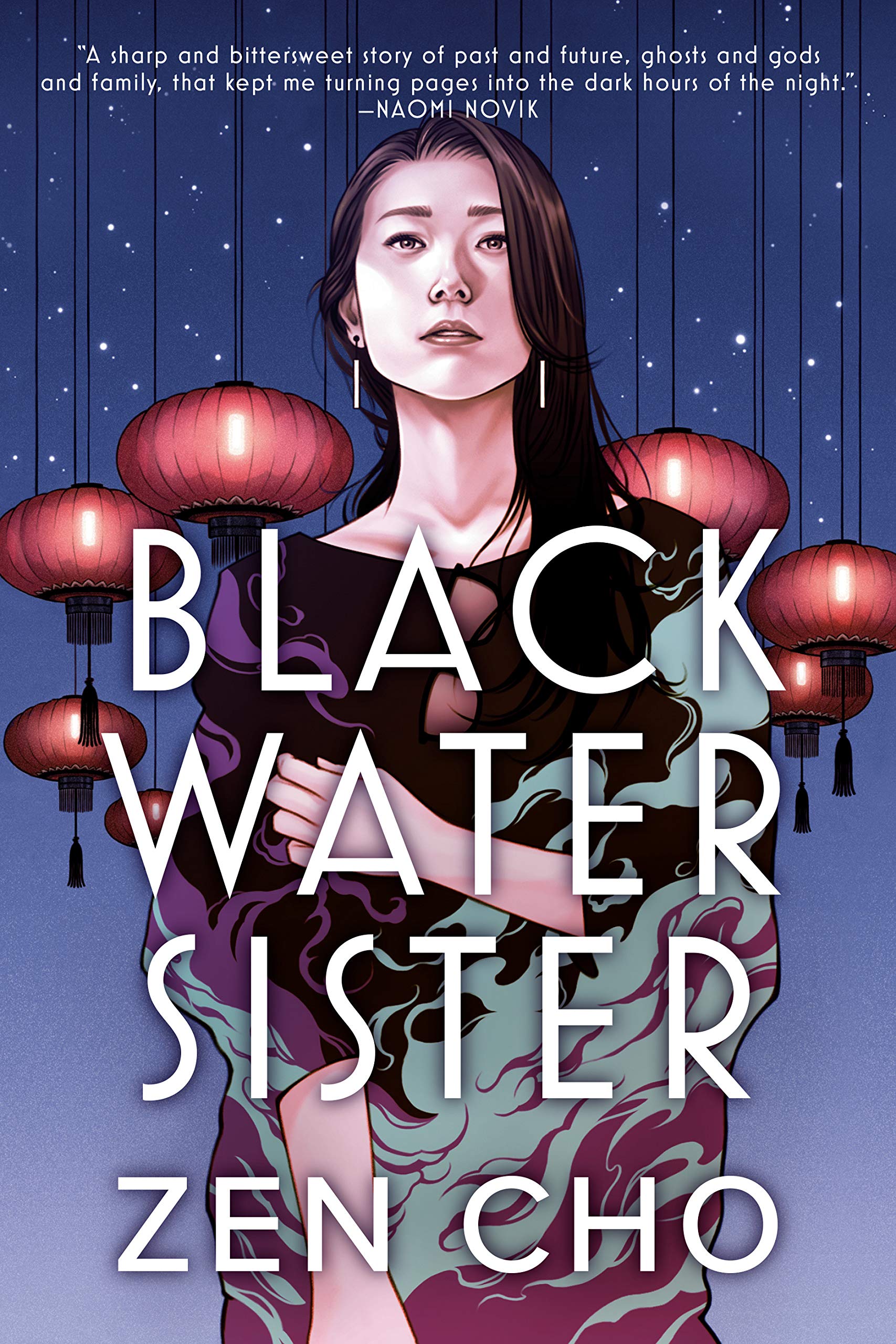
#REVIEW: Black Water Sister, by Zen Cho

I have four or five of Zen Cho’s books by now, and I’m pretty certain I’ve only talked about one of them on here, her Sorcerer to the Crown, which came out way back in 2015, before the world went to hell. I’m not in the mood to bury the lede here, so I’ll put this right up front: this is my favorite of her books, and by a pretty substantial margin. Black Water Sister tells the story of Jess, an American in her early twenties born to immigrant Malaysian parents, who moves back to Malaysia with her family at the beginning of the book, with a Harvard degree under her belt but no real plan on what to do with her life.

Then her grandmother’s spirit moves into her body, and she learns all sorts of things about Malaysian religion and Malaysian gods, and she has to protect a temple from a local gangster who also happens to be the fifth-richest guy in Malaysia, while fighting with her long-distance girlfriend and pointedly not starting a relationship with the only person her age she talks to throughout the entire book, who is a guy and would be a romantic interest in any other book.

And, yeah, it turns out her grandmother is … maybe a little malevolent? Just a titch? A little wee bit? It throws some curveballs you’re probably not expecting.

That’s not why I liked the book, though. This one is a great example of a Book I Liked For the Writing, although I have fewer problems with the story than I usually do with books I enjoy in that particular fashion. The interesting thing here is that this book reads as far more personal to Cho than her previous work– she is, herself, a young Malaysian woman, and while she’s writing a character younger than her I have to assume that some of Cho’s own experiences have made it into the book. If nothing else, the way she writes Malaysian dialogue is just fantastic. Don’t know any Malaysian? Too bad, she’s going to throw some words and phrases out there and if you can’t intuit them from context you’re out of luck. That said, the dialogue in this book is almost entirely at least translated into Manglish if not explicitly written that way; most of the time the Malaysian characters are speaking English to Jess, and the deeper I got into the book the more sidetracked and fascinated I got by how the creole actually works. Malaysian uses a lot of emphatic particles that English doesn’t use, for starters– lots of ending sentences with “lah” and “ah” and “meh” and other syllables like that, and while I never quite pulled together exactly what was going on (and the damn Internet has been no help) the name system they’re using is interesting as hell too. I loved listening to these characters in a way that I haven’t in a long time; I have lots of writers I like whose dialogue I’m big fans of, but this is the first time I can think of where the author’s representation of speech in a culture I was unfamiliar with was so interesting.

(Also, and this is a minor detail, but some of Jess’ relatives are Christians, and it’s fascinating to see the way that Malaysians apparently treat Christianity as an item on a buffet of religions, to be sampled as needed. Conversion to Christianity is pondered at one point in the book as a way to get another god (no shit) to leave them alone, and they treat it about as seriously as I might ponder picking up a new pair of shoes upon discovering that my current ones hurt my feet. It’s like “Oh, we could do that,” and that’s it.)

I can’t attribute reading this one to #readaroundtheworld, as Cho is not only an author I’ve been following for a while but isn’t even the first Malaysian I’ve read this year– that honor went to Cassandra Khaw’s All-Consuming World, and I think Khaw has another book coming out in a month or so, so I’ll have read at least three books by Malaysians this year. But it definitely pairs nicely with the project, and this is exactly the type of book I was looking to read more of for the project. My one complaint? This may not be something that bothers you, but Jess is a bit of an asshole, and not always in a good way. She’s got a filthy mouth in a way that feels jarring compared to everyone else (Jess, as the only American-born, first-language English character in the book, talks significantly differently from every other character) and the couple of times she tells her grandmother to fuck off are … kind of a trip. She also does a bit too much lying in the book for my tastes; she’s lying to her parents about being gay, among other things, and while she’s got a long-distance girlfriend she’s also lying to her through most of the book, as her girlfriend is described as too rational to want to hear Jess complaining about things like being possessed by local deities and gangsters trying to kill her. It means a lot of the book’s energy is devoted to Jess keeping secrets from everyone around her, and keeping track of who knows what, and it can be kind of wearying, to be perfectly honest. But as weak spots in a book go, a young MC acting like a selfish young person isn’t necessarily the worst fault the book could have. I enjoyed this one quite a lot. I think you will too.

REVIEW: SORCERER TO THE CROWN, by Zen Cho

…well, okay, it’ll be a review in a second.  Griping first.  This is the cover of the American edition of Zen Cho’s SORCERER TO THE CROWN:

sorcerer_front mech.indd

It’s… fine, I suppose.  Makes the book look kinda classy, there’s a dragon on there to make sure that you get the fact that there’s gonna be some magic in the book in case the word “Sorcerer” in the title wasn’t enough for you, it’ll do, right?

THIS IS THE UK EDITION:

CMsqMGkWwAEQ6ri

PEOPLE!  That shit is gorgeous.  I want the UK edition!  Why did Amazon ship me this red-hued nonsense if that is what the book looks like in other countries?  GIMME.

While I’m griping about the cover: Zen Cho is a woman, in case you’re like me and can’t necessarily read gender coding in Malaysian names.  (For all I know, “Zen” is like “Pat” and is gender-neutral anyway.)  With the single exception of one sentence from Charlie Stross, every single pull quote both at the top of the front cover and the entirety of the back is from a female author, and the vast majority of the authors she’s compared to are women as well.  And the quote from Naomi Novik is on there twice.  That kinda bugs me; it feels like her editors thought only people who read tons of women authors would be interested in picking this up.  There’s a damn dragon on the cover and the book has the word “Sorcerer” in it.  If those two things normally get you to read a book, read this book.  If knowing that “Zen” was a woman might make you think you’re gonna get girl cooties, first rethink your entire life and approach to same and then read the book anyway.  Okay?  Thanks.

Anyway.  The book.

SORCERER TO THE CROWN is thisclose to making it onto my top 10 shortlist, and is certainly going end up getting mentioned in that post at the end of the year.  It’s set in an alternate, vaguely-eighteenth-century Britain (to the best of my recollection no year is ever mentioned) and is mostly concerned with high-society Brits, which is no doubt where the comparisons to Jane Austen come from in those back cover pull quotes.  The main character is Zacharias Wythe, the Sorcerer Royal, the leader of all of Britain’s various thaumaturges and other magical individuals.

Well, sort of.  The culture of the magic-users in the book is such that they pretend that magic is the sole purview of gentlemen, but in classic British denial fashion this is done by simply deliberately ignoring that people of all classes and both genders seem to use magic everywhere.  Those folks just… don’t count, I guess.  Complicating things: Zacharias is African, an ex-slave, manumitted in childhood, whose former owner was the previous Sorcerer Royal.  Zacharias’ skin color causes him no end of trouble with the thaumaturges he is supposedly in charge of, who spend most of the book scheming to remove him from his post.

Also complicating things: Britain’s magic, provided by Britain’s connection to Fairy, has been stoppered (as in Zacharias finds a literal cork floating in the air at the border to Fairy at one point) leading to a shortage of magic.  Unfortunately, this is one of the book’s shortcomings, as a “shortage of magic” is never really defined and honestly it doesn’t seem to bother the characters or limit what they can do very much despite the fact that they keep complaining about it.  Magic is spoken of as a finite resource that can be used up, but you never really see the effects of that finite resource; the characters just worry about it.

The book gets moving when Zacharias takes a trip to the border with Fairy under the pretext of giving a speech at a School for Gentlewitches, which you might think is some sort of Hogwarts equivalent but is actually a boarding school to teach women to not use their magic, because women can’t use magic, so we have to build special schools for them so that we can make sure to train them not to.  Get it?  (Don’t get the idea that I’m complaining about the book here– this isn’t Cho being sloppy, it’s Cho skewering the culture of the setting she’s working in.  It’s nicely done, actually, and Zacharias slowly reasoning out that everything he knows about women and magic is wrong is one of the book’s high points.)

At the school, he meets Prunella, who ends up returning with him to London, only sort of with his permission.  Prunella, as it turns out, is already a talented (if untrained) magicienne, and she spends most of the rest of the book turning London’s magical society on its ear.

I won’t spoil more than that, as letting this book unfold naturally is one of the keys to enjoying it, I think.  The strength of the book is in its characters; the dialogue is fun if overly British and florid (there’s a big battle scene at the end, and the characters are speechifying and talking in sentences with subordinate clauses through the entire thing, and it works), and while the plot slips up every now and again (there’s a development at the very end that felt a bit shoehorned) it’s generally well-crafted and certainly always interesting.  There’s enough little slips here and there to keep this from a full-throated, five-star review, but this is Cho’s first novel and I’ll absolutely be picking up her second.  Highly recommended.