Leave those kids alone

I had a Work Thing today, and … well, it actually went pretty well. For certain values of “pretty well” at least, mostly involving I started a big old argument with my entire team. That’s not something I get to do all that often, and it was super fun, but it also got me through the last half-hour of the meeting without falling asleep. And you’re probably picturing a certain kind of argument when I say big old argument, and it was probably about as heated but quite a bit more civil than what you’re picturing; I’m not mad at anybody, and I don’t think anybody’s mad at me, or at least I hope not.

What was it about? Dress code and cellphones, of course. I mean, it started off more high-minded than that, but that was where it landed, and getting to air out my vehemently pro-cellphone, I-don’t-care-about-your-hoodie arguments with people who strongly disagreed with me and knew what they were talking about was actually pretty fucking invigorating.

Where did it start? With a thing called the School Improvement Plan, which is basically what it sounds like and is important enough to require capital letters, and with some other stuff called Gap Analysis and Root Cause Analysis, which is actually less utter bullshit than what I thought, but the way we were doing it is bullshit. Turns out my wife actually knows a fair amount of stuff about Gap Analysis and Root Cause Analysis, and she spent a lot of time sadly shaking her head as I was sharing documents from today with her after getting home from work.

Anyway: we were talking about student discipline, and one potential contributor to our discipline issues that was brought up was inconsistency among the staff. So, for example, if Jimmy knows that Teacher A allows something and Teacher B doesn’t, it makes Teacher B’s life harder, because teacher B tries to Enforce the Rules and is greeted with but Teacher A doesn’t do that! or something similar. Now, to be clear: I agree that this is, or at least can be, a problem. However, I don’t necessarily agree that not following the rules is the problem– I think the problem is the rules themselves. You see, we like to talk about how kids should be invested in class rules and how you should develop your class norms in consultation with your students, but no one ever applies that to schoolwide rules. You will find that you have an easier time getting me on the same page as everyone else if I am not simply handed the page.

I feel like a lot of rules in schools, not limited to but particularly rules about cellphones, are arbitrary and outdated, and “because it’s the rule” not only doesn’t work with me, it really doesn’t work with 8th graders. And I feel like teachers would be a lot better about buying into (and thus enforcing) our rules if we had reasons for them. So, as a staff, we need to spend some time reviewing, discussing, and, if needed, editing our building rules. We need to do this every year. We probably need to do it more than once a year.

And we need to do it regardless of whether Mr. Siler wins any specific argument about the rules or not, too. I’ll enforce a rule I don’t like if the staff has a conversation about something and comes to a consensus that I disagree with, because at least there’s a reason for the rule. But any rule we expect the kids to follow that we can’t justify as a group of adults needs to go. We don’t need rules that are rules just because.

(One other thing that always bothers me about this line of argument: the “get on the same page” argument only works one way, which is to insist that teachers who are less strict become more strict. It is never, ever used to rein in the exact type of teachers who love dress codes because they give them so many ways to find things that kids are doing wrong. No teacher has ever been told “We’re not worrying about this anymore, and you need to get on the same page as the rest of us.”)

REBLOG: Five Rules For The Jackholes Trying To Ruin Halloween

As someone who lives in one of those neighborhoods that kids get brought to… yes, this.

Gretchen Kelly's avatarDrifting Through

halloweensandy-2

Can we not suck the fun out of Halloween?

Can we have one day? One day where it’s just about having fun and there are no guidelines or parameters or judgement or rules?

I’ve been hearing plenty of grumbling on both mainstream and social media. Things that annoy people about Halloween. “Rules” for trick or treating.

There’s been an abundance of people who seem to have a stick up their candy bowl.

They have been lamenting the kids who trample their grass, don’t ask politely for candy. The ones who take the candy and don’t say thank you. People who wonder at the wisdom of giving candy when more kids are overweight. Remember the lady who handed out fat shaming letters to trick or treaters? And there are people who think it’s their job to determine how old is too old for trick or treating.

As a public service and…

View original post 1,106 more words

How to Launch Your New Book: Everything I Know

NewRules1(I’m going to be presenting these as Unquestionable Rules that Must be Followed.  Argue with me anyway.  Sometimes I’m very strident and wrong at the same time, especially if I think a general tone of Absolute Authority is funnier.  I am scheduling this to pop while I’m on the road, so feel free to yell at me in comments.)

So!

You have written a book.  Congratulations!  I am proud of you.  You have done something that you have probably wanted to do for a very long time and that many, many people have tried to do and failed.

Here is what to do next, so that when you publish your book, you have the greatest chance of your book making an impact.  Note my phrasing; it’s intentional: when YOU publish your book.  You’re not submitting your book to an agent or to a publishing company and waiting a year to get a quarter of a sheet of paper in an envelope as a rejection notice.  You’re going to do it yourself.

STEP ONE: THREE OR FOUR YEARS PRIOR TO PUBLICATION.

Have already written and published three other books.  At least.

That’s only sort of a joke.

Understand something: your first book?  No one has heard of you, and no one cares.  Your mom might buy a copy; she won’t read it.  Your dad will pretend to read your mom’s copy, and your little brother will openly laugh at the idea of reading your stupid little story.  Your friends will think you’re joking about this whole “author” thing.  You need to go into your first book expecting that it will sell ten copies and then no one will ever see it again.  Shoot for the stars, but plan to faceplant.  It’s okay if you do!  If I know one thing about writing beyond a shadow of a doubt, it is this:  do not expect instant success, and plan for the long game.  The trick is, once you have a handful of books out and you actually have some fans, the hope is that people will read your new book, like it, then go find the other ones.  Your first book, they read, enjoy, and then forget about you when it takes another six months for #2 to come out.

Alternatively, if this is the first book you’ve published, wait until you’re close to having a second one done before you publish the first, so that you can stagger them four to six months apart.  This doesn’t mean rush through something and make it garbage.  I am assuming you’re good at what you do; you want to give people something new from you without making them wait so long they forget who you are.  The good news about the first book is that no one will be yelling at you to get it finished.

STEP TWO: A YEAR OR SO PRIOR TO PUBLICATION.

Have a presence online.  Again, you want to be able to market to beyond your family and friends, because they don’t believe you yet.  Folk online didn’t know you when you were pooping yourself and have never held your hair back while you puked, so they are more likely to believe you when you give them your word-extrusions and tell them to pay you money for them.  There are a lot of people who will tell you that blogs and Twitter are useless for marketing; in the right circumstances, I’m even one of them.  They are useless for HAY BUY MY BOOK RIGHT NOW COMPLETE STRANGER PERSON.  That’s not going to work. They’re great for building relationships with people, who you can later convert into readers.  Also: Goodreads.  Get a Goodreads account, and start rating what you read.  You’ll need an author picture, too.  Resist the urge to post something from Facebook; if you don’t do an actual sitting for it, at least dress nice and have somebody else take a headshot.

You do read a lot, don’t you?  Start, if you don’t.

STEP THREE: IMMEDIATELY AFTER COMPLETING THE FIRST DRAFT, AT LEAST THREE MONTHS PRIOR TO PUBLICATION.

Find some alpha readers– at least three or four.  Do you have a blog?  Hit up your commenters, the people who seem to actually think you’re entertaining and smart for some reason.  Someone will probably bite.  Note that these folks are alpha readers.  Make sure that they are aware that they’re getting a first draft, and if you can, try and focus what they’re reading for.  In other words, if you want grammar help, mention it.  If you’re curious about whether a subplot is necessary, ask.

It is okay to think that a part of your book is broken and needs help at this point.  If that is the case, say to them “I think part of this book doesn’t work,” but don’t specify what that part is.  See if your readers tell you that that same bit is broken.

Give them at least a month to read through your book.  During that time, under no circumstances are you to read, edit, look at, or even think about your book.  In fact, work on something completely different.

When your alphas come back to you with comments, take them seriously.  Unless they are idiots, and then why did you ask them to be alpha readers?  That was dumb.

STEP FOUR: TWO MONTHS PRIOR TO PUBLICATION.

Get your cover nailed down.  Do not half-step on the cover.  At the very least, head yourself over to SelfPubBookCovers.com and see if something over there works for you.  I wrote an entire story in my first novella specifically so that I could use the cover I chose.  Entertainingly, people regularly tell me it’s their favorite story in the entire collection.

Very important:  Unless your job title is “graphic artist,” do not design your own cover.  You suck at cover design, goddammit, and if your cover sucks no one will read your book.  Get someone who knows what they are doing to design the cover, and yes, this will probably involve spending some money.  Bleed for your art, dammit.

(NOTE: I am literally in pain because of the effort it is taking me to link to terrible book covers by people who were presumably serious in wanting you to read their work.  I don’t want to call anyone out.  But please: don’t do your own cover unless someone else has paid you for graphic art work before.)

This goes for the text on the cover, too.  Shut up, you don’t know how to do it right and it’s going to look stupid.  Get someone who knows what they are doing.

Incidentally, you are getting the cover as early as you can so that you can do a cover reveal on your website or on Twitter, to drum up interest in your book.

STEP FIVE: RIGHT AFTER YOU GET THAT BOOK COVER.

Create a page on Goodreads for your book.  You already have an author account at Goodreads, right?  If not, do that first.  Once you have the cover and the page is done, start regularly pointing people at the page.  You want to get as many people as possible putting that book onto their bookshelves and, hopefully, talking about it.  Hopefully you’ve already got a presence over there and you’ve got people on your friends list.  Go ahead and “recommend” the book to them– but do not overuse this power.  Do it once, right after the book’s page is created, and maybe once more when the book is actually released.  No more than that.

STEP SIX: ONE MONTH AFTER SENDING THE BOOK TO ALPHA READERS.

Reread your book.  Do not read the comments yet.  Just reread your book, taking notes as necessary.

STEP SEVEN: RIGHT AFTER YOU FINISH THAT REREAD.

Read their comments.  Take them seriously.  And take one month to fix the book, based on your own notes and their comments.  Now, this commandment is one that’s going to get me flak because a lot of people’s Process simply doesn’t work like this, but to my mind the second draft should take much less time than the first.  If you need to take longer, fine; adjust the other timeframes as necessary here.  My second drafts are generally lightning quick even when school is in session, so a month is enough time for me.  Your mileage may vary.

STEP EIGHT: ONE MONTH PRIOR TO PUBLICATION.

Send the book to your beta readers.  Ideally, you have a handful more beta readers than you did alphas.  Betas can be the same people as your alphas, but it’s useful to have a few who were not alpha readers.  Make something clear to these people: by this point, the book is done.  They are not reading it to provide you with commentary.  They are there so that there are reviews available on Amazon and on Goodreads for your book on the day of release.  Writing that review– and, critically, being honest about it— is their job.  They are not to point out problems with the book unless it’s something 1) easily fixable and 2) egregious, like, say, claiming that Arthur Conan Doyle wrote Tarzan.  (Sigh.)

Make it clear to your beta readers that you want honest reviews– but keep in mind that you get to pick these folk, so choosing people you think are likely to enjoy your work is probably a good idea.  Folk can smell fluff reviews a mile away, and they won’t do you any good at all.

(Note: again, this is variable due to your own process.  I’ve never written anything that needed more than two full drafts.  There are plenty of people massively more successful than me who use many more drafts than that.  Again, adjust other dates as needed.)

(Note also: every ebook should have a page at the back with links to your blog, your Twitter page, and every other book you’ve ever published ever.  Be careful with this, and don’t link to Amazon versions on the edition you’re sending to Smashwords– you can also link to the page on your website that you created for your other books, which is probably safer.)

STEP NINE: TWO WEEKS PRIOR TO PUBLICATION.

Submit your book to Amazon, and to any other service that you can that allows pre-orders.  Amazon, I know, will allow you to set up pre-orders for your book so long as they actually have an uploaded manuscript file for it.  I don’t know off the top of my head if Smashwords does.  Note that you’ll probably need two separate properly formatted files because Smashwords has a couple of specific requirements to them.  KDP Select may also be an option for you if you want your book Amazon-exclusive; that’s up to you.

STEP TEN: DURING THE TWO WEEKS PRIOR TO PUBLICATION.

Several things:

  • Stay in touch with your beta readers.  You want those reviews up and readable by the day the book launches, if not a day or two in advance.
  • Do you have friends who write for different circles of folk than you do?  See if you can get them to interview you about your book on their website.
  • Create a separate page on your site for your book.  Include at least your short pitch and the cover and a link to the pre-order page.
  • Post an excerpt or two.  Note that it’s possible that Amazon might squawk that they found a portion of your book somewhere on the Internet– but when they do this, they seem to be amenable to the answer “Yes, I posted an excerpt to this site.”
  • If you’ve got a blog or a Facebook page, change your header image to part of the cover.  Make sure to include the name of the book, the release date, and where it’s available– and if you can make it a clickable image, that’s good too.
  • Push the pre-orders.  Amazon counts all pre-orders and all first-day sales as sales on the first day, and the higher your search ranking goes on Day 1 the better job Amazon’s algorithms will do in pushing you even higher.  Every pre-sale counts.
  • Work on something else.  Resist the temptation to change the release date because it’s done and you want it out now now now.  That temptation is stupid.   Squash it.
  • Threaten to abandon everyone you’ve ever known and everyone who loves you if they don’t both buy your book and convince a stranger to buy it.
  • How close are you with your local bookstore owner or comic shop?  See if they’ll let you run a little promotion or a flyer or something like that.
  • If you have the resources for print ads of some sort, do it.  Do not pay anyone on Twitter for anything.  Or Facebook.  Facebook advertising is completely useless.

STEP ELEVEN: THE DAY OF PUBLICATION.

Reload the KDP Reports page, over and over, every five minutes, and spend the day crying, giggling maniacally, or both.  Note that it is okay to be a spamming Twitter monster on the day your book is published.   Update folks on sales every hour if you want.  People will forgive you.  Just don’t expect it to last too long.

STEP TWELVE: THE DAY AFTER PUBLICATION.

Continue promotion efforts, but keep in mind that vomiting onto Twitter going ARGLE BLARGLE BLAAH BUY MY BOOK won’t work very often.

And start working on the next book.

The end.

In which let’s talk about soccer again

missed-opportunities1So I’ve figured out exactly why soccer isn’t going to ever really catch on in the States.  It’s not the low scoring, although that’s part of it.  It’s the inaccuracy.  I just watched Cristiano Ronaldo, a soccer player so amazingly well-known and famous that I have heard of him, take a free kick on goal that missed the goal completely.  It is at least the fourth shot on goal in this game that was not touched by any defensive player and literally did not even come close to actually touching the goal.  I’m not talking about shots that were deflected by defensive players or the goalie.  I’m talking about a guy with an open shot ten or fifteen yards from the goal who proceeds to miss the goal completely, and about the fact that this phenomenon happens all the time in supposedly “professional” soccer.

And it’s not limited to shots on goal either.  Passes, corner kicks– why the hell is a corner kick even a thing?– regularly appear to go absolutely nowhere near where they are supposed to go.  It lends the entire sport this weird atmosphere of amateurism and randomness that I don’t think us ‘Merkins really like to see in our pro sports.

I can hear the soccer fans.  “Well, it’s difficult to <x>!”  Well, I’m sure it is.  That’s the problem.  There appears to be no difference between athletic brilliance and pure geometric accident.  Our goalie just pulled off what, on first glance, looked like an awesome save– but was it, really?  There were two shots in rapid succession.  One caromed off the goalpost– because, again, the offensive player missed— and bounced right back toward a bunch of other Portuguese players.  One of them kicked it again, and our goalie, who let a goal in earlier by just falling down instead of doing some sort of, y’know, cool goalie thing, and who was already flailing around and stumbling because of the previous shot, just threw his hands up and just managed to deflect the ball over the top of the goal.

Was that an awesome save?  Incredible athletic skill from one of the premiere soccer players on Earth?  Or just dumb luck?  Dunno; near as I can tell they look exactly the same.

(It’s halftime.  Some doof sportscaster dude just said if you “take out the goals,” it would have looked like the US lost the last game and was winning this one.  Can you imagine someone saying that about basketball or football?  It means that scoring is basically random in soccer.  That’s bad!)

I have a suggestion.

Eliminate the position of goalie entirely.

Think about it.  Most of the missed shots in this game have been just that– missed shots.  Each goalie has maybe a couple of saves, and I’m willing to bet that at least a couple of those misses wouldn’t have hit the goal anyway.  It’s apparently really goddamn difficult to hit the goal.  Why have somebody in the game whose job it is to make scoring even more rare?  Get rid of ’em.  Add another midfielder instead or something.  It’ll make the game more exciting and at least make it look more skillful.

Get on that, FIFA.

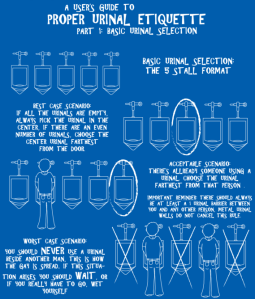
On peeing: a brief, stupid anecdote

urinal-selection-e1370199138698

And lo, it came to be that at the Answering of the Trivia, in the Land of the Snow People, I did after a Drynke of cool Water, feel the need to void my bladder.

Man thing: there are rules about urinals.  Some men– they are evil, and shunned by proper society– ignore these rules.  Most of us do not.  

I walked into the men’s room at the Fraternal Order of Police bingo hall to be greeted with the following:  four urinals, only the rightmost of which was guarded by the civilization-preserving little metal wall, and two stalls, one of which was a wheelchair accessible stall and was unoccupied.  The situation at the urinals was unacceptable; I went into the stall.

Now, let’s make this as clear as possible: I needed to pee.  

I discovered quickly that the reason that the door was hanging open was that the latch on the door was broken.  I could not, in fact, actually close the door and latch it.  I fiddled with it for a minute, pushed it shut, and figured “screw it” and went to pee.  Got as far as unzipping my pants.

And felt, rather than heard, the door slowly swinging open behind me.  And discovered something: while one would think that peeing in an enclosed area would be preferable to peeing at a urinal, particularly when said urinals are the unacceptable, barbarous bowl-stuck-to-the-wall type and not proper stand-up urinals, thus making only one of the four actually usable (the one with the privacy screen), it was in fact much much worse to be peeing in a stall where there was a very good chance that at any second someone could see the door, assume that it was unoccupied, and barge into the stall with me.  

I zipped up, left the stall, discovered that the single privacy-shielded urinal was available, and used that instead.

Feel free to revel in what a dumbass I am.(*)

(*) WordPress just corrected “dumbass,” which is a word that 1) is a word and 2) I use all the time, to “dumbs,” which is 1) not a word and 2) never used by anyone.  What the fuck?

New rule!

UnknownWhen it is 9:30 at night, and the most exciting things you’ve done all day are 1) fixing your UNBELIEVABLY GODDAMN LOUD garage door opener by the simple fix of spray some lubricant on it, you idiot, god, did you WANT the motor to burn out, what took so long? and 2) getting really mad at your PS3 and seriously considering a 2,000 word profane rant on the failings of the online store of a video game system that is literally already obsolete, and you’re sitting in front of your computer trying to come up with one, just one entertaining anecdote to end the day with, and those two things are the best you can do?

You go to bed and read, and then you fall asleep.  Even if it’s 9:30 on a Saturday.  Because you are a grown-ass man, and no one can tell a grown-ass man to stay up later than he wants to.

Except his wife.

Who is already in bed.

Like I said: new rule.

Vegetating (Day Six)

I have about 32 more hours as a vegetarian before I can go back to eating meat. When I first thought about doing this there was a real question in my head about whether I’d be able to pull it off or not; that fact is no longer in doubt at all. There is basically no way that I’m going to either accidentally eat meat or be forced to eat meat tomorrow, and I’m all done eating except for a stray snack or two for the day now, so I’m going to pull off a week without meat.

Do I want to try and go for a second week? No. No, not at all, thanks. At least not during the school year. Weirdly, it was lunches that killed me– as a teacher my lunch hour is a) extremely short and b) geographically constrained; I have to either bring my lunch with me, eat food from the school cafeteria (my usual choice) or race at top speed to one of several fast food/ grocery deli options in the area and hope there aren’t red lights or lines in my way. I tried to leave work for lunch once this week and the kids were like zombies outside my classroom door by the time I got down there. I just don’t have the time to leave the building, especially if I’m not racing. And cafeteria food is almost always meat-centered, and when it isn’t it’s rarely something I actually want to eat. (Generally, I don’t rag on our cafeteria food. But it’s terrible if you’re a vegetarian. Just not feasible at all.)

This means that I needed to bring my lunch, and I never really hit on anything that managed to keep me full for the rest of the day. Seventh grade has first lunch, meaning that we eat at eleven, and if I walk out of the building before 3:45 or 4:00 it’s a bloody miracle. So afternoons are long, and I need to make sure my lunches are filling enough that I’m not scavenging the corners in the hallways for scraps by the time I go home. I’ve been snacking a lot. Too much.

I think if I wanted to I could pretty easily shift to a plant-or-fish based diet for dinner five or six nights a week without it being that big of a deal. I do not think right now that I can include lunch in that. If I had a different job, it might be a different story, but with the way my lunches work right now it’s just too much of a pain in the ass to be including arbitrary restrictions into what I’m willing to eat.


Today was exhausting, by the way. My kids weren’t the problem; thinking was at as high a level as it ever gets and I didn’t have any particularly egregious examples of kids trying to pretend they’d never heard or math before or giving up on shit they know how to do. It was just one of those days where every time I thought I’d gotten something done or accomplished I turned around and there were five more things, Hydra-like, waiting where I’d cleared something out. Charmingly, the day ended with me and the security guard and both of our administrators investigating a stolen iPad in one of my classes; I’d not even been aware the thing was in the room, but the thief managed to convince the kid he’d stolen it from that I had confiscated it. The kid came running up to me at the beginning of last hour, practically in tears, begging me to give it back to him and not wait for his parents to get it and I had literally no idea at all what the hell he was talking about. It was lovely.

Oh, and one of the thieves (turned out there were two working together) was seven plus two kid from yesterday. So there’s a few more days where he won’t be in my room learning math. Meanwhile, the other jackass I discussed yesterday didn’t bother showing up for school today, meaning that he still has to serve his three days of in-school suspension when he gets back– so I’ll have him for a maximum of two days next week, and I don’t doubt his ability to do something on Thursday that will get him suspended again on Friday.

I think I’m glad it’s a weekend.

On basic human courtesy

I have a stupid job, or maybe I have a nonstupid job and I’m just a stupid person.

As I was driving to the gas station on my way to OtherJob this evening, praying for the fumes in my gas tank to keep the car moving until I got there, I drove past a couple of my students. They all know what my car looks like, so I honked the horn and waved and pulled into the gas station, maybe a block or two farther down the road from where they were.

Two minutes later, as I’m filling the tank and cursing how much the price of gas has jumped over the past week or so around here, they come running over to say hello. They ask where I’m going and I tell them OtherJob; they say they’re on their way home and are supposed to be home by five.

I look at my watch. It’s not too far from five already.

“Soooo….” one of them says. “Can we get a ride home?”

And here’s where my job is stupid. Any other person in any other situation upon running into a couple of people who he knows and likes and who happen to live along the way he’s already travelling would say yes to this instantly. It’s common bloody goddamn courtesy. But since I’m a teacher I have to go through this stupid mental calculus where I weigh how much I trust these two girls and whether I can trust their parents to not be stupid idiots before I throw all that to the wind and decide to treat them like they’re people and not my students and agree to give them a damn ride home, like somebody who isn’t a complete asshole.

Note that this may actually have broken the law. Not a joke.

It isn’t until I’m pulling out of the parking lot that the real bullshit of this transaction hits me: I’ve just had two teenage girls run up to me in the parking lot of a gas station, they’ve gotten into my car, and I’ve driven away. I make a joke about it and look around for blue-and-whites; luckily, no one official appears to have noticed. Which is a bit of a relief.

The drive home takes all of five minutes and is uneventful. Then I nearly kill one of the little idiots when she darts in front of my car after getting out instead of going around behind it like a sensible person.

That would have been fun.