So we’ve got a new curriculum for math this year, and like most curricula in 2025 there’s what was supposed to be a robust online component to it. My kids took a math test last week, and I discovered while they were taking the test that a question about exponents that asked them to show their work had not provided any way to put a number into a superscript.
Which, y’know, feels like it might be a massive fucking oversight.
We’re moving into the real number system this week and they’re starting off with terminating and repeating decimals, so a lot of moving back and forth between decimals and fractions. I spent an hour beating my head against their system and for the life of me I cannot figure out how to designate a repeating fraction. Is there a help system? Of course not. Check this out:
It seems like typing in an answer, highlighting the repeating decimals and then clicking that tiny button which I had to hunt for for twenty minutes (and remember, my kids are working on iPads, which make highlighting anything a huge pain) puts the repeating decimal line– which is called a “vinculum,” by the way– above the numbers you’ve highlighted.
Take a second and stare at the options in that text box and reflect upon the fact that this is supposed to be for 8th graders. I do not have the slightest idea what probably 90% of the icons on that thing are referring to, nor do I really have any idea what is supposed to be designated by an arrow pointing at three diagonal dots.
Unfortunately, it doesn’t work:
The top box is how it processed my entry. Why is there extra vinculum to the right of the seven? No idea, but it happened every time I tried. You’ll notice nothing extra is lined in the actual entry above. Why is the 27 in the bottom “correct” answer centered under the vinculum? Also no idea. I was not able to get a single answer correct involving a repeating decimal and absolutely nowhere was there any sort of help option that might have shown me what to do.
I sent an irate email to my team about how bullshit this was and I’m done for the night. I’m going to have these kids writing on the backs of shovels with coal by the end of the year. I’m so done with educational technology at this point that I can’t see straight.
State math testing tomorrow and Wednesday, and then I’m … well, it’s middle school, so never, ever stress-free, but at least a lot less stressed than I am right now. I sat down during our team meeting with the other 8th grade Math teacher and once we went through everything we knew we had to do already for the rest of the year I realized I only really have like eight more assignments to plan.
I told them today that I was going to keep things super simple in class for the next couple of days, and that tomorrow’s assignment in particular was going to be extremely short. Like, five problems short. I have entertained myself by making those five problems insanely complicated,(*) and I’m going to put the answers on the board and not mention it to anyone. We’ll see how many of them notice! I’m going to guess roughly a quarter do not.
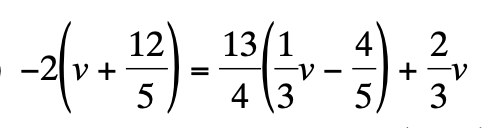
(*) Insanely complicated and yet within the skill set of anyone who has been actually paying attention. So, f’rex:
I may throw some extra credit at anyone who actually solves them instead of just circling the right answers. We’ll see.
I’m trying to decide which overused sentence I should start this post with, and I can’t make a decision.
Because unfortunately, while I haven’t read this book before, I feel like I’ve written this post before. Dava Sobel’s excellent Galileo’s Daughter is a biography of a genius, and, well, I think you probably already know if you want to read a really good biography of Galileo. The title makes it sound like a thousand different literary fiction novels– there are so many The So-and-So’s Daughter novels out there that I’m surprised that there isn’t a parody of them with that exact title– but no, this book is at least a third or so about Suor Maria Celeste, Galileo’s oldest daughter, through the prism of the surprisingly large corpus of letters we have from her to him. Suor Maria was a cloistered nun, and her letters, or at least the translation of the letters in this book, show her to be a woman of lively intellect and wit, and starting each chapter with an excerpt of one of her letters was an inspired choice.
But ultimately this is a book about Galileo– a book called Suor Maria Celeste’s Father would not have sold many copies– and, well, Galileo was Goddamned fascinating, so if the author is of even middling talent writing a good book about him should not be especially difficult, and as it turns out Dava Sobel possesses far more than the typical allotted share of talent. So maybe this isn’t as comprehensive a review as I might have thought I was going to write when I sat down, but I assume the You Should Read This is still coming through at sufficient volume for you to hear it. Because you should.
Most of us have some sort of memories of Spring Break, although I suspect for most people they involve parties, or beaches, or some form of public drunkenness. For me, on the other hand, my strongest memory of Spring Break, one I reminisce about every time my own break rolls around, involves going to see a movie on the first night of a Spring Break in grad school with a good friend of mine who is a professor at Oxford now. We had to stand outside to wait for tickets in a driving, wet, utterly bullshit snowstorm in downtown Chicago, and Bill stepped out of line for a moment, threw his arms over his head, yelled “SPRING BREAK!” at the top of his lungs, and rejoined the line without another word.
I may not have partied enough as a young man, is what I’m saying here. And I openly laughed at anyone who asked me what I was “doing” for my break. I’m going to be sitting in a damn chair reading a book, that’s what I’m going to be doing. And it will be glorious.
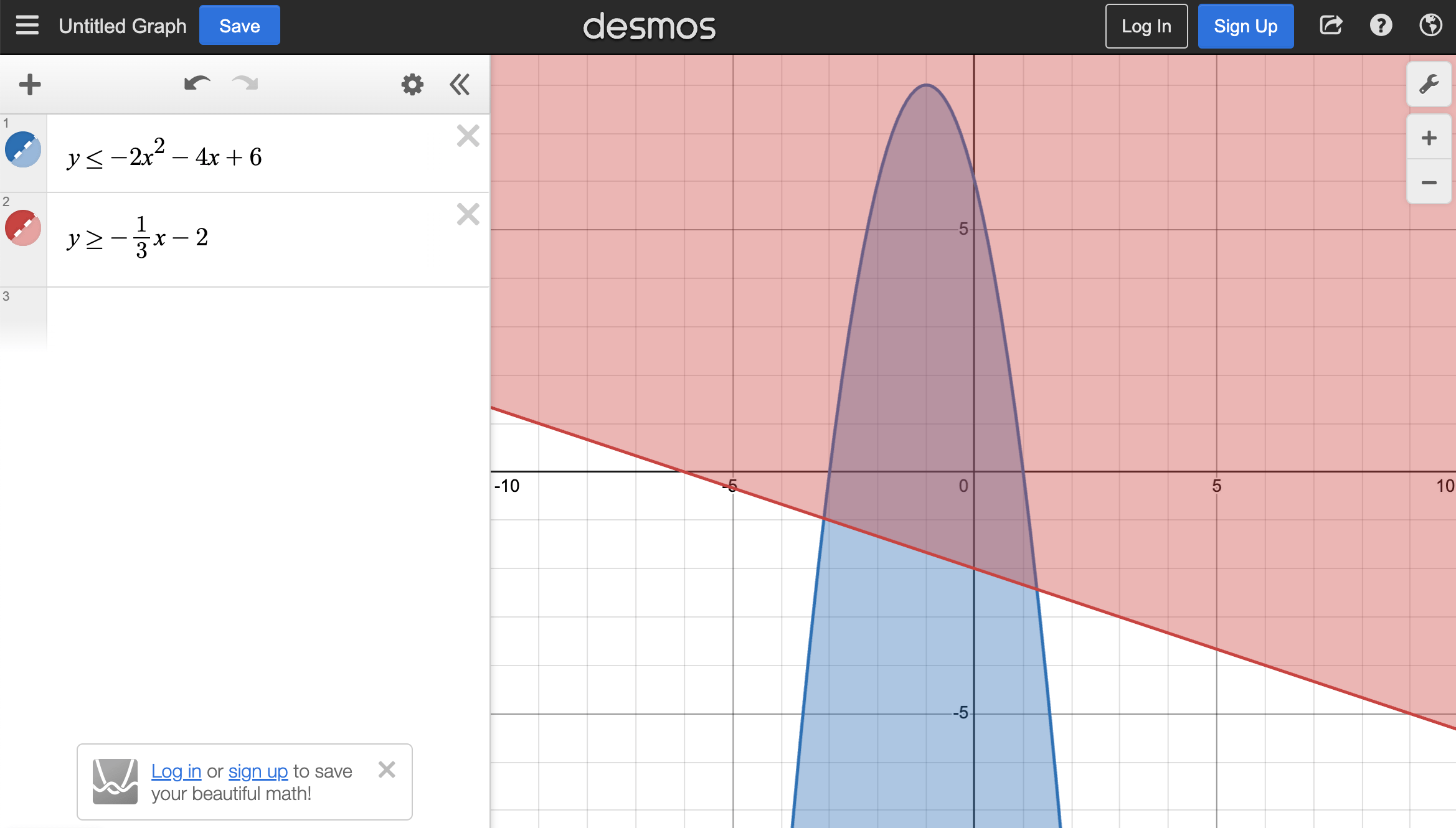
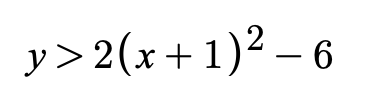
Spent the last half hour talking a high school sophomore off the ledge, which is what you expect to happen when you teach 8th grade. She’s in Algebra 2 right now, which technically I’m legally allowed to teach, and I can absolutely handle both the mathematics behind and the explanation of that second inequality up there, but she swears up and down they haven’t been working with quadratics at all. That’s the second question of the two she asked me about, and the first of the other pair of inequalities looks like this:
…which is a reasonably tricky PEMDAS problem (a parenthetical with an exponent and a multiplier on it is the stuff of 10,000-comment internet videos) even before you get to graphing quadratics by hand, which I’m capable of with intense concentration but may not be great about explaining very well at the moment. Both pairs of inequalities have a simple linear inequality and a quadrilateral, and long story short, I’m not convinced her teacher gave her the assignment that he meant to. On an e-learning day, no less? You serious, man?
This isn’t a kid who’s going to forget that they just spent a month on quadratics or something like that, by the way. She’s bright. And she took a picture of one of her assignments from last week, which was graphing absolute values. The leap in difficulty from graphing absolute values on a number line to graphing systems of inequalities where one inequality is linear and the other is a PEMDAS nightmare that turns into a quadratic is … stark. There’s gotta be something else going on here.
Anyway, we’ve got the day off tomorrow again, which was the right decision. It’s been 20 below or worse all day, and it’s supposed to warm up significantly tomorrow, but at 8:00 in the morning it’s still going to be 20 below, and even after a two-hour delay it’s still going to be fifteen below– the temperature isn’t going to be conducive to human life until after noon, and you don’t make kids walk to school in subzero wind chills, especially when a lot of them don’t have coats. We will not lose Thursday or Friday, as it will be regular Midwest January cold and not the kind that has you cursing God.
The kids will, of course, find a way to make Thursday and Friday feel like a long week.
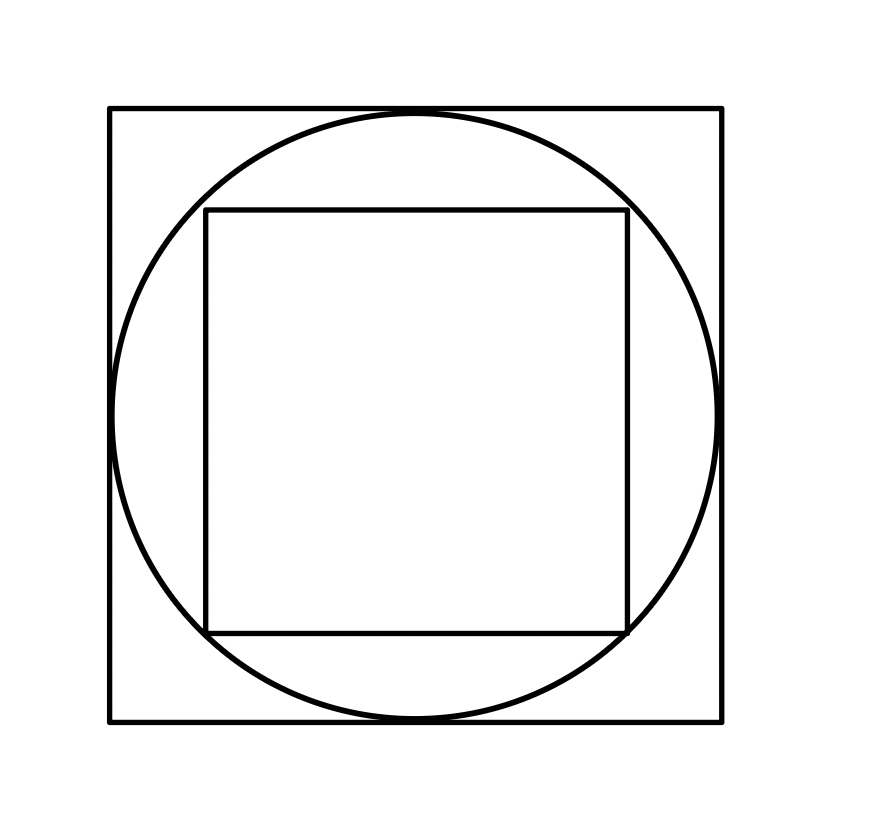
I have removed the Second Skin from my new tattoo, and the itching is absolutely maddening, so I’m going to distract myself with math. Because that’s why you come here, right? As a reminder, this is the original image, and the question is the ratio of the inner square to the outer square:
The first thing we’re going to do is draw the two diagonals of the inner square. These are, by definition, perpendicular to each other, and they are also equal to the circumference of the circle. Let us define the radius of the circle as x:
What we have now is four right triangles inscribed inside the circle. Pythagoras tells us that the sum of the squares of the two legs are equal to the square of the hypotenuse, which is the line on the left of the square there. Therefore, defining the hypotenuse as Y, we get:
x2 + x2 = y2 2x2 = y2
Take the square roots of each side, and we get:
√(2x2) = √(y2)
And therefore:
√(2x2) = y
Which means that all four sides of the inner circle are equal to √(2x2), thusly:
To get the area of the inner square, all we have to do is multiply √(2x2) by √(2x2), which, conveniently, just gets rid of the square root symbols. The area of the inner circle is 2x2.
Now, we need to realize that since the radius of the circle is x, the diameter of the circle is 2x, and that the diameter of the circle also equals the width and the height of the outside square. So that outer square is 2x high and 2x wide:
Therefore, all we have to do to get the area of the outside square is multiply 2x by 2x, which gives us 4x2. Which, conveniently, is exactly twice the area of the inner square, which was 2x2.
The outside square is therefore twice the size of the inner square, and the ratio of the inner square to the outer square is 1:2.
Or, y’know, you could just rotate the fuckin’ inside square, which makes it visually obvious.
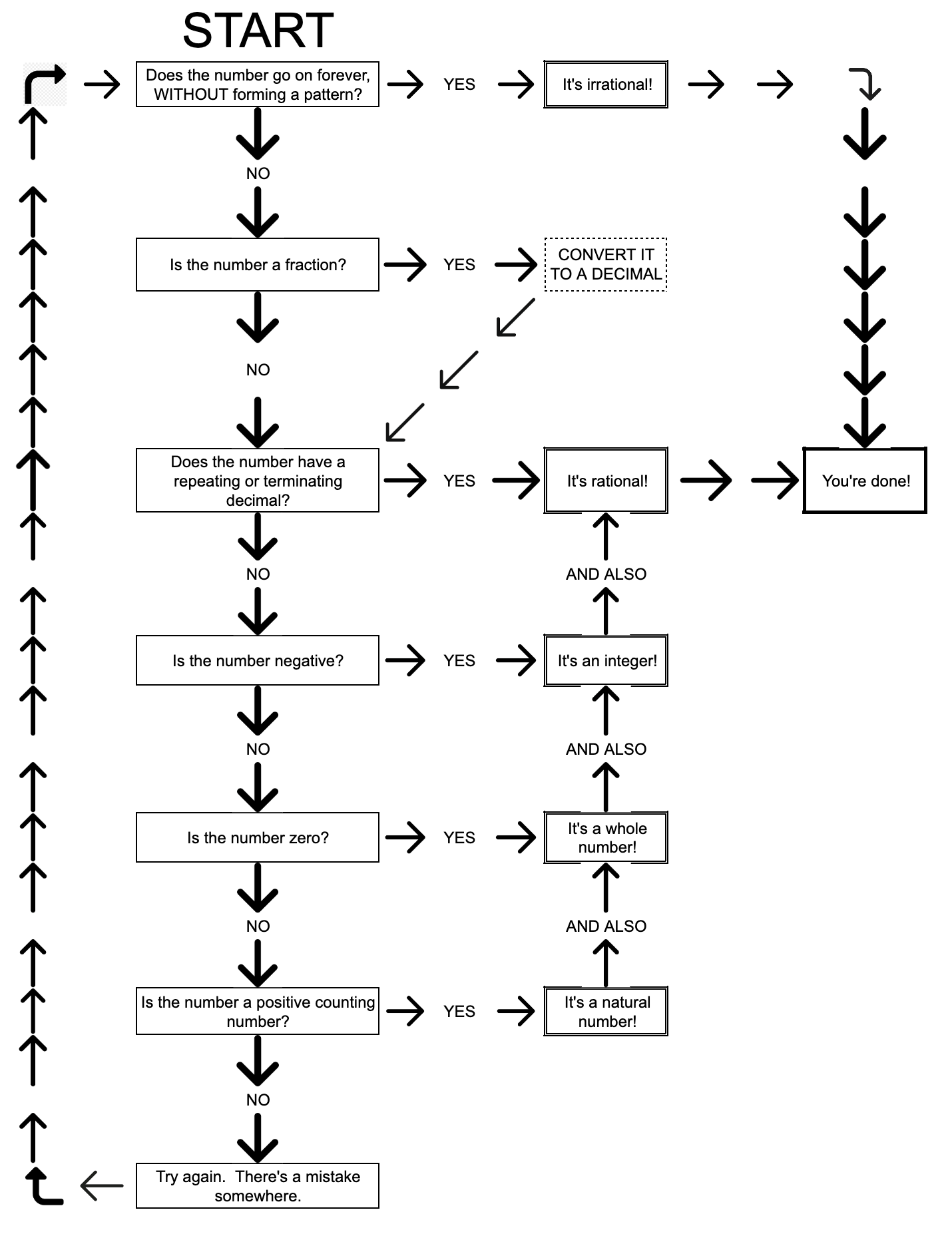
Okay, maybe that wasn’t as complicated as I thought it was going to be:
Basically all I did was add the “Is the number a fraction?” step there, and we’ll have to review converting fractions to decimals a bit, but it’ll do and they need to remember how to do that anyway.
In the meantime, I actually called out sick today; my Mounjaro (I assume) got on top of me hard in the last couple of days and I spent less of last night sleeping than I generally like to do, in favor of activities that generally aren’t meant to be described in polite company. So I slept most of the day away once it passed. I may have to have a review day for my kids on Friday already, though, which feels awfully early, although if I remember right we probably had about one a month last year anyway so maybe not. We’ll see how the next couple of days go, assuming I can drag my ass out of bed.
From the “I’d have two nickels, but it’s weird that it happened twice” department: Between Kyne Santos, who wrote this really awesome fucking book, and a simply outstanding TikTok account called Carrie the One, I follow two different math-based drag queen accounts on social media, or at least I did before I killed off my TikTok account. I say an awful lot that you already know from the title and the cover whether you want to read this book or not, but let’s be real here: a book about math written by a drag queen might be the ultimate “you already know if you want to read this” book, and to be honest this is less of a review than a notification that this book exists, and you might have missed it, and if the notion of reading this book rustles your jibblies in literally any way at all you should go spend money right away.
This book is part memoir, part textbook (simultaneously of mathematics, the history of gay culture and the drag movement, and of the history of mathematics) and part adorably unhinged geek-out about how fucking cool math is. You probably need to be at least comfortable with algebra to be able to fully appreciate it, if only because it’s kind of hard to talk a lot about math without getting at least a little bit into the weeds, but Kyne’s going to be explaining what ℵ0 is at some point and if that terrifies you you should at least take a deep breath before jumping in. It’s only 233 pages, though, so even if you have a rough time with it it’s not terribly long.
Each chapter takes on some aspect of mathematics– there’s a chapter on infinity, a chapter on algebra, a chapter on what “proof” means in a mathematical context and what the difference between numbers and numerals are, and so on, and Santos interweaves their own story and the history bits into the more technical (but again, not super technical, so far as it goes) math-focused parts. I picked up a couple of things that I am absolutely going to be bringing up in class, or at least with my Algebra kids– I have my lesson plans for Monday done already, and they’re directly from an anecdote in this book about imaginary square numbers that absolutely set my brain on fire– and Santos is one of those people who can carry a lot of what could be a slog just by sheer enthusiasm for the subject matter. Again, if you’re even the least bit curious, absolutely give this a shot. It’s well worth it.
Wednesday remains Trainings and Meetings day around here, and as such I did not have any interaction with my students beyond responding to emails. What I did have was a very depressing Math team meeting where we looked at some data, reflected on the fact that the mid-year test had been (rightfully, mind you) cancelled and so we therefore weren’t going to get any updates on that data anytime soon, reflected further upon the fact that this particular assessment tool demonstrates that our students, by and large, appear to know nothing at all, and had a brief discussion wherein we were all forced to admit that none of us had the slightest idea what we might be able to do under the current circumstances to fix the problem.
(Nor can we be sure that the data captures the issue accurately, since the test was administered while the students were home, and we have no way of ensuring that it was taken seriously.)
One of the more entertaining fights in comments that I have had over the life of this blog was a post where I was complaining about my students performing poorly on a test about slope. Well, it is now several years later and I can confidently report that despite attempting to teach slope in a variety of different ways and with a variety of different strategies since then, my 8th graders still do not really appear to understand slope, and attempting to teach it virtually during a pandemic is … suboptimal.
Allow me, if I may, to further elucidate.
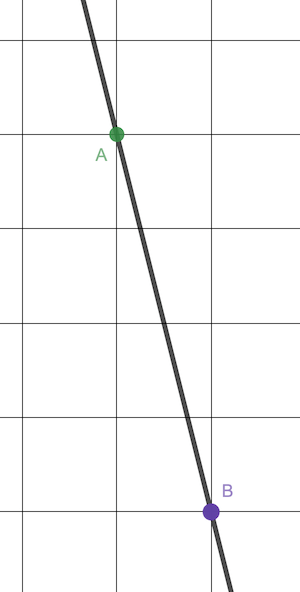
I have not yet actually introduced the formula for slope, which is complicated enough that I can’t reproduce it in WordPress’ text editor and would have to copy and paste an image. Instead, I’ve started beginning the unit with simply counting. Count the rise, or the vertical distance between points A and B, remembering (hopefully) that if you go down from A to B your “rise” is negative (this is confusing, because no one naturally thinks of something called “rise” as negative, and I wish the word was different) and then count the “run,” which is the horizontal distance between A and B and is always positive.
You will note on the above image that the slope of that line is -4, because you count down 4 squares to go from A to B and one square for the run, and -4/1 is equal to -4. I’m breaking this down in such a granular fashion that today was the first day we actually talked about negative slopes. Also, the reason there are no numbers anywhere on that image is that I discovered that some of my kids were simply writing down the number nearest to one of the points as (chosen randomly) the rise or the run, with no actual counting taking place. So I removed them on today’s assignment.
I have discovered that many of my students genuinely believe that there are five squares between A and B, because rather than starting from 0 they are counting the line A is actually on as 1 and going from there.
I have discovered– this is not surprising, but remains depressing– that a number of them do not include “left” and “right” among the concepts that are salient to them, and thus I must frequently remember to say “from A to B” rather than “from left to right.”
And I had a genuinely bewildering conversation with one of my kids, a kid who generally does well in class and has one of the highest scores in his grade on the test we were discussing earlier, absolutely cannot wrap his head around the words “uphill” and “downhill,” a set of terms I was using to distinguish positive slope (uphill, from left to right) and negative slope (downhill, from left to right) while I was talking. He consistently reported that any line was both going uphill and downhill at the same time, even when I made it clear which direction I was moving in. I eventually ended up creating this diagram:
He is color-blind, by the way, a disability that I have somehow never had to worry about in 17 years of teaching, so I have to make sure that color is never salient information in any diagram I do for an assignment, which is why one of the lines here is dotted. This can occasionally be trickier than it ought to be.
Anyway, I pulled this diagram together, still trying to work on this uphill/downhill thing, and asked him, gesturing with my mouse while talking, which of the two lines was going uphill when I moved from left to right. I even said “We’re moving from A to B on the dotted line, and C to D on the solid line. Which is going uphill?”
“Both,” he replied. And I swear to you, he wasn’t fucking with me. I tried a stairs metaphor. Which of these lines looks like you’re standing at the bottom of a flight of stairs, looking up to the top? Both. You’re sure you understand the “left to right” thing we’re doing here? You’re telling me C to D and A to B both look like walking upstairs?
Yes. Yes, he was.
This kid’s not stupid. Not at all. And he wasn’t fucking with me; I could hear the frustration in his voice. He was trying to get this, as opposed to the dozens of my students for whom no set of directions can be short or clear enough that they can be expected to read or follow them. But I don’t have the slightest Goddamned idea where the hell the disconnect was happening.









 Welcome to infinitefreetime dot com