Thoughts and questions

I’ve got a few things rattling around in my brain, none enough for a whole post, so let’s just toss all three of them together. Why not, right?

FIRST: That game up there? Was crafted deep in the bowels of Hell, on the lower foothills of Mount Sonofabitch. I just beat the game’s third major boss tonight, after, no shit, probably five or six hours of attempts and farming over the last few days. The recommended level for his area? Seventeen. My level when I finally took him down about half an hour ago? Forty-five. And the next area promptly beat the shit out of me again.

SECOND: You may have heard the godawful fucking story about the people Trump effectively sold as slaves to El Salvador, including a number of them who were accused of no crime at all other than being brown. Now, before I ask this, I want to be crystal fucking clear that this is horrible and the people responsible should rot in Hell. Okay? We’ve got that? Everybody understand? Good. Because while I’m having some trouble untangling the court cases, what with not being a lawyer and all, it looks like a judge ordered the government to produce one of the men involved by midnight tonight? And there may or may not be a temporary stay on that order, or maybe SCOTUS just overturned it, I dunno, it looks like things changed while I was playing video games. But here’s my question: Does the court, any court, have the ability to order other entities to do literally impossible things? Because part of the whole point of selling these men to El Salvador was to put them beyond the reach of US courts. Short of invasion, which Trump obviously isn’t going to do, we don’t really have a way to compel El Salvador to return any of these people, and certainly not to do so in the next three hours and eighteen minutes. The judge has no jurisdiction. Again, yes, I recognize that there’s something horrible about taking the situation these human beings are in and reducing it to a legal hypothetical, which is part of why I’m doing it on my blog and not, say, BlueSky– but does anyone actually have any authority to compel this to happen right now? The courts can order the government to do shit all they want. What happens if they just … can’t?

THIRD: I don’t remember the goddamn third thing. Fuck. I’ve had this post in the back of my head all day and now that it’s time to write it Thing Three is gone.

Right, shit, the economy went to hell today too. So I, personally, with very modest investments in, until yesterday, the low (very low) five figures, have lost about a thousand bucks in the last few days. I do not expect things to get better anytime soon, for obvious reasons. I have been contributing a couple hundred a month to an account managed through MetLife that I deliberately rarely look at, and $100 a week to an Acorns account that I monitor perhaps more carefully than I ought to. Yesterday I reset a bunch of stuff on Acorns so that now that $100 a week goes directly to my savings account and is not invested in anything. My understanding of how this works is even if the value of individual shares of a given stock are falling, buying more of them means a faster theoretical recovery later on, since I’ll own more stock, assuming that the companies I’m investing in don’t go under, in which case that money is just gone. But if I think it might be years before the market recovers– and I do– isn’t there more value in socking that money away into a savings account, where it’s not going to just vanish? Or at least is much less likely? The interest rate is going to be a lot lower but at least it’ll be positive.

Help me out if you know anything about investments. I’m sure there are better ideas than the binary I’ve set up here, but if you’re going to give advice at least tell me which of those two is a better idea right now before telling me about your third thing, okay? Thanks.
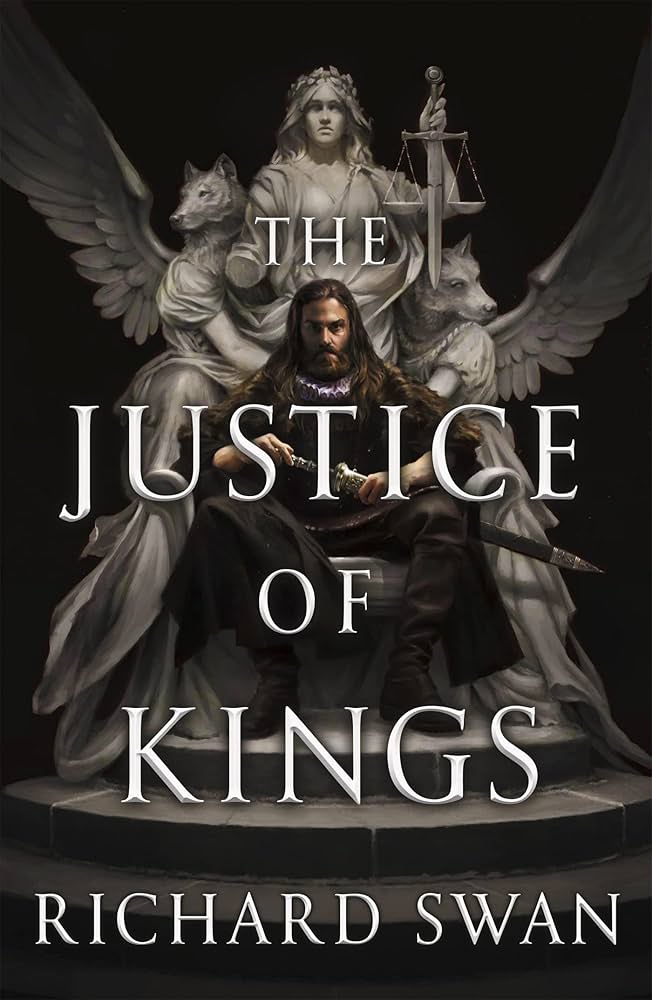
#REVIEW: The Empire of the Wolf series, by Richard Swan

I generally write three different kinds of book reviews. The first kind is for books I’m enthusiastic about. That’s the most common type, by far. Rarer is a pan of a book; firstly, because I genuinely like most of the books I read (there are lots of books, and I’m pretty good at picking out ones I am going to like) and secondly because I generally don’t like shitting on a book unless 1) I think it really deserves it and 2) I think I can do it entertainingly. The least common is mixed reviews. Why? Mostly because I don’t bother to write them– “this was meh” is hard to make entertaining or interesting, and if I finished a book with not much of an opinion of it either way, it’s frankly easier to simply not write about that book.

A subtype of the mixed reviews is books that I liked but everything interesting I have to say is negative, and that’s kind of where we’re landing with The Empire of the Wolf. It took me … five days? Six? to read all three books in the series, most of which are around 500 pages each. In general, I had a good time with them, but almost everything I have to say that I think people might be interested to read is negative, and a lot of it ends up a little more political than I like my book reviews to be. There are Bad Books, and there are Books I Didn’t Like, and this series fits more into This Is Not The Book’s Fault. Or maybe it is! I dunno.

So, the story: the narrator of the series is Helena Sedanka, a young woman in the story but telling it much later in her life. The main character, on the other hand, is Sir Konrad Vonvalt, an Emperor’s Justice. The Justices are effectively judges who ride circuit and double as investigators and police; Vonvalt has authority over basically everyone except the Emperor himself, and is able to decide on his own how crimes are punished. Helena is his clerk; she travels with him and is responsible for recording the details of the cases that are brought to him and the resolution of same, and she’s in training to become a Justice herself. All Justices have the power of the Emperor’s Voice, which can compel people to tell the truth, and most have other abilities as well; Konrad can also speak with the dead, for example, and other Justices can speak with animals.

The setting is, effectively, the Holy Roman Empire. Note Holy Roman Empire; think Charlemagne and Germany, not Caesar and Italy. Most of the names are pretty clearly German-adjacent and the Empire’s war of expansion is actually called the Reichskrieg, which was an actual term the Holy Roman Empire used.

The first book starts off as a murder mystery, and absolutely blows the fuck up over the course of the next two books to where they’re dealing with literal threats to reality from a demonic parallel dimension. I don’t want to spoil anything and I almost didn’t want to give you that much; you have no idea where this series is going to end up from where it starts, which is a compliment. Predictable, it’s not, and the twists and turns of the plot over the three books are tremendously well-done. To be clear, I’m about to spend the rest of this review complaining, but I’m absolutely on board for whatever Richard Swan does next. My dude has got chops; he just didn’t quite hit the mark on this one in certain ways.

Just for example: Konrad Vonvalt is an unbearable asshole.

Like, I’ve disliked characters in books before. I’ve disliked main characters in books before. But Vonvalt is unbearable in a lot of ways that make him really hard to put up with and even harder to understand why the other people in the series put up with him. Roughly a third of his dialogue involves telling other people to shut up. He is absolutely insufferably long-winded, completely full of himself, and will not listen to anything other people have to say. He would be the worst boss in human existence.

And Helena is in love with him, for no clear reason, and at various points he claims he is in love with her, despite being twice her age and her immediate supervisor, which is ick. I do not want to read about ick right now. There is enough ick in the actual world and I don’t need it in my books. I would like it if men in the actual world would stop trying to fuck their subordinates and I don’t want to read about that type of man in my books. Even then, it would be easier to put up with if the two of them had any chemistry at all; they do not. He orders her to do things and he tells her to shut up. The word “insolent” appears more in this book than any thirty other books I own. Their relationship is ridiculous in the extreme, and I don’t believe in it even before I get to the part where it grosses me out.

(Helena herself, in general, displays … not great taste in men? She has a brief relationship in Book One where she stops pining over Vonvalt for a while, and he’s not a good idea either for a whole different set of reasons. I went back and forth a lot over how I felt about Helena through the course of the series.)

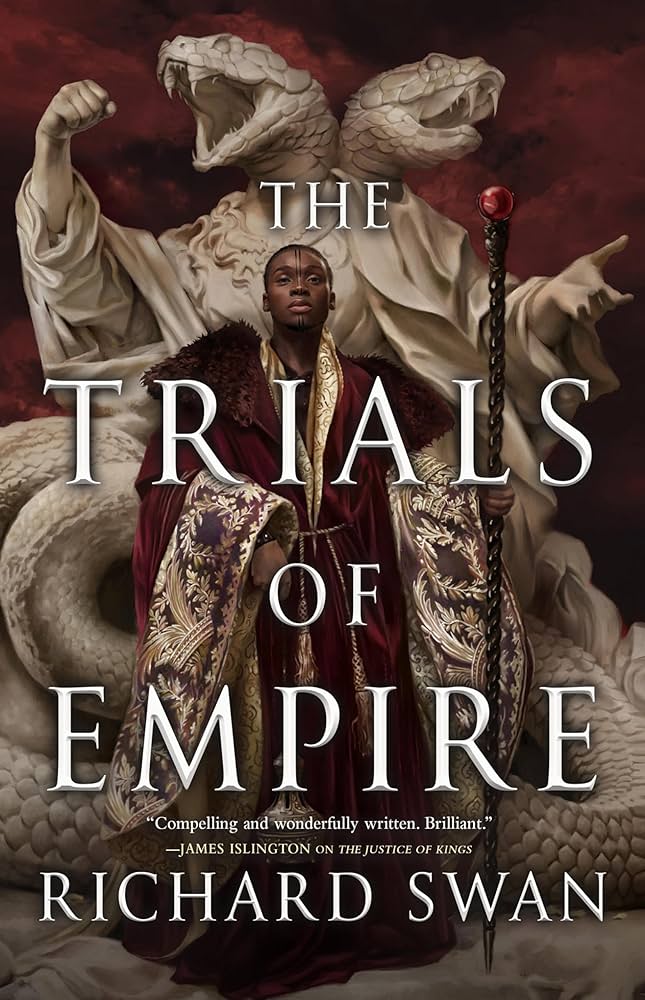
And this one may not even be the author’s fault, but see the guy on the cover of book three? That’s Bartholomew Claver, the bad guy. Bartholomew Claver is a very good villain. But if he’s ever described as being Black on the page, I missed it, and by “missed it,” I mean that I looked at the cover when I picked up The Trials of Empire, thought “Wait a minute, who the hell is that?”, then realized from his clothes that it had to be Claver, and went back to the first description of him looking for any evidence at all that he was supposed to be Black, then read the entire third book paying close attention to the physical descriptions of Claver and saw nothing to indicate anything about his skin color. And yes, I’m fully aware that there were people of color living within the Holy Roman Empire, and furthermore as an empire you would expect these folks to have absorbed some non-white cultures, but whiteness is very much the default in this series.

So we have two possibilities here: either Claver is not meant to be Black, which makes the artist’s choice rather curious, or he is, but Swan never described him as such or did so in such a subtle way that when I went back looking for it I still didn’t see it, and either way it means the only Black guy in the whole damn series is the bad guy, which is also sorta squicky.

You see what I mean, though, when I say that the reasons I didn’t like the book were kind of political, and that they maybe might not be the book’s fault? There are some structural issues too; this series could have used a fourth or maybe even a fifth book, because when I say everything goes to Hell in book three I mean that absolutely literally and a whole lot of shit happens really fast, and Swan either lost some control over his own story or had to cut some stuff back or both, and the third book feels really rushed and kind of muddled in a way that the first two didn’t. And if you’re less annoyed by Vonvalt’s personality than I was you will have a better time overall than I did. So, yeah: this is a mixed review. I had a mostly good time with this series, with the caveats as listed above, but the stuff I liked mostly outweighs the stuff I didn’t, and I’m in for Richard Swan’s next series. I just hope to hell Sir Konrad isn’t in it.