
 Here is my normal approach to starred reviews. I admit that this is probably more generous than many, but I’m not worried about it. For every guy like me who hands five-star reviews out to a third of the books he reads, there will be someone else who reserves them for books that should win awards. It balances out.
- A five-star book is not only a book that I really enjoyed, but (this is critical) a book that I will evangelize and recommend to others.
- A four-star book is one that I enjoyed, but not necessarily enough to be evangelical about it.
- A three-star book is a book that I finished.
I usually don’t review two-star or one-star books, because most of the time I didn’t finish them. I have to hate a book to finish it if I don’t like it; generally I finish it with horrified fascination as the overriding emotion. Sometimes I like a book on some levels but abhor it on others; sometimes I just like looking at a train wreck.
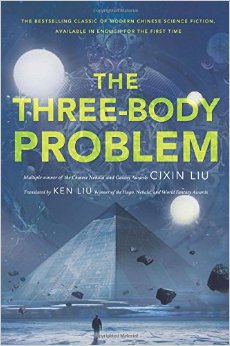
I just gave The Three-Body Problem five stars on Goodreads, despite having some reservations about it, and I want to take a minute to explain why. The book was originally written in Chinese and translated into English by Ken Liu, who I understand is of no relation to Cixin Liu. And therein lies the first problem: there is no way to read this and not immediately recognize that it’s a translated work. This is no slight on Liu, who is clear in the translator’s note (there’s a translator’s note) that preserving the Chinese character of the book was a priority, and the book isn’t hard to read, but I feel like the “this was obviously not written in English” character of the text is going to turn some people off. This is especially clear in dialogue; English speakers simply don’t talk like the characters in this novel.
(See what I mean? Not complaints, not flaws. Reservations.)
The plot of the book is occasionally slightly impenetrable, particularly the first 20% or so, which require some background knowledge of the Chinese Cultural Revolution in order to properly appreciate– or, at least, I assume it’s required, since I don’t have it and found the first part a big of a slog. Once the book jumps forward into… now? Near future? I’m not sure– it becomes much easier going. I finished the book in about a day and a half, so it couldn’t have been that rough.
The other thing? The science. My favorite book of last year was Andy Weir’s The Martian, which I recommended enthusiastically to everyone, with the caveat that the book would involve math and chemistry and you should be prepared for that. Half of the characters in The Three-Body Problem are physicists. There’s a whole bit toward the end that is all about unfolding a proton from 11-dimensional space down to 2-dimensional space so that it can be turned into a supercomputer. They fail to do it right twice. That happens.
I am also not quite sure that Cixin Liu has ever played a computer game. I won’t go into that particular gripe any more than that sentence, but there’s a lot of stuff going on with a VR game and it’s… weird.
But here’s the thing: this book? It’s inventive as hell. There are aliens. They’re coming for us. And they don’t get anywhere near us during the first book, which is part one of a trilogy. And the whole thing is just as clever as hell in a whole lot of ways and I can’t wait to read the second book even though there were parts of it I don’t like and I’m going to have to be real careful about who I recommend it to.
So I’m calling that five stars. Your mileage may vary, I suppose, but you should check the book out anyway.
 Welcome to infinitefreetime dot com