
You might remember a few years ago that I did a project called Read Around the World, where I read one book from every US state and from as many countries as I could manage in a year. The final-final-final update never got published, and has a few more countries on it than the “final” 2021 update did, but I never managed to read anything from Israel during that time. I can remember thinking about what to do if I read something from a Palestinian author during the project– would I count that as Israel? Should Gaza and the West Bank count as their own place, and leave, for lack of a better word, Israel Israel untouched? Well, I never had to decide, because I wasn’t about to try rereading the biography of David ben-Gurion I bought when I was in Israel on a dig after college, and nothing else ended up dropping into my lap.
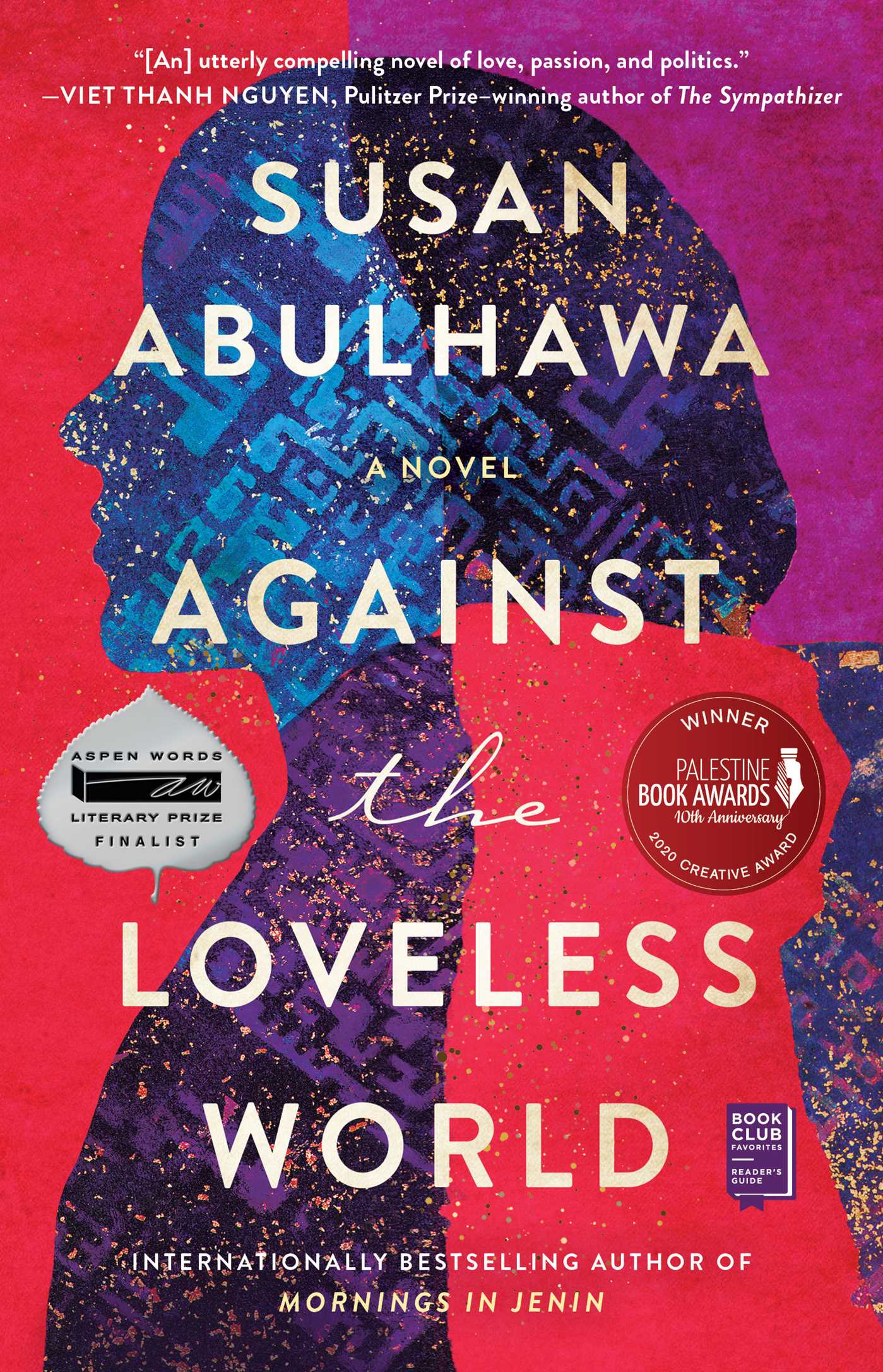
I haven’t really worried about geographical diversity too much since 2021. Or, at least, I didn’t until October 7 happened, and I decided to make a stronger effort to find some books by Palestinian authors to read. I don’t think I talked much, if at all, about Rashid Khalidi’s The Hundred Years’ War on Palestine, which I read in … December? I think? But Susan Abulhawa’s Against the Loveless World has been sitting on my shelf for way too long, and since I wanted something different after three straight Red Rising books, I decided it was time to dig into it.
So, I just wrote a post where I told you to read Red Rising because it was good. I still stand by that post, obviously. But you need to read Against the Loveless World because it is important, which is not quite the same thing. Don’t misunderstand me– it is also good; I would not have, for the second day in a row, read an entire book in less than 24 hours if it was not a good book– but it is a story that Americans in particular need to hear.
Against the Loveless World is a novel, not a memoir, but it is written in the style of a memoir and both Abulhawa and the main character, Nahr, are Kuwaiti-born Palestinian refugees. Abulhawa has lived in America since she was 13 and Nahr narrates her book from solitary confinement inside an Israeli Supermax prison, so this is clearly not a self-insert. It feels a lot like My Government Means to Kill Me in that respect. Nahr grows up more or less happily in Kuwait, but the Iraqi invasion leads to persecution of Palestinians and her family is forced to move to Jordan. She and her family spend the rest of the book moving back and forth between Jordan and Palestine; I don’t know for sure that the word “Israel” is ever used in the book; when it is grammatically necessary to refer to it the phrase “the Zionist entity” is often used. The book takes its time with her radicalization, saving the events that put her in prison for the last fifth or so of the book, but from the moment Saddam invades it becomes clear over and over that by virtue of being a Palestinian and in particular a Palestinian woman she is considered to be less than nothing by everyone with any power around her. When her husband abruptly abandons her and disappears things get even worse and she is forced(*) into prostitution for a while, she manages to provide for her family but at the cost of not being able to admit to anyone how she is doing it.
Her first trip to Palestine is so that she can obtain a divorce, which of course she can’t do without permission of her husband, the guy who abandoned her and prompted the need for a divorce in the first place. He more or less signs power of attorney over to his brother, and it is when the two meet that the book really takes off. She’s able to meet some members of her family for the first time as well, family members who were never able to come visit in Jordan or Kuwait because leaving the country would have led to the Israeli government stealing their homes out from underneath her. At one point she visits her mother’s childhood home, which is occupied by a colonizer at the time. It’s … quite a moment.
At any rate, the book is marvelous, and I don’t want to spoil a lot of it. But I will read more by Susan Abulhawa, and I think I’m going to try to find a few more Palestinian fiction authors to read work by, which I’ll be able to get to in a million years, since I am so far behind. You really, really, really ought to strongly consider picking this one up. It’s cheap. Do it.
(*) It’s more complicated than that word implies, and Nahr’s relationship with her, uh, procuress is incredibly layered and frankly one of the highlights of the book. If you’re thinking you might need a trigger warning about this book, though, you’re right.
Discover more from Welcome to infinitefreetime dot com
Subscribe to get the latest posts sent to your email.
 Welcome to infinitefreetime dot com
I trust my regular readers and commenters, but if you’ve never commented here before and you feel the need to show your ass in any way regarding this post be aware that I do not intend to put up with it. You’ll be banned and your comment deleted the second I see it. Period.
LikeLike
Book ordered!
LikeLiked by 1 person
Given the books you’ve recommended to me in the past, I think this one is particularly up your alley. I hope you enjoy it.
LikeLike