I read books, did you know that? Let’s talk about a few of them real quick:
A traditional American woman, a “tradwife” influencer, suddenly awakens in the brutal reality of 1855—where she must unravel whether this living nightmare is an elaborate hoax, a twisted reality show, or something far more sinister in this sensational debut novel.
“A bold and biting satire, Yesteryear…will have you cackling and gasping right to the final page.” —Nita Prose, #1 New York Times bestselling author of The Maid series
I already own a book called Trad Wife, and I realized the other day that there is another book called Trad Wife coming out soon, and I sort of feel like I should buy that too so that I can put them next to each other on the shelf. Simple things please me, I suppose.
Read those. Don’t read this. It’s one of the worst books I’ve finished this year. It’s not a “satire” so much as a book about an asshole, the twist at the end is mind-blowingly bad, and it squanders every bit of goodwill the premise– which is genuinely interesting– might engender in the reader. Everyone in it sucks.
“One of 2026’s literary triumphs.”—Boston Globe
From the Booker Prize-winning and New York Times bestselling author of Shuggie Bain and Young Mungocomes a vivid, moving novel following a young man returning to his Hebridean island home, a portrait of a father’s expectations and a son’s desires.
Spoiler alert! Everyone is gay. Everyone is gay. And no one will admit to anyone else that they’re gay, except everyone kinda knows that the gay people are gay, and if anything this is a better satire of repressive religious environments than Yesteryear was, and this book isn’t a satire either. I enjoyed this one, although the fact that the main character is John-Calum and his father is John (thus the “John of John”) led to me getting embarrassingly far into the book before I realized that Old John was getting some POV bits here and there and the author wasn’t just randomly swapping between calling his main character John and calling him Cal. You can absolutely blame me for that but I will feebly point out in my own defense that had their characters on the page been more distinct I wouldn’t have been able to make such a dumb mistake. POV John and Cal’s Dad John from Cal’s Perspective are very different characters, let’s leave it at that.
I still don’t know what literature is, but this was enjoyable, and I look forward to Shuggie Bain, currently on my Unread Shelf.
Stephen’s god died on the longest day of the year…
Three years later, Stephen is a broken paladin, living only for the chance to be useful before he dies. But all that changes when he encounters a fugitive named Grace in an alley and witnesses an assassination attempt gone wrong. Now the pair must navigate a web of treachery, beset on all sides by spies and poisoners, while a cryptic killer stalks one step behind…
From the Hugo and Nebula Award winning author of Swordheart and The Twisted Ones comes a saga of murder, magic, and love on the far side of despair.
Okay, granted, the phrase “love on the far side of despair” is right there, but just be aware before you get into this that it’s a romance. No, it’s not a romantasy, it came out in 2021 before that word existed, but I wasn’t aware of what I was getting into when I picked this up. That sounds like a criticism; it’s really not. I don’t mind romance, and I don’t mind romantasy, either, a lot of the time, but I really feel like the cover and the copy lead you to expect a certain kind of book that you will get tantalizing glimpses of here and there but is not this book. That said, I’ve already ordered the rest of the series, and I may reevaluate the first book once I’ve read the rest of them. I don’t remember being a huge fan of The Twisted Ones, which is the only other T. Kingfisher book I’ve read, but she’s got about a thousand books so there’s a lot to dig into with this author.
New York Times bestselling author Shannon Chakraborty sets sail into the second adventure of pirate Amina al-Sirafi as her quest to track down magical artifacts brings her to the island lair of a sorceress whose woven enchantments are impossible to flee.
I loved the first Amina al-Sirafi book, which was my fourth-favorite book of 2024, and this was every bit as good as the first book, with an intensely creepy villain and a great, twisty mystery to unravel. I have a weakness for pirates and Arabian-themed fantasy, and, well, again, judge this book by the cover, which features a shipwreck and a griffon. I can read books about this character forever, and I want at least twelveteen more of them. Seven thumbs up.
One of the things I said about The Bone Raiders, the first book in Jackson Ford’s Rakada series, was that you could go ahead and judge it by its cover. The cover of that book was five badass women of color, draped in human bones and carrying weapons, plus a giant, fire-breathing lizard that is not technically a dragon but may as well be.
I am tempted to point out that this cover features two fire-breathing lizards, hit “Publish,” and retire for the night.
I fucking loved the first book, about a group of raiders in a heavily Mongolian-inspired steppe setting, who decided to try and tame the aforementioned fire-breathing lizards so that they could ride them into battle. By the time this book begins, they have mastered taming said fire-breathing lizards (which are called araatan, by the way) and all four of them have their own. Which means that the psychic crazy lady from the first book who thinks she’s immortal until she makes good on a deal she made with God now rides a dragon.
Its name is Sponge Bath. I’m not sure there are sponges in this world. I definitely don’t care. Ford can have that little anachronism for free. Two others are Tooth Monster and Princess. The fourth’s name is a plot point and I won’t reveal it.
And then the araatan start getting sick, and all four women have the same vision at the same time, featuring the words “You can save them,” and we’re off to the fucking races.
Jackson Ford is so good that it makes me sick. My jealousy is off the charts; this shit is simply not fair. I’m coming off several books in a row that didn’t hit the way I wanted them to and I needed my ass kicked, and I’m glad I saved this book for when I needed my ass kicked, because damn. Somehow a book about four women wearing bones and riding dragons also gets way deeper into everyone’s character than the first one did, and the ending is so crushing that I didn’t believe it at first, fully expecting a particular plot development to let one character hit the reset button on everything that had happened, and … nope. If you are a crier, in addition to kicking your ass, this book will make you cry, and you won’t see it coming. I am not a crier and it still almost got me.
Violence and humor and violence and world building and violence and lesbians and violence and rebellions and violence and family drama and violence and betrayal and violence and possession and gods. Because like hell we’re not going to up the stakes on this one.
I don’t like writing negative reviews of books by authors I like. I especially don’t like it when authors I like write two books in a row that I have to write negative reviews for. Kuang’s sixth book, Katabasis, wasn’t a bad book, and I didn’t dislike it, necessarily, but when you’re coming from an author whose books have nearly all ended up on my end-of-year best-of lists, a book not doing that is a downgrade. But I said in the review of that book that it might have fallen victim to my own expectations for it, and that I wanted to reread it at some point, and I still plan to do that.
Here’s the second-worst thing I can say about Taipei Story: it’s the first of Kuang’s books that I’m nearly certain I’m never going to revisit. Here’s the worst thing I can say about Taipei Story: if this was my first R.F. Kuang book and not my seventh, I would not be planning to pick up her next book.
And yet I’m still not willing to call it a bad book. If you are interested in character studies, and if the idea of spending just shy of 300 pages in the head of an American college sophomore who has moved to Taiwan for a ten-week intensive summer Chinese program sounds like something you might want to read, you will probably like this book! I am, unfortunately, not that reader. Character studies really aren’t my thing, and while I generally don’t need my books to be about people who are like me– I read about wizards and dragons and space aliens, for fuck’s sake– Lily is so closed off and so internal that I couldn’t find a way to care about her. And while I’ve studied enough languages to know that a ten-week residential Chinese course would be insanely difficult, it … doesn’t make for a good story, unfortunately. Lily doesn’t really do much over the course of the book. She doesn’t get along with her roommate, she has the most insanely awkward sex scene in the history of the written word, and that’s really about it.(*)
The meat of the story is supposed to be about when her grandfather dies, a grandfather who she barely knows because she lives in America and he’s still in China, and it leads to this mental crisis where Lily feels like she was learning Chinese to get to know her family and her history, and one of her few connections to China has just died, and her grandmother is sliding into dementia and barely remembers her most of the time. She has a few conversations with her mother where it becomes clear that she doesn’t really know much about her family’s history, partially because she never asked and partially because no one ever bothered to tell her anything, and she has a bit of a breakdown for a while, and I can imagine someone who finds this really fascinating, but it’s just not me.
I’m also frustrated because for the second book in a row I feel like forces external to the book have affected my opinion of it. In the case of Katabasis it was the pre-reading checklists and the idea that the book was super complicated and deep and you needed background knowledge to properly appreciate it that was circling around, and it just turned out to not be true. In the case of this book, Kuang’s grandfather literally died while she was in Taipei at an intensive residential language study. I would really like her next book to Not Be About Her. Do I get to tell her what to write? No, I don’t. Do I get to be disappointed by her choices anyway? I do. But the big difference between Kuang and Lily is that Lily is 19 and Kuang’s experience was in her late twenties, so she’s written Lily as less mature and able to process her feelings than she thinks she was, and again, it just didn’t work for me.
Again, the book’s not bad by any means, and I’m still in on day one for whatever she writes next. But this one just didn’t work for me.
(*) It was awful. I had to put the book down and walk away for a while. Like, the scene was supposed to be alienating and kind of creepy and weird, and it succeeded so much in that goal that it made me not want to read the book any more for a while. That’s sort of a compliment? But I’m still cringing from secondhand embarrassment right now, and I finished this book three days ago.
It is possible that you just read this piece and are surprised that I didn’t address The Controversy. That is because I find The Controversy to be so fucking stupid that I lose brain cells every time I think about it. If you are unaware of The Controversy, do yourself a favor and don’t look into it. If you are upset by The Controversy, go touch some fucking grass and find a real problem, you zygote.
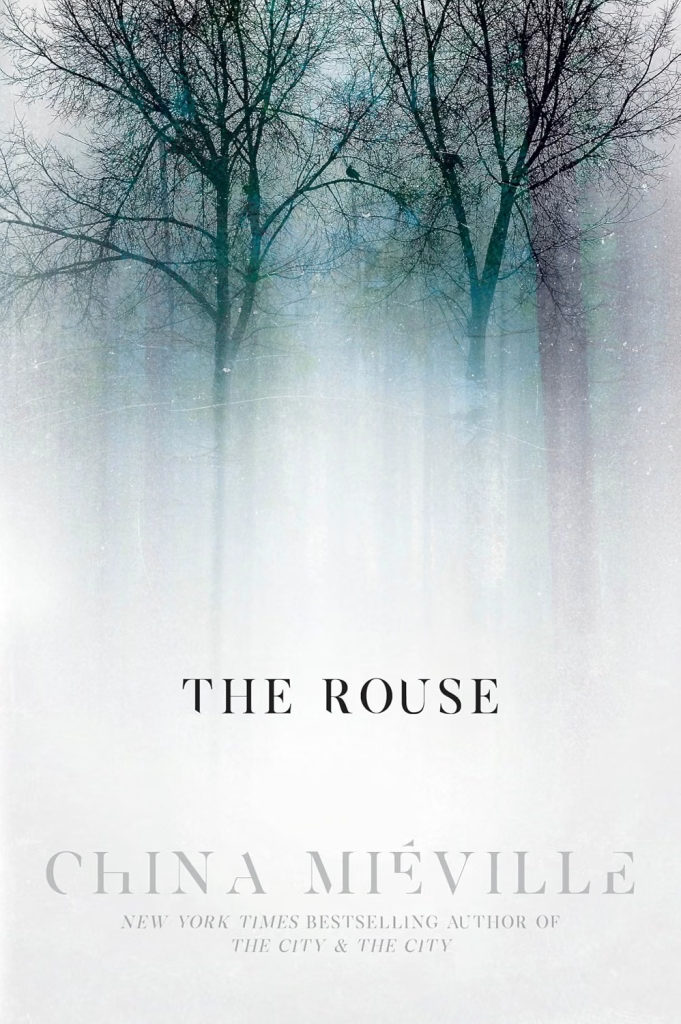
I got a new R.F. Kuang book today, along with the second installment of He Who Fights with Monsters, and the middle of those three September 15 arrivals is China Miéville’s new doorstop, which is one thousand two hundred pages. And I’m probably going to order the special edition of Tad Williams’ The Dragonbone Chair, out September 29, (and 672 pages) because it gives me an excuse to read that series for the first time and the new hardbacks are stunning. However, I need to make sure the other books in the series are getting the same treatment, because God forbid they don’t match.
In other words, now that my lesson planning is finished, I’m going back to my chair, because Warlords of Wyrdwood isn’t gonna finish itself and I need to get to the Kuang book soon. There is Discourse that I’m missing, damn it!
I had a plan for tonight’s post, but after a conversation with my son I’ve decided to refine it further and write it another day. Unfortunately, that leaves me with not a lot other than bitching about how insanely fucking hot it is outside and various other forms of electronic begging for death.
Anyway, now that I’ve failed at that, time to go finish the last Robert Jordan book I ever have to read.
I actually only had one five-star read in August, which was Tana French’s The Keeper, Book of the Month by default, although Daggermouth has grown in my estimation since I read it.
These four Tana French books are a completed trilogy and a standalone novel, and you will never guess which one is the standalone novel, and I want to have a quick sit-down with whatever filthy jackanapes were involved in making cover decisions over at Viking.