#REVIEW: Chants of Sennaar (PS5)

This game made me, for the first time in quite a while, want to turn my YouTube channel back on.

I’m still not quite done with Khazan, thus the lack of a review yet. I’ve beaten it, and I want to get through New Game+ before I put it away, but I wanted a palate cleanser, something that wasn’t combat-focused and that didn’t brag about being difficult. Something chill, for lack of a better word.

How about a puzzle game about translation? How much more directly up my God damn alley could a puzzle game about linguistics possibly be? It’s unimaginable.

Here’s the premise of Chants of Sennaar: you’re the … person, of indeterminate gender and no name, in the faceless hood up there. You’re exploring what is effectively the Tower of Babel, which is occupied by five different groups of people, each of whom speak a different language. Your job is to 1) get to the top of the tower, 2) learn everybody’s languages on the way up there, and 3) get everybody to talk to each other. There’s a bit more of a story to it than that, but it’s a little on the obscure side, and gets downright weird towards the end of the game. That’s good enough as a gist.

Each language has 42 glyphs associated with it, and follows different rules as far as subject-verb order, plural marking, and other things like that. Sometimes the meaning of a glyph can be intuited by what it looks like, and one language lays glyphs on top of one another in a really neat way that, once you figure out what’s going on, lets you create glyphs correctly that you’ve never seen. Your avatar keeps pretty good notes, and glyphs are marked in your journal as you discover them while you explore. You can add your own notes to any glyph, and if you think you know what something means but haven’t proven it yet, your assumed translation will show up in a different font when you’re trying to read something, so that you can see what you’re still guessing at versus what you’ve definitely successfully translated.

(What will happen is every so often your notebook will have a page that will have three to five pictures on it, and if you match glyphs successfully to the pictures, it’ll confirm the meaning and translate that glyph automatically from then on. This will happen even if your guess at the meaning was wildly wrong. It does mean that it’s possible to brute-force your way through some translations, and there were definitely times where I was certain I knew three of the four glyphs and wasn’t sure about the remaining one, and just worked through my unknown glyphs until I got the right one.)

You will also occasionally find Rosetta Stone-style texts that will have the same thing written in more than one language, which can help you figure out new glyphs if you’ve already completed one of the two languages. This is where different word orders and different pluralization rules can really mess with your head, though, and there are two languages that use markers to make an entire sentence negative, which can also be fun. I loved this shit, y’all.

There are some non-language-related puzzles here and there, but they’re rare and generally not hugely challenging and the occasional very light stealth section; they weren’t difficult (and not very punitive when you screwed up) but I found myself kind of resenting them after a while just because they kept me from the stuff I was interested in. You’ll eventually unlock teleporters between the different levels, and you’ll be able to translate entire conversations between different groups that will cause the residents to start cooperating with each other and sometimes change things about some of the areas. These were my favorite parts, honestly.

Graphics and audio do their job; my wife commented at one point that she found the sound of my character walking around to be really satisfying, for whatever that might be worth, and the different areas are really visually distinct from one another, from a forbidding fortress area to a science lab to mines to a really futuristic area toward the very top of the tower. This took me nine hours to play through for $15, and I got a Platinum trophy out of it. I did have to consult a guide once, where I couldn’t figure out how to move forward and it turned out that I’d been meant to pick up an object that I didn’t realize I could interact with. That was it, so it really hit that sweet spot where some careful thinking could always get me past whatever obstacle had been thrown in my way.

This isn’t for everyone, I realize, but for me at least it was a hell of a game, and at just $15 you should definitely grab it if puzzlers are your thing.

On Stephen Mitchell’s GILGAMESH: A NEW ENGLISH TRANSLATION

This is very much not a book review. Don’t get me wrong, I’m still gonna tag it under “Reviews,” but the Epic of Gilgamesh is four thousand years old and the notion of putting a star rating on it is kind of ludicrous. Now, Stephen Mitchell’s new translation includes a decently long introduction and 80 or so pages of translation notes, so I could “review” that, but I did not pick this up to read his notes or his introduction; I picked it up because I realized I didn’t have a decent translation of the epic in the house anywhere and I got a wild hair up my ass about it.

Now, that said: Mitchell’s translation– well, his adaptation, and I’ll get to the distinction in a bit– is in fact a lovely read, and it combines being compulsively readable in English with a fine poetic feel that makes reading it out loud flow beautifully. I’m not an expert here by any means– I considered shifting my Master’s degree away from Hebrew Bible and more toward Babylonian studies in grad school before deciding to abandon the entire affair, but that’s as close as I get.

The problem is neither is Stephen Mitchell, who openly admits that he “doesn’t read cuneiform and has no knowledge of Akkadian.” Which makes the decision to publish a new translation, or adaptation, or version, which is his word … interesting? He basically sat down with a bunch of English versions (of, remember, fragmentary texts in one of the oldest languages that humanity can still understand) and some scholarly treatments of the work and pulled together his text from that, first doing a prose pass and then converting it to English verse.

(There’s a whole post or maybe a series of them in here about how one translates poetry from one language to another; needless to say it’s hellaciously complicated and requires a lot of expertise in both of the languages involved and in writing poetry. I could never.)

Fun fact: the Epic of Gilgamesh contains the oldest reference to blowjobs I’m aware of. From Book VI:

Sweet Ishullanu, let me suck your rod,
touch my vagina, caress my jewel.

Except! In the translation notes at the end, Mitchell states that the literal translation is “eat your vigor,” which … okay, that sounds like a blowjob too, but since he doesn’t know any Akkadian it’s hard to say how reasonable that leap is, right? An actual scholar of the language and the culture might be able to provide some details there that led to that specific choice of words; for Mitchell it’s basically just vibes. This bothers the nearly-dead Bible scholar in me; it may not be especially relevant to other people.

There’s a bit where Enkidu tears the “thigh” off of a bull and throws it at Ishtar, and she takes it and puts it on an altar and makes it a centerpiece, and I’m thinking that maybe it wasn’t the thigh he actually tore off? Would love to see what a scholar had to say about that. But that’s not this version!

Anyway. I enjoyed reading this even if I had some issues with it, and maybe I’ll take a deep breath and find something more academic about the work and maybe a more traditional translation to compare the two. Or maybe not! It’s not like I don’t have a shitton of other stuff (including, remember, a whole other book called Gilgamesh) to read.

Just shoot me, ctd.

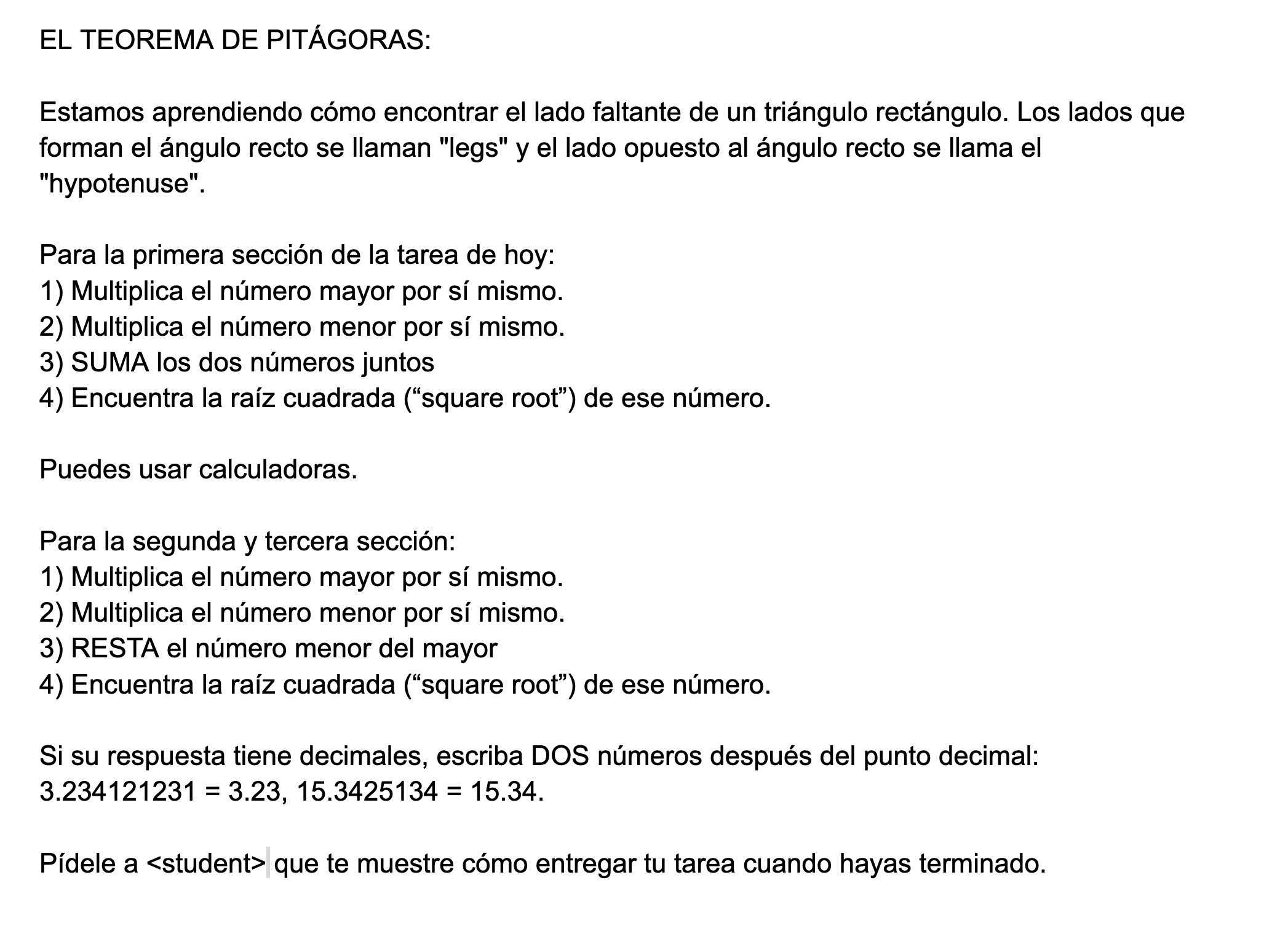
I did something today that I’ve never done in twenty years of teaching– I would estimate, without a shred of exaggeration, that 2/3 of the teaching I did during my fourth hour was in Spanish. It was time to sit down with my newcomers and see where they were at, and the only way to do that was to communicate with them in their own language. To wit, I generated this for them:

And then I banished about half of the class from the room, sending them with my co-teacher to her classroom, mostly to cut down on the number of other kids who might want to talk to me and also to prevent a certain student from getting Valentine’s Day-related harassment, and sat down with the kids and went through a bunch of problems with them. I’m hoping that document is translated well from what I typed; based on my meager Spanish it looked okay, and the kids didn’t have questions. The boy read through it, smiled at me, and proceeded to get nearly a perfect score on his assignment with only a small number of questions, all of which, I’m proud to say, I understood; the girls are a little bit behind for 8th grade but not enough that I’m terribly concerned about it. I have English-speaking kids who, based on this one assignment, have bigger problems than they do. One of them does seem to rely kind of heavily on the other, who did most of the talking and also appeared to do the lion’s share of the work, but we’ll see how that shakes out in a couple of weeks.

You may notice, even if you don’t read Spanish, that the actual Pythagorean Theorem doesn’t appear anywhere in that document. That’s entirely intentional; I generally deemphasize the formula itself in favor of the process of figuring out a missing leg or a missing hypotenuse. They know the formula, but I treat this as mostly calculator work, and I drill the phrases “square-square-add-square root” and “square-square-subtract-square root” into their heads until they’re repeating them in their sleep. Since I didn’t have any real idea where these kids might have been in terms of their math skills I decided I’d leave it out entirely for now.

We are taking it easy tomorrow, across the board. I kinda feel like I’ve worked the kids (all of them, not just the new ones) like dogs this week, and between talking a lot more than usual and the added stress of teaching in a foreign language today, I’m ready for a day where I can wave them vaguely in the direction of a Quizizz or something else that has a chance of being fun rather than being at the board or hunched over someone’s shoulders all day. They’re picking this up pretty well so far so I think if I have a calm Thursday before a four-day weekend God will forgive me.

On translations

Let’s put a quick trigger warning for sexual assault here; it’s an unavoidable plot point of a book I’ll be discussing several paragraphs into the piece, and it won’t be dwelled upon.


I’m on my third book in a row that I’m reading in translation, and my fourth in a row that wasn’t written in especially modern English, since the Ernest Shackleton book was published in 1909. I haven’t loved any of the three that I’ve finished, but I’m not far enough into the fourth one to really have an opinion of it yet– maybe 40 pages deep on a 600-page novel. And the bit that I’m having trouble wrapping my head around is that I’m not sure how to discern between a book that I didn’t enjoy and a translation I didn’t enjoy. I can think of one particular series where the first book was translated by one person was great and the second was translated by someone else and it was so bad that I couldn’t get even a third of the way through it; that I can blame on the translator. But when it’s the only book I’ve read by a given person, or sometimes the only book by that person available in English, it’s a lot harder to tease that apart and it may actually not be a difference worth bothering to tease apart in the first place.

It’s the most recent book that’s really got me thinking about this, honestly– and if you’re wondering why I’m not specifically naming the book, it’s because this is pretty clearly running into my Don’t Shit on Books Without a Good Reason rule, and my Goodreads is right there anyway– because this book was very clearly deliberately written in a certain way, and I’m not sure it survived translation into English very well.

(Let me reiterate the trigger warning)

The book is about a woman whose father sexually abused her for several years when she was a child, and she is, as a result, estranged from her family, most of whom don’t believe her. She is very much not over her trauma, and in fact dwells upon it more or less constantly. The book is told entirely from her perspective, and, well, she’s not in an especially mentally healthy place; the entire book is about disputes over inheritance, and her father passes away partway through the narrative. Now, I think what’s going on here is that the author is trying to mimic in text what is going on in this person’s head, and as a result the entire text is very very repetitive, constantly circling back to the same events and the same conversations, and also with insanely long sentences that can sometimes take up a page or more. The text is never pauses for breath, never slows down, and constantly loops back to retread the same material, sometimes phrased differently and sometimes repeating the exact same language several times in a (paragraph-length) sentence.

I made fun of this on Twitter while I was reading it, and the fact is this isn’t that far off from what’s going on:

So, like, I can see what the author is trying to do here, and I even appreciate the technique, but the unfortunate result is that, in English and to me at least, the book is really damn difficult to read. Imagine a book where every sentence was like that Tweet, and each sentence in the book was similar to the Tweet in a way that was very like the Tweet, and not like things that are not like that Tweet, that’s what you’re trying to imagine right now, you’re imagining a book where every sentence is like that Tweet, because the sentences in this book are all like that Tweet and you’re imagining them.

I am not kidding. Like, I’ll post examples if I have to.

And the thing is, I didn’t dislike the book, I just didn’t enjoy it at all, if that’s something that makes any sense. I mean, I finished it instead of putting it down, and I don’t think I regret buying and reading it, and it made a big splash in its country of origin when it came out so it even remains a good choice that way. But I wish I could read it in its original language to see behind the scenes, so to speak, on how the translator did her job, because this book must have been a nightmare to translate.

I need to be able to read all of Earth’s languages, is what I’m getting at here. Is that the Moderna shot, maybe?

In which I read The Witcher

… or, rather, I read the first two hundred pages of Blood and Elves, which I’ve come to discover is technically the third Witcher book, after two books of short stories, but is branded as the first book because it’s the first novel.

And it’s terrible. Absolutely unforgivably terrible. I went and looked at other bad reviews of it on Goodreads, and many of them seem to feel like the first two books (the short stories) were pretty good and then this one shit the bed, but that sentence with all the arrows pointed at it up there is where I decided I really was going to put this down, and then I read a few more pages anyway, and it’s just a Goddamned awful book. I’m going to lay a bit of the blame on the translator– I am willing to wager a small sum that the words she translated as “bite your own backside in fury” are a Polish proverb expressing angry frustration, but if that’s the case it should never have been translated literally. As a guy with a couple of degrees in Biblical studies I take translation pretty seriously, and there is no good reason to ever translate a proverb literally when you’re translating for a different culture. But it wasn’t the translator who wrote the endless conversations where characters explain things to each other that they already know, or the utter disgrace to women everywhere that is Triss Merigold’s character, or who decided to write two hundred pages about a guy called a Witcher where he does no Witching of any kind.

Seriously, the dude’s supposed to be a monster hunter. There is none of that in this book, or at least not in the first half. It’s dreadfully boring. And I was dumb enough to jump straight to the box set of the first three novels, so I not only have this thing sitting on my shelf now but two other books that I have no intention of reading. Bah.


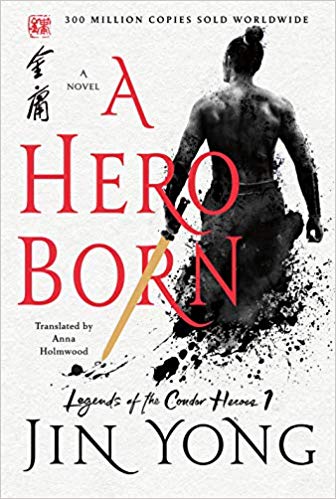
And so long as we’re talking about works read in translation, the book before dipping into the world of the Witcher was Jin Yong’s A Hero Born, which is the first book of a massively successful series in China that has only recently been translated into English. This is one of those books that I ordered because I got flooded with people talking about it in a short period of time, and the phrase “Chinese Lord of the Rings” kept coming up.

I don’t know what the Chinese Lord of the Rings might be, but it is not Legends of the Condor Heroes. To be honest, having read it, I cannot for the life of me imagine what the hell possessed anyone to compare those two books to each other, other than the knowledge that it would get my specific subtype of nerd to order a copy. They were both initially published in the fifties. That’s all I’ve got. What A Hero Born is is a perfectly serviceable wuxia novel, or in other words a book set in ancient China that is all about powerful martial artists going around and doing things.

What things are they doing? Hard to say, because rather than describe the action most of the time Jin Yong just names the move and either expects you to know what that is (which I can’t believe is actually the case, but I suppose might be) or expects you to fill in the details yourself. In other words, you might have one character attack another with a Rooster Masturbates the Moose move and have that move be countered with an Insipid Charlatan, but the variant from the Batman Eats a Blueberry Crepe school of kung fu, not the normal one.

What’s that mean? Hell if I know. And clearly this works in China, and I didn’t hate the book by any means, but it was sort of a slog.

So, yeah. So far, not regretting writing my Best Books of the Year post with a couple of days left in the year.

On actual helpful ed tech

I am tired– okay, that’s always true, but it’s basically bedtime and I just wanted to take a moment for this– and so this will be a brief piece, but: my lesson for my 8th graders today involved something that I don’t do a lot in my classes: note-taking. I defined and provided a bunch of examples of rational numbers and irrational numbers, mostly me talking and writing on the board and the kids being surprisingly dutiful about writing it all down.

I have a student in one of my classes who speaks basically no English at all. She is– there is some debate about this, and every time I remember to just cut to the chase and ask her about it, she’s not in the room– either from Mexico or Guatemala, or possibly Guatemala via Mexico, I’m not sure, and she only speaks Spanish.

She uses Google Translate to get by in my classroom. I’ve got her paired with another kid who speaks a moderate amount of Spanish and they have their Chromebooks out at all times and the one kid will translate anything important I say into Spanish for her. Unfortunately, this wasn’t working very well today, since I was writing quite a bit and the other girl had to take her own notes as we were going.

She came up to me and told me (in English, which I was impressed by) that she didn’t understand what I’d said after the lecture, and the amazing thing is that between my own limited-but-not-nonexistent Spanish abilities and the translation software I was able to translate all of the notes for her in maybe an extra five or six minutes. At which point she happily– and, I noted, accurately– did her assignment.

I am very old-school in my teaching despite having spent last year literally working as an ed tech advocate. It’s nice when something works like it’s supposed to and actually makes my job easier.

In which I hope this is funny

ku-mediumI don’t know how to write this post.  I’ve been working on it in my head for over a week now, and in none of the versions in my head have I hit the tone I like, but this story is either funny enough or weird enough to deserve telling– I just don’t know how to do it right.

Also, here’s a phrase I’ve never used on the blog before, but this is important:  Consider this your trigger warning, if you’re partial to such things.  This will end well, but it will not start well.

I was out of the office for a good chunk of last Tuesday.  When I got back the guy who had been acting as our principal designee (because the principal and AP were both also out of the office) said that there had been a really weird spike in sexual harassment issues during the time we’d been gone.  These things happen in middle school, but they’re not super common, so for multiple things to happen in the same day is odd.  I’m not around for the explanation or the ensuing phone calls; I just know Stuff has Happened.

The next day, I walk into a parent conference with the designee and the assistant principal because I need to talk to my boss for a few minutes, and end up sitting down and being part of the meeting.  Mom is the parent of a fifth grade boy, and he appears to be in grave trouble.  She is expressing two emotions: the first is horror and the second is an almost craven sense of apologeticness, if that’s a word.  She’s so sorry for what he did that it almost hurts me to listen to the conversation.

She keeps saying that when he used “the word” or “that word” that he didn’t really mean what the word actually meant, that they are immigrants and “that word” is used differently in their country.  She looks Hispanic, and so does the boy, and he has a unique first name that really doesn’t scan to any particular ethnic group or nationality that I’m aware of, so I assume “their country” is somewhere in South America.  Then I hear her speak to her son in whatever language they speak at home and it’s clearly not Spanish, but she doesn’t talk long enough for me to get past hey wait that isn’t Spanish and start listening for whatever the language actually is.  The general mood in the room is solemn; I consider leaving but she begins addressing her remarks to me as well as the other two as if I belong there so I don’t.

Eventually, she leaves, insisting that not only will she tell her son to stop using “the word” but that she will stop using “the word” herself, because she knows that the reason this happened is that she’s been setting a terrible example for their son and that she realizes that this is not how things are done in America.

One guess on what I think the word is, right?  There’s only one word in the English language– well, two, maybe— with enough power that someone would refuse to even say it while talking about it.  So he’s called someone the N-word, right?  But that’s not sexual harassment.  It’s a lot of things but it’s not sexual harassment.  So… huh?  Weirdly, though, there’s talk about how she’s pretty sure her son likes the girl he used “the word” around, and… huh.

They leave.  The AP and the other guy exchange a look, both take a deep breath, and then crack up laughing.

“What the hell happened?” I ask.  “What was the deal?”

“He threatened to rape a fifth grade girl,” the AP says, practically wiping tears from her eyes.  The boy, remember, was also a fifth grader.

My eyes widen.  What the fuck are you assholes laughing about?  This is, as you might imagine, a big deal.   I’ve literally never had to deal with a rape threat in a school before.  That’s major.

I express that sentiment.  They laugh harder.

“They’re German,” the AP says, as if that explains it.  I give her a yeah, so the hell what? sort of gesture.

Apparently there is, and if you are German or speak German better than I do please feel free to enlighten me here, some sort of German proverb, or slang expression, or figure of speech, or something, that basically means “stop bugging me” or “leave me alone,” meaning mild, possibly even affectionate harassment– that, when translated into English, comes out as rape.

This woman has been using this phrase, translated, around her son, for years.  She has apparently, and at this point my AP does a picture-perfect impression of this lady, one that causes me to lose it and crack up out of sheer disbelief, on multiple occasions said the phrase “I’m busy, go rape your father” to her son.

Her son, in saying “I’m going to rape you,” to a little girl in his class, meant “I’m gonna get on your nerves.”

And, understandably, this has caused all sorts of merry hell to break loose.  Apparently Mom is fully aware of the word’s connotations in English– how could she not be?– but hasn’t managed to purge the word from her vocabulary, to the point where American friends of hers have actually called her out on it and asked her to stop using it.  You can imagine how this would go, right?  You don’t just drop a loaded term like rape into a conversation without causing a little bit of a hitch here and there.  And, god, if she’s seriously said “Go rape your father” to her son while on the phone with someone else?  What the fuck I don’t even.

This all sounded deeply weird to me, of course, even a little unbelievable, until it hit me that I use the phrases “Are you fucking with me?” and “Are you shitting me?” on a fairly regular basis, and in very much the same way those phrases would be hugely opaque to anyone with no understanding of colloquial English.  This is, presumably, more or less the same phenomenon, only through another filter where it’s been translated.

So… yeah.  I have no idea if anyone reading this is laughing right now, or if you just think that’s an insanely weird conversation to have to have.  I hope you at least understand why I felt like I had to post it.  🙂