
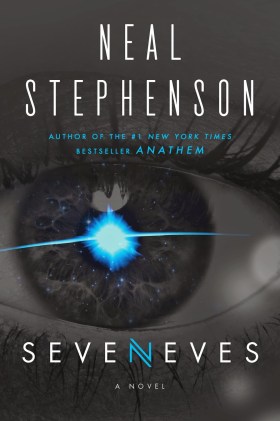
#Review: SEVENEVES, by Neal Stephenson

seveneves-usHere is the first sentence of Neal Stephenson’s enormous, 880-page novel Seveneves:

The moon blew up without warning and for no apparent reason.

That, my friends, is a brilliant goddamn first sentence.  Brilliant.  I made a terrible mistake several years ago and let the Baroque Cycle be the first Neal Stephenson books I ever tried to read.  That meant I didn’t touch him for years until finally picking up Snow Crash just for the hell of it, and he’s rapidly becoming one of my favorite writers, to the point where I might re-attempt the Baroque Cycle books if I’m ever feeling crazy.

I’ve already written one post where I talk about the premise of this book, but since y’all don’t necessarily read every single thing I post let me recap:

The moon blows up.  That’s kind of a problem.  Humanity has to, on a real tight schedule, move enough people into permanent life in orbit (starting on the International Space Station, but rapidly adding on significantly) before the wrecked bits of the moon scour all life off of the planet in an event called the Hard Rain.

For 500 pages, it’s basically The Martian, except instead of one guy on Mars it’s what’s left of the entire human race on a space station.  The tone is very similar, though; lots of technical detail, lots of trying to be as realistic as possible given the circumstances, lots of holy shit this is gonna kill everybody if we don’t figure it out.  By the end of the first 500 pages, rather a lot has gone wrong and we are down to eight surviving humans, all women– one past childbearing age and seven others, the titular “Seven Eves” of the book.  One of them happens to be a geneticist, so it turns out that rebuilding the human race from seven women isn’t quite the difficulty one would expect it to be.

After those 500 pages the words “Five Thousand Years Later” appear, on a page by themselves.  And then there are over three hundred more pages.

Stop reading.

Close the book and put it on a shelf.  It was a great book.  Don’t read a single other word, because the epilogue, or whatever the hell I’ll call it– hell, it’s 300+ pages long, it’s an entire novel all by itself– and it is terrible.

It took me two weeks to read the first eight hundred pages of this book, and with thirty pages left this afternoon I closed it and put it away, because the epilogue was that ridiculous and nonsensical and just plain bad.  Literally pages and pages of unnecessary description and backstory and nonsense in between individual lines of dialogue from time to time.  A book that has been careful to establish scientific and cultural plausibility for its entire running length suddenly stops making any sense at all.  It’s not just bad, it’s hacky, and it’s stunning that Neal Stephenson wrote it, much less that he felt it was a worthy add-on to the rest of the book.

I four-starred it on Goodreads, and the first 500 pages are good enough that you should buy the book anyway.  Hell, the first 500 pages would be on my shortlist for the best books of 2015, easily, if it weren’t for the albatross at the end.  Don’t get me wrong: I recommend you read this.  But that’s because I figure once you’ve read 500+ pages you’ve already gotten your money’s worth.  Just don’t touch anything past then, because I’ve never seen a novel go off the rails this badly.

In which SHUT UP BRAIN I DO NOT WANT YOUR THINKS

seveneves-usSo I accidentally blew a hole in the plot of the book I’m reading last night, and I’m really annoyed with myself so I thought I’d complain about it on the Internet.

Let’s start with something else, though. Have you ever seen The Firm?  The John Grisham book that got turned into a Tom Cruise movie?  I’ve both seen the movie and read the book, and I’m pretty sure I read the book before the movie came out, although that was in 1993 and I haven’t revisited either since so my memory is gonna be a little bit fuzzy.

Anyway, if you haven’t seen it, here’s the deal: Tom Cruise is a young lawyer who gets hired out of law school to work for an insanely prestigious, high-paying law firm, only he discovers quickly that the reason the law firm is so high-paying is because they are POWERED! BY! EVIL!

Tom Cruise doesn’t wanna be evil.  But, oh no!  The evil people are, I dunno, threatening his friends and family if he doesn’t partake in the evil, or maybe he just doesn’t wanna give up the paycheck or something– like I said, it was 22 years ago and I don’t really remember the details all that well.  The main plot tangle of the movie is how Tom Cruise will retain his heroic Tom Cruiseness in the face of lawyerly evil.

(This was before Tom Cruise was widely recognized as a crazy religious nut, obviously.)

And the answer is: fail the bar exam.  Which he hasn’t taken as the movie starts, and which he still hasn’t taken after he discovers all the Evil. They can’t make you do evil lawyerly stuff if you aren’t a lawyer, Tom!  Fail the fuckin’ bar!

Now, note: this is a plot hole, but it’s easily dealt with by inserting a single line of dialogue somewhere where the bad guys are all like “We know you’re gonna pass the bar, RIGHT?” in vaguely threatening terms, just enough that he realizes that that’s not gonna quite cut them off.  But it never even came up, at least in the movie, and it annoyed me that someone as smart as Tom Cruise never thought of this perfectly obvious way out of his jam.

Which brings me to Neal Stephenson’s Seveneves, which I’m reading (and, notably, enjoying the hell out of) right now.  Note that I’m not yet at page 200 in a book that I think clocks in over 800 pages, so what we’re discussing here is less spoilers than the basic setup of the book.  But if you really don’t want to know what happens in the first quarter of the book, I guess you should stop reading now.

The moon blows up in literally the first sentence of the book.  It’s the greatest opening sentence I’ve read in years.  Now, if you’ve been reading me for a while, you know we’re fucked already, and you might be wondering how the book gets past the first paragraph.  The answer is that the moon breaks up in an odd (and possibly important to the later plot) way: it breaks into seven large chunks, rather than uncountable small pieces, and those pieces remain in roughly the same place, and continue orbiting the earth and chaotically spinning around each other.

It is quickly realized, though, that eventually those moon chunks are gonna start bashing into each other, and that sooner or later– in just a couple of years, actually– Earth will be subject to what they’re calling the Hard Rain, in which all those now itty-bitty chunks of Moon start falling into the atmosphere and onto the planet and basically scour the Earth of all life.

That’s bad.

So right now what everyone’s doing is scrambling to get some small remnant of humanity off of Earth and into a sustainable space station before everyone else dies, and there’s been (again, I’m less than 1/4 in) a lot of engineering talk and politicking and generally the kind of thing that makes me love a book and this one is no exception.

It hit me last night that 1) the ISS at this point in the future has a captured asteroid attached to it, and 2) I just got to the point in the book where a small group of characters is dispatched to go grab a comet because they need water ice.  Which means that the technology to do these things already exists.

Which means that we shouldn’t be trying to get half of a percent of humanity into outer space so that someone survives when the Hard Rain hits.  What we should be doing is strapping ion engines to those big chunks of the moon, or at least the biggest ones, and pushing them out of orbit.  And, as far as I can tell, this option has not even been discussed.  Would it be complicated?  Sure!   But it wouldn’t be a book if the solution wasn’t complicated– the pieces are orbiting each other and spinning and the orbital dynamics to push them into a higher orbit much less out of Earth’s gravity would be complicated as hell, but so is the sustainable habitation in outer space problem, and this one saves all of humanity instead of literally leaving over 99% of us to die horribly.  And, honestly, may well be cheaper.

And, at least at the point where I’m at, it’s not even been discussed.  And it’s an obvious enough solution that it should have at least come up at the drawing board stage to be dismissed because Reasons.  And I really like this book, dammit, and I have to potentially spend 600 more pages pretending I didn’t come up with a better way to solve their problem than what the supposedly really smart characters came up with.  (For that matter, I’m completely certain that Neal Stephenson is smarter than me, too, so I keep trying to figure out what I’ve missed that makes my idea wrong.)

Sigh.

I hate it when that happens.