
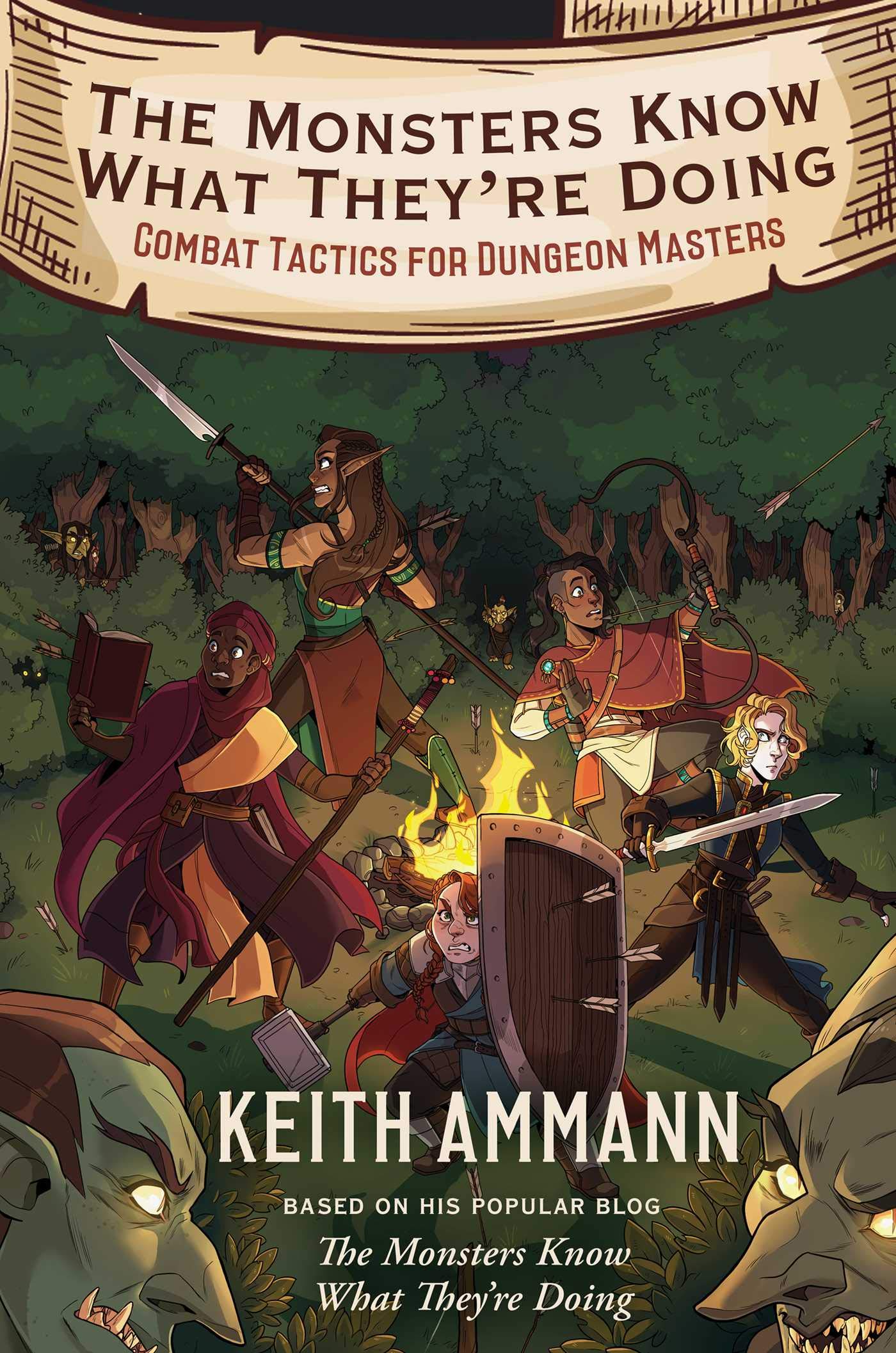
This is a new one: I’ve started reviews before by pointing out that I know the author, but in this case, I really know the author, as in “he knows my real name, was in my ed school grad program, and he’s been to my apartment.” Keith and I essentially had the exact same day-to-day schedule for two solid years, and while we’ve fallen out of touch other than occasional social media interactions since graduating in 2005, it’s simply not possible for me to leave my relationship with him aside while talking about this book. The Monsters Know is, in a lot of ways, possibly the Keith Ammanniest thing Keith Ammann could possibly have written, and while that’s a compliment, it’s very likely not one that’s going to be salient to anyone other than me.
Here’s the tl;dr: If you play Dungeons & Dragons, and especially if you’re a DM, you’re highly likely to really enjoy this book. If you do any sort of fantasy roleplaying that isn’t exactly D&D but is D&D adjacent, it’s probably going to be useful anyway. The book– five hundred-plus pages– is filled with essays on what feels like the entire Monster Manual (it probably isn’t, but still) breaking down various fantasy monsters based on their provided stat blocks, and providing suggestions on how they might act, what tactics they might use, and how they might react to any number of possible actions by your player characters.
There is also math. I’ll get to that in a bit.
Now, to be clear, I did not read this entire book. Why? Because it’s more of a sourcebook than something you sit down and read straight through, and if I have a criticism of it it’s not of the writing or the subject matter but the physical format of the book, which looks like a novel or, like, a “regular” book, when I really feel like it ought to be formatted more like a roleplaying sourcebook of some sort. I probably read … half of the entire thing, skipping around to different monsters I was interested in and occasionally occasionally passing over sections that were a little more power gamey than I’m interested in. Ordinarily I wouldn’t review something if I hadn’t read all of it, unless it was an actual DNF, but again: that’s not what this book is. The section on the kuo-toa will be there whenever you actually decide to include kuo-toa in your game; you don’t really need to read every word of that to appreciate what the book is doing. I am fairly certain that if I told Keith, word for word, “I liked your book but I didn’t read all of it,” he would not be a bit surprised, nor should he be.
Let’s be a touch more specific, though: based on, for example, the description of a species as being high Dexterity but low Strength and medium Intelligence, and the different combat abilities that a species or monster might have, The Monsters Know might suggest that this species prefers to attack from ambush, using sniping tactics and a high likelihood of retreat once injured. From there the section might move more specifically into D&D language, suggesting that Dash and Disengage actions might be used frequently in combat, and sometimes it’ll go so far as to map out a model encounter of sorts. A lot of the time it’ll then get into the actual mathematics behind various attacks, spells, etc, using those numbers to suggest which abilities a monster might prefer to use and which would provide a bit more utility and a higher reward to risk ratio. A lot of the time it’ll suggest a hit point threshold at which point a monster might retreat, too. I haven’t DMed much at all, really, but this was still fascinating to read and to think about, and I may suggest my son look through it, as he’s starting his first homebrew campaign soon. The book loses me a bit when it gets super granular about the numbers behind the abilities, but that’s the beauty of a sourcebook; you can ignore the stuff you aren’t as interested in. I was never a power gamer, and was always more interested in the abilities that felt fun or cool than whatever might be strictly the most effective move at any given time, so that stuff isn’t for me as much.
So yeah. My buddy wrote a book. If you’re into the same kind of nerdery we are, you should definitely check it out, and you can also go to Keith’s blog (the source of a lot of this material) at themonstersknow.com. If you’re in, he’s on his … fourth or fifth book by now, I think, so there’s a lot more where this came from.



 Welcome to infinitefreetime dot com