This was on my board on Friday, which was the last catch-up day until the final. I passed out progress reports at the beginning of class and went to my desk.
Spent the day running around town– as a family, no less– and getting stuff done and possibly spending some money unnecessarily. Then I came home and built a Lego set. I’m going to play video games for an hour now and then do some reading, so this is pretty much the perfect Saturday. We drove past a protest downtown, too, and the boy’s reaction to it makes me think I should probably take him to one sometime soon.
(I am … ambivalent, at best, about the utility of public protests, especially in 2025. That doesn’t mean that I look down at people for participating in them; I definitely don’t, but I don’t know that I find it a useful way to spend my time. There may be a post in there somewhere; I should probably interrogate the idea more.)
Anyway. What are you doing with yourself this weekend? I would like to officially plan as much of the next three weeks as humanly possible tomorrow, so spending the whole day at my desk is definitely possible.
I was able to successfully get myself up out of bed and showered before 8:30 this morning. I had a cup of coffee and screwed around on my phone for a while, then spent an honest to goodness solid hour studying, and managed to successfully regain at least some of my knowledge of trigonometry in the process. I think what I’m going to do this week is spend the next couple of days filling obvious holes in my knowledge (“obvious” meaning “I remember knowing this, and now I don’t,” as opposed to, say, calculus, which is an entire domain of knowledge that I never really had a grasp of) and then take a practice test on Thursday. (Why Thursday? It’ll take a while, and Friday’s going to be busy. I’ll have time to study but not for an entire practice test.) If I do okay on the practice test, I may go ahead and take a shot at the real test next week and see if I can just knock it out. I only need like a 60% to pass, I think? If I do crap on it, I’ll stick with the original plan and study through June or until I can pass a practice test solidly. I don’t want to have to pay for this thing more than twice, and ideally, only once. I’ve also literally never failed a standardized test so I have some pride on the line here too.
In other news, school is out, and I’m finding that I don’t have a lot to say about that. This was a pretty good year, all told; it had its moments, like they all do, but my honors class was awesome enough to carry through the rest of the year and even my most annoying kids continue to pale in comparison with what I’ve had to deal with at previous schools. That said, I think I’m due for another round of reevaluating classroom procedures; everything I’m doing right now is still very COVID-informed and I’m seeing signs that certain policies may be starting to bite me in the ass a bit. I didn’t really try to reinvent the wheel when I changed districts, but I’m comfortable enough in the new place now that I think I can tweak some things. We’ll see.
I’ll end on a question: certain sectors of American society have been claiming that attempting to impose any sort of penalties or punishments for the obvious criminality of certain individuals was going to cause widespread civil unrest. Locally, I am aware of one (1) house that is now flying a very small (comically so, in fact) American flag outside their house, upside down. Is anyone reading this aware of any civil disobedience or protests literally anywhere other than the tiny little group that’s been outside the courthouse in New York since the trial started? Any downtowns flooded with fash lately? Trucker rebellions? Anything at all?
You might remember a few years ago that I did a project called Read Around the World, where I read one book from every US state and from as many countries as I could manage in a year. The final-final-final update never got published, and has a few more countries on it than the “final” 2021 update did, but I never managed to read anything from Israel during that time. I can remember thinking about what to do if I read something from a Palestinian author during the project– would I count that as Israel? Should Gaza and the West Bank count as their own place, and leave, for lack of a better word, Israel Israel untouched? Well, I never had to decide, because I wasn’t about to try rereading the biography of David ben-Gurion I bought when I was in Israel on a dig after college, and nothing else ended up dropping into my lap.
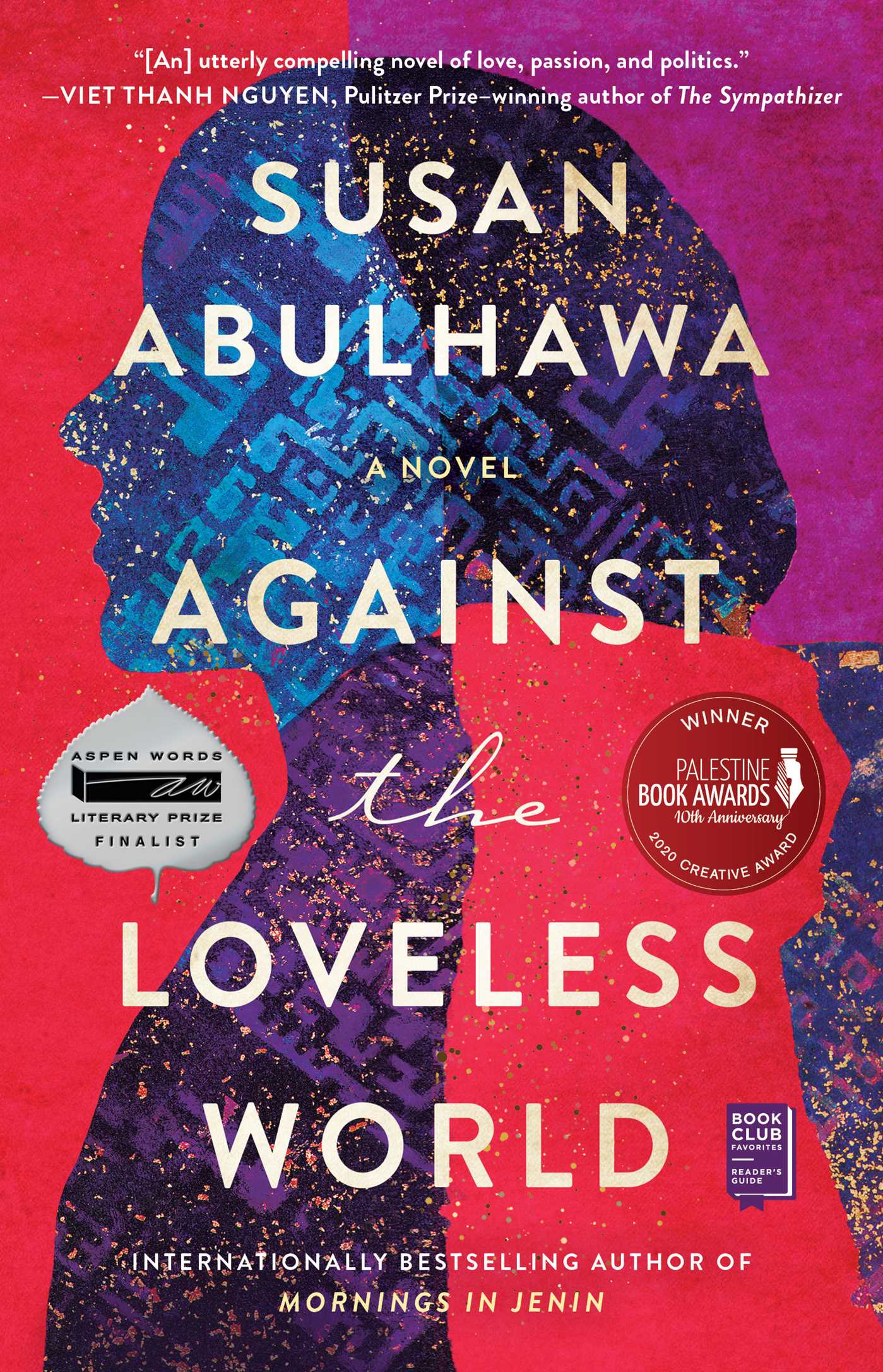
I haven’t really worried about geographical diversity too much since 2021. Or, at least, I didn’t until October 7 happened, and I decided to make a stronger effort to find some books by Palestinian authors to read. I don’t think I talked much, if at all, about Rashid Khalidi’s The Hundred Years’ War on Palestine, which I read in … December? I think? But Susan Abulhawa’s Against the Loveless World has been sitting on my shelf for way too long, and since I wanted something different after three straight Red Rising books, I decided it was time to dig into it.
So, I just wrote a post where I told you to read Red Rising because it was good. I still stand by that post, obviously. But you need to read Against the Loveless World because it is important, which is not quite the same thing. Don’t misunderstand me– it is also good; I would not have, for the second day in a row, read an entire book in less than 24 hours if it was not a good book– but it is a story that Americans in particular need to hear.
Against the Loveless World is a novel, not a memoir, but it is written in the style of a memoir and both Abulhawa and the main character, Nahr, are Kuwaiti-born Palestinian refugees. Abulhawa has lived in America since she was 13 and Nahr narrates her book from solitary confinement inside an Israeli Supermax prison, so this is clearly not a self-insert. It feels a lot like My Government Means to Kill Me in that respect. Nahr grows up more or less happily in Kuwait, but the Iraqi invasion leads to persecution of Palestinians and her family is forced to move to Jordan. She and her family spend the rest of the book moving back and forth between Jordan and Palestine; I don’t know for sure that the word “Israel” is ever used in the book; when it is grammatically necessary to refer to it the phrase “the Zionist entity” is often used. The book takes its time with her radicalization, saving the events that put her in prison for the last fifth or so of the book, but from the moment Saddam invades it becomes clear over and over that by virtue of being a Palestinian and in particular a Palestinian woman she is considered to be less than nothing by everyone with any power around her. When her husband abruptly abandons her and disappears things get even worse and she is forced(*) into prostitution for a while, she manages to provide for her family but at the cost of not being able to admit to anyone how she is doing it.
Her first trip to Palestine is so that she can obtain a divorce, which of course she can’t do without permission of her husband, the guy who abandoned her and prompted the need for a divorce in the first place. He more or less signs power of attorney over to his brother, and it is when the two meet that the book really takes off. She’s able to meet some members of her family for the first time as well, family members who were never able to come visit in Jordan or Kuwait because leaving the country would have led to the Israeli government stealing their homes out from underneath her. At one point she visits her mother’s childhood home, which is occupied by a colonizer at the time. It’s … quite a moment.
At any rate, the book is marvelous, and I don’t want to spoil a lot of it. But I will read more by Susan Abulhawa, and I think I’m going to try to find a few more Palestinian fiction authors to read work by, which I’ll be able to get to in a million years, since I am so far behind. You really, really, really ought to strongly consider picking this one up. It’s cheap. Do it.
(*) It’s more complicated than that word implies, and Nahr’s relationship with her, uh, procuress is incredibly layered and frankly one of the highlights of the book. If you’re thinking you might need a trigger warning about this book, though, you’re right.
My first exposure to Mark Oshiro actually happened because a mutual Patron suggested that Mark read The Benevolence Archives, Vol. 1 on their Mark Reads Stuff YouTube channel. I admit I feel a little special because, technically, they had heard of me before I heard of them. Which, take that, traditional publishing!
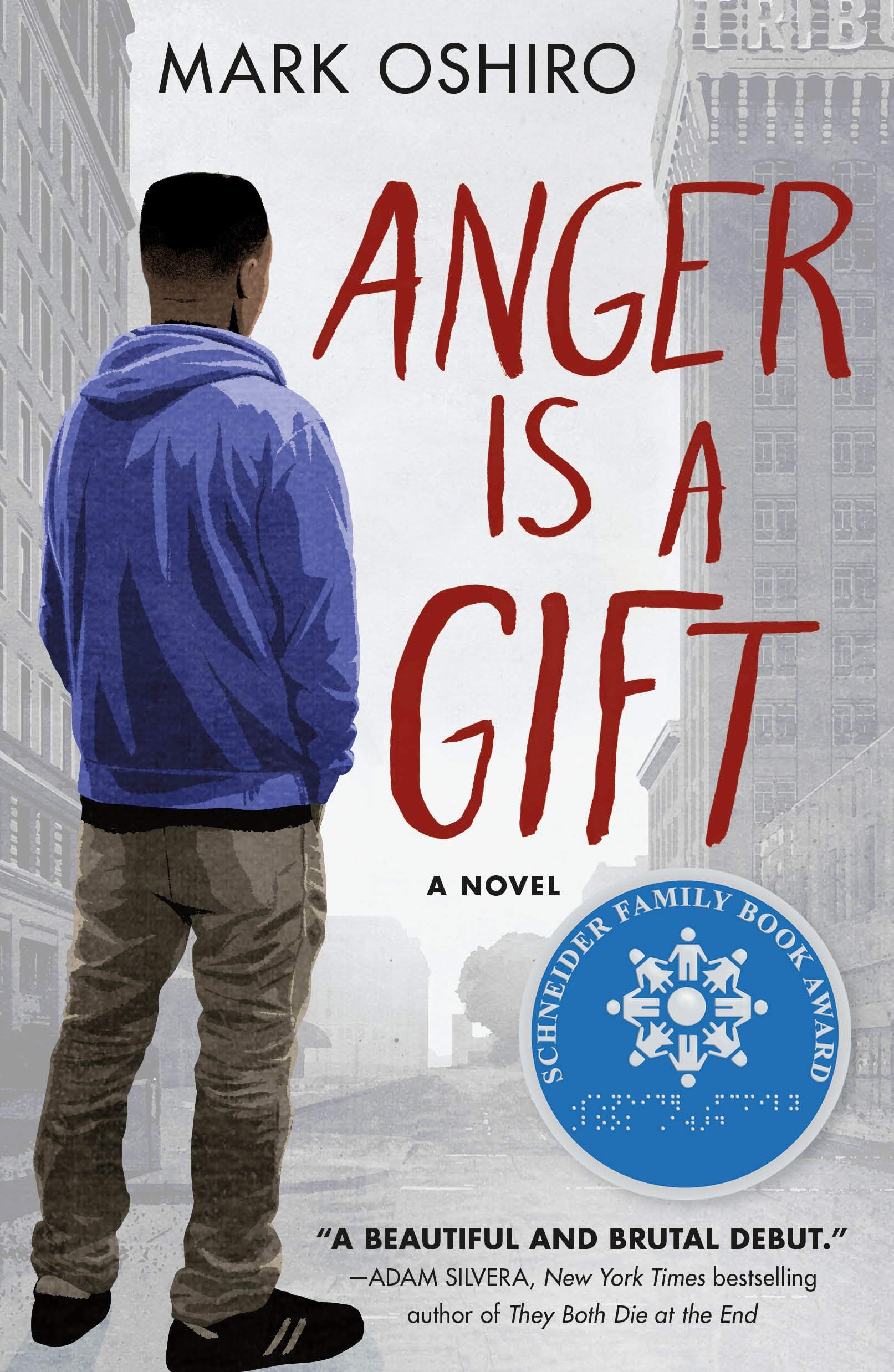
Anyway, they seem to have been enjoying themselves, and watching them read my book has been fun as hell, so I figured there was a good chance I’d like their work as well, and in that spirit I just finished their debut novel, Anger Is a Gift.
And it has kicked my ass. I made a terrible mistake last night while reading in bed; at one point I looked over at my wife (who is reading Harrow the Ninth right now) and said “This book is trying to lull me into a false sense of security. I don’t trust optimism any more. Something terrible is about to happen.”
And like ten minutes later I was so angry I could barely breathe, and any thought of sleep within the next hour or so at the least was banished. Not angry at the book, mind you, although I did come very close to tossing it across the room. Angry on behalf of Moss Jeffries, the book’s main character.
As the events of the book begin, Moss has been without his father for a few years. His father was shot by a police officer while leaving a local corner store with headphones on and hands filled with groceries. He attends high school in Oakland, CA, at a school that has recently begun a policy where students can be pulled from class, at any time, by school police officers to search their lockers. As it turns out, the cop in question already does not exactly have the rest of the student body’s trust, and this policy goes badly.
Which leads to metal detectors at the door. Which goes badly.
Which leads to the students planning a walk-out as protest. Which goes very badly.
I’m not going to spoil any more; suffice it to say that protest and police brutality and loss are strong themes of this book, and it begins with a handful of content warnings that maybe I should have taken a bit more seriously myself, because reading this book as a teacher of Black and Brown children in 2020 was very, very difficult. These kids are failed by nearly every adult in their lives– Moss’ mother is wonderful, as is his boyfriend Javier’s mother, but the school personnel and even some of the other parents are benignly neglectful at best and actively harmful at worst, and I spent as much time angry with school personnel as I did with the actions of the police.
I will admit that there were a few moments where I had thoughts of the Would they REALLY … type, mostly relating to various actions the police take regarding the protesters, and … honestly, there’s no excuse to be thinking something like that in 2020. Even if this was mildly unrealistic when it was released in 2018, it’s just not any longer. It’s impossible to have watched the actions of the police across the country this year with your eyes open and declare anything to be beyond them.
That quote on the cover of the book declares it to be “beautiful and brutal.” And … yeah. That’s a really good description of the book. Anger is a Gift was a hard book to read, but absolutely well worth it, and I think you will hear about it again at the end of the year.
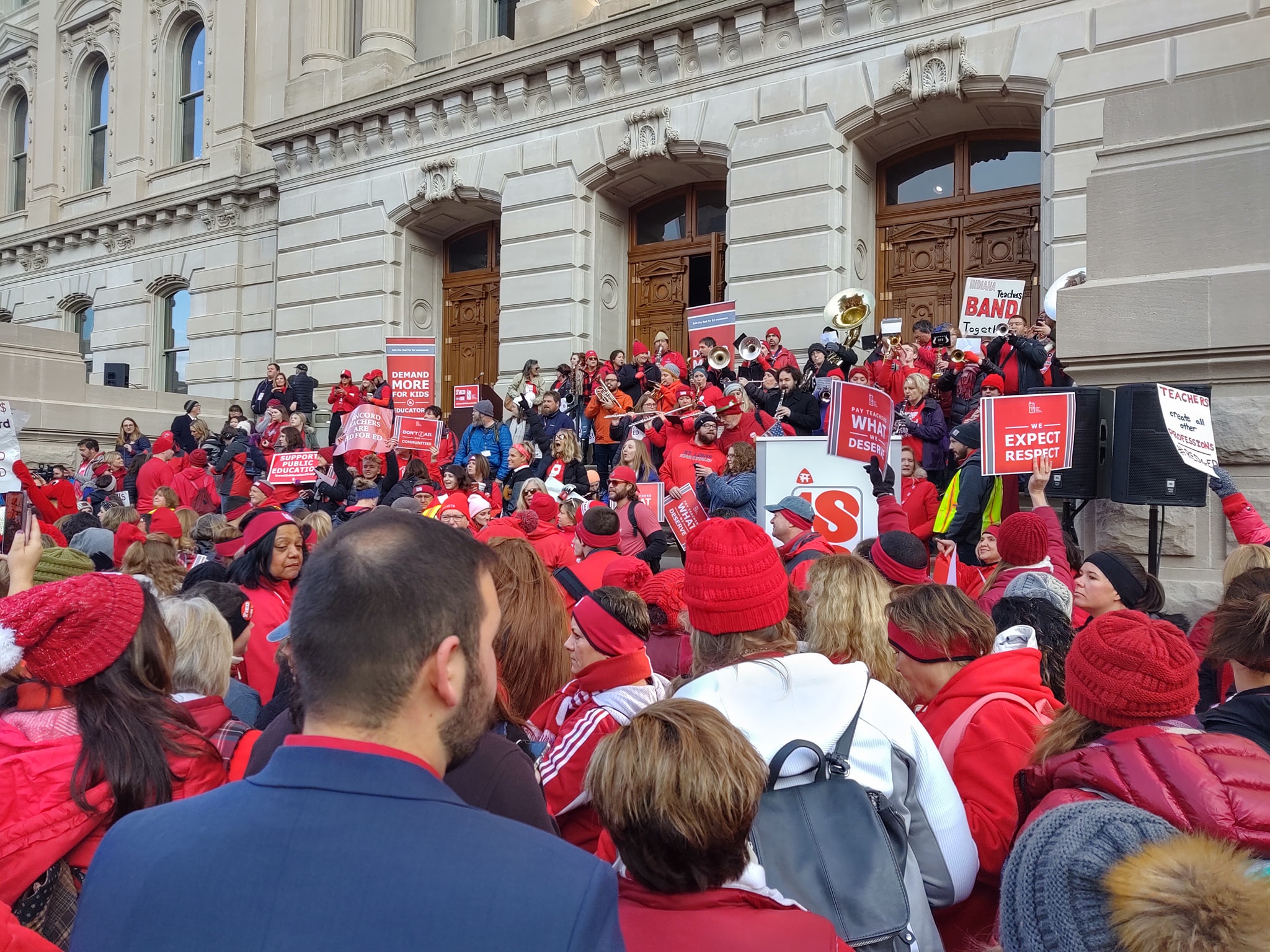
There were apparently something on the order of fifteen thousand teachers protesting at the Statehouse in Indianapolis today. Most of the public districts across the state, including mine, cancelled school today when it became clear that it would be utterly impossible to staff the buildings given the number of people taking personal days to attend the protest. I was not personally among them; I know a bunch of people who went, obviously, but given that my mother is currently back in the hospital and the only viable transportation to the protest was by bus (I am not about to fight fifteen thousand extra out-of-towners for parking in downtown Indianapolis) I was deeply leery of being three hours away from home and not actually personally in charge of when I could come back.
So I didn’t go. Which, honestly, is probably for the best; I have Twitter and my blog when I want to talk and/or think about politics, the governor wasn’t there anyway, and I really didn’t need to spend the day in a simmering rage. If I could have had a guarantee that no one would try to talk to me while I was there it might have worked out okay, but that seems unlikely. Instead I stayed home and played with cats and also played the new Star Wars game on my PS4, which is not the most productive use of my day but possibly the most sane.
The new cat’s name might be Dr. Doofenschmirtz, by the way.
This is for the kids who die,
Black and white,
For kids will die certainly.
The old and rich will live on awhile,
As always,
Eating blood and gold,
Letting kids die.
Kids will die in the swamps of Mississippi
Organizing sharecroppers
Kids will die in the streets of Chicago
Organizing workers
Kids will die in the orange groves of California
Telling others to get together
Whites and Filipinos,
Negroes and Mexicans,
All kinds of kids will die
Who don’t believe in lies, and bribes, and contentment
And a lousy peace.
Of course, the wise and the learned
Who pen editorials in the papers,
And the gentlemen with Dr. in front of their names
White and black,
Who make surveys and write books
Will live on weaving words to smother the kids who die,
And the sleazy courts,
And the bribe-reaching police,
And the blood-loving generals,
And the money-loving preachers
Will all raise their hands against the kids who die,
Beating them with laws and clubs and bayonets and bullets
To frighten the people—
For the kids who die are like iron in the blood of the people—
And the old and rich don’t want the people
To taste the iron of the kids who die,
Don’t want the people to get wise to their own power,
To believe an Angelo Herndon, or even get together
Listen, kids who die—
Maybe, now, there will be no monument for you
Except in our hearts
Maybe your bodies’ll be lost in a swamp
Or a prison grave, or the potter’s field,
Or the rivers where you’re drowned like Leibknecht
But the day will come—
You are sure yourselves that it is coming—
When the marching feet of the masses
Will raise for you a living monument of love,
And joy, and laughter,
And black hands and white hands clasped as one,
And a song that reaches the sky—
The song of the life triumphant
Through the kids who die.




 Welcome to infinitefreetime dot com