…yeah, I’m stealing from Scalzi again. What of it? Thinking about this stuff is fun. You may remember this post, which focused on science fiction and fantasy books; he’s just redone the premise, except focusing on books that aren’t science fiction and fantasy. He appends the suffix (as a Writer) to his post; while some of the books I’m going to mention definitely influenced me as a writer, I’ve included some that had no real effect on my writing because of the way they affected the rest of my life. I’m also only doing eight, not ten, although I reserve the right to go back and add more if I smack my forehead and remember something obvious later.
The timeline I’m working with here, by the way, is “through college.” Books are in alphabetical order by author.
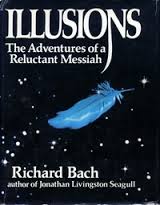
Illusions: the Adventures of a Reluctant Messiah, by Richard Bach. This was– drink every time you see this phrase in this post– first given to me by my Uncle David, when I was in middle school, I think, and getting used to the idea that I really wasn’t ever going to be a Christian. It had a rather profound effect on my psyche and my ideas about how the world worked for several years afterward. I reread this book this year for the first time in probably a decade or two, and I’ll admit I’ve outgrown it; it seemed awfully silly to my jaded older self and I’ll admit that of all the books on this list this is the one I hesitated the most to include. But… man, at that time in that place? I was copying quotes from this book into a notebook. I’ve never done that before or since with any other printed work, not even the LOTR books, and I’ve got lines from those tattooed on myself.
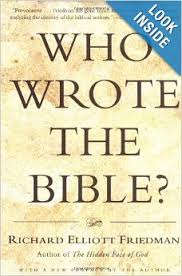 Who Wrote the Bible? by Richard Elliott Friedman. I can pinpoint this one pretty precisely: I read this my senior year in high school. When I started the book, I was sort of planning on majoring in journalism in high school (see two later entries for more background on this) and planning on Uncovering the Truth for the rest of my life. By the time I finished it I’d already started becoming the kid who was going to go through four years at Indiana University without so much as setting foot in the journalism building. Who Wrote the Bible? rewrote my entire future on the spot, taking my preexisting mild interest in religious studies and blowing it up into a full-scale obsession that was going to dictate the course of my studies for the next six years of my life– I ended up triple majoring in Religious Studies, Jewish Studies, and Psychology with dual minors in Near Eastern Languages and Cultures and Anthropology, then heading off for a Master’s degree in Hebrew Bible from the University of Chicago before realizing that reading was more fun than research and stopping my program before moving on to the Ph.D. None of that would have happened if I hadn’t randomly found this book on a shelf in a friend’s house and asked to borrow it.
Hm. This book is responsible for, like, 2/3 of my student loans. Never mind. This book sucks.
A Prayer for Owen Meany, by John Irving. 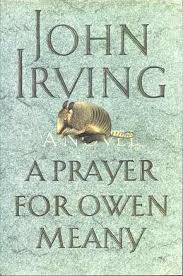 Two guesses who loaned me this one, and the first one doesn’t count. Yep! Uncle David. This is another book that influenced me both as a person and a writer; not only is Prayer a great story with a fascinating set of twists and turns and a somewhat unexpected supernatural bent to it, but it taught me how to be a newspaper columnist– Owen Meany runs a column called VOICE, written in all caps, throughout most of the book.
I had a column in our school newspaper my junior and senior year. What was it called? VOICE, of course, although I didn’t write it in all caps, mostly because no one would let me. I also never told anyone where I got the name from, and I don’t think anyone ever noticed. I haven’t reread this book in a while; maybe I should add that to the 2014 rereads list.
Misery, by Stephen King. 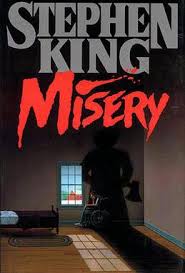 One of my many ongoing reading projects (which didn’t go mentioned in the post the other day) is to reread every Stephen King book, in order. It didn’t make the post because I don’t really care if I get it done in 2014 or not. Very, very few of those reads will be new; I read Rage for the first time a couple of months ago but I’m pretty sure I’ve read 95% of King’s actual novels already.
The first one? Misery. I don’t remember exactly how old I was, but… well, I wasn’t what was probably considered old enough to be reading Stephen King. Maybe fifth grade? Sixth? Somewhere around there. I was at my grandmother’s house and rather bored– my brother and I may have been spending the night, actually– and I came across her copy of it and picked it up. By the time she noticed what I was doing I was already too hooked for there to be any chance of talking me into putting it down or distracting me with something else. I still have that exact copy; she never got it back.
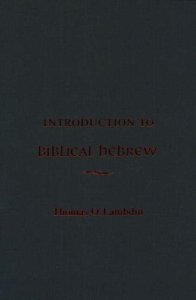 An Introduction to Biblical Hebrew, by Thomas O. Lambdin. What? You can’t see anything in the image of the cover? That’s on purpose; Lambdin’s Hebrew grammar features blood-red foil stamped into a dark grey cover, and it is a forewarning of what you are getting into: you are going to bleed for this book, and it’s letting you know before you even open the cover that it is a bad evil motherfucker and you probably ought to leave it on the shelf like a sensible person. I had this book with me everywhere I went in college for two years and everywhere I went in grad school for two years after that; it taught me to study in a way that no textbook and really no class ever did or has since. Now, granted, a loooooot of the credit needs to go to my first Hebrew professor at IU, Bernie Levinson, who was hands down one of the finest educators I’ve ever met in my life, but there was still something about this damn book. I’ve still got it; if my house burns down I’ll rescue my copy, if only because I don’t actually think it can be destroyed and I would hate to see what the book I referred to as “the Lambdin” for years would do to human civilization if freed from its earthly shell.

One More Time: The Best of Mike Royko, by Mike Royko. This one, I’ll admit, is in some ways a bit of a cheat, as I didn’t get the book itself until well after college, when I found both it and its sequel For The Love of Mike on a shelf in a Barnes and Noble together and bought them both immediately. I’m including it because Mike Royko was my writing idol in high school; our local newspaper syndicated his column and as far as I was concerned getting to read Mike Royko’s columns was the entire reason my parents were paying for the paper. The school newspaper, and journalism itself, were a really big deal for me in high school, as you may have already picked up on, and the fact that I wanted to be Mike Royko when I grew up had a lot to do with that. The guy was brilliant, simple, direct, understated, and wrote like he had scalpels for fingers, a simile that may only make sense to me but still seems beautifully appropriate anyway. I still pick this up and leaf through it from time to time, although probably not often enough, and I miss the hell out of getting to read Mike’s columns a couple of times a week.
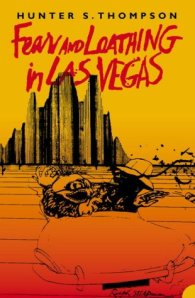
Fear and Loathing in Las Vegas, by Hunter S. Thompson. Speaking of journalists, and speaking of people I miss the hell out of: this one is absolutely an “as a writer” entry, as I worship at Thompson’s altar and every word I’ve written since I first read this book has had his stamp on it somewhere. I firmly believe Hunter Thompson to be one of the finest prose writers who ever lived and the finest writer of invective who ever lived; my greatest regret is that George W. Bush outlived him, because that means I’ll never get to read the obituary Hunter Thompson wrote for George W. Bush.
His Nixon obit, of course, is brilliant.
This is yet another Uncle David recommendation, which will surprise no one; half of everything important I’ve read in my life came from him somehow.
Weirdly, I don’t remember when I read this book for the first time– I can’t even pin it down to “high school” or “college” or “before then” or anything like that. I suspect I was probably in high school, as my parents generally weren’t ever too prone to taking anything I was reading away from me but I can’t imagine they’d have overlooked something as full of drug references as Fear and Loathing.
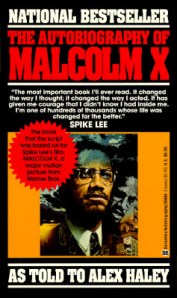
The Autobiography of Malcolm X, by Malcolm X and Alex Haley. The Autobiography of Malcolm X is beyond a doubt, without a question, no ifs, ands, or buts, the most important book on this list and the most important work of nonfiction I’ve ever read in my life. I first read this in sixth or seventh grade and the damn thing blew my goddamn mind. Malcolm is my idol in a lot of ways; there’s a poster of him hanging up in my office that I’ve had in every home (and most of the classrooms) that I’ve lived in for years. He’s one of my two favorite human beings; the other is Abraham Lincoln. My son came very close to being named Malcolm Michael; if we have another kid (unlikely) and it’s a boy (hopefully not; if we have two I want a girl) he’s going to be named Malcolm Abraham. There are not many books that I literally think everyone should read. Every living human being should read The Autobiography of Malcolm X. Period.
I’m going to stop at eight, if only because some of the other choices I thought about feel like cheats for some reason or another. Let’s call three other books Honorable Mentions: Zen and the Art of Motorcycle Maintenance, by Robert M. Pirsig (another Uncle Dave loaner, by the way), Integrity, by Stephen Carter, and, well, the Bible, which I feel weird putting in bold. I feel compelled– unnecessarily, I suspect– to point out that I really don’t mean The Bible Meant A Lot To Me in the way most people would. I suspect most of you have been reading me for long enough to know what I’m getting at, and if not, well, reread this piece a time or two, because there’s hints.
 You may have had a bad day today.
 Welcome to infinitefreetime dot com