In which I ain’t mad

anigif_enhanced-9949-1393531503-3So, my kids bombed the Applied Skills, and I don’t care.  I’m not legally allowed to discuss individual test items, and that’s not an issue that I care to challenge the state on, so I’m not going to.  I can say the rest of this, though: I had maybe six or seven kids who didn’t even finish, which for my students is incredibly rare.  (By comparison, I had only two kids out of all my current students who didn’t finish it last year, and at least three times that many in one class this year.)  Every other seventh-grade teacher who I talked to, in more than one building, reported the same phenomenon: much higher than normal numbers of kids not finishing the test.

This tells me that the state way overshot the difficulty level, and they’ll adjust for that when they score.  Plus, as I said a couple of days ago, I have kids who got zero points on the Applied Skills in sixth grade and still passed the test.  I learned after my first year teaching sixth grade; this test always looks horrifying and tries to destroy both my own confidence in my ability to do my job and their own confidence in their ability to do their jobs (as a bonus, the hardest question was the first one again this year) and it is manifestly not worth stressing out about.  They came in confident, no one gave up, and I felt like they did their best on the LA test that came second today despite getting beaten down by the math test.  That’s really all I can ask for.  I’m not wasting time worrying about it.


Something I am going to spend my time worrying about:  remember Raymond?  Unfortunately, his seizure during class a couple of weeks ago was only the first in a series of them.  He’s not been in class very much lately as his parents have struggled to find the cause of the problem and adjust medications, but they sent him in today because of ISTEP testing.

He apparently had at least one seizure during the test today.  He didn’t test with me because of his disabilities; he gets extra time and he has difficulty with fine motor skills like writing so he’s got a scribe with him for the test.  His para told me that there was no point anywhere during the test where Raymond had any idea what the hell was going on around him or what he was supposed to be doing on the test.

I can’t get mad at his parents; they were trying to do what they thought they were supposed to do.  But I’ll be damned if I’m not going to raise hell to get that test invalidated, and I hope to hell his parents keep him home for the next couple of days.  This is true for obvious humanitarian reasons– this test is not important enough for a kid to jeopardize his damn health to take– and slightly-more-selfish reasons, such as the fact that current ed reform theory is that there is nothing more important to student test scores than the skill of the teacher (and I’m certainly the only one who’s going to get blamed) and I suspect that fuckin’ epilepsy might have a bit to do with his scores here.  I didn’t find out about all this until late in the day so I didn’t have time to talk to his parents; I’m sure as hell going to be meeting with administration tomorrow to see what we can do about invaliding the test.

I suspect that meeting is going to be fun.

Even more standardized testing nonsense

do-not-read-400x301…because I can never, ever stop talking about this.

You may recall, if you’ve been reading for a bit, my post where I declared all grades to be arbitrary bullshit.  Yes, all grades.  Go ahead and click the link for additional explanation, or just click here to get the whole three-part series.  What is also arbitrary bullshit, always, is how we determine what is a “pass” and a “fail” on a standardized test.

Lemme back up.

I didn’t do any teaching today.  The first round of the ISTEP test is next week.  It’s what they call the “Applied Skills” portion of the test, with the multiple choice part coming in either the last week of April or the first week of May; I don’t remember.  Basically, the Applied Skills portion of ISTEP is the story problems part.  It’s still paper-based and the kids have to write everything out and show all of their work, which is why it’s so much earlier than the rest of the test– because it can’t be graded by a machine.

I spent all day today with The Hunger Games playing on my class DVD player, calling my kids back for what are called test talks— a brief three- or four-minute conference with me where we went over their ISTEP score from last year, their performance on the three Acuity tests over the course of this year, and– and this was a new wrinkle I threw in this year– their performance, specifically, on the Applied Skills portion of last year’s ISTEP.

It will not surprise you, I think, regardless of whether you teach or not, to discover that kids (not just mine) tend to have a harder time with open-ended story problems than they do with (somewhat) more objective multiple-choice problems.  For one, you can’t guess your way through an open-ended question, and just multiplying together every number you can find– the go-to “I don’t get this” reaction– is not often the right response.   I had many, many conversations today where I praised a kid on their high ISTEP score, then flipped the scoresheet over to the other side and watched their faces fall when I showed them their scores on the objective portion of the test.  My reason for doing this?  Those are the money points.  Nearly all of my kids can substantially improve their ISTEP scores just by being a little bit more conscientious on the applied skills test they take on Tuesday.  It’s literally a matter of moving some zeroes to ones.  Individual points on this test count more toward their overall score than a single question on a multiple-choice test will, so if they focus on doing their best on Tuesday they’ve got a really good chance of bringing up their overall score.

Back to arbitrary bullshit:  I discovered today, and I’d suspected this before but I hadn’t actually seen proof, that it is possible to pass the ISTEP for mathematics in seventh and eighth grade and get no points whatsoever on the entire Applied Skills portion of the test.  I have at least two kids who pulled that off– literally zero Applied Skills points, but a pass on the overall test.  No points at all for “Figure the area of a rectangle that is four feet by three feet,” but we’ll pass you if you can figure out that C, 12, is the answer if the problem is 4×3.

You tell me how useful a “pass” actually is under those circumstances.

Here’s why standardized testing doesn’t work

original-1First things first:  I’m pretty convinced there’s not gonna be school tomorrow.  Again. The prediction for tomorrow morning between five and seven AM has windchill temperatures in between twenty and twenty-five degrees below zero.  It’s supposed to warm up quickly after about nine or ten o’clock, and be almost civilized by the end of the day, but I just don’t see any way that they’re making kids walk to school/wait for buses in that kind of wind chill.  Twenty below has been the trigger for the last several school closings and there’s no good reason to assume tomorrow will be any different.

I had tests planned for today for both of my seventh grade groups but the eighth grade test was scheduled for tomorrow.  I spent most of my time in the gym before school grabbing my algebra kids and saying things like “Hey, remember how I said there was a test tomorrow?  I lied.  It’s today.”  It is either a sign that my kids really like me or that they just don’t care that much about their grades that none of them bothered to gripe about not having time to study.

My seventh graders, though, knew that there was a test today.  We’ve been talking about it for a week and reviewing for a couple of days. And for both of my goddamn groups today they knew what slope was and how it worked during the first class period and then bombed the shit out of what should have been a pretty easy test during the second.  And I have no idea why.  I bet if I give it to them again tomorrow or Monday they’ll do goddamn fine.  But not today, for whatever reason, even though I was getting correct answers to everything I threw at them during the first period of class when we were reviewing.

Lesson is: sometimes kids don’t know shit, even if they knew shit before, and you can’t always predict when those days will happen.  My first and second hour kids got the worst results I have ever seen as a math teacher on their window test today.  And again: it was not a hard test.  That record lasted an hour and forty minutes, until my third and fourth hour kids took the same test and did even worse.  If today had been ISTEP day they’d have fired me already.  And the next test we take they might get the highest scores in the seventh grade.  What happened?  Hell if I know.  They knew it and then they didn’t.  And that’s just the fuck how it works sometimes.

We’ll post-mortem it on Monday, I guess. Er… well, maybe tomorrow.  But I kinda doubt it.

In which politicians make a good decision, plus a bunch of bullshit

ku-mediumIt has not been a good week.  I’ve been tired, sick, crabby, stressed out, and not reacting to the kids well at all, and the fact that in general they’ve had a bad week themselves has not led to anything good happening in my classroom.  We had school today; I’m still crossing my fingers that we’ll be off tomorrow morning since it’s supposed to be a bazillion below zero again, but we were open today.

A bit of good news I just discovered: the state board of education has voted to extend the testing window for the first ISTEP test by a full week and a half, which is fantastic news.  Means that all the snow/weather delays won’t kill us.  Great news.

Anyway: good news aside, shit like this doesn’t help.  I took my morning class on a bathroom break this morning.  I generally follow the boys into the bathroom because if I don’t they fuck around and make a lot of noise and generally act like assholes; once everyone’s occupied with actually doing what one would expect one to do in the bathroom, I head back into the hallway.

I discovered another student– one of mine, but not in my first and second hour class (so he was out of someone else’s room)– trying his damnedest to climb over the stall door into the handicap-accessible stall.   You read that right.  Climb over.  Which, the way our bathrooms are designed, would have required him to haul himself seven or so feet off the ground.  He is not remotely athletic enough for this task.  He’s hanging by his hands, scrabbling with his feet and trying to get purchase on the door to climb over.

My response was probably not nearly as profane as the situation deserved.  I did not ask him what in the blue fuck he thought he was doing, for example.

“The door’s locked.”

I did not ask him if he had considered that perhaps the fucking door was locked because there was a person taking a fucking shit inside the bathroom stall.  As you would fucking expect there to be if a bathroom stall was closed.  Somehow, I managed to get through that conversation without swearing or using the words “imbecile,” “moron,” “fucknut” or “halfwit.”

I don’t know how.

Later, when he was in my room, we’re going over some simple bell-ringer work.  My kids understand what factors are, and they understand how to do prime factorials, but they frequently forget what they are.  In other words, it’s an annoyingly persistent vocabulary issue and not a math issue per se.  At any rate, they’re supposed to be finding all of the factors of 36 and then doing a prime factorization of 28.  I give them a few minutes to do both, ask a couple of kids to explain what they did, correct a couple of misconceptions, and then work both of the problems on the board in a couple of different ways, emphasizing that they need to show their work for these kinds of things, even if they’re able to rattle off factors of 36 off the tops of their heads, ISTEP scoring demands that they show how they came up with their answers.

I walk past this same kid.  Note that I’ve spent five or ten minutes going over exactly how to do this shit and it’s still on the board.  Note also that the problem is on a Powerpoint projected on the board and is manifestly impossible to miss.

He has written 35 x 28 = 7 on his piece of paper and nothing else.

Again, I do not swear.  I do not ask him what in the merry fuck he is doing.

He says– and I swear to God I’m not making this up– “Oh, was I supposed to divide?”

I could have been a doctor or a lawyer, people.

——————————————————————-

The other thing that happened today was one of my girls from my second math class being pulled out of class to be told that her house had burned to the ground this morning.  There are three girls from the same family in my building; I’ve had two of them, one this year and last year and the other three years ago.  The fire apparently started in the girls’ room, so everything they own is completely gone; the upper floor is apparently a total loss and most of what was on the bottom floor is thoroughly water-damaged by now.  All of the humans living in the house are uninjured; to the best of my knowledge they have not found the cats.

I can’t even imagine.

Edited to add…

Interesting follow-up to the math post here.  Stay tuned for a few more minutes; there’s another chunk of the Benevolence Archives coming.  All violence from here on out!

On math and feminism and societies

Feeling a little grab-baggish today.  First things first, watch this.  Shut up and do it, dammit, it’s Saturday and you can spare eight bloody minutes:

You didn’t watch it, did you?  Jerk.  Fine, I’ll sum up:  the fella in the video is a British physicist, and he demonstrates a couple of interesting properties of infinite series: first, that the sum of 1 -1 +1 -1 +1… out into infinity is actually one half.  Then, to further screw with our brains, he demonstrates that the sum of the series 1 + 2 + 3 + 4 + 5… is negative one twelfth.  Which is completely absurd, but the demonstration he works through is elegant and relatively simple even for non-mathematicians (which, for the record, is a category I’m including myself in) so long as they have some recollection of how algebra works.

I came across this here, at Phil Plait’s awesome Bad Astronomy blog.  The article touched off a bit of a shitstorm in the comments and elsewhere on the Interwubs for what is probably a perfectly obvious reason; it doesn’t make a speck of logical sense.  The math concepts being applied are apparently actually useful in string theory.  The problem, of course, is that most of the people involved in the argument don’t have the faintest goddamn idea what they’re talking about– which, surely, is the first time something like that has ever happened on the Internet.  This makes the argument not terribly enlightening.

Me, I’m inclined to trust the experts– while I agree that neither answer makes a drop of intuitive sense, I’m also sympathetic to the counter-argument that infinity itself doesn’t actually make a drop of sense to our non-infinite brains and that therefore “this doesn’t make sense” isn’t actually a valid knock against the math.  In fact, if I’m being honest, I find that argument fascinating.(*)  The guy in the video also points out that you’re right that if you stop at any point along the sequence, yes, you’re going to get a certain number, either 1 or 0 in the first instance and something really big in the second– but that if you extend the series to infinity, a concept that doesn’t rightly fit in our brains, you get these wonderfully unexpected results.  It’s cool.  And he’s kind of adorable.  So go do what I said and watch the video, because I know you didn’t watch it the first time.

—————————-

Complete change of subject: I need a feminist, or at least someone with a bigger vocabulary than me, to ‘splain me something, and to do it out of the goodness of her or his heart, because I’m perfectly aware I can research this myself but I’d rather ask the Internet for some reason:  is there a specific term for a society that is patriarchal in practice but not by law, other than “de facto patriarchy”?  Like, a single term?  The example I’m thinking of is America, obviously, where there are no longer any laws preventing women from, say, high office, or corporate boards, or other offices of high power that are currently occupied either nearly exclusively or literally exclusively by men, but that nonetheless all or nearly all of those offices are occupied by men.

To phrase it differently, I’m looking for a term or set of terms that distinguishes what I’ll call for the sake of argument a “hard” patriarchy– where women are literally not allowed access to positions of power via specific religious or legally enforceable and punishable prohibitions, from a “soft” patriarchy where the barrier is culture and not law.  Note that in a practical sense the effects can be exactly the same, which is why “de facto” and “de jure” would work if they weren’t phrases and not individual terms.

And maybe also you can see why I’m not trying to stuff this into a Google search, too.  🙂  Anybody got anything for me?

——————————————

(*) We’re gonna leave my inconsistency re: theology there aside, although now that I’ve noticed it I may think about it harder later.

In which this isn’t helping

2014-01-10 19.28.23I am, generally, someone who tries to be realistic about his students.  Teachers tend to run the gamut; some of them truly believe that all of their kids can change the world if they want to, and far too many succumb to cynicism and don’t give their kids credit for anything.  I try to split the difference as much as I can. The simple fact– and this would be true regardless of what kind of district I worked in, and I do not work in a high-income district– a certain percentage of my kids are going to exit the world more or less as poor and ignorant as they were when they came into it.  I’ve found out about three or four former students just in the last few weeks who have had babies recently; none of them have graduated high school yet, and at this point I pretty much doubt any of them ever will.  The thing that keeps me going, though, is that despite all their disadvantages in life and despite an American culture that pays lip service to education but does not actually give a damn about it or value people who have it, some of my kids are going to succeed despite all the shit life has stacked against them.  And here’s the thing:  I cannot look at a roomful of seventh and eighth graders and pick out which ones are going to make it and which ones aren’t.  It is entirely possible that a kid who I think is already fucked for life at 12 is going to find a way to escape the morass of shit he’s found himself in and lead a good life.  It’s also entirely possible that my honors kid who I think I’m gonna be asking for a job in twenty years is going to have something happen to her that sends her spiraling.

I know the truth about this country; I know that education can’t actually overcome poverty, most of the time, and I have no illusions that my contributions in seventh grade math– seventh grade, the grade where any human being, regardless of any other factor, is least likely to, able to, or interested in Taking Shit Seriously For Their Future– seventh grade is generally the worst year of your life— are going to make any real difference.  For some kids? Sure, absolutely.  For all of them?  Most of them, even?  Not really.  They’re gonna go do what they’re gonna go do, and maybe that’ll be Good Things and maybe that’ll be Bad Things, but the simple fact is their seventh-grade math teacher isn’t gonna make all that much difference to how things turn out.

But again:  I can’t tell the difference from here.  I can’t tell you which of these kids I’m actually gonna make a difference with.  I can’t tell you which of the kids are actually gonna remember me (positively, hopefully) and which won’t.  And given the number of kids who have told me I was their favorite teacher or mine was their favorite class who I would have thought hated me, sometimes I’m not even sure they have any idea.

(Kinda embarrassing late edit:  Because I can’t see the future, I have to treat all of them as if they’re going to make it.  Even if I think they’re not going to.  All of them, all the time, every day.  Which, weirdly, is less positive than it sounds, and frankly is frequently exhausting.  That was kinda the point of this whole first part and I never actually said it.)

I’ve not even started this piece and I’m sidetracked already.

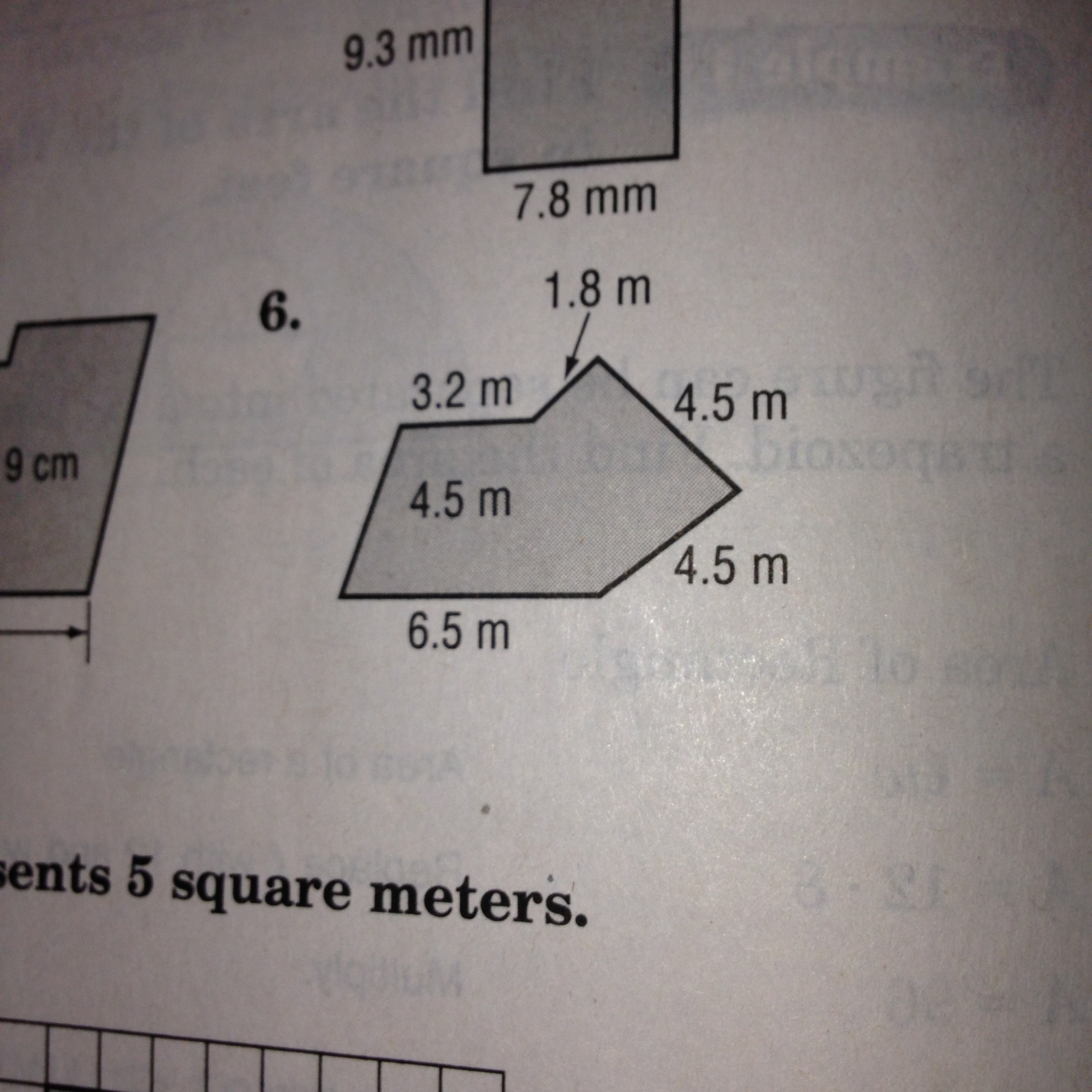
I talked earlier this week about what we’re doing in class:  composite shapes, like the one in the diagram above– an actual problem in their math workbook.  Here’s the thing:  for good or for bad, my kids are not very good at geometry right now.  They can’t quite wrap their heads around how formulas work, they don’t want to bother to remember them, and even when they do they frequently leave bits out or randomly decide that even though they multiplied pi by the radius squared the last thirty times they calculated the area of a circle they’re gonna add it this time.  And, while I’m going back and forth on things, I myself bounce back and forth between “You fucking idiots have been doing this shit for three or four years now, when the fuck is it going to click?” and trying to be a bit more reasonable and recognizing that even with the smart ones learning is going to involve backsliding and making mistakes and goddammit circles were a pain in your ass when you were their age too so stop being an asshole.

Simple shapes are bad enough.  Maybe they shouldn’t be; maybe I should be a better teacher and they should get them by now; maybe they should be better students and maybe just once in a while spend ten seconds studying or actually pick up a book and do some damn homework once in a while.  They don’t; I know this.  Doesn’t change my job.  Ain’t nobody gonna blame the kids.  It’s me and I know it; governors can’t get elected calling kids stupid.  They’re gonna call me incompetent instead.

Simple shapes are bad enough; when you glomp three or four of them together and then don’t provide all of the measurements that they need, it gets much worse.  They don’t quite understand which operations to use at any given time, most of the time; they’re terrible at anything involving multiple steps, and they cannot, cannot reason their way out of a paper bag with a bright light at one end and a rabid dragon-wolverine at the other.  Composite shapes are a horrible sick combination of all of these things and plus it’s the first week back from Winter Break and plus we’ve been doing this for two days and they just. do. not. get it.

Will they get it?  Yeah, probably, eventually.  With me, maybe not?  But maybe in eighth grade, they’ll get it.  Somebody’s gotta teach this shit first, and I remember being pretty bad at long division once upon a time.  It clicked sooner or later.  This will too.

But back to that shape.  Here, look at it again:
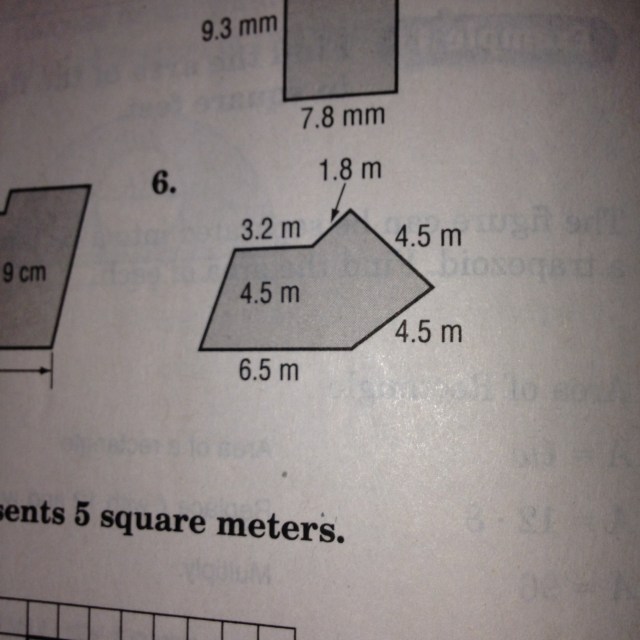
2014-01-10 19.28.23I’m gonna admit something:  I looked at that figure for three or four minutes with one of my smarter kids today, and I’ve spent another five or six minutes looking at it now, before posting it in front of God and the internet, and I swear to you that I have no goddamned earthly idea right now how the hell I might find the area of that shape.  I say this fully aware that some smartass is going to set me straight within five minutes, either here or on Facebook (let’s be honest, it’s gonna be Facebook) and I will be properly chastened at that time.  But right now?  I don’t even know where to start.  It sorta looks like two trapezoids pushed together, which would be fine, except I don’t have the height on either of them; that angle up at the very top might be a right angle but I think it’s the only one.  There’s no good way to make triangles out of it; again, I don’t have any heights to go with the bases.  Parallelograms are right out because the angles don’t match.

Literally:  no clue.

And my seventh-graders are supposed to be able to figure this shit out.  My seventh-graders, who struggle with basic triangles, and require patient coaching to figure out the area of L shapes that are plainly and obviously (even to them!) two rectangles stuck to each other.

I don’t like having to say “I don’t know how to do that; skip it” in fucking math class.  Especially when I’m spending effort, as I have to every day, trying to convince them that yes, you can do this.  That yes, you do understand this.  That yes, this is possible to begin with.  It doesn’t fucking help when my completely grown three-college-degrees-two-master’s-degrees-twelve-years-of-teaching-experience-and-a-partridge-in-a-fucking-pear-tree ass proves unable to solve a problem that they are expected to do.

It was a frustrating day.  Go ahead, point out how I fucked this up; it’s probably something obvious.

Story problem time!

image028Have a math problem:

A boat travels 60 kilometers upstream against the current in 5 hours.  The boat travels the same distance downstream in 3 hours.  What is the rate of the boat in still water?  What is the rate of the current?

If you are a reasonably educated person, you should be able to make headway with this fairly quickly:  the boat travels 12 km/h upstream (60/5) and 20 km/h downstream (60/3), which means that the boat’s speed in still water is the average of the upstream/downstream speeds, (20 + 12)/2 km/h, or 16 kilometers per hour, and the current is 4 km/h, which is the difference between either of the measured speeds and the average.

I spent about half an hour last night texting back and forth with a former student trying to work her through this problem and becoming more and more bewildered about what it was she didn’t get about it as the conversation went on.  She got the math– the math isn’t really that complicated, right?  Just division and an average.

What she didn’t get?  Rivers.  As it turns out, “downstream” and “upstream” are not terribly salient terms to kids who have lived in cities all their lives– and while, granted, the town I currently live in is actually called South Bend because the river bends south while wending through it, the terms “downstream” and “upstream” hadn’t managed to really ensconce themselves in her vocabulary as of yet.

This young lady is generally one of my brightest kids, mind you.  I’m not mocking her at all here, although maybe she deserves it a little bit– but the entire conversation got me thinking about how incredibly easy it is to write standardized test questions that you think are questions about math but turn out to hinge on some other kind of non-mathematical knowledge.  She could not wrap her head around the idea that the boat wasn’t going at its full speed “downstream” and that the current wasn’t slowing it down by (20-12) 8 km/h going upstream.  Which, of course, was one of the answers, because whenever anyone with half an ounce of sense writes a multiple choice test, one of the horrible tricks you do is thinking “Now, how might the students screw this up?” and then writing answers that match what they might have gotten if they did something predictable wrong.

The math?  She’s got it.  The geography lesson that the writer of the question no doubt didn’t realize was embedded into being able to get the question right?  Not so much.

I’ll talk more about this later; just wanted to get the thought down before it fell out of my head.  This is part of the longer series of posts I alluded to the other day before hell fell on my face and knocked me out for a couple of days, I think; I’ll get back to it soon.