
To state the obvious right away: I have blatantly stolen the topic of this post from John Scalzi; his (original, better-written, much more SF-heavy) entry with the exact same title can be found here. In fact, I’m going to steal his idea to the extent that I’m actually going to quote him from his intro:
What does “meant the most to me” mean? Pretty much what it says — that these works are the works I returned to again and again as pieces of writing, as stories, and as experiences. I’m not interested in arguing whether these books and works are the “best”; I couldn’t possibly care about that. I am interested in explaining why they mean as much as they do to me.
Other than the first few entries, and particularly the first, these are in no particular order. Oh, and since I might as well put this here: One thing that has sort of annoyed me as I’ve put this list together is that I can’t honestly put many books by women or people of color on it. You’re gonna see Margaret Weis and Salman Rushdie and that’s about it; the list would be very different if I were including books from, say, the last ten years and not my entire life. Go find something by N.K. Jemisin or Cherie Priest or Saladin Ahmed or Sheri Tepper or Helene Wecker or Nnedi Okorafor or Seanan McGuire; they’re all gold. I just can’t put them on an “entire life” kind of list just yet.
 1) The Hobbit/ The Lord of the Rings, J.R.R. Tolkien: The one everybody who has ever met me could have predicted was going to be on this list. I first read the One Trilogy to Rule them All in something like second grade and have tried to reread them at least once a year since then; there have been many years, especially when I was younger, that I read them multiple times a year. I’m 37; I wouldn’t be surprised if I’ve read them 35 to 40 times by now, if not more than that.
My uncle gave me these books– The Hobbit first, and LOTR soon after when it became quickly clear that I was not yet satisfied. By doing so, he became more responsible than any other living human– and I think I include my parents in that; my personality is in many ways much more like my uncle than either my mom or my dad– for me developing into the enormous unwashed nerd you see before you now.
(Oh: he also told me that “mutton” was gorilla arm when I first asked him about it, a lie I continued to believe for far, far longer than I ever ought to have.)
I still own my original copies of all of these books. I do not intend to be buried, but I do want them with me when I’m cremated.
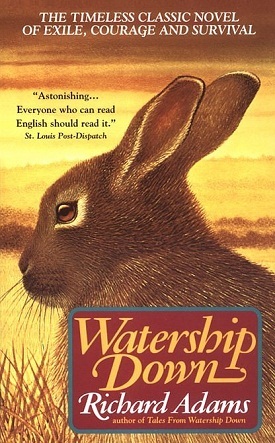 2) Watership Down, by Richard Adams. “Silflay hraka, u embleer rah” may be the only example of a line from a book in a foreign language that I have memorized; it’s Lapine, rabbit-language, for “Eat shit, stench-king.” Wait, no, there are two; Eloi, eloi, lama sabachthani is floating around there somewhere but I likely only know that one because of hiphop. I actually don’t remember how I came across Watership for the first time– honestly, it was probably uncle Dave again, which is gonna be a theme– but it’s another perennial, a book I read at least every year or two. I’ve done class projects on this book, I’ve read it to kids, I’ve written papers on it, and my wife and I have semi-matching tattoos from it: I have el-Ahrairah on my left shoulder blade, and she has the Black Rabbit of Inlé in the same location. Oddly, nothing else by Adams has managed even close to the same impact.
Some may dispute this book’s status as fantasy; it features psychic rabbits that go on an adventure together; shut up.

3) Haroun and the Sea of Stories, by Salman Rushdie. I suspect I’ve bought more copies of Haroun than any other book other than the LOTR series and the Bible; I’ve certainly given away more copies of it than anything else I can think of. I don’t get Haroun, it’s as if Salman Rushdie killed Neil Gaiman and J.K. Rowling and then spent a long weekend dismembering them and smoking their ashes. It’s not like anything else he’s ever written– it’s a fairy tale, first and foremost, cloaked in dozens of mythical and literary and historical allusions and yet still written in language that is clear and accessible to anyone literate. There’s none of the pretense that shows up in Rushdie’s other work; this is unapologetically a book that can (and should be) enjoyed by children. And it’s meant to be read aloud– when I was a language arts teacher in Chicago, I used this as a read-aloud for both of my classes both years I taught there, and it worked wonderfully both years. The recently-released sequel, Luka and the Fire of Life, was good but not as magical. This is my favorite book that I don’t have a tattoo of.
 4) His Dark Materials trilogy, by Phillip Pullman. Wait, no, I lied; I don’t have a Dark Materials tattoo yet, although one’s been in the planning stages for a while. These books are special because I read the first one really not expecting much of anything out of it– in fact, I may have actually been coerced into reading it. I loved it and by the third book I was as hooked as I’ve ever been into anything. I love the hell out of this story; the third book may be the only book that’s ever made me cry on a goddamn reread, which ought to be impossible. Bits of it were quoted at my wedding, for crying out loud.
The movie was godawful, from what I heard, and they never made any sequels– which is fine, because the subject matter (“little children try to kill God” is not a totally unfair paraphrase) is absolutely unfilmable. I don’t care; this is one of the most wonderful, life-and-love-affirming series I’ve ever read, and I’ll fight you if you try to tell me different.
I’ve read nothing else by Pullman. I’m almost afraid to.
 5) Dragonlance: Chronicles trilogy, by Margaret Weis and Tracy Hickman. I like that the cover image I was able to find for this is kind of beaten up, because I read the everloving hell out of these books in fifth and sixth grade and my copies look just like this. The Dragonlance books were probably the first fantasy series that I got really into that didn’t have my uncle’s fingerprints on them either metaphorically or literally– I don’t know that he’s ever read the series, and since I’ve read Weis and Hickman’s work as a grownup and not terribly enjoyed it it may be too late for him. But, man, in fifth grade, where all I thought about was girls and Dungeons and Dragons and really didn’t have enough opportunities to play with either, these books were what I marinated my brain in when I didn’t have any other opportunities. I haven’t reread them in a good long time– mostly because I suspect the charm will have worn off– but I could polish off a Dragonlance book in three hours in sixth grade, so I read them all the damn time. I may have read Autumn Twilight more often than any other book than Fellowship of the Ring, and that’s really saying something.
 6) A Game of Thrones, by George R. R. Martin. Did you notice how this one was a reference to a single book, and didn’t include the word series or trilogy or heptalogy or whatthefuck ever? Good, it’s intentional. Thrones is fucking brilliant, the best introductory novel to a series I’ve ever read. And each book in the series after that has gotten progressively worse (with a brief uptick right around the Red Wedding) to the point where I’m not sure I’m even buying The Winds of Winter and I might punch George R. R. Martin if I ever meet him. But, God, Thrones was freaking amazing: unpredictable, fresh, treading the same ground that Tolkien inspired but managing to do it in a way that felt like something new and not a retread and also no elves, which was a plus. And he managed to surprise me– and if you’ve read the book you know exactly the part I’m talking about– in a way that no other book I’ve ever read in any genre has managed. I literally had to put the book down and walk away for a while after That Part because I couldn’t believe what had just happened. Game of Thrones is a wonderful, astonishingly good book– good enough that the sequels keep getting worse and are still “great” on book three– just pretend that after that the series ends and that Feast for Crows and especially the execrable Dance with Dragons never happened.
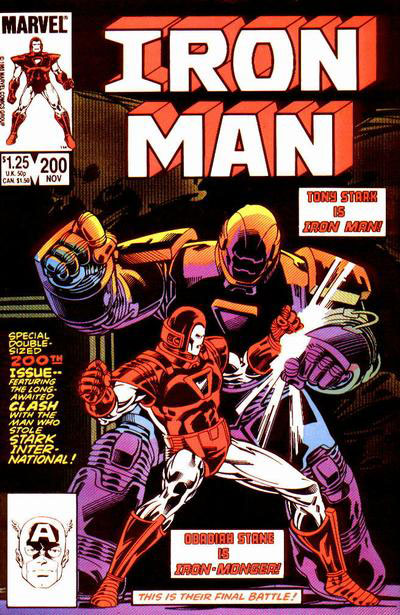 7) Iron Man #200, by Denny O’Neil and M.D. Bright. Shut up; what’s the second word in “comic book”? Book. Iron Man #200 was the first comic book I ever read; I still have my copy, and since then I’ve managed to acquire something like 85-90% of all the Iron Man comics ever published in some form or another. This is the comic that launched a lifelong hobby even if I do want to get rid of some of the evidence nowadays. (Weirdly: that’s my most popular post ever. By a decent margin. Go figure.)
Looked at another way, this book cost me thousands and thousands and thousands of dollars over the last 28 years, just so that I can have a bunch of huge boxes that I hardly ever open taking over a third of my office. You know what? Never mind. Fuck this book.
(No, really: the Obadiah Stane storyline that culminates in this issue is seriously one of the best Iron Man stories ever told; there’s a reason they pirated it for the movie. I just wish we’d have seen the Silver Centurion armor; it remains one of my favorite designs all these years later.)
(Oh, right edit: I can add one more person of color, as I’m pretty sure Mark Bright is black, for whatever that’s worth.)
 8) The Hitchhiker’s Guide to the Galaxy, by Douglas Adams. This is another entry in the “brilliant launch, weaker sequels” category, unfortunately, but holy crap I cannot even imagine how different high school might have been had I never read the Guide. Yes, I was that much of a geek. I reread this for the first time in a few years earlier this year, and it astounded me just how many huge chunks of this book I have committed to memory, a claim I can’t really make for anything else, even books I’ve reread far more times. When I first started going online– local BBSes in the early nineties, on a 300-baud dialup modem attached to a Commodore 64/128 computer– I used to play a game called Trade Wars all the time. Every Trade Wars game I ever played was replete with Hitchhiker’s references; there are probably still BBS leaderboards out there somewhere with Prostetnic Vogon Jeltz at the top all these years later.
(Well, no, there aren’t; that would be ridiculous. But it’s fun to imagine.)
9) The Belgariad, by David Eddings. 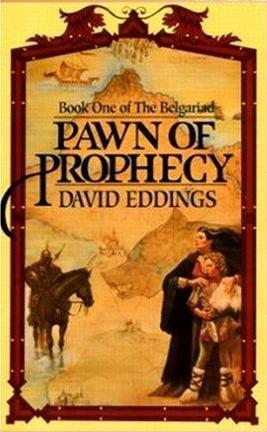 The last two entries in this piece are going to be a trifle more difficult to write about as they’re functionally the same book, but The Belgariad goes first because it leads into at least ten books or so before the quality starts falling off. I was introduced to the work of David Eddings– and later, co-writer credit with his wife Leigh– by, say it with me, my uncle David, and now that I’m sitting here thinking about it my lifelong obsession with redheads may be a result of the massive crush I had on Ce’Nedra from this series. Eddings was Tolkien with a clearer system of gods and magic– the Will and the Word was great– and a young protagonist who I could relate to in a way that Frodo and Sam weren’t good for; Belgarath and Polgara were awesome, and the first book of the series contains one of the most epic dressing-downs of a main character’s idiocy that I’ve ever read, as Garion literally magics up a storm and Belgarath has to cope with the continent-wide weather disturbances that that engenders. “Do you know how much all that air weighs?”

10) The Sword of Shannara, by Terry Brooks. As I said, this is sort of functionally the same book as Pawn of Prophecy above; a young protagonist and his family, an older, wizardly mentor figure (this time the druid Allanon, who had me fantasizing about being able to fire blue flames from my hands for years oh hell I’m still doing it today who I am I kidding) and a mystical/magical threat to all humanity that can only be defeated by finding the MacGuffin. Shannara may be the greatest MacGuffin fantasy literature ever, actually, as the sword, when they finally actually find it (spoiler, I guess) turns out to not at all be what they think it will be, which just sorta makes the whole plan to Find The Sword and Beat the Baddie all that much more MacGuffiny.
Oh, and the cover was great. Yes, great. The Hildebrandt brothers were gods, and– again– I will fight you if you disagree with me. This one comes in slightly after the Belgariad because the sequels weren’t as tightly linked to it and because honestly they stopped being as good faster than the Belgariad/ Malloreon /Elenium / WTFever series…es ever did.
(Phew. Did you finish that? Go write your own; I want to see more of these.)

 Welcome to infinitefreetime dot com