 I am, generally, someone who tries to be realistic about his students. Teachers tend to run the gamut; some of them truly believe that all of their kids can change the world if they want to, and far too many succumb to cynicism and don’t give their kids credit for anything. I try to split the difference as much as I can. The simple fact– and this would be true regardless of what kind of district I worked in, and I do not work in a high-income district– a certain percentage of my kids are going to exit the world more or less as poor and ignorant as they were when they came into it. I’ve found out about three or four former students just in the last few weeks who have had babies recently; none of them have graduated high school yet, and at this point I pretty much doubt any of them ever will. The thing that keeps me going, though, is that despite all their disadvantages in life and despite an American culture that pays lip service to education but does not actually give a damn about it or value people who have it, some of my kids are going to succeed despite all the shit life has stacked against them. And here’s the thing: I cannot look at a roomful of seventh and eighth graders and pick out which ones are going to make it and which ones aren’t. It is entirely possible that a kid who I think is already fucked for life at 12 is going to find a way to escape the morass of shit he’s found himself in and lead a good life. It’s also entirely possible that my honors kid who I think I’m gonna be asking for a job in twenty years is going to have something happen to her that sends her spiraling.
I know the truth about this country; I know that education can’t actually overcome poverty, most of the time, and I have no illusions that my contributions in seventh grade math– seventh grade, the grade where any human being, regardless of any other factor, is least likely to, able to, or interested in Taking Shit Seriously For Their Future– seventh grade is generally the worst year of your life— are going to make any real difference. For some kids? Sure, absolutely. For all of them? Most of them, even? Not really. They’re gonna go do what they’re gonna go do, and maybe that’ll be Good Things and maybe that’ll be Bad Things, but the simple fact is their seventh-grade math teacher isn’t gonna make all that much difference to how things turn out.
But again: I can’t tell the difference from here. I can’t tell you which of these kids I’m actually gonna make a difference with. I can’t tell you which of the kids are actually gonna remember me (positively, hopefully) and which won’t. And given the number of kids who have told me I was their favorite teacher or mine was their favorite class who I would have thought hated me, sometimes I’m not even sure they have any idea.
(Kinda embarrassing late edit: Because I can’t see the future, I have to treat all of them as if they’re going to make it. Even if I think they’re not going to. All of them, all the time, every day. Which, weirdly, is less positive than it sounds, and frankly is frequently exhausting. That was kinda the point of this whole first part and I never actually said it.)
I’ve not even started this piece and I’m sidetracked already.
I talked earlier this week about what we’re doing in class: composite shapes, like the one in the diagram above– an actual problem in their math workbook. Here’s the thing: for good or for bad, my kids are not very good at geometry right now. They can’t quite wrap their heads around how formulas work, they don’t want to bother to remember them, and even when they do they frequently leave bits out or randomly decide that even though they multiplied pi by the radius squared the last thirty times they calculated the area of a circle they’re gonna add it this time. And, while I’m going back and forth on things, I myself bounce back and forth between “You fucking idiots have been doing this shit for three or four years now, when the fuck is it going to click?” and trying to be a bit more reasonable and recognizing that even with the smart ones learning is going to involve backsliding and making mistakes and goddammit circles were a pain in your ass when you were their age too so stop being an asshole.
Simple shapes are bad enough. Maybe they shouldn’t be; maybe I should be a better teacher and they should get them by now; maybe they should be better students and maybe just once in a while spend ten seconds studying or actually pick up a book and do some damn homework once in a while. They don’t; I know this. Doesn’t change my job. Ain’t nobody gonna blame the kids. It’s me and I know it; governors can’t get elected calling kids stupid. They’re gonna call me incompetent instead.
Simple shapes are bad enough; when you glomp three or four of them together and then don’t provide all of the measurements that they need, it gets much worse. They don’t quite understand which operations to use at any given time, most of the time; they’re terrible at anything involving multiple steps, and they cannot, cannot reason their way out of a paper bag with a bright light at one end and a rabid dragon-wolverine at the other. Composite shapes are a horrible sick combination of all of these things and plus it’s the first week back from Winter Break and plus we’ve been doing this for two days and they just. do. not. get it.
Will they get it? Yeah, probably, eventually. With me, maybe not? But maybe in eighth grade, they’ll get it. Somebody’s gotta teach this shit first, and I remember being pretty bad at long division once upon a time. It clicked sooner or later. This will too.
But back to that shape. Here, look at it again:
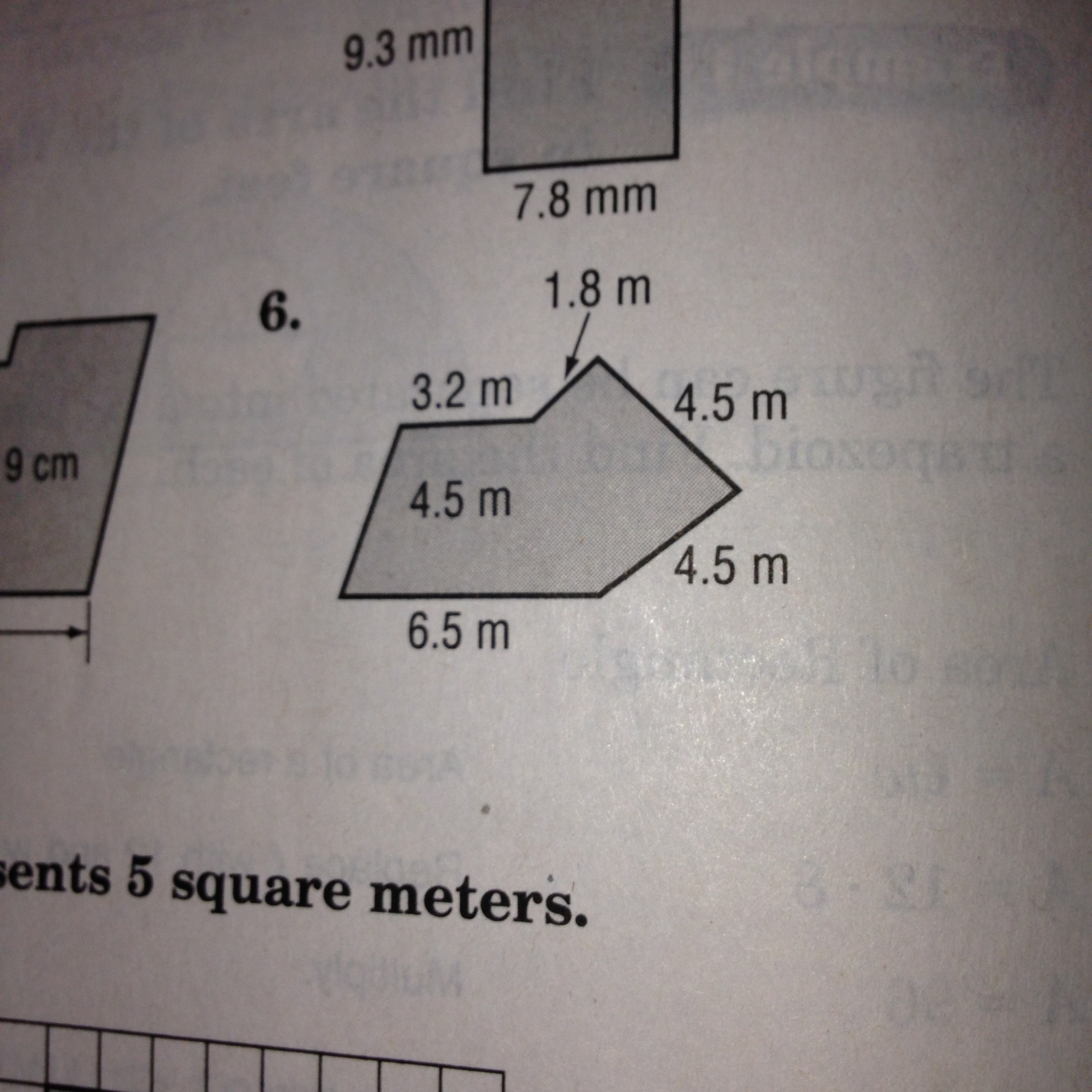 I’m gonna admit something: I looked at that figure for three or four minutes with one of my smarter kids today, and I’ve spent another five or six minutes looking at it now, before posting it in front of God and the internet, and I swear to you that I have no goddamned earthly idea right now how the hell I might find the area of that shape. I say this fully aware that some smartass is going to set me straight within five minutes, either here or on Facebook (let’s be honest, it’s gonna be Facebook) and I will be properly chastened at that time. But right now? I don’t even know where to start. It sorta looks like two trapezoids pushed together, which would be fine, except I don’t have the height on either of them; that angle up at the very top might be a right angle but I think it’s the only one. There’s no good way to make triangles out of it; again, I don’t have any heights to go with the bases. Parallelograms are right out because the angles don’t match.
Literally: no clue.
And my seventh-graders are supposed to be able to figure this shit out. My seventh-graders, who struggle with basic triangles, and require patient coaching to figure out the area of L shapes that are plainly and obviously (even to them!) two rectangles stuck to each other.
I don’t like having to say “I don’t know how to do that; skip it” in fucking math class. Especially when I’m spending effort, as I have to every day, trying to convince them that yes, you can do this. That yes, you do understand this. That yes, this is possible to begin with. It doesn’t fucking help when my completely grown three-college-degrees-two-master’s-degrees-twelve-years-of-teaching-experience-and-a-partridge-in-a-fucking-pear-tree ass proves unable to solve a problem that they are expected to do.
It was a frustrating day. Go ahead, point out how I fucked this up; it’s probably something obvious.



 Welcome to infinitefreetime dot com