

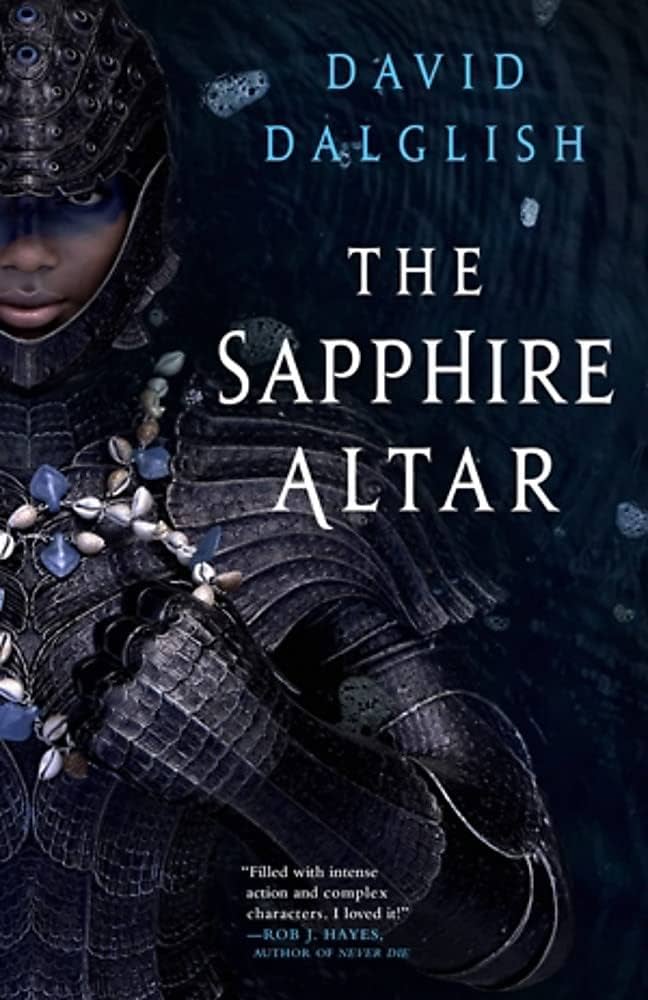
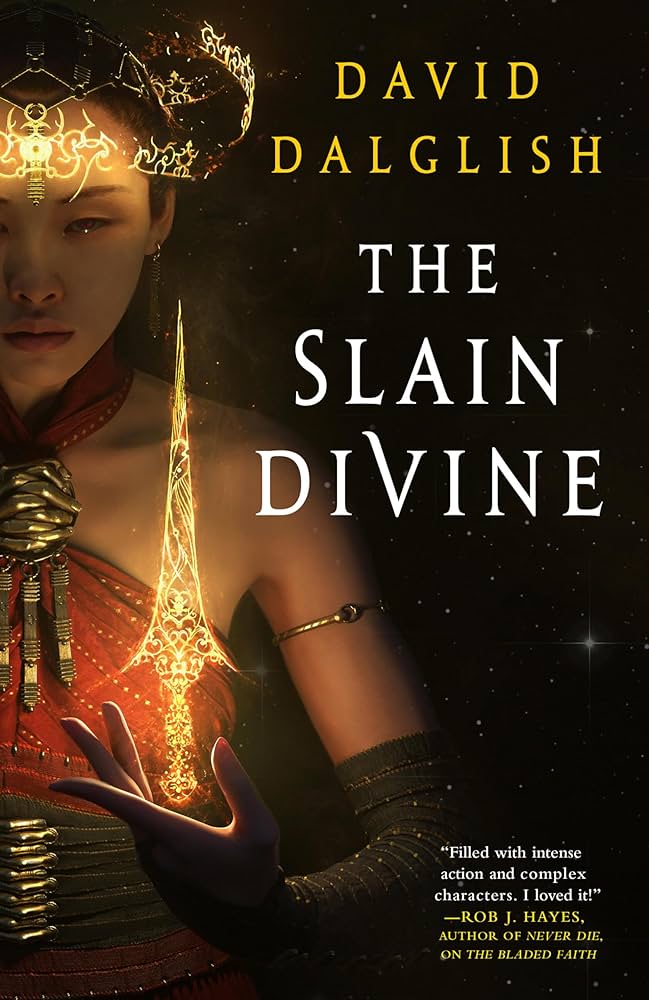
It took me eight days to read through David Dalglish’s three-volume, 1500-page Vagrant Gods series, the covers of which ought to be clickable above. I don’t recall what drew my attention to this series initially, but I bought all three in a fit of consumerism before reading any of them, and they’ve been sitting on a shelf for perhaps longer than they should have before I finally got to them. I’m not about to go back and look to find out how long; it’s been a while.
Shoulda read ’em earlier, because they’re awesome, and they manage the rare feat of starting off pretty good (I four-starred the first book) and then getting better with each successive volume. The series tells the story of Cyrus, a young (initially, at least) prince who not only witnesses his parents’ executions in front of him during an invasion but also literally witnesses the death of one of his gods. Cyrus is held in captivity as a puppet regent for a few years, and ultimately is able to escape with the help of a small band of revolutionaries, who forge him into the Vagrant, a vicious assassin whose one and only goal is to drive the Everlorn Empire from his native island of Thanet.
It is possible you are rolling your eyes right now; the word “assassin” is used way too much in fantasy literature nowadays, and a whole lot of assassins don’t really do a lot of assassinating because the authors want them to be relatable, and it’s harder to do that with somebody who is killing people all the time. You will possibly be pleased to learn that Cyrus does an immense amount of assassinating in Vagrant Gods. Holy crap, does he do a lot of assassinating, and his body count by the end of the series is horrifying. He’s practically the PC of a first-person shooter out there; this is a series that does not shy away from violence and is really not at all interested in a relatable main character. (It’s also, for what it’s worth, rotating-POV third person, but Cyrus is absolutely the main character for all that.) The books also do a pretty good job of making even the ultimate big bad guy of the series feel, if not relatable, at least understandable; the Everlorn Emperor is (mostly) immortal but the previous emperors live in his head, and he’s really only about half-sane during the book his POV shows up in, which makes him a fascinating character.
But the most interesting thing about this series is the way it handles divinity. Gods can be killed, and in fact are killed, and resurrected and sometimes killed again after resurrection, all over the place in this series, and the Everlorn Empire’s drive for, well, empire is due mostly to the need of the Divine Emperor for more worshippers. I’d call it an analogue of Christian imperialism, but only if Jesus was, like, still alive, but on his fifth or sixth body, and if he literally got more powerful with every new worshipper. One character ends up channeling one of the deceased gods for most of the series, and she can literally transform back and forth like the world’s most awesome lycanthrope between her form and the god’s. The crew that Cyrus amasses around himself is uniformly very cool, with a lot of interesting abilities, some of which are divinely inspired and some of which aren’t. Basically everything magical can be traced back to some god or another; this isn’t a world where mages, per se, exist, but the gods are generous with their followers.
Also, for what it’s worth, nearly everyone in the series is brown to some degree or another, and there’s a handful of prominent gay characters. Thanet is clearly more friendly to the LGBTQIA spectrum (not that they call it that, and the words “gay,” “lesbian” and “transgender” are never actually used) than Everlorn is, and some of the most noteworthy revolutionary activities are triggered by Everlorn trying to mess with Thanet’s rules about who can marry who.
Again, I don’t remember what brought me to this series, but it turns out David Dalglish has written a lot of books, so I’ve got a nice back catalogue to dip into if I want. I’m pretty sure this series is the only one set in this world, but I’m looking forward to seeing more of what he has to offer. If you’re looking for a series with a lot of political intrigue, great action, and a fascinating perspective on fantasy religion, you’ll love these books.


 Welcome to infinitefreetime dot com