
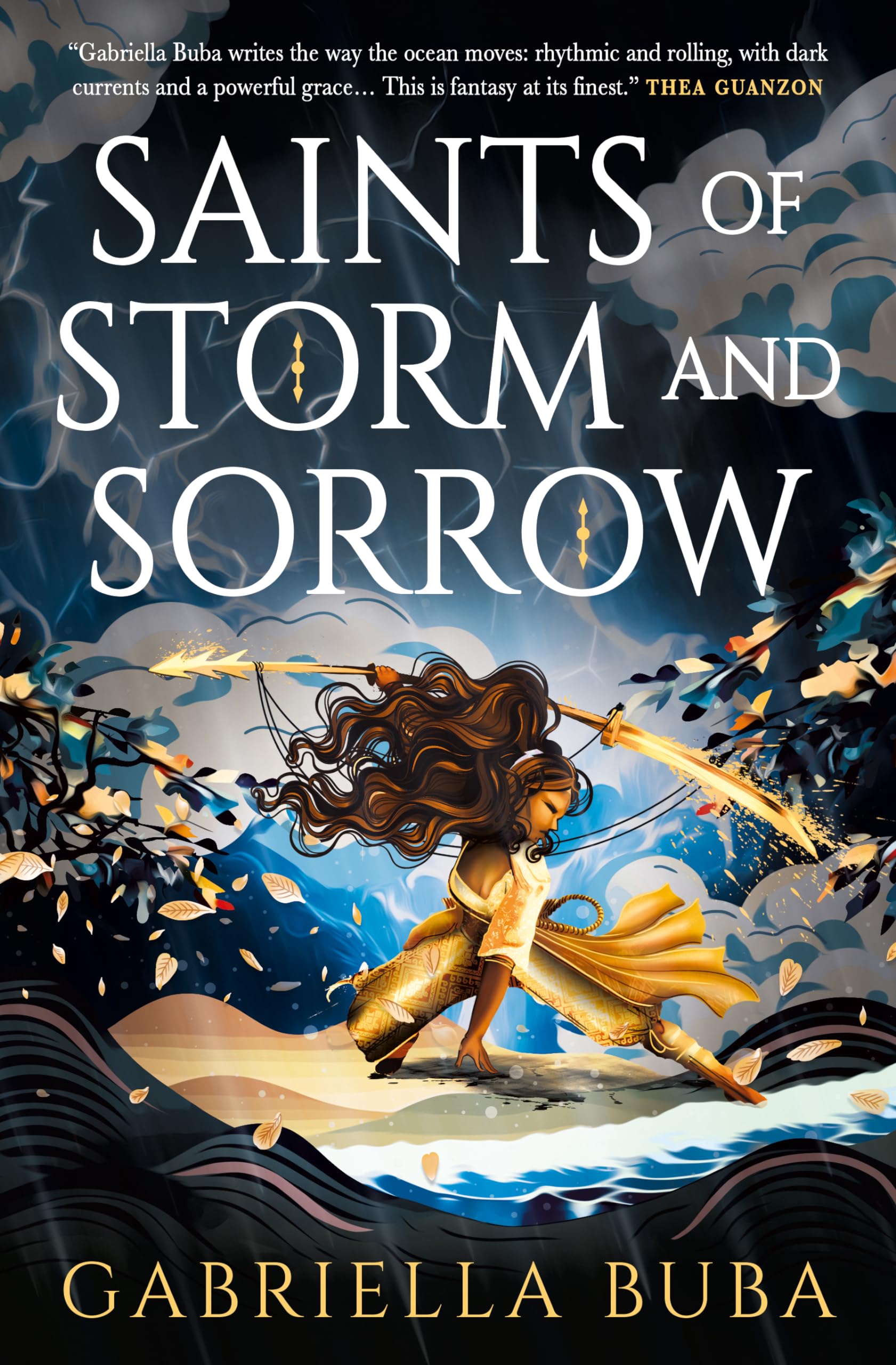
Really, the phrase “bisexual nun” was all I needed.
Here’s the thing about Gabriella Buba’s Saints of Storm and Sorrow: it’s one of those books where a lot of what I have to say about it is negative, but I’ve already pre-ordered the sequel, out this summer, and I’m genuinely looking forward to reading it. I lost some sleep to reading this book, and several times I had to force myself to put it down at the end of the night to go to bed. There’s something compelling and propulsive about Buba’s writing that ended up outweighing some of the things about this book that didn’t make sense or didn’t quite work, and I guess I just need you to keep that in mind while you’re reading this, because I want to talk about the weird stuff. I ended up four-starring this, but in a different mood I could have been talked into a three, and for most of the first half it was going to be a five. So one way or another it’s kind of all over the place, but the tl;dr to this whole post is that the book is well worth the time to read it even if there are some issues.
So here’s the thing. The main character, Lunurin, is a nun. She is also a priestess, quite possibly against her will, of a storm goddess called Aman Sinaya. Now, when I first read this in whatever blurb or online review I saw that caused me to order this, along with the phrase “bisexual nun” and the phrase “Filipino-inspired,” I assumed that this meant that this book wasn’t set on Earth.
And … technically, it isn’t? But it totally is. Lunurin is a Catholic nun. The bad guys are the Spaniards. They speak Spanish. They’re in the Philippines. I’m pretty sure the word “Catholic” never shows up, but … there is no attempt to be subtle here. Lunurin and her female love interest are both Catholic nuns, biracial and despised for being so, in a colonial atmosphere that is more or less identical to the Spaniards colonizing the Philippines. (Do you know any Filipinos? Ever notice how they all have Hispanic-sounding last names? There’s a reason for that.) And the book wants to get into the syncretism that happened whenever Catholicism ran into indigenous religion, which is a fascinating and complex subject, but if the colonized people can literally call down typhoons while being literally possessed by their gods, and Jesus … doesn’t do any of that? It kind of wreaks havoc on your worldbuilding. Christianity toppled, say, Norse religion, sure. But you know who the Norse didn’t have? Actual fucking Thor. And Lunurin can call down lightning by letting her hair down. And everyone just acts like Christianity is a reasonable alternative to that, just because the priests say so?
Nah.
I would kind of love for a book where Christian missionaries run into a religion that literally grants powers to its priesthood, but this isn’t that book and that’s not the story that Buba is interested in telling. She wants to start a book that is already past the colonization phase and so that’s what she gives us, and it’s not exactly the book’s fault that it sent my brain down all sorts of other pathways once I realized what was going on. There’s something to be said about having trouble accepting the basic premise, of course, but I’m a lifelong fantasy/sci-fi reader and suspending disbelief is something I’m good at. But I’m not going to pretend it wasn’t an issue.
Let’s see, what else? This is something that’s going to get fleshed out better in the sequels, I’m sure, but I never quite understood the relationships between any of the main characters. Two of them end up married, and I’m not sure either of them wanted it except one of them kinda did and the other sort of shrugs and rolls with it, and the nun female love interest is an absolute mess of a character, which is yet another complaint that may or may not represent a problem with the book. Messy people exist! But holy shit is Catalina a mess. She’s inconsistent, jealous and a religious fanatic (nun, remember) and there’s also a healthy degree of self-loathing going on as well as some internalized racial hatred, and … she’s realistic, in a lot of ways, I think, maybe? But that doesn’t automatically make her fun to read about.
There are a couple of explicit sex scenes that tonally really do not match the rest of the book, too, so be aware of that. This is not a romantasy by any stretch of the imagination, and I let that fool me into thinking that at no point would glistening cocks be involved. Or, well, one cock that glistens at least once. And, again, I’m not convinced that the people fucking actually like each other, or whether they’re trying to play each other, and it’s okay for the characters to not know each other’s motivations, and it’s okay for the characters to be inconsistent in their motivations, but I definitely don’t get them and I’m not convinced the author did either. The problem is that in this particular scenario complicated characters come off exactly the same as characters with no actual arc and no planning, and I genuinely can’t tell which one this is.
So yeah. Again, I’ve bought the sequel. Lunurin’s relationship with her actual goddess– as opposed to Jesus, who doesn’t seem to be real and doesn’t occupy a lot of her time despite the nunnery going on– is fascinating, and again, she doesn’t appear to like her very much, and while I have my problems with the setting as it currently exists, it’s got its positives just out of sheer originality. It may be that I’ll read book two and tap out for what I’m presuming will be a third book in the future (this may be a duology, I’m not sure) or I might shift into full-throated approval. We’ll see. But I’m giving this one a thumbs-up regardless, now that you’ve read all the caveats and quid pro quos and such.

 Welcome to infinitefreetime dot com