I have spent my Wednesday evening trying to put Wuchang to bed for good, failing because of a bug in the final trophy, somehow refraining from throwing my Xbox through a wall, and then … well, laughing a whole fucking lot at something that’s gonna get me in trouble if I talk about it.
(Forgive the movie clip; if there’s an actual video of Malcolm’s comments, I can’t find it.)
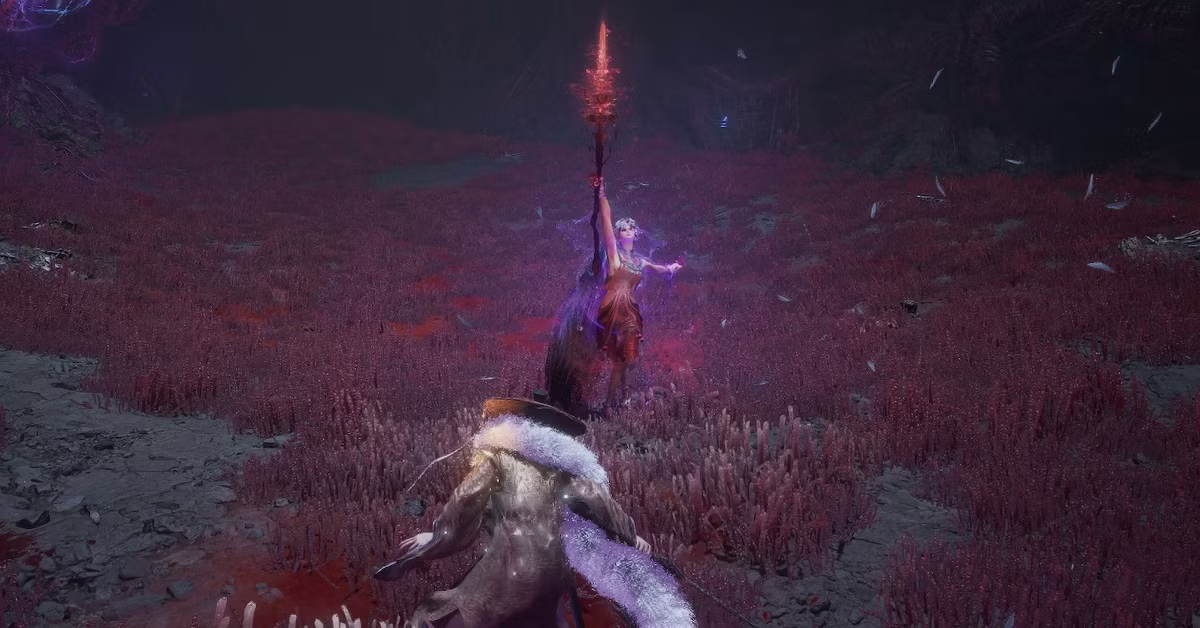
I am working on getting every ending on Wuchang: Fallen Feathers, and doing so either involves 1) playing through the entire game four complete times or 2) doing some fuckery with backing up your saves and, on an Xbox, preventing your game from automatically backing itself up to the cloud while you’re on a backed-up save that you don’t want to be permanent. There’s one ending that actually ends the entire game prematurely, and I wanted to snag that one tonight, but it involves being good enough with a particular boss that you can crush her more or less at will (on it) and making sure you understand exactly how the Xbox Series X’s cloud backup works and when it chooses to back up saves to the cloud. Because if you do it right, you let it back up, beat the game the way you don’t want to keep so you get the achievement, then back out of the game and delete your local save, forcing the game to go back to your previously cloud-backed-up save.
Do this wrong, and you’ve either locked yourself into finishing the game prematurely, meaning you need to play through again to get the other endings (bad) or in a worst case scenario you screw up badly enough to delete your save entirely, meaning that not only do you have to start over again but you have to do it from scratch.
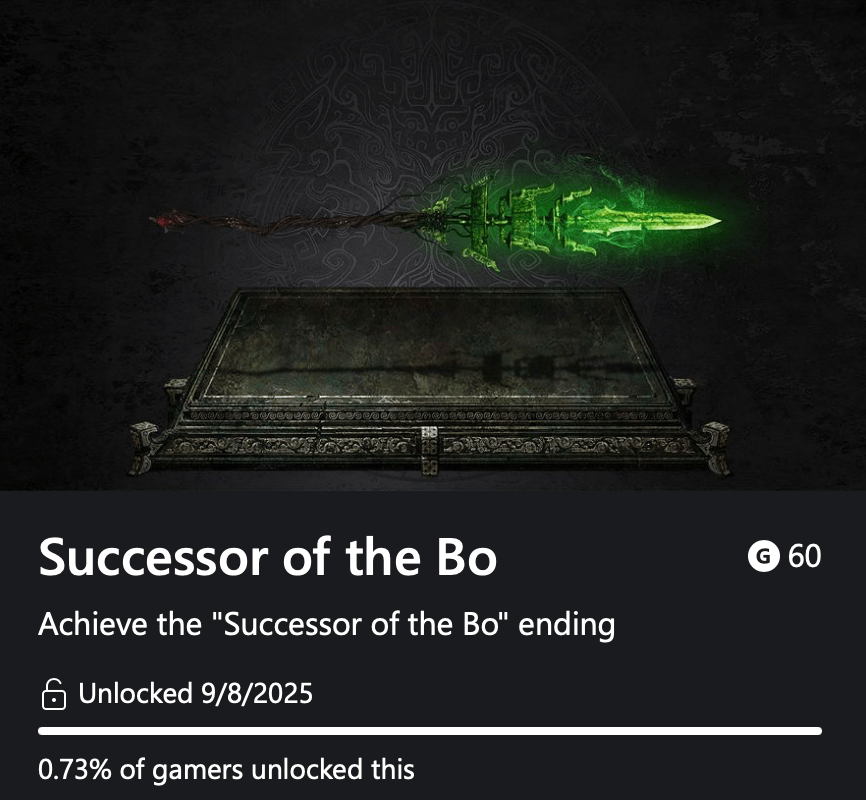
Anyway, I successfully pulled it off, to wit:
Check that completion percentage out, yo.
Anyway, there’s still more game before those last two endings, where I have to do this over again, so I can still screw this up. But at least the most annoying one is out of the way.
This book represents an interesting milestone for me in a couple of ways. First, I am rarely offered nonfiction ARCs for review, something I’d like to encourage more of. Second, I don’t think I’ve ever read a biography of someone I was less familiar with prior to reading the book than I was with Charles C. Diggs. While I don’t think I could claim to have never heard of him– I have read too much about the Civil Rights movement to have never encountered his name before– I couldn’t tell you much other than that he was a Black congressman. I certainly wouldn’t have recognized a picture of him. I was a little worried that this might hurt my enjoyment of the book; as it turns out I have more than enough context around his life that that wasn’t a problem.
The interesting thing here is that, sitting here, I’m struggling with the urge to make this piece a review of Diggs rather than a review of the book. At the same time, though, you weren’t sent a copy of this for free, so I kind of feel like if I’m going to convince you to read it you probably need to know a little bit about the fellow you’ll be spending a few hundred pages with. To wit: Charles C. Diggs Jr. was the son of one of Detroit’s most influential Black businessmen. His father was the founder of the slightly-oddly-named House of Diggs, a funeral home that at one point handled just over half of the deaths among Detroit’s Black citizenry. Charles Sr. had a short-lived political career as a Michigan state Senator but mostly kept his business empire running; Charles Jr. started his political career in his father’s seat in the Michigan Senate but was elected to Congress in 1954 and never looked back. He would remain in office until 1980, when a financial scandal led to him being censured by Congress, forced to resign, and briefly imprisoned. He holds the distinction of being the victim of one of Newt Gingrich’s first acts of assholery, as the future Speaker of the House and fellow resignee-in-disgrace began agitating for Congress to expel Diggs almost as soon as he took office.
When Diggs entered office, he was one of only three Black congressmen, joining William Dawson of Illinois and Adam Clayton Powell, Jr. of New York. He proved himself to be skilled at coalition-building and incrementalist approaches to civil rights– one of his first legislative accomplishments was desegregating airlines, for example– and eventually became one of Congress’s foremost experts on and advocates for Africa as well. Soon after taking office he traveled to Mississippi to sit in on the trial of Emmitt Till’s murderers, which made national headlines, particularly as Mississippi at the time had absolutely no idea how to handle a Black Member of Congress.
But let’s talk about the book. House of Diggs is a very strong political biography and a worthy addition to my library about the Civil Rights movement and is somewhat less successful as a biography of a person. Which, honestly, kind of fits with its subject anyway, as Diggs was quite successful as a politician and much less successful as a person. His children are barely mentioned, but his four wives, three of whom had children with him, would have described him as a poor father anyway, and you won’t find out about any of the three divorces until nearly 80% of the way through the book. He had a gambling problem and was absolutely terrible with money, which is part of what led to his own downfall and at least tangentially led to his father’s business empire slowly disintegrating after the senior Diggs died by suicide in 1967. The finance issues that led to his resignation and jail time are a bit too complicated to go into detail about here, but I felt Orr did a really good job of explaining the details of what happened, both in a literal factual sense and in how Diggs’ own personality flaws led to his eventual indictment. It also seems to be true that the practices that took Diggs down were quite common in Congress at the time, and Orr doesn’t neglect the role of racism in his prosecution while never losing sight of the fact that, no, “everybody else was doing it” isn’t really a top-10 legal defense.
All told, I’m really glad I was sent this, as it’s from a university press and I likely wouldn’t have even encountered it otherwise. If political biography is your thing or you have an interest in the Civil Rights movement, I highly recommend taking a look.
My current phone is an iPhone 14 Pro Max. Apple is a few days away from announcing the iPhone 17, and my phone has reached the point where on most days I have to charge it for a bit while I’m at my desk or doing something else; the battery isn’t getting through a full day reliably any longer. I used to replace my phone almost every year more or less whether I “needed” to or not; I’ve gotten out of that habit with the last few phones as they’ve gotten steadily more expensive.
So here’s my dumb problem: I don’t really want an iPhone 17 of any particular stripe, although it’d be highly unlikely that I would order anything other than another Pro Max. Not because I’m thinking of switching back to Android– I am Apple’s bitch now and forever, and am too thoroughly tied into their ecosystem to even seriously consider switching– but because their foldable phone is rumored to be coming out in 2026.
Rumors for the price of the foldable iPhone have ranged between two thousand and two thousand five hundred dollars, and that’s before whatever tariff fuckery might happen between now and next September.
That’s … a hell of a lot of money. And it’s even more money if I spend the $1200 or whatever I’m going to pay for a 17 in between now and then. And it’s also money that would be spent on a first-generation Apple product in a category that, so far, phone manufacturers have not exactly been covering themselves in glory with. Foldable phones are tricky as hell, and from what I’ve seen so far no one has really nailed the tech yet.
Now, for a sensible person who doesn’t have a spending problem, this isn’t actually a hard decision. I hold onto my current phone until it’s genuinely untenable to keep using it; if that’s before the Fold is released, well, that sucks, but it happened, and if the Fold comes out and I don’t like the price or something else about it (or they delay it, or the rumors are wrong, or or or … ) I just buy whatever the equivalent of my current phone is at that time.
That’s the sensible approach. But the sensible approach ignores the fact that I’ve been fighting off the newshiny for three years already, and I am maybe more sensitive than I should be to being annoyed by my phone– part of the reason I have a Pro Max is that I don’t like having to think about battery charge pretty much ever– and, like, September is the month you buy new phones. I recognize that all of this is stupid; that’s why I titled the post the way I did.
I could, in theory, try a smaller phone for a year, instead of buying the most expensive phone in their lineup. What would that be like? I don’t even know. But it would cut the pain a little bit if I decide to upgrade a year later.
Anyway. I have no common sense, but that’s why I have readers, who I assume are smarter people than me. What say you? Put up with bullshit for another year assuming I’ll want to trade up in 2026, upgrade but with a less expensive model so that it’s not as big of a hit in a year (worth pointing out: the trade-in will get me money back) or assume that I’ll manage to talk myself out of spending laptop money on a phone a year from now and just get the phone I’d be getting if I didn’t know anything about the Fold?
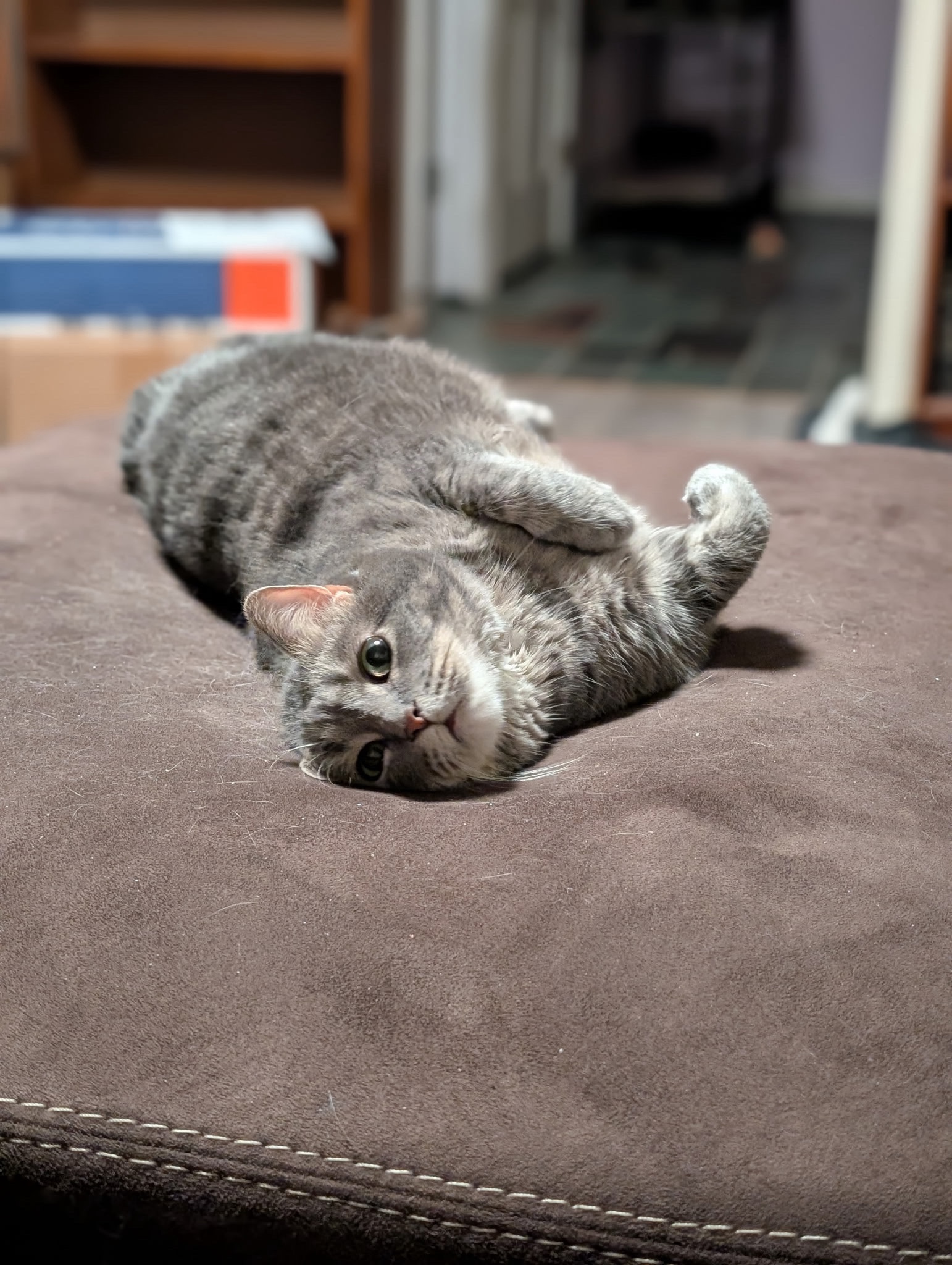
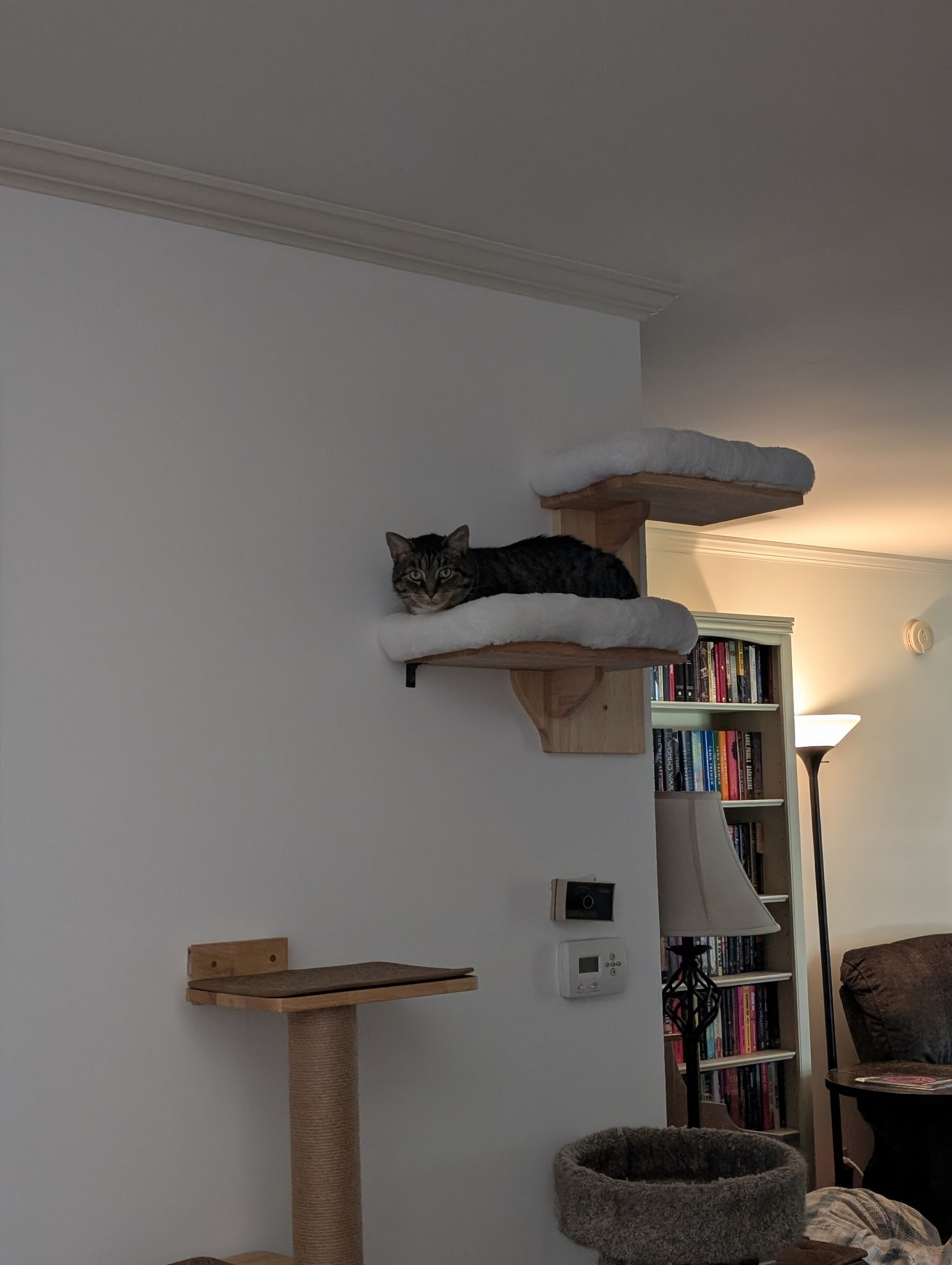
I feel like there needs to be a post here about the general hysteria around all the corners of the internet I frequent about That Man last weekend, and whether he had died or not, but there was a two-hour Thing at Hogwarts this evening, and I just got home from that, and I have lesson planning and some other business to attend to so I can sleep, so … yeah. Instead, have a picture of Jonesy in his new sky bed I installed last weekend.
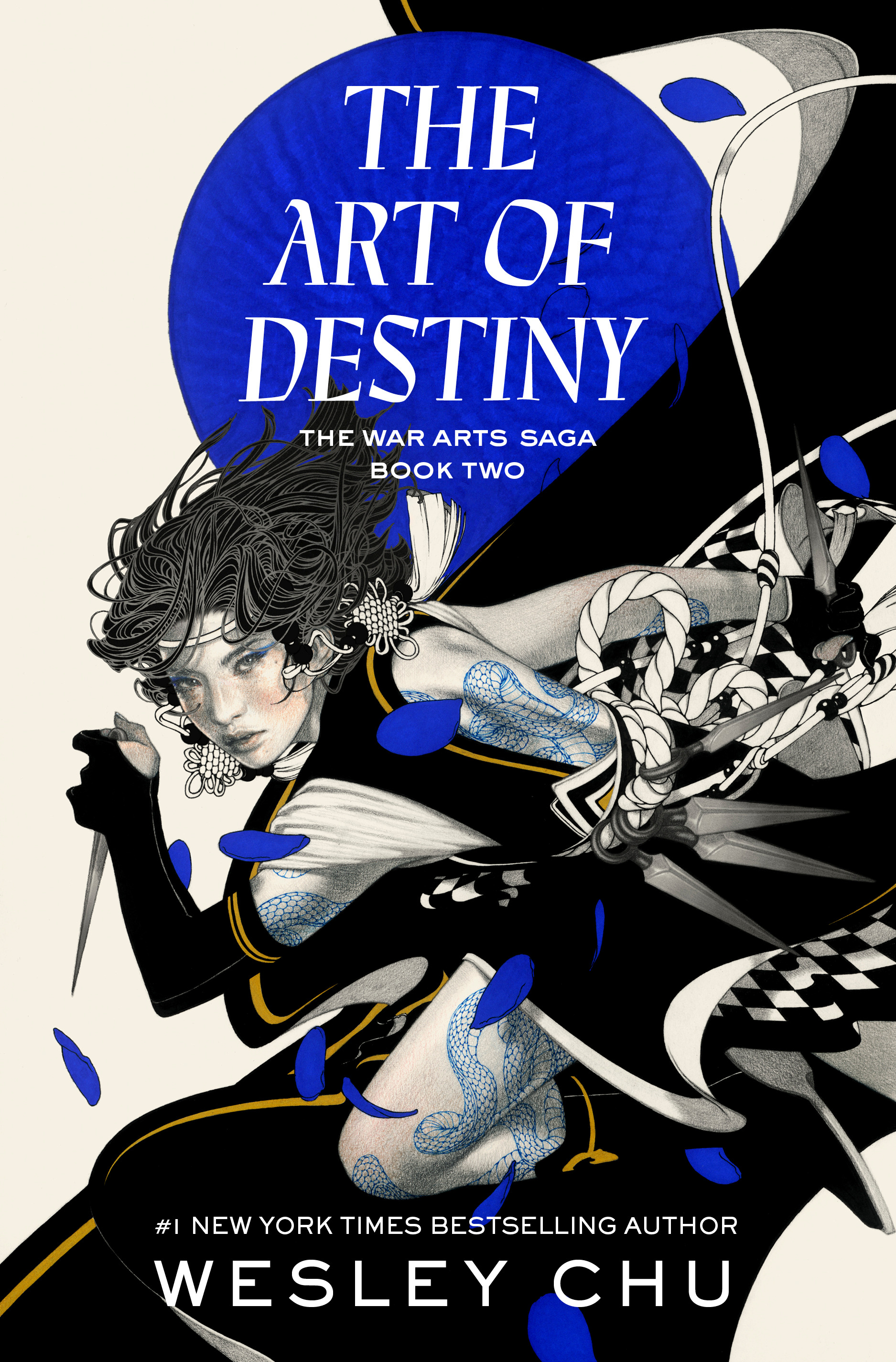
A quick recap: I got asked if I was interested in reviewing Book Three of Wesley Chu’s War Arts Saga, and replied that I’d love to, but I hadn’t read the first two books yet, and somehow that led to me getting sent review copies of the entire trilogy. My review of the first book, The Art of Prophecy, is here, and while I’m not going to go directly into Book Three like I thought, there’s only going to be one book in between, so I’ll probably have a review of that next week sometime.
But yeah. I enjoyed the book, but it definitely has a case of Middle Book Syndrome, where it sort of feels like they’re moving pieces around in preparation for finishing it off in Book Three. Destiny sticks with its same crew of players as the first book; Jian and Taishi are in training, Qisami spends most of the book on a job, and Sali spends the book trying to get the fragment of the Khan’s soul out of her body. Qisami feels like the main character of this one, which is a little odd, as I felt like she was the least important of the leads in the first book, to the point where I don’t think I mentioned her in the review. She has some interesting character development that is almost entirely tied up in spoilers, and Sali has a major status quo change and a clear direction going into the last book. The characters don’t interact as much in this one, either; they all end up in the same place for the last third of the book, but even then nobody really runs into each other; they’re all just doing their thing in the same city.
Jian and Taishi … feel kinda wheel-spinny. Taishi was easily my favorite character of the first book and she’s not got nearly as much time on-page in this book, and Jian gets captured again and it just sort of feels like a retread of a lot of what happened in the first book. There are some interesting developments in the religion around Jian; I was thinking as I was reading Prophecy that it’s super rare in the real world for a prophecy to be proven wrong and its supporters to just shrug and give up, and … well, turns out they didn’t, but I won’t say much more about it than that. But Jian still kind of feels like an immature kid for the majority of the book. There are some signs of maturation toward the very end of the book, so hopefully I won’t feel this way about him in the conclusion to the trilogy.
Don’t misunderstand me; even if I had bought these, this certainly wouldn’t put me off the third book, as a lot of my gripes are just part and parcel of the way middle books in trilogies tend to be messy. It’s not like there was much of a risk of anyone trying to read this as a standalone.
I’ve got another book I was sent for review to read next, as it’s out on the 16th, and then I’ll be diving into the conclusion. Stay tuned!



 Welcome to infinitefreetime dot com