 Got into an interesting conversation on Twitter tonight (I’m writing this Sunday night to pop on Monday morning) and I feel the need to expand on my thoughts a little bit without the restriction of 140 characters, especially since the thread quickly expanded to include four different Twitter handles, and actually talking got kinda difficult quickly.
You can hit up my Twitter stream if you want all the details, but this is the Tweet that caught my attention. I’m stripping the username out of it because the guy was being reasonable and polite the whole time and I’m not writing this to dump on him– plus, again, my Twitter feed is literally to the right of this post anyway if you want to go looking.
The original post was a question:
My only question to you two is this: is it wrong to discriminate against authors based on gender and race?
A bit of background is perhaps necessary: While I am not completely certain where the hashtag campaign originated, it blew up right around the time this article by K. T. Bradford was published at XOJane. The headline for the article really tells you everything you need to know: I Challenge You to Stop Reading White, Straight, Cis Male Authors for One Year.
A couple things on that.
1) I am a white, straight, cis male author.
2) I like it when people read my books. I like it more when they read my books via sending me money for them.
3) You should absolutely do this challenge if you’re remotely interested in it, even though it means you won’t be reading any of my books for a year. Although you could decide to start it in May, right after you finish reading The Sanctum of the Sphere.
Is it wrong to discriminate against authors based on gender and race?
Yes. Discrimination is wrong.
However, and this is real goddamn important: DECIDING TO NOT READ SOMEONE’S WORK IS NOT DISCRIMINATING AGAINST THEM. That’s first and foremost. Absolutely nogoddamnbody anywhere owes an author a read of their books. I don’t owe it to anyone to read their books. None of you owe it to me to read my books unless you are my momma or my wife, and even they probably don’t really have to if they don’t want to. As a reader, in order to read your books I have to invest both a) my money and b) my time, which is far more valuable to me. You are not entitled to either of those things.
As a writer, I am similarly not entitled to either of those things from my readers. It takes a special kind of blindness to one’s own privilege to see “I don’t want to give you my money or my time” and interpret it as discrimination. That is not remotely what that word means and you absolutely cannot even begin to think that way unless you believe (and you may not even realize you believe it) that you are somehow entitled to the time and money of other people. It’s simply not true at all.
Furthermore: nowhere does K.T. Bradford say you should never read books by white, straight, cis male authors again. She explicitly challenges her readers to stop reading writers of that persuasion for a year. Even if you could claim discrimination if someone was trying to talk people out of buying your work based on some immutable physical characteristic of yours, your already-bad-and-wrong case gets even weaker when the time-limited aspect is added in. This is not, to use a food metaphor, never eat a cheeseburger again. This is try some goddamn chicken once in a while.
This is, in fact, basically the book version of Lent. A lot of y’all are Christians, right? So maybe you gave up something for Lent. It’s ludicrous to decree that you are discriminating against gambling, or chocolate, or Coke Zero or masturbation or whatever by giving it up for a few months. You’re denying yourself something you like, yes, and maybe a really good candy bar might debut during that forty days or however long Lent is, but it’ll still be there after Lent. And maybe in the meantime you’ll have discovered that you really enjoy playing handball instead of gambling, or eating roasted brussels sprouts instead of chocolate, or vodka instead of Coke Zero, or self-flagellation instead of masturbating. Once Lent is over, you can go right back to those other things– only now you’ve discovered all this other stuff that you like too! Maybe you’ll discover something you liked even more than chocolate!
How would you have known that if you never tried?
Now, all that said: I am not participating in this challenge. I already try to keep an eye out for writers of color and women writers, and if I remember right three of my four top books for the last two years were not by white males, so I’m clearly doing something right. I bought Django Wexler’s first book at least partially because I assumed that being named Django meant he was black, and I still think he’s cheating. I am, in fact, reading The Goblin Emperor by Katherine Addison right now, and I’m about halfway through it and it’s spectacular. Do I say this so that you’ll give me a cookie? No. I say this to point out that by looking out for the occasional Saladin Ahmed or Helene Wecker or Bill Campbell or Nnedi Okorafor or Ann Leckie or whoever, I’m already getting cookies. And cookies are delicious and you should eat more of them, even if it means that sometimes you’re too full for yet another baked potato.
Hmm.
I may, at some point in this post, have overmixed a metaphor.
tl;dr: Quit being silly, white guys.


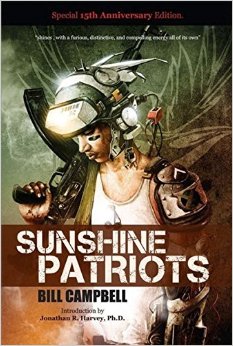 This book, right here, you should read it.
 Welcome to infinitefreetime dot com