
Wednesday morning braindump

This is, rather emphatically, not a review of this book, as it’s eight hundred damn pages long, I’m not quite 1/4 of the way through it, and I have no plans to abandon it at all. This will be spoiler-free, for the most part, and even if I do spoil something, like I said, I’m early enough in the book that it barely counts.

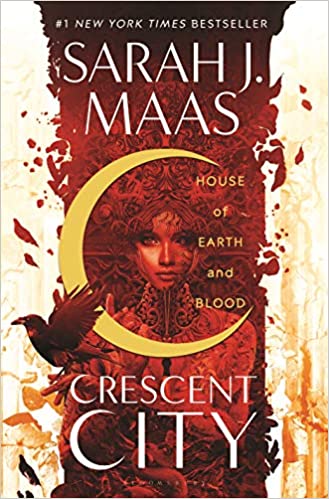
I discovered Sarah Maas had a new series out when I found it at Target, of all places, several weeks ago; buying a book from Target would prove to be only the first of several deeply weird things about this book. First of all, take a look at that cover: what’s the name of the book? If you said Crescent City, you’d be wrong, as that’s the name of the series, currently planned as a trilogy but who knows. The name of the book is House of Earth and Blood, following the modern trend of naming books Noun of Noun and Other Noun. Seriously, look around, there are dozens of them. I feel like somebody needs to have a word with whoever did the cover layout, as that’s … weird.

Second, I’m having some serious issues with wrapping my head around the worldbuilding she’s doing here. For all practical intents and purposes, House of Earth and Blood is set in the modern world, except not: this book is clearly (?) not set on Earth, although people have cell phones and order out for pizza and days of the week are called Tuesday and months are called April, and the main character works in an art gallery, except so far literally none of the main characters are fully human. So it’s sort of urban fantasy-ish, except that it’s not set in the Real World, which is how every other example of UF I’ve ever read works, but even though it’s not set on Earth there is this deeply bizarre mishmash of real, ancient human cultures all over the place: the titular House of Earth and Blood is one of the four Houses of … Midgard, and a group called the Vanir is a thing, and there is slavery in the book, and people who are enslaved have SPQM tattooed on them, which stands for Senatus Populusque Midgard, which might hit you kind of funny if you know anything about Rome.

There’s a character named Maximus Tertian, and there are also angels, most of whose names end in -iel, as you’d expect from angelic names derived from Hebrew, and there was an angelic rebellion at one point, because of course there was, and meanwhile the main character is named Bryce Quinlan. It’s all very schizophrenic and oh did I mention that despite all this the book is shaping up to be a police procedural/murder mystery? Because it is.

My ultimate opinion on this book is really going to depend on whether this ends up feeling like it all makes sense together or is just very very lazy. I really enjoyed Maas’ Throne of Glass series, so she has a ton of goodwill built up, and I’m entirely willing to believe that there is a plan for this, but right now the whiplash is really getting to me.


I probably shouldn’t even talk about this, and I’ve been resisting talking about this, because I feel like there’s no way to do it without coming across as vaguely creepy, but it’s still on my mind two days later and there’s a reason the word “braindump” is in the name of this piece. So let’s get mad at TikTok for a couple of minutes. (TikTok? Tik Tok? How do I not know if it’s one word or two yet?)

I ran into this random video on my For You page a couple of days ago. An older white lady, very very angry, ranting into the camera, which usually isn’t how TT goes for a couple of different reasons. Anyway, she was bitching about how “you” need to stop looking at “her video,” because “she” is “only fourteen” (clearly not referring to herself) and how TT is “promoting child porn” and people should stop going to look at “the video.”

First of all, this is probably a kid doing some sort of booty dance in a tank top, which is about half of TikTok at any given moment. The notion that there’s actual child porn on the site feels … somewhat unlikely. But if you think there is child porn on the site, what the hell are you doing posting a ranty video at people to stop looking at it, with no indication whatsofuckingever of what the hell it is we’re supposed to stop looking at? Like, what am I supposed to do with this information, white lady? You’re very upset about some video, and you don’t want me to look at it, which, okay, fine, but that’s literally all the identifying information you put in your video? That there’s something Out There Somewhere that is so bad you’re literally calling it child pornography, so maybe throw out a user name or something so that the rest of us can block or report it? Because it’s not like the For You page gives us a choice of what we’re looking at, right?

…and this is why I’ve resisted posting this, of course, because tell us the username so we can block and report is functionally exactly the same as tell us the username so that all the dirty old men can go look at the child porn, and now everyone looking at your stupid little video with even a trace of common sense is stuck in this weird limbo between I would like to help you get rid of the terrible thing and I am not a fucking degenerate, and you can’t do one without setting yourself up to be accused of the other, and one more time why the hell did you decide to post this? Because, again, functionally speaking, what you just posted is I don’t like someone else’s video but I’m not telling you who or which one, but I’m really REALLY mad about it.

Subtweeting on fucking Tiktok, and fuck it I’m just going to spell it differently every time I use it in this post, shouldn’t be a thing. And now I’ve posted about the stupid thing, and I can stop thinking about it.

Anyway. I’m done now.


9:18 AM, Wednesday May 13: 1,370,016 confirmed cases and 82,389 Americans dead.

#REVIEW: THE CITY WE BECAME, by N.K. Jemisin

I’ve only been to New York once. I was living in Chicago at the time, so it was probably fourteen or fifteen years ago now, and I was only there for a few days. I went to visit a girl, and I honestly wasn’t terribly interested in doing a lot of sightseeing with the limited amount of time we had, which I think disappointed her a little bit. She lived in Battery Park City, which is on the extreme southern tip of Manhattan (you could see the Statue of Liberty and Ellis Island from not far away from her apartment) and other than the travel needed to get to Manhattan from whatever airport I arrived in, I didn’t really see any of the other boroughs. We went to Central Park, visiting the Zoo and finding the apartment building and the church from Ghostbusters, so you can tell whose priorities were driving the few places we did visit. If I were to identify myself with a city it would still be Chicago, despite the fact that I’ve now been away from the city for longer than I lived there.

The City We Became is, in a lot of ways, Not for Me. Jemisin has described the book repeatedly as a love letter to New York City, and as someone who doesn’t know the city I don’t know that I was missing anything, necessarily, but I suspect New Yorkers will get more out of the book than I might have. Except maybe for Staten Islanders. I would love to know what people from Staten Island think of this book, actually. It will be fascinating to see if this book is greeted with the near-universal acclaim that her previous work and particularly her Broken Earth trilogy received; if you’re not familiar with her, you should be: she is the only author ever to receive the Best Novel Hugo award three years in a row, and she is, hands down, the single most important author working in science fiction and fantasy today. And this, while still certainly fantasy, is very different tonally and structurally from her previous work, to the point where I’m not entirely certain I’d have pegged it as a Jemisin book if I didn’t know she’d written it.

None of that, mind you, is a complaint. The City We Became is the first book of a new trilogy and the basic storyline is simple enough that you can cover it in a sentence: New York City comes to life (roll with it) and chooses five individuals to act as avatars of each of the five boroughs.

(Pauses to put Beastie Boys on; To the 5 Boroughs has always been my favorite of their albums.)

Anyway, the Beasties thing broke this into two sentences rather than the promised one, but: there are complications. Turns out the birth of a city is a somewhat fraught and dangerous process, and there are those who tend to oppose it when it happens. You may have heard of Atlantis, for example, which did not survive the birthing process. There are a handful of other living cities as well; the avatars of São Paulo and Hong Kong make an appearance. There’s also a hell of an Oh Shit moment at the very end when the true nature of what they’ve been calling the Enemy throughout the book is revealed; a more careful reader than me may figure it out in advance (I should have; minor spoiler: take the myriad Lovecraft references seriously) but it’s still a great moment.

This is not one to sleep on, y’all. Jemisin is a powerhouse of an author no matter what, and a project like this that she’s openly admitting is some of the most personal work she’s ever done is not something to be missed. Go pick it up.

#REVIEW: TRAIL OF LIGHTNING, by Rebecca Roanhorse

trail-of-lightning-9781534413498_hrHere’s a one-sentence review of Trail of Lightning, by Rebecca Roanhorse, that ought to tell you basically everything you need to know:  I started it Saturday night at 10:30 PM, reading before going to sleep as I always do, and I had finished it by dinnertime the following day, and I worked from 11-5 on the day I finished it.
I woke up at 8:30 on a Sunday morning and rather than roll over and go back to sleep I grabbed a cup of coffee and took this book out onto my back porch to read outside for an hour or two before it got too hot.  I realized after I’d been out there for an hour that I’d left my phone sitting next to my bed.  Do you have any goddamn idea how rare it is for me to be more than ten feet from my phone for an hour?

(Okay, yeah, you probably do, but still.)

If that’s not enough, and if that gorgeous cover isn’t enough, how about the genre?  Trail of Lightning is Navajo post-apocalyptic urban fantasy.  And hard core Navajo, to the point where I feel kind of bad saying “Navajo” and not “Diné”.  There are words in this book that contain letters that I don’t know the names of, guys.(*)  A pronunciation guide would not have gone unappreciated.

Right, the story.

It is The Future.  Global warming and sea level rise has gone way way worse than anyone imagined (it is hinted, but not explicitly stated, that something supernatural may have happened to make it worse) and as a result huge swaths of what used to be the United States– like the entire midwest– have drowned and Dinétah, the Navajo nation, is an independent nation-state on its own again.  Maggie Hoskie is a social outcast who hunts monsters.

There are monsters, by the way.

I’m no hero.  I’m more of a last resort, a scorched-earth policy.  I’m the person you hire when the heroes have already come home in body bags.

That paragraph is from page 2.  It was at that precise moment that I knew I was in and this book was going to be something special.  Maggie is a bit of an asshole, so if you’re not the type to like abrasive first-person protagonists this may not quite be your cup of tea, but watching her hunt monsters and argue with trickster gods and do magic stuff and navigate the fascinating world that Rebecca Roanhorse has created was absolutely one of the biggest pleasures of the year so far with me.  Trail of Lightning joins two other debut novels by women of color– Jade City and The Poppy War— that are guaranteed to be on my top 10 list at the end of the year.  Roanhorse’s prose is clear and accessible and the book absolutely flies; this is the kind of novel that I want to write as much as I want to read it.

I’m just not going to try and read it out loud.  🙂

(*) hataałii, for example– I have no idea what to do with that L–, or yá’át’ééh, which has accents and apostrophes.  No italics for the Navajo words, either, which is great, unless you’re scanning for words you don’t know and don’t have that to help you.  (**)

(**) Audio on the web is inconsistent, but the ł may be pronounced like a W.

#REVIEW: THE LIVES OF TAO, by Wesley Chu

51zuwjF8-lL._SX301_BO1,204,203,200_The Lives of Tao is the second of Wesley Chu’s books that I have read.  It is, I’m pretty certain, his debut novel, and has two sequels, The Deaths of Tao and The Rebirths of Tao.  I like Chu’s work quite a bit from what I’ve read of it, but this one has a few problems that didn’t show up in Time Salvager, which was the first Chu book I read.  He has some major strengths as an author, chief among which is writing fast-paced books that are difficult to put down and writing solid action.  The book has some weak parts, too, but we’ll get to those later.

The premise is thus: millions of years ago (think during the dinosaur age) a rather large group of aliens crashed on Earth.  The aliens found Earth’s atmosphere uninhabitable for them and quickly discovered that the only way they would be able to survive on our planet was to effectively act as symbiotic organisms and inhabit the bodies of creatures that were already surviving on Earth.  They were isolated from each other for millions of years (the aliens, the Quasing, aren’t precisely immortal– they can be killed– but they don’t die of old age) but eventually Earth managed to evolve intelligent life and ever since then the Quasing have been guiding our evolution as a species and trying to get humanity to a point where they can go back to space– which is apparently way more complicated than it sounds.   The book picks up when Tao, a Quasing whose host has just been killed is forced to inhabit the body of an overweight, unambitious computer programmer named Roen Tan, and basically has to change him from a video-game-obsessed chubby schlub into an international man of mystery and combat operative in a not-especially long period of time.  Oh and there are two different factions of the Quasing now and they don’t like each other all that much.

If that premise interests you, you should read this book; you’ll like it.  If you’re already scratching your head and going “Well, wait, what about…” then you might want to skip it, as not quite fully thinking the premise through is why this is a perfect four-star book (out of five) for me.  Over the course of the book you find out that most of the Quasing characters you encounter have inhabited major historical figures over the course of their, remember, theoretically infinite, millions-of-years-old lives.  Tao himself was, among others, Genghis Khan and Zhang Sanfeng, who you may not have heard of but was the inventor of tai chi.  At various points in the book Shakespeare, Galileo, the apostle Peter and any number of other important historical figures are all revealed to have been hosts for Quasing.

The problem is, “humans have never controlled their own destinies and have been inhabited by aliens manipulating them in a shadow war for literally all of history” isn’t the premise for an action-adventure with some comedy elements like this book.  It’s the premise of a horror story.  And the Quasing are not remotely alien enough to be actual aliens, much less aliens that are all millions of years old.  It’s not quite clear how they’ve not managed to return themselves to space yet either; they’ve retained all of their scientific knowledge, but Chu’s need to keep to the actual human span of history means that there need to be ridiculous bits like Galileo having been told by a Quasing that Earth wasn’t the center of the universe.  Did this just … never come up before?   I mean, once humans had opposable thumbs and enough of an intellect to use their tools, what was keeping the Quasing from just jumpstarting us to at least something close to the level of technology they had?  There are nods here and there to one of the factions not really wanting to alter human history that much, but there are apparently hundreds if not thousands of these things and they’ve been here for, again, the literal entirety of human history.  There’s no human history to alter.  There’s only Quasing history.

But again: I read this book in about three days in big gulps.  If you can ignore the previous paragraph, if that sort of thing isn’t going to get under your skin and gnaw at you, you’re probably going to like this book, and even though I am one of those people I’m going to end up picking up the sequels.  Don’t get me wrong: four stars, I enjoyed reading this.  But the premise needed some work before this went to print.  We’ll see if there are any corrections applied in the later books.  For now?  I’m still in.

COVER REVEAL: The Well Below the Valley, by Katherine Lampe

Katherine Lampe is a Twitter buddy and fellow independent author.  I reviewed the first book in her Caitlyn Ross miniseries last year and enjoyed it a lot; this is book seven.  This will be a big week for her around here, because she’s doing a guest post for me later this week too.  

The cover is by the most excellent Matt Davis, who I plan on working with myself just as soon as I find the right project.

well002

Six months after the birth of her daughter, Caitlin Ross’s life is in a tailspin. Still suffering from what he endured at the hands of his former lover, her husband, Timber MacDuff, has drawn away. The gods have stopped speaking, except for vague hints in bad dreams. Unwilling to face reality, Caitlin goes about her daily routine as if nothing has changed while deep inside she longs for distraction.

When the county sheriff asks for help with a puzzling situation, Caitlin believes her prayers have been answered. A rancher has drowned in the middle of a desert, and the means appear supernatural. The case is right up Caitlin’s alley, but her interest pits her against Timber, who insists getting involved is too dangerous now that she’s a mother. Neither he nor Caitlin realizes a greater danger awaits. Strange events in Gordarosa have brought the area to the attention of a group known as Shade Tracers. Mundane mortals, they’ve taken it upon themselves to protect humanity from magic—with deadly force, if necessary. One holds Caitlin responsible for a personal tragedy, and will stop at nothing to see justice done..

Past and present converge in Caitlin’s darkest adventure yet. With her own life at stake, she must journey through time to uncover the truth behind the Shade Tracer’s obsession. Success could provide the key to solving the local mystery. Failure will doom her to a life on the run, forever hunted.

The Well Below the Valley will be released in print and electronic editions August 2, 2016.

EXCERPT

Just then, some odd flickers from the BLM land adjacent our property caught my eyes. Shading them with my hand, I squinted into the distance. A flash. A beat, and then another. No regular rhythm. They seemed to originate from the low hill from which we often watched the moonrise.

Some kids dicking around with a mirror. BLM land was public property, and this section lay convenient to town. Bored local teens partied there. Timber and I combed the ground a couple of times a month, picking up the trash they left behind.

I bent to retrieve my basket. As I straightened, the light flashed again, this time with a distinctive quality hard to define. Less like a mirror. More like a flame. I’d just settled on the difference when something whizzed past my left ear, and a cluster of berries fell off the rowan tree at the center of the garden. A split second later, a sharp CRACK! rang through the air.

My jaw dropped. What the hell? I lifted my eyes from the rowan berries to the hilltop in time to see the light flash again. At the same time, panicked voice shouted not three feet behind me.

“Jesus Christ, Caitlin! Get DOWN!”

A heavy object struck my back, knocking me to the ground. My basket flew from my hand, spilling my harvest. I hit the earth with a shock that drove the wind from my lungs. AS I lay there, cheek in damp soil, the intense, green scent of bruised tomato vines clogged my nose. A foot from my head, a pepper plant exploded. CRACK! Understanding washed over me, and I began to shake.

Someone was shooting at me.

About the Series

Rural Gordarosa looks like any small mountain town, with stunning scenery and locals who enjoy gossip. Witch Caitlin Ross knows, however, that there’s more to her hometown than meets the mundane eye. The caretaker at the local theater isn’t human, for example. And her best friend’s uncle is a demon. Sometimes Otherworldly forces get out of control, and Caitlin has to step in to put things right.

Walking the line between Urban Fantasy and Magical Realism, the Caitlin Ross series is unique in being written with a polytheistic Pagan world view, in which the gods are often as flawed as humans and the other is not necessarily monstrous. The books give readers access to a world where magic is an ordinary part of life, but, for all that, never commonplace. By presenting enchantment as a given, they highlight the wonder in the every day.

About the Author

Musician, DJ, and unrepentant Iconoclast, Katherine Lampe studied at the University of Michigan with Ken Mikolowski, and at Naropa University with Allen Ginsberg and William S. Burroughs. The daughter of an English teacher and a self-professed heretic masquerading as a Presbyterian minister, she is interested in the individual’s relationship with the divine. Her work explores the interaction of the supernatural and the mundane in the lives of real people.

REVIEW: THE UNQUIET GRAVE, by Katherine Lampe

41-X1K0SW+L._SX311_BO1,204,203,200_I’ve said this before, many times: I read books in print.  I have a Kindle Paperwhite, and the iBooks app on all of my various iDevices, but I read every single day and 95% of my reading is on paper.  This wouldn’t be terribly notable except for the part where I’m an independent author, and the vast majority of us make our money pushing ebooks.  In other words, I sell something that I don’t regularly use, and worse, when one of My People writes a book, frequently the sad truth is that I’ll happily purchase and download your book but it’s entirely possible that it’s gonna spend a long time languishing on my Kindle before I have an excuse to get to it.

Not that I’m always super prompt about paper books, mind you, because I have a backlog like every avid reader.  But at least with my print books they’re sitting on my Unread Shelf in my bedroom and they’re glaring at me, and I remember they’re there.  Ebooks are on my Kindle; sometimes I don’t even know where my Kindle is, much less remember a specific book that I ought to get to.

What this means is that when I tell you that once I got started on Unquiet Grave I barely put it down, you probably ought to take it pretty seriously, because “barely put it down” is not something I say about ebooks very often.  Even more amazingly, it’s urban fantasy, hardly my favorite genre– in fact, one I have been complaining about regularly for almost its entire existence.

So.  Right.  The book.  Unquiet Grave is the first of Lampe’s Caitlin Ross series, which is currently at a fairly astonishing six books.  Caitlin is a musician, and in fact drama with her band is one of the main elements of the plot of the book.  She’s also a witch.  However, she doesn’t want to be, and when a supernatural encounter at a gig drags her into the role of protector of her town and Investigator of Strange Doings, she has to make a choice about whether to embrace her nature or continue to suppress it.

Here’s what’s interesting about this book, or at least part of it: it’s the first book in the series, but it feels like it could be book two or three.  The characters have backstory and history that makes the world feel established, and Caitlin herself has been through some shit in her past that I want to know more about.  I don’t know if subsequent books in the series march forward in chronological order or what, but I’d love to see something set before this book at some point.  The Celtic-infused magic system feels like it has rules and boundaries without a lot of time spent explaining them, and Caitlin’s relationships with her husband, bandmates and friends feel real.  The central mystery of the book, which drops back a generation or two into her fictional Colorado town’s history, is a great, interesting story.

The point: you should check this book out.  You’ll like it.  Promise.