

#REVIEW: A House of Dynamite (2025)

Two movies? In two days? Madness!

You may recall that last year I read a book called Nuclear War: A Scenario. I called it the scariest book I had ever read, and while I absolutely cannot say that I enjoyed it, it ended up at a pretty high position on my Best Books of the Year list at the end of the year.

Kathryn Bigelow’s A House of Dynamite is, technically, not a film adaptation of Nuclear War: A Scenario, or at least, if it is, it never claims it. That said, it may as well be: a single nuclear missile is launched from an unknown source (in NWAS, it’s immediately attributed to North Korea) toward what is eventually determined to be Chicago. The movie tells the story of the seventeen minutes between the detection of the launch and the impact of the missile three times from the perspective of three different groups of characters in the American government, all ending as the president makes his decision about what the US’s plan of retaliation will be. That decision is described by one character as “surrender or suicide,” and it’s not clear that there is really a whole lot of daylight between those two scenarios.

You might think that watching the same twenty minutes three times (the film’s runtime is just under two hours, so there’s not exactly a clock ticking in the corner for the entire movie) might be repetitive enough to drain some of the tension out of the film. For me, at least, it absolutely wasn’t, and the fact that you hear some of the same conversations three times over the course of the movie didn’t cut the drama at all. This might be partially attributable to my age– I think us ’80s kids are going to get hit harder by this movie than the generations before or after us, as the threat of dying by nuclear annihilation was something that was hanging over our heads for our entire childhood and we’ve internalized that very differently than people who didn’t go through that. But I had to go outside and mow the lawn after watching this movie just to burn off excess nervous energy, and I think it’s gonna have me fucked up for the rest of the day if not for longer than that.

I don’t have a ton to say about the technical aspects of the movie. The music is very effective, quietly echoing Jaws in the worst imaginable way and again plucking at the strings of the ’80s kids. The acting is as good as it needs to be with no really standout performances; the only actor in the film I was previously familiar with was Idris Elba, who plays the President as someone who never really thought he’d have to make the decisions he is faced with and allows just a trace of “Why me?” to come through his performance. Angel Reese has a cameo; I guess I’ve heard of her, but the movie’s not going to live or die on her playing herself for a couple of minutes.

Much like Nuclear War: A Scenario, I can’t really recommend this movie so much as say it’s very effective at what it wants to do and it’s up to you whether you want that in your brain or not. I wouldn’t spend a lot of time reading reviews; they’re very mixed, and I’m guessing that the film’s ending is primarily responsible for that. I’m not spoiling anything; for me, it ended in the best way it could, but clearly a whole lot of other people disagreed.

I think I’ll go mow the lawn again.

(ALSO: If you’re a Movie Person, please follow me on Letterboxd. I need people over there.)
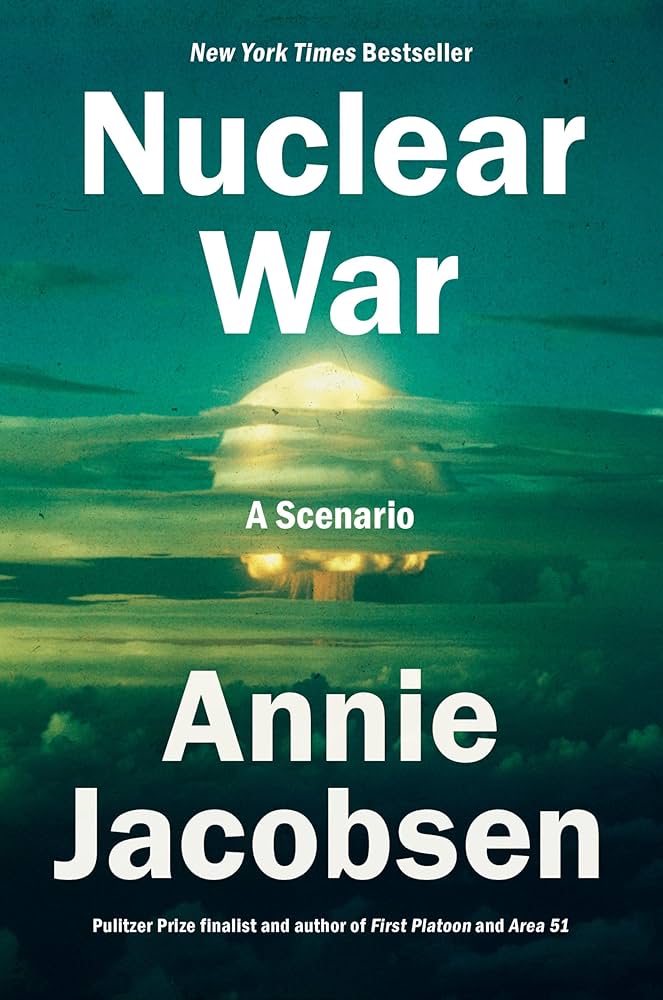
#REVIEW: Nuclear War: A Scenario, by Annie Jacobsen

I’ll not bury the lede: this is the scariest fucking thing I’ve ever read.

My regular readers might be protesting already. Didn’t I just post a “review” of Josh Malerman’s Incidents Around the House that more or less boiled down to “Nope”? And then I named it Book of the Month? And, like, a week later, this book is the scariest fucking thing I’ve ever read?

Here’s the thing: Incidents Around the House is scary as hell. If you enjoy horror as a genre you should read it. But it’s absolutely, indisputably, fictional horror. None of that stuff is going to happen in the real world and you’re not going to learn anything terrifying about the real world while you’re reading it.

I am, meanwhile, not even sure whether I can classify Nuclear War: A Scenario as fiction or nonfiction.

I mean … okay, technically it’s near-future science fiction. And by “near-future” I mean “could, in theory, happen tomorrow.” But the book is so heavily researched and so thoroughly grounded in the world as it exists today that it feels nonfictional, and if you look at the categories it’s trending in on Amazon none of them are fiction categories. There are elements, of course, that are more fictionalized than others; some specific things that happen to, say, the President are not exactly likely to unfold in that exact manner, and there’s an unintentionally (I think) hilarious throwaway detail about the President pro tempore of the Senate that is a clear invention.

But this book starts off with the all-too-possible launch of an ICBM carrying a one-megaton nuclear bomb toward Washington DC, and the next 300 pages covers the next seventy-two minutes in more or less second by second detail, and by the end of the book human civilization is over and everyone you know and care about is either dead or wishes they were and reading about it is not fun. I had to force myself to put it down and go the fuck to sleep Monday night, and got home from work yesterday and sat down and finished it before doing anything else. It’s a propulsive, compelling read but Jesus fuck is it going to give me nightmares.

I will make one small complaint: by the end of the book– spoilers, I suppose, but whatever– Europe, Russia, the Korean Peninsula and the United States are smoking wastelands. However, it might not surprise you to discover that Australia, Africa and South America are more or less entirely unmentioned. There are no nuclear powers in Africa or South America, to start, and Australia just doesn’t get involved. Here’s the thing: I don’t really have a sense of how much of a literally global problem that amount of fallout would be, or whether the inevitable nuclear winter’s effects would possibly be mitigated somewhat in the Southern hemisphere. Jacobsen is clear that she thinks human civilization is fully past-tense after a multination nuclear exchange, but, like, would pockets of civilization be able to survive in, say, Brazil or sub-Saharan (and thus farther from fallout) Africa? Is it possible that the currently inhabitable parts of Australia would stay habitable? Or is everyone literally fucked from the fallout in the atmosphere? Maybe the jet stream keeps it in the northern hemisphere, or, like, something. I don’t know, and I’d like to.

You don’t want to read this book, because it’ll fuck you up hard. But you may want to read it anyway. I dunno. You do you. I’m gonna go crawl under the bed for a week.