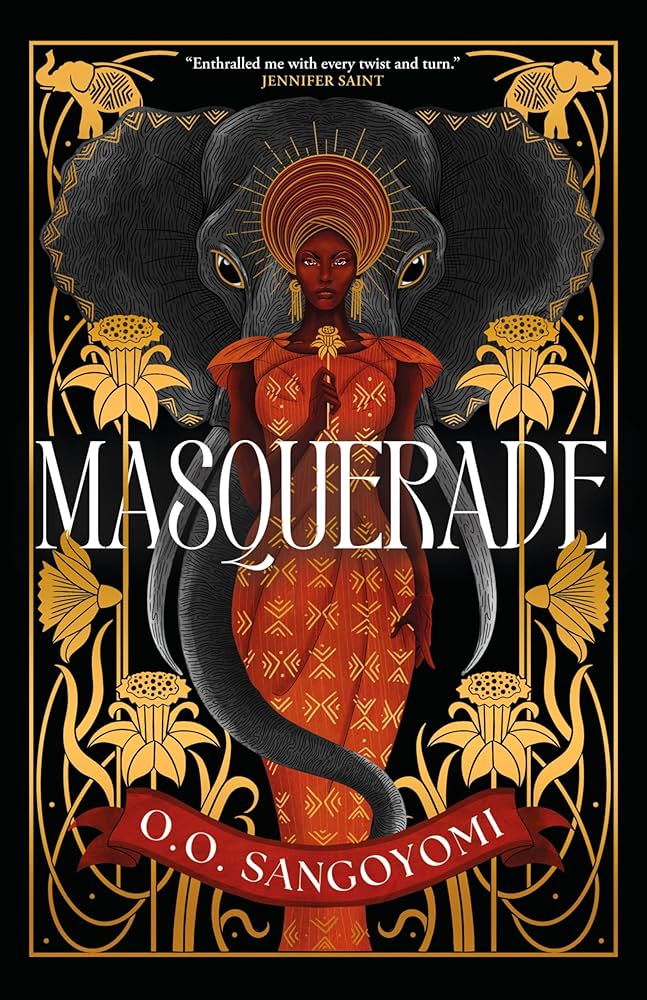
First things first: I’ve said this before, but if you’re not tapped into all the sci-fi and fantasy coming out of Nigerian and Nigerian-descended authors in the last five years or so, you are missing out, and you should fix that. This is going to be a somewhat mixed review of O.O. Sangoyomi’s debut novel, Masquerade, but the damned thing oozes with potential, and even if I had liked this less than I did I’d still be in for the sequel. Which sort of feels like “I like less than half of you half of what you deserve,” but I promise it’s a compliment.
The book jacket describes Masquerade as a “richly reimagined 15th century West Africa,” but I’ve got to be honest, despite what I just said about Nigerian fantasy this feels very much like historical fiction to me, and the speculative elements are minimal at best. I’m not precisely sure what’s being reimagined here. It falls under the fantasy genre because everyone is fighting with axes and machetes and spears, and when that happens we just call it fantasy regardless of how well it fits. It’s very low on the “low to high fantasy” axis, in other words.
Now, I’m not going to claim to have a lot of knowledge about West African history– I probably have more than your average American, but the average American knows nothing, so that’s not much of a brag. The book is set in Timbuktu, which was a real place, and the countries and city-states that show up as adversaries are all real, and the Yoruba are still around. If Sangoyomi has played around with history at all, it’s subtle enough that I can’t tell you about it. I can tell you that the main character, Òdòdó, is a blacksmith at the beginning of the book, and blacksmiths are consistently referred to as “witches,” but … I was never exactly clear why? Everybody’s still using smithed tools like it’s not a big deal, but they’re more or less the dregs of society for some reason.
A quick word on orthography: note all the accent marks in Òdòdó? They’re in nearly every word in the book of remotely African origin and there’s no pronunciation guide. The word I’ve rendered as “Yoruba” up there is Yorùbá in the text, for example. The city they live in is Ṣàngótẹ̀, and I don’t even know how to reproduce that S properly– I had to copy and paste it. I hope everyone will forgive me if other than the main characters’ names I don’t bother reproducing all the accents. If I knew how to pronounce them I might, but I don’t.
So anyway, Òdòdó is busy making herself a life as a blacksmith when she is abruptly kidnapped and brought to Sangote to be the wife of the Alaafin, who is basically the emperor. He’s picked her out while pretending to be a vagrant and having a brief conversation with her at her forge.
She is … surprisingly okay with this. I kind of need to rain some abuse down on the blurb-writers for this, who make the book feel like a revenge tale of sorts, and pay no attention to the “loosely inspired by the Persephone myth,” because once you get past the kidnapping there’s not a lot of there there. But no! Òdòdó is surprisingly cool with being kidnapped, she just wants her mom to be at the wedding, and her naïveté (goddammit!) at her fiancé’s (DAMMIT) insistence that he can’t find her mother to get her blessing is rather annoying. Òdòdó gets pulled into some political maneuvering, falls for a couple of truly amateurish stunts from the Alaafin’s mother, and accidentally helps touch off a revolution, and then somehow the book redeems itself entirely at the end, catching me by surprise in such a way that guaranteed the sequel was getting picked up.
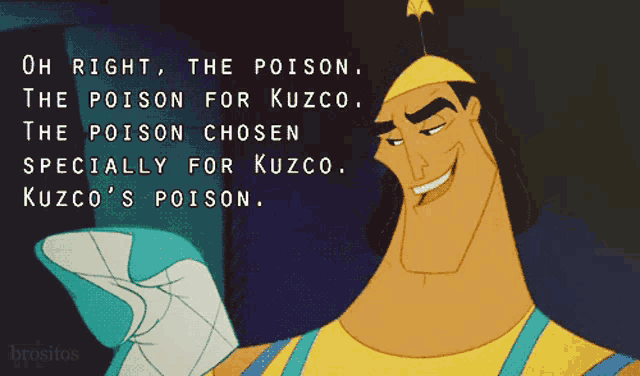
Strengths: the worldbuilding, other than the weird witchery of blacksmiths, was really interesting, and the basic novelty of the setting was great. Sangoyomi’s prose is excellent, and the book managed to include some romantic elements without descending into full-blown romantasy. The weaknesses are the characters, particularly Òdòdó herself, who careens back and forth between being a silly little girl and a seasoned political operative. It’s also unclear how much of a time frame the book takes place over, and you’d be forgiven for thinking it’s just a few months at best, which is not enough time for her to learn some of the things she learns how to do. She’s really good at anything she needs to be good at for the plot to move forward, including occasionally outsmarting actual generals (and coming up with war tactics they haven’t thought of) and defeating grown men in combat, and then she’ll turn around and drink from a cup that the mother-in-law has handed her that may as well have this on the side:
If this hadn’t landed the dismount, I’d probably have just put it on the shelf and moved on, but the ending really was well-done, if perhaps again a bit out of character, maybe? Who knows! But I’d have kept an eye out for this author’s next series. As it is, I’m in for the next book. This isn’t the best thing I’ve read this year or anything like that, but it’s solid and it’s a fast enough read, at about 330 pages, to be able to forgive its flaws.


 Welcome to infinitefreetime dot com