
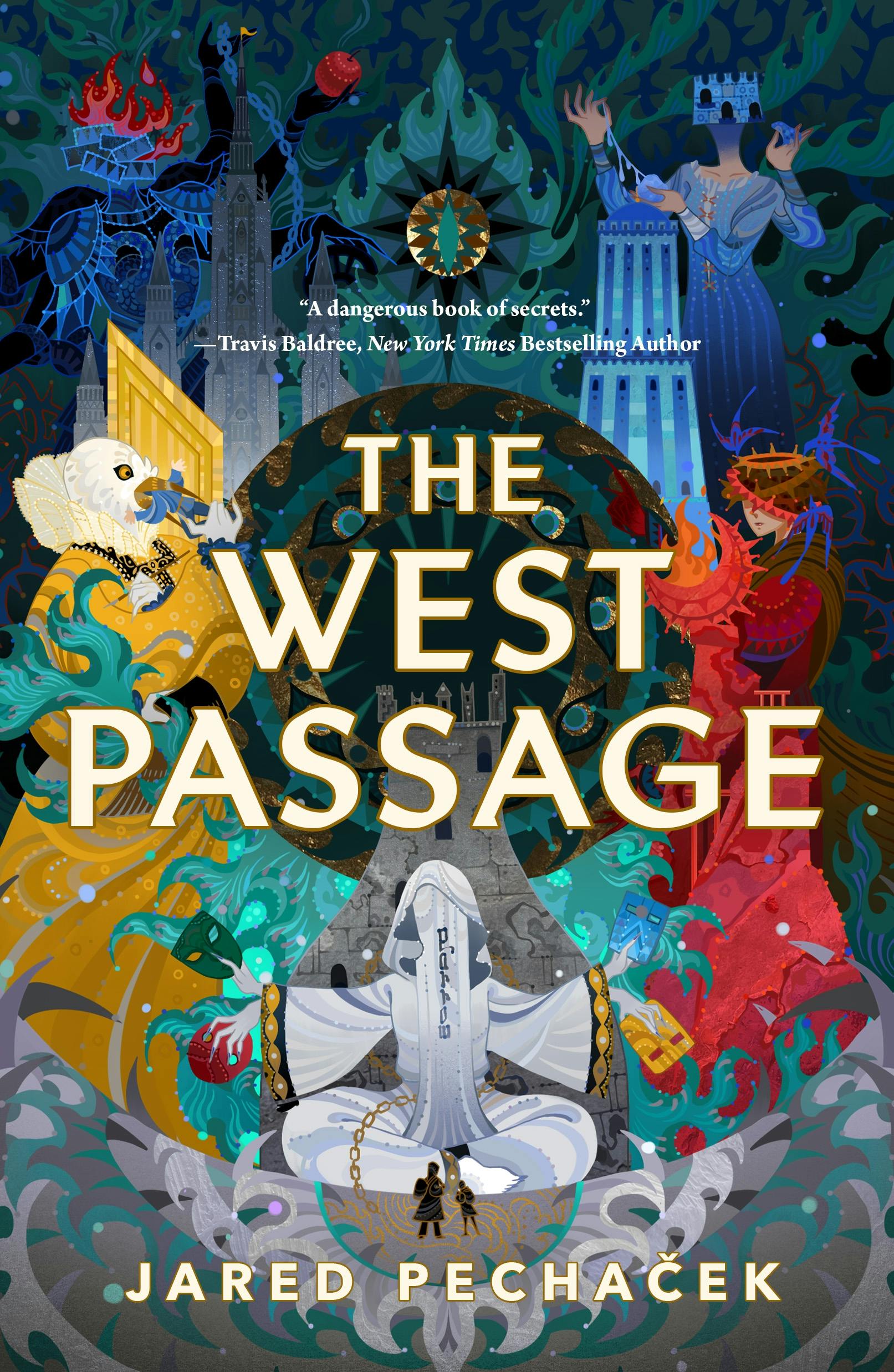
This is going to be one of those books that is difficult to review, at least the way I usually do reviews. Or maybe it won’t be. I’ve certainly written some reviews before that involved flapping my arms around like a landed fish and babbling shut up and buy it before; this will, more or less, be one of those, because despite having read this book cover to cover and having been nearly hypnotized by it throughout that process I find it difficult to describe it without a lot of comparisons that may or may not make any sense.
It’s as if you rolled Gormenghast, The Shadow of the Torturer and Through the Looking Glass into a meatball and then rolled it in honey.
It’s like Harrow the Ninth, but it makes sense.
It’s Labyrinth but the baby eats people. And the baby’s not the point. But the baby’s in there, I promise. Oh and also if China Miéville wrote Labyrinth.
This is a book that uses perfectly normal words to describe things, like “light,” only then you discover that light can be poured out of a jar. Someone’s hair is made of twigs and someone else is a rabbit, only they lay eggs. Something will be described as a beehive and you will think you know what a beehive is and then it will crouch down on the legs that you didn’t realize it had and excrete honey into a jar through a urethra, typically not a body part possessed by a beehive, which don’t even have bodies, much less body parts. Everything is larger than you think it is and has more mouths than you think it should, except for the one thing that has lots of tongues, because that thing has no mouths at all. Everything is crumbling and decrepit and falling apart and no one remembers why they are doing the things that they are doing anymore other than continuing to eke out a pointless existence in a palace that goes on forever, and the world is sort of ruled by five sisters only they aren’t really sisters and I’m not sure they’re even female, because at one point a character gets what for the sake of this sentence I’ll call a promotion and then that character is referred to exclusively with female pronouns for the rest of the book.
This is a book where on one level you will have a pretty good idea what is going on, because the page-to-page events are explained clearly and vividly, and on another hand you will have absolutely no idea what is going on, because none of the nouns mean what they think they mean and your mental picture of what is happening is probably wildly inaccurate for a reason the book hasn’t even revealed yet. It’s a book with not one big quest but two big quests that are sort of intertwined, with a knight and a squire and a Beast that must be vanquished and a Mother who is sixteen and has no children but will find a child in a sack and many Ladies, only some of them have towers for heads and some are birds and at one point a character will be revealed to have three arms and four legs and you won’t be sure if that was the case for the whole book or not, and sometimes everything is on fire, and that’s usually bad.
It’s fucking amazing and it’s one of my favorite books of the year.
I just wish I had some idea how to pronounce “Pechaček.”

 Welcome to infinitefreetime dot com