
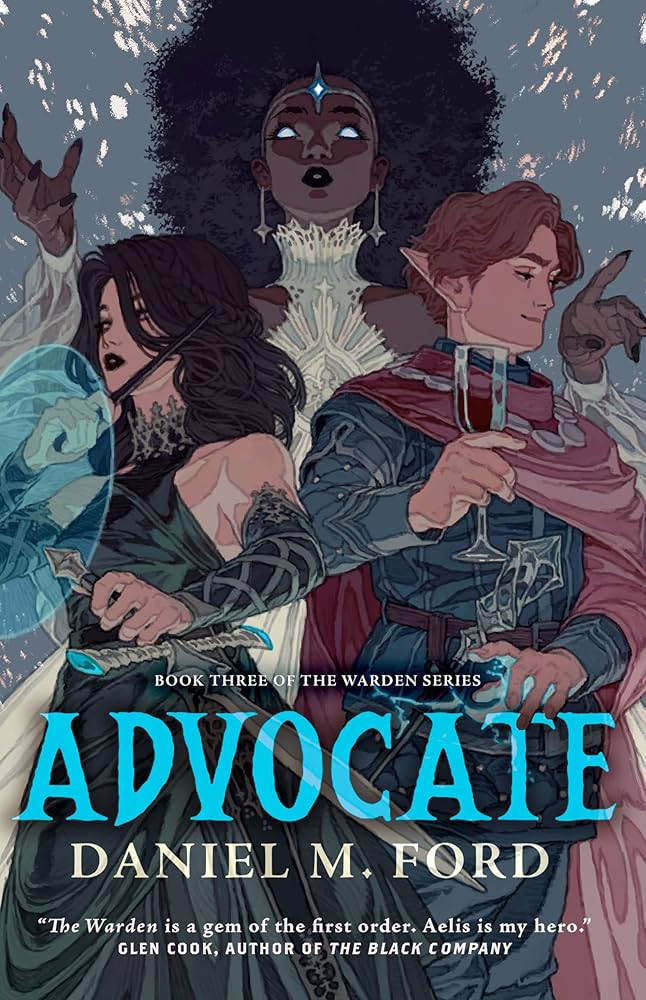
The standard disclaimers apply: Dan and I are Internet Mutuals, the origin of which is lost to time but almost certainly involves Twitter somehow. I spend a fair amount of time hanging out in his Discord server, which is, in fact, the only Discord server I spend any time in. And while I reviewed The Warden, the first book in this series, I somehow did not review Necrobane, the second book. My vague recollection is that I had kind of complicated feelings about it and the review just kind of got away from me; I didn’t dislike it, although I do have to talk about it in order to talk about Advocate.
Which, by the way, I’m gonna screw this up: the name of the book is Advocate, not The Advocate. I keep wanting to put that The in there.
So let’s rip the Band-aid off here: viewed on its own, I really enjoyed Advocate, for much the same reasons I enjoyed Warden, and the rest of Dan’s work. Aelis is a fabulous asshole, of a type I enjoy reading about, and a couple of the new characters, particularly an alcoholic gnome named Mihil and a fellow Warden (and ex-girlfriend) of Aelis’ named Miralla, are also a lot of fun. That’s Miralla in the back on the cover, although the elf on the right is not Mihil, even though he should be.
(I get why he isn’t; that’s Amadin, another Warden, and he’s a fairly important character, but I suspect the real reason Mihil isn’t on the cover is that including a gnome in the composition would make placing the cover text tricky.)
The bulk of Advocate unfolds like a mystery, although we know who committed the crime from the first pages of the book, and Aelis’ job is less to prove her former mentor innocent than to convince the court that no crime was committed in the first place. The story is satisfyingly twisty-turny and Aelis gets plenty of time to show off her two best character traits: her utter confidence in her own ability to outwit literally anyone and her tendency to make a snap decision, get in over her head, and then somehow come out on top anyway. There’s lots of swordplay and quite a bit more actual necromancy than what we saw in the last couple of books.
Advocate‘s biggest problem is that, while the cover calls it “Book Three of the Warden Series,” it is, for now at least, the final book of the Warden series, and it’s structured much more like Book Three of Six than Book Three of Three. But let’s back up a little bit and talk about Warden and Necrobane.
Warden ended with Aelis screwing up in a fairly spectacular way, potentially unleashing a continent-wide zombie plague. I was expecting the rest of the series to be focused on that not-minor problem, and the book went an entirely different way than I expected, dealing with what I thought was going to be a two-book problem in about a hundred pages or so and then pivoting into something else. At the end of Necrobane, Aelis’ love interest is magically bound to a particular plot of land in the midst of a wild forest a fair distance away from Lone Pine, and Aelis is unable to figure out how to free her. Then, at the end of the book, she is summoned to the city of Lascenise, a major (and wealthy) metropolitan area, to serve as an Advocate for her old mentor, who has been accused of murder. An Advocate is basically a Warden lawyer; Bardun Jacques has a lawyer but is entitled to a Warden defending him (and investigating his case) as well. He has asked for her specifically. She has no real choice but to go.
This was another left turn, and I was concerned with what it meant; that Book Three would be taking place in an entirely different place and with, importantly, an entirely new cast— Maurenia being magically stuck on a couple acres of land a week or two away, and half-orc werebear Tun being entirely unsuited to life in a city. And, in fact, that’s exactly what happened. The two stories do end up knitting themselves together, but Tun’s presence in the story is minimal and Maurenia’s role is basically to be something else that Aelis has to worry about in addition to the rather significant number of new problems the story is dumping on her head. It’s probably important to point out that Aelis was going to have to head toward civilization anyway, as she was going to need access to libraries to figure out how to release Maurenia, but she’s more or less stuck there until her Advocate duties are discharged. Making things worse, in her last scene with Maurenia before leaving it’s made clear that there’s a time limit on how long she has to break the spell before Maurenia is, effectively, taken over by the forest.
(Side note: Necrobane also features a fight with one of the creepiest monsters I’ve seen on-page. The book contains a tooth golem, which is every bit as awful as you might think, and maybe worse.)
So your appreciation of Advocate is going to be contingent on how much you like Aelis, and how willing you are to lose the supporting cast we’ve grown to like over the last two books. This is what I mean by it being a better “book three of six” than an end to a trilogy; there’s lots of expansion to the worldbuilding and lots of character development for Aelis (we meet her family!) and all of that is cool but if you were really vibing with her and Maurenia’s relationship, or her mentor/mentee relationship with the little girl she’s teaching to read at the end of Necrobane, you’re gonna have a hard time. And this would be much easier to bear if we knew there was Book Four on the way out there, but Tor has really screwed this series over(*) and right now there isn’t one. I decided to star-rate it on its own merits, mostly because no one can stop me, but I can imagine other readers being less happy.
I want more books in this series, in other words, not only because the world is fascinating and I want more but because I think the story and the characters deserve it.
(*) Not my story to tell, unfortunately, but I feel like they owe Dan another trilogy to make up for how they treated this one. Even if I didn’t know him, the simple fact that somehow I have bought five copies of the three books in this trilogy and still don’t have a matching set to put on my shelf would have me deeply pissed.
 Welcome to infinitefreetime dot com