I need a new word

There is a very specific type of bad writing that I feel like we need a name for, and this couple of paragraphs from the book I’m currently reading may be the literal Platonic ideal of it:

I’m not going to name the book, but the sleuths and generically curious among you shouldn’t have a whole lot of trouble figuring it out.

  1. This is the wrong verb, in a way that would make Mark Twain’s eyelid twitch. One does not “snatch” a piece of paper that is sitting on one’s own desk.
  2. Also the wrong verb. I also kind of want to quibble about the use of the word “worn,” which implies age– “tattered” might work better here. That said, I think this is probably the point I’m most willing to argue about.
  3. A blockade “of sorts”? You’re surrounded by twenty thousand enemy troops. That’s a fucking blockade. Or, even better, a siege, which has the advantage of being the correct word.
  4. Two sentences ago you said the blockade happened “one night past,” and now they’re testing your defenses “each night.” You’ve got to be outnumbered thirty to one; what the hell could they be waiting for?
  5. How are the scouts getting past the twenty thousand enemy troops? Why do you need scouts when you’re fucking surrounded? Also, how the hell did this letter get past the siege in the first place?
  6. This is Capital One arena, which seats twenty thousand, in far tighter accommodations than troops besieging a fort would use. See note #5.
  7. This is a world where dragons exist. So do the Uraks themselves, who are basically tall orcs. “Monsters” really doesn’t tell me anything about what these “larger beasts” are.
  8. Why? Why in the world would you not believe them?
  9. I don’t think you will, sir, and you’re sending this letter because you don’t think you will either, so “No matter” is a really weird way to conclude this letter.

This book is six hundred and eighty pages long, and this type of thing is on nearly every page, although it’s quite a bit more concentrated than usual here. I’m going to finish the book today, because while the writing is … again, I need a word more descriptive than “terribad” here, the story itself is engaging enough to keep me interested. But god, man, find a better editor. You need the help.

On Arabic, pedagogy and my new life goal

Something happened at work today that rarely happens in a middle school: I, the teacher, was bored. This is dangerous. I’d finished my grades, my kids were all quietly working on something or another, and other than randomly wandering around and talking to people, I didn’t have anything in particular that needed doing. Somehow I got thinking about Arabic again, and that led to me downloading a book called All The Arabic You Never Learned The First Time Around. This book is by James Price, but you’ll never know that from looking at the .pdf I downloaded, which never mentions the author’s name.

Y’all.

I need a print copy of this book, and I think I’m probably going to have to make one by going to Kinko’s (does Kinko’s still exist?) and printing all 564 pages and then binding the damned thing myself. Amazon wants over seven hundred dollars for the sole used copy they have, which also looks home-printed, and if there’s another copy out there on a legit site I can’t find it.

I have never encountered a bitchier textbook in my life, and I love it.

There will be a lot of images in the rest of this post. They are all from the first two chapters of, again, a .pdf that is five hundred and sixty-four pages long.

In general, this man despises all human life. It’s glorious.

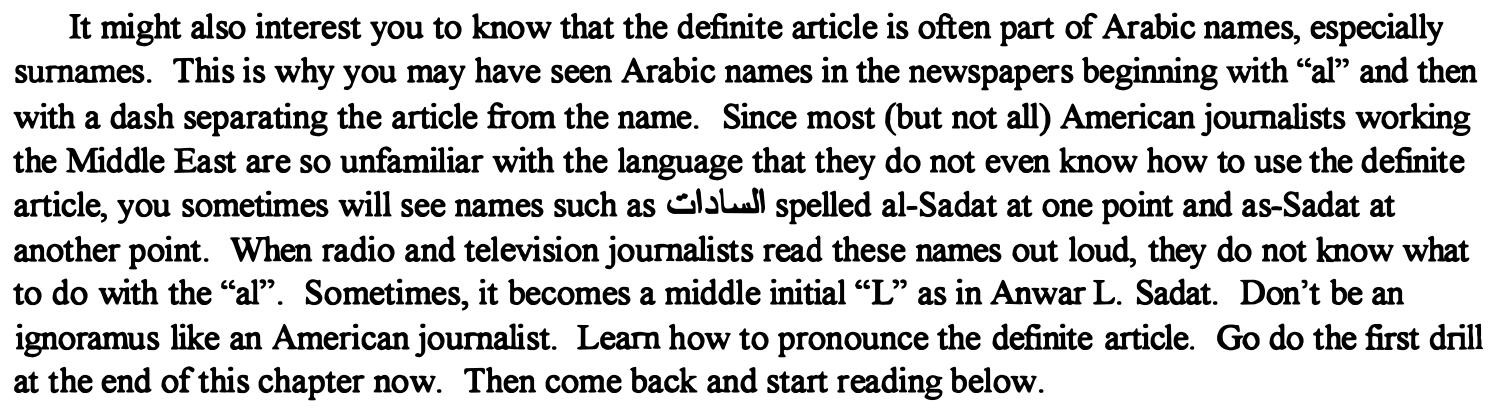
Who does he despise the most? American journalists. Oh my God does James Price hate journalists.

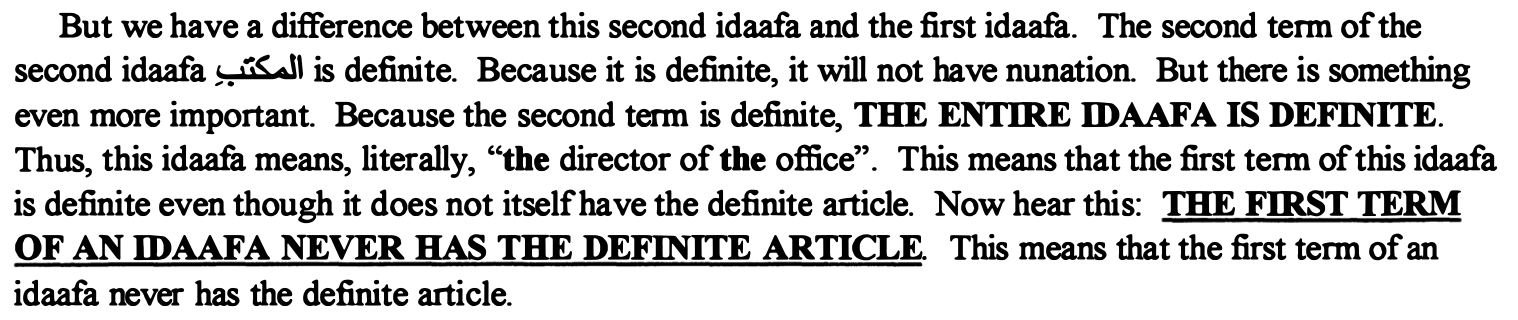
You know how most language textbooks pick a few basic words and use them for examples over and over? And how lots of times those are simple, easy words that everyone uses all the time? You will never guess the first three sample words this guy picks. Not if you try for a thousand years.

I’m not kidding. This is going to happen over and over again:

Any hint of confusion is met with immediate scorn, which is something all good teachers do:

This is the last paragraph of the first chapter:

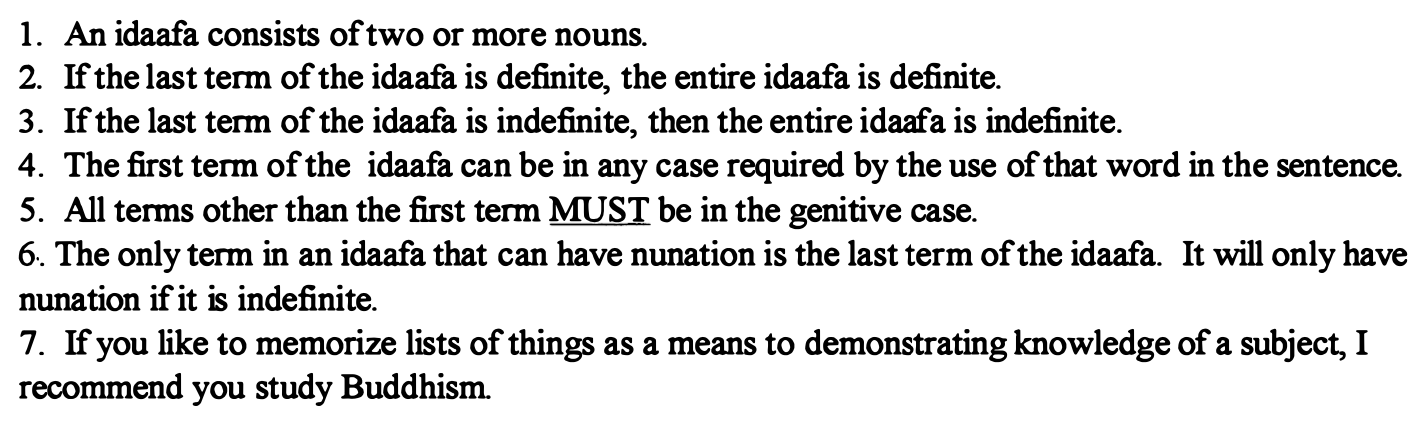
Chapter Two starts getting into case endings and something called “Idaafa,” which I cannot explain just yet. I can tell you that James Price thinks idaafa is very simple and easy and does not have a whole lot of patience for people who do not understand it, to the point where this chapter starts using typesetting for emphasis along with the usual heavy doses of sarcasm:

I am going to start modeling all of my teaching after the last two sentences in this paragraph, including the use of all-caps, underlined bold text:

Shit, is that what it means? I understand now!

Toward the end of the chapter, we get this gem, where he makes fun of the reader for studying the text he wrote:

I’ve only read two chapters, remember, and I haven’t really thoroughly studied them, but I think I’m starting to detect a theme here, as this is how he ends chapter two:

This is the best textbook I have ever seen, and James Price is my new educational idol. Please, please, let someone find me a print copy of this, or I swear to God I’m making a leather-bound copy myself.

In which I face Jod and walk backwards into Hell

It has come to my attention that there are actual human beings who think that the plural of “email” is “email.”

These people are sociopaths.

You can use “email” as a collective– “I get lots of email” or “I sent some email” if you like, but if it is used as a plural, ie, “He sent two emails”, and you don’t include that -s at the end, you are bad and wrong and you should go far away.

Or embrace the phrase “email messages,” and dodge the issue that way.

The end.

Sigh.


This is not okay.

IMG_2089.JPG
I’m calling for an official Grammar Boycott of McDonald’s until we get a retraction and an apology.

You’re asking the wrong question

I’m much more concerned about your grammar.

IMG_2032

A thing that just happened

ivz2e0v32nti3knv6afjActual conversation I just had with my son.  Context: I am picking him up from day care, and my wife is already in the car, which is not usually the case.

DAD:  Guess who’s in the car?

BOY:  Toys!

DAD:  Toys are a what.  Guess who is in the car?

BOY:  Snacks!

DAD:  Snacks are also a what.  People are whos.  Guess who is in the car?

BOY:  Thinks.  Stuff!

Dad gives up.  Exeunt.