#REVIEWS: No Longer Human and The Setting Sun, by Osamu Dazai

My lovely wife has returned from her long sojourn, and all is right with the world again. After lazing about and whining all day yesterday, I was a veritable dervish this morning, managing to tidy, vacuum and dust every room in the house other than the office, which still got a lick and a promise. I read two books today and built half a Lego set on top of everything else. I think I can call the last Saturday of break a success.
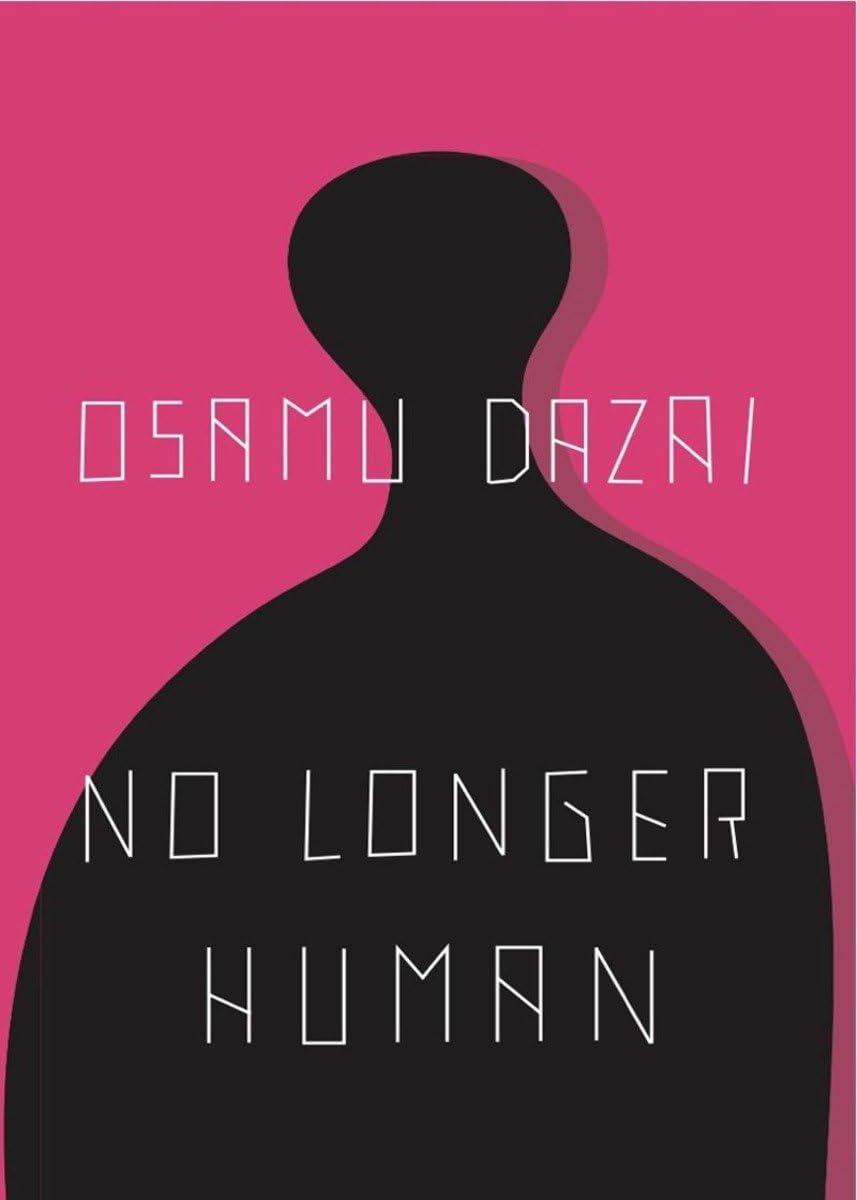

Reading two books in a day isn’t the accomplishment it might sound like, because both of them were novellas. I’ve seen a bunch of students over the last couple of years reading these two books, and because the covers are striking (and I pay attention to what they’re reading regardless) I asked a couple of kids about them last year, and was greeted with enthusiastic recommendations. I didn’t get around to it last year and then when I recently found another couple of kids reading them before Spring Break decided to jump on them.

I … don’t get it.

So, Osamu Dazai was born in Japan in 1909, which already places him well outside of anything my students are usually willing to read. His books are obviously translated, and both of these books were written post-war, in 1947 and 1948, right before Dazai died of suicide at 38, in a scenario that appears (I haven’t done a ton of research other than reading a Wiki article) to precisely match a suicide attempt described in No Longer Human. The books sound like they were written in the late forties, frankly, which isn’t a criticism but is another reason why I’m surprised that my students are reading them, because the style of a novel from the 1940s and 1950s is wildly different from the modern YA or romantasy that I catch them with most of the time, and that’s before you have to deal with the cultural unfamiliarity of being translated from Japanese.

The closest analog to No Longer Human that I can think of is that it feels like a Japanese Catcher in the Rye. It’s about a young, profoundly alienated man, and it’s casually misogynistic in the way work from that era frequently is. It’s written in first person and is semi autobiographical; the framing device is that it’s written as three notebooks by the narrator, covering a couple decades of his life, and there’s another unnamed individual in the preface and epilogue who talks about how the notebooks were given to him. I read The Setting Sun cover to cover in a single sitting and I can’t tell you what the hell its deal is. I mean, I can describe the plot, that’s simple enough– it’s another first-person narrative, this time of a woman named Kazuko in her late twenties, a member of a formerly aristocratic family that has fallen apart after World War II. Her mom dies. Her brother is a drunken mess who eventually kills himself. She tries to have some love affairs. Then she gets pregnant and the book ends. There’s some obvious symbolism scattered throughout– a bit about burning snake eggs, and snakes constantly showing up around moments of despair– but it’s mostly a pretty straightforward narrative.

So, yeah, I get the plot. I just can’t tell you why it’s a book, if that makes any sense. I feel like I get No Longer Human, and part of me can sort of see why it might appeal to teenagers, who respond to alienation narratives. I don’t know why the hell there’s a copy of Setting Sun in our school library or why the kids are professing to enjoy it as much as Human. There are strong themes of addiction and alcohol abuse through both books and a ton of suicidal ideation and successful suicides along with some genuinely terrible family situations. I dunno; I’m gonna ask some questions on Monday and maybe send an email to the kid who was most interested in me reading these last year. Don’t misunderstand me; neither are bad books, and No Longer Human is genuinely good, but I don’t see the appeal to 14-year-olds in 2025. I need answers here, y’all.
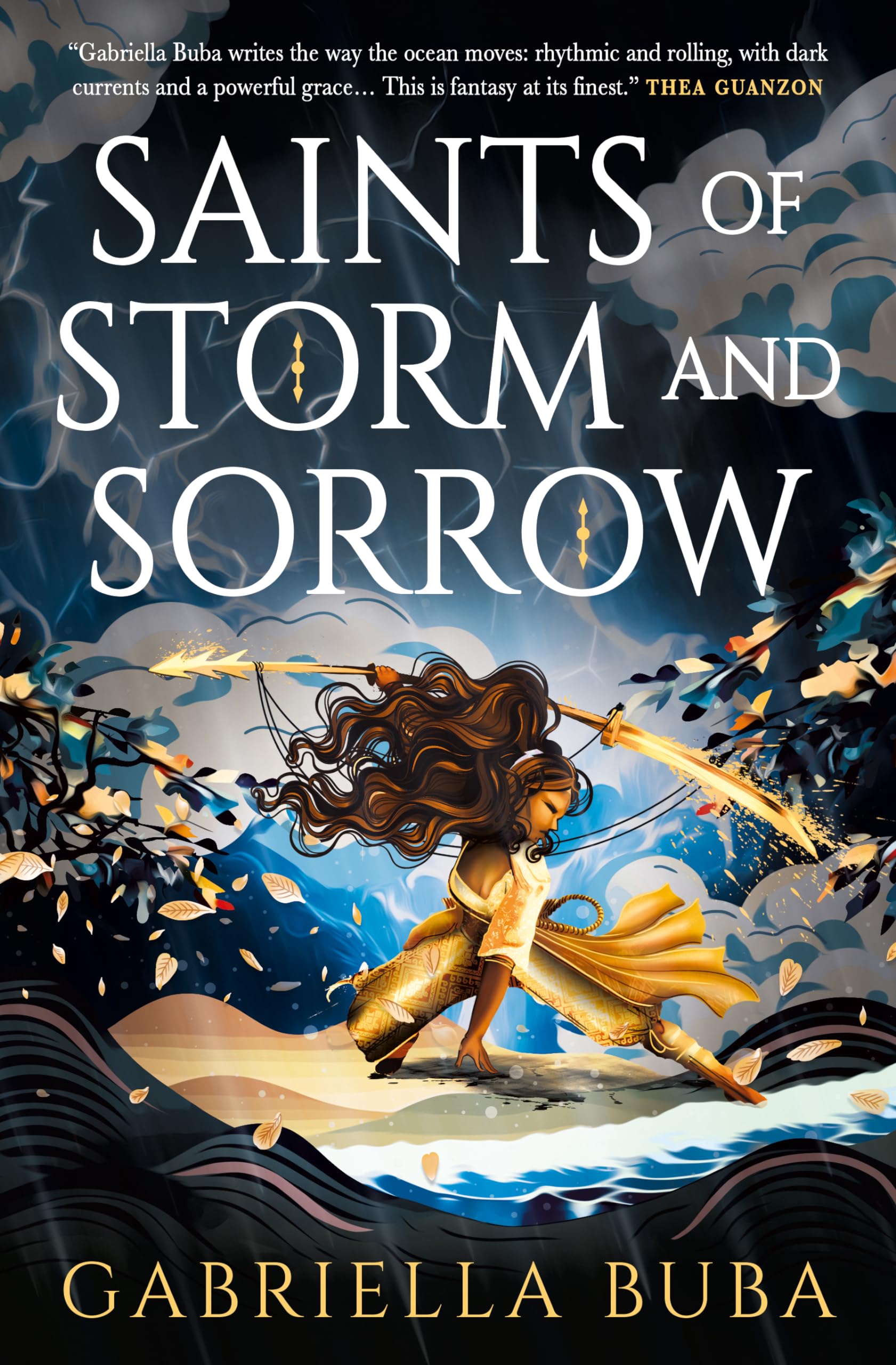
#REVIEW: Saints of Storm and Sorrow, by Gabriella Buba

Really, the phrase “bisexual nun” was all I needed.

Here’s the thing about Gabriella Buba’s Saints of Storm and Sorrow: it’s one of those books where a lot of what I have to say about it is negative, but I’ve already pre-ordered the sequel, out this summer, and I’m genuinely looking forward to reading it. I lost some sleep to reading this book, and several times I had to force myself to put it down at the end of the night to go to bed. There’s something compelling and propulsive about Buba’s writing that ended up outweighing some of the things about this book that didn’t make sense or didn’t quite work, and I guess I just need you to keep that in mind while you’re reading this, because I want to talk about the weird stuff. I ended up four-starring this, but in a different mood I could have been talked into a three, and for most of the first half it was going to be a five. So one way or another it’s kind of all over the place, but the tl;dr to this whole post is that the book is well worth the time to read it even if there are some issues.

So here’s the thing. The main character, Lunurin, is a nun. She is also a priestess, quite possibly against her will, of a storm goddess called Aman Sinaya. Now, when I first read this in whatever blurb or online review I saw that caused me to order this, along with the phrase “bisexual nun” and the phrase “Filipino-inspired,” I assumed that this meant that this book wasn’t set on Earth.

And … technically, it isn’t? But it totally is. Lunurin is a Catholic nun. The bad guys are the Spaniards. They speak Spanish. They’re in the Philippines. I’m pretty sure the word “Catholic” never shows up, but … there is no attempt to be subtle here. Lunurin and her female love interest are both Catholic nuns, biracial and despised for being so, in a colonial atmosphere that is more or less identical to the Spaniards colonizing the Philippines. (Do you know any Filipinos? Ever notice how they all have Hispanic-sounding last names? There’s a reason for that.) And the book wants to get into the syncretism that happened whenever Catholicism ran into indigenous religion, which is a fascinating and complex subject, but if the colonized people can literally call down typhoons while being literally possessed by their gods, and Jesus … doesn’t do any of that? It kind of wreaks havoc on your worldbuilding. Christianity toppled, say, Norse religion, sure. But you know who the Norse didn’t have? Actual fucking Thor. And Lunurin can call down lightning by letting her hair down. And everyone just acts like Christianity is a reasonable alternative to that, just because the priests say so?

Nah.

I would kind of love for a book where Christian missionaries run into a religion that literally grants powers to its priesthood, but this isn’t that book and that’s not the story that Buba is interested in telling. She wants to start a book that is already past the colonization phase and so that’s what she gives us, and it’s not exactly the book’s fault that it sent my brain down all sorts of other pathways once I realized what was going on. There’s something to be said about having trouble accepting the basic premise, of course, but I’m a lifelong fantasy/sci-fi reader and suspending disbelief is something I’m good at. But I’m not going to pretend it wasn’t an issue.

Let’s see, what else? This is something that’s going to get fleshed out better in the sequels, I’m sure, but I never quite understood the relationships between any of the main characters. Two of them end up married, and I’m not sure either of them wanted it except one of them kinda did and the other sort of shrugs and rolls with it, and the nun female love interest is an absolute mess of a character, which is yet another complaint that may or may not represent a problem with the book. Messy people exist! But holy shit is Catalina a mess. She’s inconsistent, jealous and a religious fanatic (nun, remember) and there’s also a healthy degree of self-loathing going on as well as some internalized racial hatred, and … she’s realistic, in a lot of ways, I think, maybe? But that doesn’t automatically make her fun to read about.

There are a couple of explicit sex scenes that tonally really do not match the rest of the book, too, so be aware of that. This is not a romantasy by any stretch of the imagination, and I let that fool me into thinking that at no point would glistening cocks be involved. Or, well, one cock that glistens at least once. And, again, I’m not convinced that the people fucking actually like each other, or whether they’re trying to play each other, and it’s okay for the characters to not know each other’s motivations, and it’s okay for the characters to be inconsistent in their motivations, but I definitely don’t get them and I’m not convinced the author did either. The problem is that in this particular scenario complicated characters come off exactly the same as characters with no actual arc and no planning, and I genuinely can’t tell which one this is.

So yeah. Again, I’ve bought the sequel. Lunurin’s relationship with her actual goddess– as opposed to Jesus, who doesn’t seem to be real and doesn’t occupy a lot of her time despite the nunnery going on– is fascinating, and again, she doesn’t appear to like her very much, and while I have my problems with the setting as it currently exists, it’s got its positives just out of sheer originality. It may be that I’ll read book two and tap out for what I’m presuming will be a third book in the future (this may be a duology, I’m not sure) or I might shift into full-throated approval. We’ll see. But I’m giving this one a thumbs-up regardless, now that you’ve read all the caveats and quid pro quos and such.

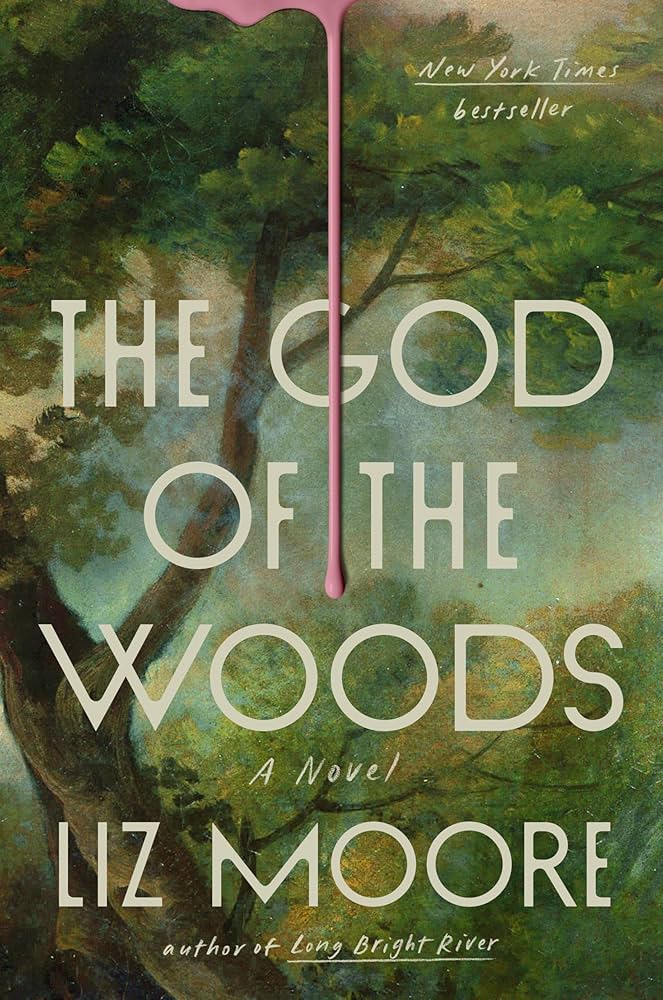
#REVIEW: The God of the Woods, by Liz Moore

One good thing about being sick is that in between naps, coughing fits, randomly snotting all over my pillow and light hallucinations, I can get a fair amount of reading done. I was really hoping not to lose two more days this week but this is legitimately the sickest I’ve been since the last time I had COVID and right now I’m just hoping to be functional enough to go in on Monday.

Anyway, The God of the Woods is real real good, a missing persons story worthy of Tana French at her best, and you ought to read it. The story bounces around from the 1950s to the end of 1975, set mostly at a summer camp in the Adirondacks, a camp run by a multigenerational wealthy family that appears to own or employ most of the town it’s set in. The twist here is that while Barbara Van Laar has gone missing in 1975, her brother Peter Van Laar (the fourth, no less) also disappeared at the same camp fourteen years prior. The book bounces around several different timelines, giving a host of characters both inside and outside the family and inside and outside the investigation time as POV characters, and does a great job of both juggling multiple mysteries and character arcs and tying them all up in a satisfying fashion at the end. I have said this before; I am not the world’s most careful reader, unfortunately, and I’m further impaired by this bastard of a head cold I’ve got going on right now, so the fact that I was able to keep up with a mystery novel that was jumping around between three different timelines and half a dozen characters without completely losing track of what was going on is a testament to the author’s skill. I wasn’t aware of Liz Moore before this, and buying the book was a bit of a dice roll (to be honest, the title had me thinking there were going to be some spec fic/ horror elements, and … I admit, having finished the book, I’m not sure I get the title) but it’s one I’m glad I made and I’ll be checking out more books by her in the future.

Short and sweet, I know, but as I said, I’m kind of dying here, so just trust me on this one. You’ll like it.

#REVIEW: The Eyes Are The Best Part, by Monika Kim

I called this “deliciously, delightfully fucked-up” in my Goodreads review, and … really, isn’t that enough?

I am tempted to say it is, because it has been a long day, and I am tired, and I don’t have a ton of stamina at how the hell is it almost 8:00 already to write a complete review, so I’ll just say this: Monika Kim’s debut about a college-aged Korean-American girl named Ji-Won is equal parts horrifying and rage-inducing, which is an interesting combination. Ji-Won’s father leaves her mother at the very beginning of the book after an extramarital affair, leaving Ji-Won’s mother an emotional wreck and upending their family entirely. Ji-Won has to take on trying to keep her family stable while negotiating her first semester at college, and when her mom takes up with a white guy who is pretty clearly a narcissistic, womanizing scam artist and she catches the attention of a second white guy who is horrible for a whole different set of reasons, keeping her family stable starts to take a backseat to keeping herself stable.

Because she’s growing obsessed with eyes– eating them, specifically– and the more her mother’s beau pulls the wool over her eyes, the easier simply murdering him to get him out of their lives becomes to consider. And we’re off to the races, as Ji-Won both grows (descends?) into becoming a budding serial killer and definitely descends into some pretty interesting types of what I think is technically referred to as The Crazy. She has bad dreams and occasional hallucinations and for a minute at the end there you think the book is going to take the easy way out and then it doesn’t, and … yeah, I’m sticking with “deliciously, delightfully fucked-up,” here. Not for everybody, either, in case that’s not perfectly obvious, but I loved it.

A quick word on the white guys, as I feel like I just opened the book up to a certain set of accusations: the book is not anti-white so much as it is anti-a couple of specific kinds of white guys, and in particular it takes aim at Asian fetishization, which, at least as far as I’m familiar with it, pretty much is a white guy thing. The college guy is unbearable in a few other kinda white-specific ways too, but at least at first he pales(*) in comparison to the mother’s new boyfriend, who is immediately and clearly awful to everyone except her. Anyway, if you’re the type to get het up when you think white people are being criticized you’ve probably bailed on my blog years ago, so I doubt this will be a real problem for anyone who might take my recommendation seriously anyway. If not? We can take it, I promise.

One way or another, there’s a great build-up here, a brief moment where you might be worried that the end is about to get away from the author, and then she nails the landing anyway. I really liked this one, and I’ll be keeping an eye out for future work from Monika Kim in the future. (I also picked up a second copy from Illumicrate, because … my god, that cover!)

(*) I swear I didn’t do that on purpose, and I’m sorry, but not sorry enough to remove it.

#REVIEW: The Nightward, by R.S.A. Garcia

I don’t know what to say about this one.

Now normally when I say something like that, it’s a bad sign. This isn’t that. The Nightward is a good book. But it is a good book in a very specific way, and the specific way it’s good makes it kinda hard to talk about. This is a book with lots of secrets, and lots of mysteries that may or may not be unraveled in the course of the text. In some ways it’s a very straightforward narrative and in some other ways I have absolutely no idea what the hell is going on.

Let me give you what I can: the basic narrative, as I said, is reasonably simple, and is spelled out pretty effectively on the cover: the two most prominent characters are Viella, the nine-year-old princess of the Queendom of Dun, and Luka, her bodyguard. Viella is only princess for a short time; there is a coup and her mother is killed, and the rest of the book is more or less about keeping her alive while the villains work various and sundry machinations in the background. Dun is one of six Queendoms– the book’s society is very matriarchal– and we see most of them for at least a little while over the course of the book.

(There’s a map at the beginning of the book. I probably should have paid more attention to the map. It’s that kind of book.)

Now, that doesn’t sound like much, I know. It’s R.S.A. Garcia’s worldbuilding that sets this book apart, though, and that’s part of what’s hard to talk about. There are queens everywhere and armies of badass women and pregnancy increases magical power to what appears to be a pretty substantial degree, and there are dragons and zombies and battle cats (which probably aren’t actually Battle Cat, but try and stop me) and then there’s a whole lot of other stuff going on that will make you go wait, what? and then you’ll start paying closer attention and there will be lots of hints, at first, and then later on outright blinking neon signs that Something Else Is Going On Here.

(The titular Nightward, by the way, is a book. It’s probably a spellbook of some sort, and the bad guys opening it was Definitely Bad. It … might not be a spellbook, though? Maybe.)

Do I know what the Something Else is? Nope. Not a bit.

And here’s the rub, right? I really liked this book, but it’s book one of a duology, and book two doesn’t come out until the end of 2025, and I kind of want to counsel you to put this on a wishlist and wait until book two comes out and then buy them both at once. Because I want it now, and the problem is I’m going to have read 150 books in between this one and the sequel and I’m gonna have to reread Book One anyway if I want to properly appreciate Book Two. And Garcia has an awful lot of plates spinning on poles right now, and not to mix metaphors or anything but I feel like sticking the landing properly on this is going to be challenging. If she pulls it off, this is going to be a truly remarkable series. If she doesn’t … well, you’re not going to be rereading Book One in the future if you didn’t like Book Two, right?

So. I five-starred this. I am very heavily anticipating the sequel, and I will preorder it the second I learn that it is available. And I want you to at least have it on your radar, but right now my recommendation is very much based on potential awesomeness, because there’s so much going on that’s not quite clear yet and I need a slightly clearer picture before I can start jumping up and down and waving this book over my head at people. Maybe hold off until late 2025, and then buy both of them at once. If you remember books better after a year than I do, jump in now, if only so I have someone to talk to about this. But definitely stick it in the back of your head, one way or another.

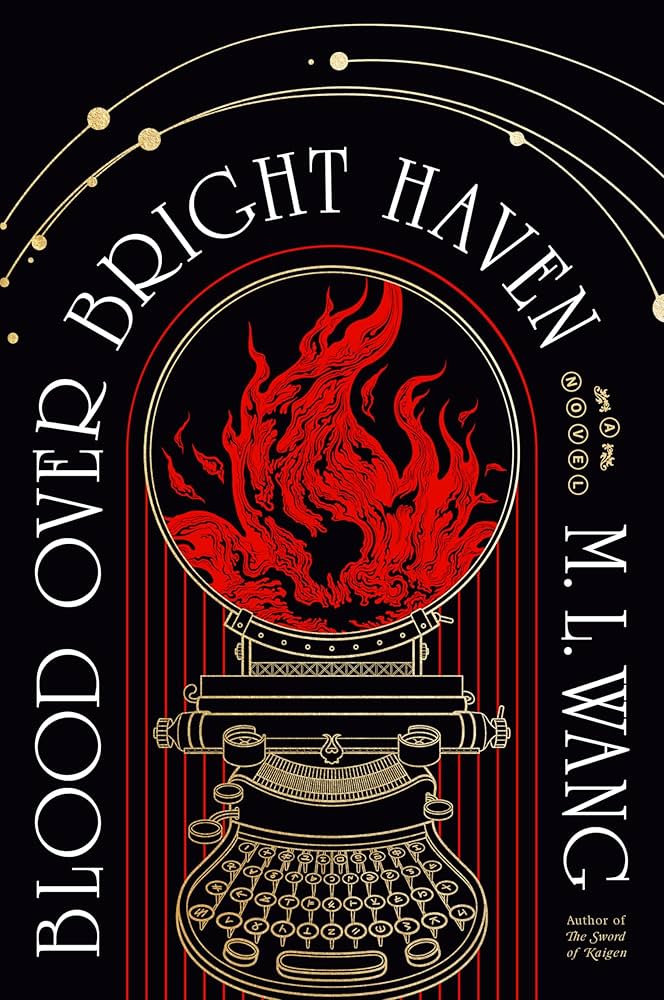
#REVIEW: Blood Over Bright Haven, by M.L. Wang

I discovered the work of M.L. Wang through BookTok, which is, by and large, convinced that her The Sword of Kaigen is one of the best books ever written. I read that one first, and … it’s not one of the best books ever written, not by a long shot, but it was good enough to get me to pick Blood over Bright Haven up and then take several months to get around to reading it. I didn’t start off well with this book either; by pure coincidence it shares a lot of plot points with Ava Reid’s A Study in Drowning, which I read immediately before it, and starting a second book in a row where the main character was a trailblazing female academic in a field where no one wanted her around and who cried all the time was a bit jarring even before it turned out that, somehow, in both books the fact that said main character was a huge fucking racist was a big plot point. Now, this is fantasy racism, which doesn’t make it a lot better,(*) mind you, but it’s a big theme of both books, so be prepared for that. Also, while we’re talking about things that might be in a content warning, Drowning has a character who is a rape survivor (although, creepily, the act in question comes off as consensual the first time it’s described) and there’s a rape attempt in Blood.

A Study in Drowning was not a great book– serviceable, but not much more– and it kind of poisoned me against Blood over Bright Haven for the first third or so. I nearly put it down. I’m glad I didn’t.

For starters, and I don’t want to get too deep into spoilers, because you deserve to experience this at the book’s pace, Sciona is very much not the main character of Blood over Bright Haven, even though it will seem like she is for most of the book.

Second, Blood over Bright Haven is one of the angriest books I’ve ever read, up there with Yellowface and Iron Widow,(**) although, again, you spend enough time in Sciona’s head that you might not realize how angry the book is at first. This is a deliberate misdirect on the part of the author and in retrospect it’s tremendously effective at prepping you for the big twist midway through the book. A bit of background: Sciona starts the book off by being named a Highmage of her home city-state of Tiran, an office that no woman has ever held before. This happens quickly; another weird similarity it has to Drowning, come to think of it; you get yourself mentally ready for her to take half the book to become a highmage and it’s, like, a chapter. Magic in this book is fascinatingly mathematical and complicated and meaty, it’s more like writing equations or geometric proofs than what for lack of a better word I’ll call “traditional” spell casting, although it’s not as explicitly mathematical as, say, To Shape a Dragon’s Breath.

Anyway, for our purposes the salient part of writing a spell is that you have to determine where the spell gets its energy from, and how much energy it might take to pull off any given magical effect. If you pull too little you’ll get partial results and if you pull too much, something is probably going to explode. Sciona is a prodigy at mapping, which is the process of figuring out where magical energy sources are and how to pull from them, and she gets put on a huge project involving pushing back the magical wall that surrounds the city, a huge … public works project, which isn’t quite what you might expect from a fantasy book but that really is what’s going on here.

Also, spells are written on magical typewriters, which is just super fucking cool.

Anyway, blah blah blah class conflict blah blah blah sexism blah blah blah plot development and then she figures out where the sources of her magic are really being pulled from, and I’m not telling you anything else, because you deserve to experience this on your own, and probably by this point if you’re like me you’ve decided you don’t like Sciona all that much. Unlikable MCs are tricky, right? First of all, you often can’t be sure if the author realizes they’ve written an unlikable main character, or if it’s just your reaction to that person (I call this “Lana Lang syndrome”) and also because the author wants you to keep reading, which can be a hard sell if you don’t like living in the head of the person you’re reading about.

I’m just going to say that it was clear quickly that M.L. Wang knew exactly what she was doing here, and that Sciona’s personality flaws are clearly intentional and are also pretty essential to the book unfolding the way it does. She has a great conversation (well, fight) with a relative late in the book where the relative just rips her to shreds and every word she says about her is true and I just kind of read it in awe of how fully in control of her characters Wang was.

Also, and I’m not going to go into details because, again, I want as few spoilers as possible, but reading this book on Thanksgiving lent the whole book a really interesting synchronicity with actual life. You’ll understand when you read it.

And, yeah, I’m about to end the second review in a row with the phrase “one of the best books of the year,” and a wish that M.L. Wang’s many fans on BookTok and elsewhere would realize which of her tradpubbed books (she has several that she published herself, and this and Kaigen were both originally indie titles) is clearly the superior one, because this book deserves the press and attention that The Sword of Kaigen has gotten. Go read it.

(*) The sole physical characteristic that the Kwen characters are given is “copper hair,” and I’m still unclear what precisely the difference between copper and red hair is, but you could take this as evidence that the despised minority in this book are white people, which is an interesting choice that ultimately doesn’t end up mattering very much since this is very much a Not Earth book.

(**) The fact that all three of the authors here are Asian women is a coincidence. It’s an interesting coincidence, but a coincidence nonetheless.

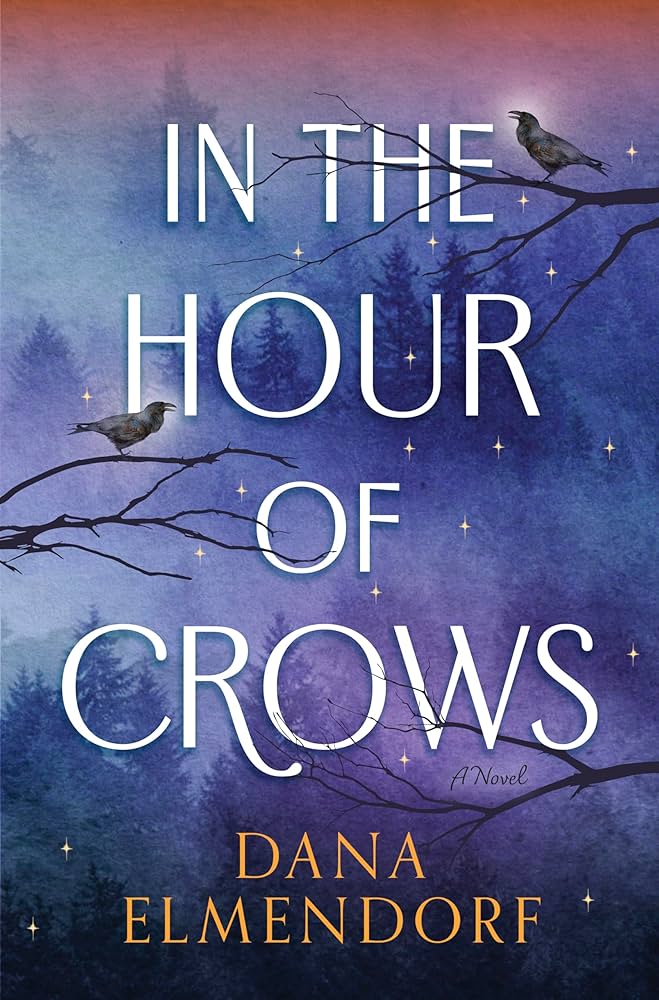
#REVIEW: In the Hour of Crows, by Dana Elmendorf

A touch of housekeeping first– I have parent/teacher conferences after school tomorrow and Tuesday, and am expecting to get home a shattered wreck of a human being both nights, so I’m going to do my damnedest to get three book reviews written today so that I don’t have to get home and scribble something down after 13-hour days at work. In accordance with prophecy, this means that I absolutely will get home and scribble something down after both of those 13-hour days, but still.

Dana Elmendorf’s In the Hour of Crows is one of those books where I heard about the premise and then suddenly had the book; I don’t recall spending money or making an active decision that I needed to own it, but I heard “Appalachian gothic horror about a young woman who can raise the dead” and then it was on my unread shelf somehow. It’s a quick read at only 288 pages, and I started it before bed one night and finished it the next morning. The main character, Weatherly, has the ability to raise the dead by “talking the death out of them,” which I can imagine being the premise for something utterly ridiculous and instead ended up being this cool Christian/aboriginal syncretistic thing where she starts by whispering secret Bible verses into a dead or dying person’s palm and ends with her absorbing their deaths and literally spitting the substance of their deaths out into a nearby vessel, one that can never have contained alcohol before she uses it. She can only do this once for any person; if she tries it again, it won’t work, and her powers must be deliberately passed on to someone else before she dies.

Like, right away, yup, I’m in, and let me remind everyone again that part of the reason I like most of the books I read is that I have years of practice in determining what I like to read and what I don’t. And I was utterly on-target on this one; between the setting, the approach to magic, and the characters (Weatherly’s grandmother, who despises her, is a standout) I ended up really enjoying this one. The book actually ends up being a murder mystery, as Weatherly attempts to save someone and fails, leading everyone to assume that she did it on purpose, and her cousin Adaire’s death in a car accident ends up being wrapped up in that death. Weatherly herself is a bit of a hellion, or at least recovering from her hellion years– she’s in her early/mid twenties in the “now” of the book, but it jumps around in time quite a bit– and her utter lack of concern for what the law might want in any particular set of circumstances is occasionally kind of hilarious. Pretty much every move she makes makes her look more guilty of murder, and she … just does shit anyway, because she wants to. She’s great.

The book also features the single most disrespectful and petty funeral service I have ever seen in print; it’s probably only a couple of pages in total, but it’s the thing I’ll remember the most about this book after the details have faded on the rest of it.

I think this is Elmendorf’s debut, and I kind of hope she stays with this wider setting and style of book in the future, as I’d love to read more of it. More books about Weatherly probably aren’t super likely, but if she wants to write an actual sequel of sorts, I’d love to see something about the grandmother. Definitely give it a look.

#REVIEW: Of Blood and Lightning, by Micki Janae

I don’t wanna write this, dammit.

I was sent author Micki Janae’s debut novel Of Blood and Lightning by her publisher in exchange for a review. It’s been sitting on my shelf for a while now, mostly because I wanted the review to come out close to release date and the book comes out next Tuesday. I felt like it was going to be right up my alley based on the description I got. And any time the cover of a book features a young Black woman holding a sword, I’m gonna pay attention. The blurbs about Micki Janae make it clear that a big part of the reason she wrote this book is she wanted to see representation of Black people and specifically Black girls in fantasy, and I absolutely, wholeheartedly support that goal.

The problem is the book really needs some more time to cook. Don’t misunderstand me; I know I was sent an uncorrected proof, and I’m not talking about, like, grammar errors or typos or the occasional clunky sentence. There aren’t that many to begin with, and “uncorrected proof” means uncorrected proof, and I’m not holding that against the book. No, this needs structural edits. Story-level edits. Big chunks of it need to be either beefed up or rethought entirely, and especially for something that boasts of the worldbuilding on the back of the ARC, I feel like a lot more thought needs to be put into the book’s basic premise.

And that’s all very general, I know, and it’s entirely possible that one of the problems is a me problem, which is that Micki Janae didn’t write the book I wanted her to write, or at least the book I wanted to read. And I don’t really like criticizing books for not being different books.

The problem is that my specific gripes about this book are probably not gripes that a white guy has any real business making about a book about a Black girl written by a Black woman. Particularly when it’s not like anyone is sending my books to her for review. And I think that rather than sticking my hand into the buzzsaw that that conversation could very well turn into, I’m going to refrain from going into details.

Of Blood and Lightning is not a bad book. But there’s a much better book hiding inside it, and I feel like it’s a missed opportunity, particularly in a world where Tracy Deonn’s Legendborn or Ladarrion Williams’ Blood at the Root exist, or, perhaps, a certain Greek mythology-themed megaseries that is already dominating the YA fantasy market. If you read those books already and you’re looking for more, or if you’ve got a young person in your life who you think might enjoy a book about a young Black woman who inherits the powers of Zeus, well, pick it up. I’d be happy to see this book be successful! I really would! I just wish I could be more enthusiastic about it.

Of Blood and Lightning releases October 8th.