
On YA, genre and litratcher

I was originally going to write a review of this book and discuss this in the review, but I took a nap this afternoon and still have 60-some pages left. Why did I just say “this book” and not the name of the book? Well, I’m doing that thing where I don’t want this post necessarily showing up in search results for the book, especially since this post is going to be pretty critical and it’s important for you to know that I’m really enjoying the read. I’m going to be a little sneaky about which title I’m talking about, though. Let’s see if you can figure it out.

I am a lifelong genre reader, and for most of that time I’ve been fairly open about my disdain for what people call Literary Fiction. Feel free to blame it on me being too dumb for Literary Fiction. That’s fine. I have an ego but for some reason it doesn’t extend to being bothered by that particular allegation. I don’t get most of the examples of the genre I’ve read; I usually don’t understand why anyone bothered to write the book in the first place and I understand even less what anyone is talking about when they praise them. In particular, use of the word “comic” can be a red flag. One guarantee is that any time a book reviewer I’ve never heard of describes a book as “comic” is that it will not, in any way, be funny. In fact, for the most part, it won’t even be trying to be funny and failing. “Comic” means something else to Literature People. I don’t know what it means and I’m not going to bother finding out.

This particular book has a bunch of pull quotes by people I’ve never heard of who wrote books I’ve never heard of on the back. The sole exception is George Saunders; I’ve heard of him and I know he’s fancy but that’s all I can tell you. The blurbs aren’t as bad as they can get; none of them appear to be random collections of words, and none of them use words that should not be used to describe books (“deliciously turquoise and refreshing prose”– HARPER’S) in them. But this was on the New York Times’ 10 Best Books list, which usually means only ten people read it, and it was a National Book Award finalist. Here is the list of every National Book Award winner. I admit, I have read five of them– interestingly, all but one nonfiction winners– and I have never heard of considerably more than five.

Anyway, this book should have been YA and nothing, nothing will convince me otherwise.

If the exact same book had been written by a woman, it would be shelved with YA. It’s The Hunger Games with a more complicated vocabulary, more swearing, and footnotes about the American carceral system. The premise is the most YA-coded thing I’ve ever seen; the idea is that incarcerated criminals can get their sentences commuted if they agree to engage in gladiator combat to the death every so often; if they make it three years and are still alive, they get to go free. They earn something called, no shit, Blood Points as they work their way through the combats; Blood Points can be cashed in for food, weapons, armor, better accommodations, shit like that. There’s this weird color-coded & scientifically implausible technology built into their wrists so that their captors can torture them for talking.

And partway through the book the main character finds out that she’s going to have to fight her girlfriend in her final fight– the convicts are loosely organized into teams, and a rule change means people on the same team have to fight if they’re at the same rank– and predictable angst occurs.

Come the fuck on.

Now, I’m not done with the book, so I don’t know whether the two characters are actually going to fight or not, but this is one hundred percent a science fiction dystopia that would have been shelved with YA with a different author. That’s not necessarily a bad thing! I’m thoroughly enjoying the book, and I’ll finish it tonight, having burned through its 360 pages in less than a day. Unless it completely blows the ending, it’s gonna be a five-star review. But looking at these blurbs and a couple of other pieces about it, it’s hilariously obvious that most of the people reading it have never touched dystopian literature in their lives and haven’t read any YA at all, because … one thing this book is very much not is especially original. I could have sketched out a broad outline of the plot within ten pages of the start of the book. So could anyone who has read any YA in the last fifteen or so years. I’m not going to look up how long ago Hunger Games came out because I don’t feel like being old. But there are a ton of “blabla has to fight to the death, because Reasons, plus fascism” books out there and while this is an excellent example of one, that’s still exactly what it is.

I’ve got lesson planning to do and then I really do want to finish this book tonight, so I’m going to leave this here– I probably will do a second post once I’ve finished the book, though. But come on, guys. Somebody got chocolate in your peanut butter and peanut butter in your chocolate and you’re doing your level damn best to not admit that you’ve got a Reese Cup in front of you. It’s a Reese Cup. We love Reese Cups. Just admit what it is and eat the damn thing.
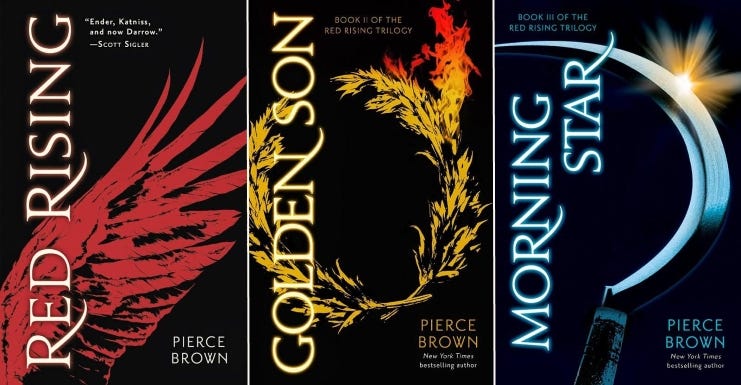
Go read RED RISING

The big new plan for 2024 is to clear my reading backlog before I let myself buy any new books that aren’t part of a series that I already own. Red Rising has been sitting on my bookshelf for months, because it’s Part One of, currently, six, and the series is expected to conclude with a seventh book that has not yet been released. It was clearly originally planned as a trilogy; you can see on those covers that they refer to the “Red Rising Trilogy,” and subsequent books just declare themselves to be “A Red Rising Novel.”

I, uh, just read the entire first trilogy back-to-back-to-back over the course of a week? And it took me less than 24 hours to read the 520-page third book? I had heard from some people that you don’t really have any idea what you’re in for in the rest of the series from the first book, and while I enjoyed it, it didn’t blow me away, but man, Golden Son and especially Morning Star are fucking amazing, and Morning Star in particular moves at such a breakneck(*) pace and is so twisty-turny that I’m not even sure what to compare it with. I don’t want to do a full review right now, so I’m not going to get into the plot at all, but damn. The end of Morning Star is a great stopping point, so I’m going to let the series simmer for a little bit before jumping into books 4, 5, and 6, but if you’re familiar with these books and something was holding you back, go for it. If you need more detail, I’ll probably write in more depth once the series is done.

Anyway, that’s been my Saturday; I read the first half of Morning Star yesterday and then didn’t do much of anything today until I’d finished it. The wife and I are gonna watch John Wick 4 once the boy goes to bed, and in between now and then I can hear my PlayStation crying out for me to stop neglecting it. So it’s video game time, I think.

Y’all doing anything interesting this weekend? Tell me about it.

(*)No pun intended, for those of you who are familiar with the series.

#REVIEW: DOCILE, by K.M. Szpara

First things first:

CONTENT WARNING: While I don’t think the review itself is going to be a trigger risk, DOCILE’s back cover warns of “forthright depictions and discussions of rape and sexual abuse,” and I would add warnings for confinement and torture to that as well. Go NOWHERE NEAR THIS BOOK if that will be unhealthy for you.

As is my usual tradition, rather than beginning this by talking about the book I just read, I’ll talk about me a bit. First, I probably should have bought Docile at C2E2, as K.M. Szpara was there and I got two other autographs from authors who were literally sitting at the same table as him. In fact, I think S.L. Huang was sitting next to him. It ended up getting ordered a week or two after getting home instead, so it was a little cheaper but it’s not autographed.

Second: without getting too far into the details, my reaction to this book was probably somewhat informed by the fact that I’ve had to have a stern conversation or two with credit card companies since my mother passed away in January. The notion that at some point in the future debt might be made inheritable has a bit more salience with me right now than it might otherwise. (And, because I don’t want people reading into this too much, let me be clear that we aren’t talking about a huge amount of money here or anything– but the conversations still have to be had.)

This book is a hell of a thing, y’all. I described it on Twitter right after I finished it as the best book I’ve read this year, which, okay, it’s only April, but I’m in lockdown so I’m forty books in already– and a few hours later I kind of want to walk away from the word best but it is certainly the most interesting book I’ve read this year, and the most thought-provoking book I’ve read this year, and it’s the one I most want to find three or four other people who have read it and just sit around and talk about it for a couple of hours. “Best” doesn’t ever mean the same thing to any two people, and this book definitely has some … problematic aspects? Starting with that content warning up there, so there are already a lot of people I can’t recommend this to, and I was going to save the links for later in the piece but the book has nothing to say about race, which for a book set in future America that is effectively about slavery, is at the very least a pretty substantial omission.

This is, in other words, one of those books that some people are going to hate, and I’m not going to put myself in the position of arguing with those folks; that just wasn’t my experience of the book. Your mileage will vary, of course.

At any rate: let’s get to the premise, at least. Docile is set at some unclear amount of time in the future, somewhere outside of Baltimore. Income inequality has increased to the point where there are literal trillionaires out there walking about, but the majority of people are buried in debt, which has been made legally inheritable– so each generation is finding itself in a deeper hole than the one before it. One way out is by finding someone wealthy to buy you out of your debt, becoming what’s called a Docile. A contract is signed, and Dociles have certain rights (the book isn’t a hundred percent clear about how often these rights are honored, but they aren’t treated as a joke) but it is possible to sign for a lifetime of servitude if your debt is high enough, to clear the debt of the rest of your family. Most Dociles take a drug called Dociline, which effectively erases free will in the person taking it, making them a perfect servant. Some Dociles are used for labor, and others become personal servants and/or, effectively, sex slaves. The book’s main character, Elisha, signs a lifetime contract to become a Docile at the beginning of the book, selling three million dollars’ worth of debt and also snagging a thousand dollars a month in a stipend for his family.

His Patron is Alex Bishop III, the other POV character of the book, who is the scion of the family that invented Dociline. And Elisha, whose mother was also a Docile and who is suffering lingering effects from the drug, refuses to take Dociline, which he has a right to do. Which means that Alex, who has taken him on as a house servant and sex toy, has to train/brainwash him to become a proper Docile.

There’s a lot going on.

The front cover of the book contains the words THERE IS NO CONSENT UNDER CAPITALISM right front and center where you can’t miss it, and consent is one of the many themes of the book– others include income inequality, individual free will and autonomy, personhood, and the predatory nature of capitalism itself, and the book has an awful lot to say. I don’t want to spoil a lot of the details, especially since I was utterly wrong about a twist that I spent most of the book assuming was coming and never saw, but Szpara is a hell of a writer and I blew through this 500-page book in, basically, three big gulps.

Alex is, to put it very mildly, not very nice to Elisha at first, although the relationship between the two changes radically over the course of the book– and just how real the relationship is is one of the things that the book interrogates. After the first time they have sex Elisha openly wonders to himself if he’s been raped, and do not go near this book if the frequent explicit sex scenes are going to be a problem for you.

(This is another place where the reaction to the book is going to be all over the place– I would never, in a million years, have thought of this book as erotica, but apparently there are some folks out there who are treating it like it is? And you’re going to react very differently to this book if you’re reading it to get off or because you enjoy BDSM as opposed to, say, reading it because it’s a sci-fi dystopia and that’s a thing you like. Frankly I find the idea of people reading this for titillation to be a bit creepy, or at least the idea that you’d read it for that reason and be successful. You do you, I guess, but while there aren’t any sort of stereotypical Brutal Stranger Rape Scene type of things that tend to make me put books down, nearly all of the sex in this book is, let’s say, at least squicky about consent, and there’s at least a couple of scenes where the goal is absolutely Elisha’s sexual humiliation.)

So, yeah: Docile is problematic and messy and gross and I found it utterly fascinating and I have no idea what K.M. Szpara’s next book is going to be but he can have my money right now. If you read this and you’re still interested in the book, absolutely check it out, because I want people to talk to about it, but if you feel like it’s not for you I’d pay close attention to that feeling and take it seriously. I’m glad I read it, and it’s going to stick with me for a while, but it is definitely not for everyone.


12:31 PM, Friday, April 10: 473,073 confirmed cases, 17,036 American dead.

Anyone watching this?

3porcento.jpg

I haven’t heard any buzz about this program at all, and only found out about it because I was scrolling through Netflix menus pretty much at random– any of you Netflix folks watching 3%?   We’re only three episodes in, so consider this a conditional recommendation, but so far my lovely wife and I are both finding the show to be pretty compelling science fiction.  The disadvantage: it’s dubbed from Portuguese, so when I say things like “the acting is good,” which is a thing I’d say about this show, what I basically mean is that the actors look like they’re acting well, and the English speakers they’ve hired to overdub their voices usually don’t suck that much.

The premise, so far:  it is The Future, and The Future appears to really suck for everyone who lives in what I assume is still called Brazil.  Each year everyone who turns 20 is eligible to take a series of tests that only the titular 3% will pass.  Those who pass are able to go to “the Offshore,” which…

…well, none of them seem to know what the Offshore is, they just really really hope it’s better than the shit dystopia they live in now, and no scenes have been set in the Offshore yet, so the viewers don’t have any idea either.  So, really Hunger Gamesy, but done pretty well.  Three episodes in, we’re still all testing, and the tests have been varied and interesting enough to keep us watching.  If this is what the entire first season is about, it might be a problem, but so far?  So good.

Anybody else watching this?  If not, anybody want to start so I have someone to talk to about it?