
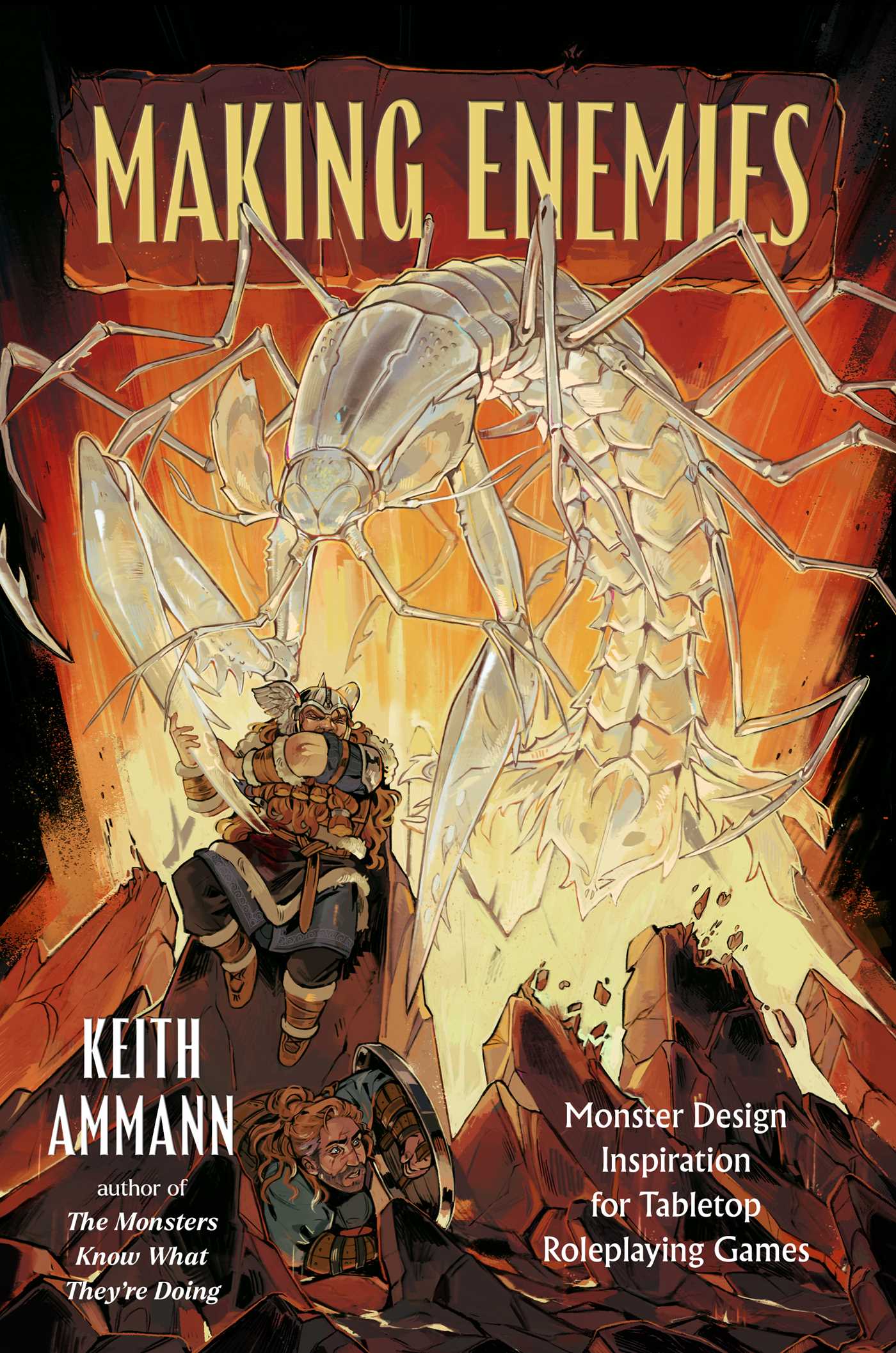
#REVIEW: Making Enemies: Monster Design Inspiration for Tabletop Roleplaying Games, by Keith Ammann

We’ll begin with my absolute favorite thing for book reviews: Disclaimers! First, that I got a copy of this book for free (it comes out on Tuesday) and second, that I’ve known the author for a vaguely shocking twenty-two years, and not in the usual parasocial Internet way that I know a fair number of authors but in a “he’s been in my apartment and we’ve worked on grad school projects together” sort of way. There’s a review of his book The Monsters Know What They’re Doing here; this is actually his fifth book, technically part of a series but, given that they’re all roleplaying sourcebooks dedicated to helping game masters for TTRPGs do their jobs better, there’s no reason to feel like you need to read them in order. I admit it; I have not read the books in between, although I intend to.

Here’s the thing about Keith, guys: Keith is one of the smartest motherfuckers guys I’ve ever met. He’s ludicrously well-read and he’s got a mind like a steel trap. If he had been born seven hundred years ago he would have been a monk and would have discovered something that we all take for granted by now; if he’d been born in the 1810s instead of the 1970s you would never have heard of Gregor Mendel. However, he was born in the 1970s, so instead of more or less inventing genetics as we know it, he writes about roleplaying games.

Making Enemies is, ostensibly, about creating home-brew monsters for your TTRPG campaign. He doesn’t limit himself to Dungeons & Dragons with this one; attention is paid to Pathfinder, Shadowdark and Call of Cthulhu, along with another system that I have to admit I’ve never heard of called the Cypher System. Each section of the book begins with a more generic introduction to/discussion of the aspect of monster design being discussed, such as morphology, abilities, size and number, quirks and weaknesses, etc; and then there will be sections afterward dedicated to the differences you’d see among each of the specific systems. I felt like Call of Cthulhu got a little shorted, as it doesn’t quite work the same way as the rest of the systems (You Are Fucking Doomed is more or less Call of Cthulhu’s entire thing, and this book is about making good enemies for your players, not killing them in seconds) and of course D&D gets a bit more attention than the others, but there’s good stuff here for everybody who plays TTRPGs.

Nothing I’ve just said is sufficient to prepare you for just how deep this book gets, over and over and over again. The chapter called Weird Nature, about monster type and morphology, could be copied and pasted into a biology textbook with barely a sentence changed. The book interrogates the entire concept of “monster” over and over again in a way that is completely fascinating and yet in some ways entirely unnecessary to a book about TTRPGs, which are generally much more lowbrow than this. There are interviews scattered throughout the book with professional game designers, and it’s stunning how high-level, no pun intended, some of these discussions get. I would love to know how much actual research went into this book that had no direct relationship to TTRPGs. My guess is: lots.

(Memo to Keith: go whole-hog on your next book. I want four hundred pages on your theory of game design. Do it.)

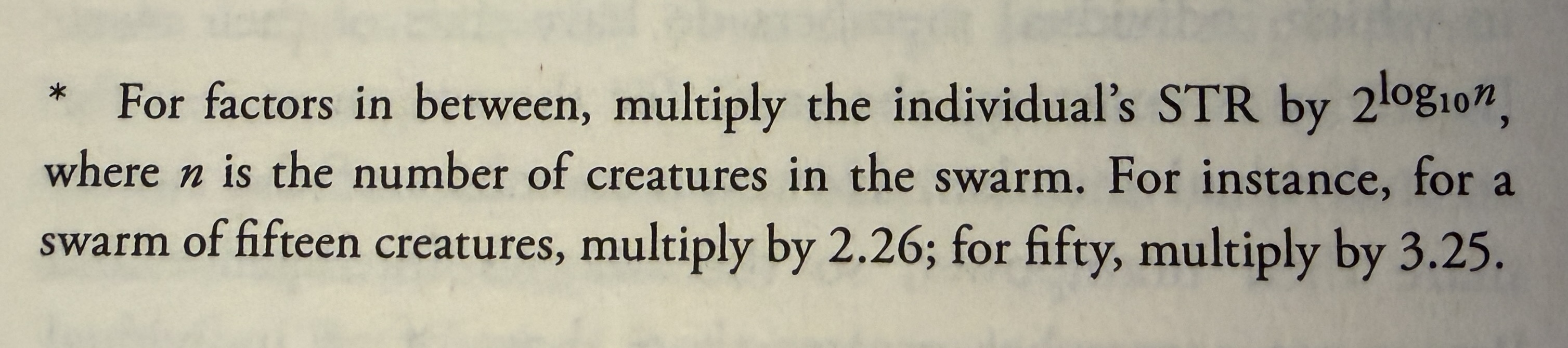
But seriously. I feel like I should have been taking notes and adding Post-Its into the book while I was reading it, and the reader of this book should be prepared to see the occasional quotes from genuine academic works of philosophy and then less than a page later an anecdote about The Muppet Show. That’s not to say that this book doesn’t have a ton of good old-fashioned in-the-weeds nerd math, because it does. Witness:
I’ve talked about this before: I love enthusiasm. My favorite thing about TikTok is how great of a vehicle it is for people to share activities they love with other people. And the reason I feel so comfortable recommending what by rights ought to be a very niche book to literally everyone I know who reads is that Keith’s incredible enthusiasm for game design and TTRPGs shines through every page of this book. I enjoyed The Monsters Know What They’re Doing quite a bit and recommended it, but I was clear (and so was the book!) that it was a book for people who ran TTRPG games. I think there are people out there who would enjoy this regardless of what they’ve done in the TTRPG space; if you consider yourself an autodidact and an intellectual (dare I say “polymath”?) you may find yourself skipping the weedier sections here and there that get into specifics about the systems, but the interviews and the beginnings of every chapter and the relentless attention to careful thinking throughout are going to bring a smile to your face.

Making Enemies comes out October 7th. Check it out.

On terrible people and my time & money

While I’ve been doing some DMing for my wife and son lately, the last time I spent serious time playing role-playing games was in college. I lost my group when I moved to grad school, and basically never tried to find another one after that. My college group mostly bounced back and forth between Call of Cthulhu and Dungeons and Dragons.

One of the best campaigns I was ever involved in was a published Call of Cthulhu game called Horror on the Orient Express. I have some of my best memories as a gamer from that campaign; it was a tremendous achievement in game design and, not for nothing, was expertly run by our DM as well.

I recently discovered that Chaosium, the company that owns Call of Cthulhu, was planning on updating and republishing Horror on the Orient Express in a new, two-volume, 700-page, ludicrously expensive version for their 7th edition rules. It’ll be out in a couple of months.

Did I say ludicrously expensive? I don’t care, I’m buying it anyway. This is why I have a job.

Well, it’s for the seventh edition, and while I doubt that the seventh edition is all that different from the rules I’m familiar with (and it’s not like I intend to run this; I’m buying it for nostalgia value and to reread it) it felt weird to think I was going to buy an adventure for 7th edition Call of Cthulhu without actually owning the core rulebooks for 7th edition Call of Cthulhu.

So I spent a hell of a lot of money at the Griffon yesterday. Because these damn things are pricey, even under normal circumstances.

Let’s talk about H.P. Lovecraft a little bit.

Just in case you’re not familiar with him (although I doubt that’s going to be the case for too many of you; after all, you’re here,) the Call of Cthulhu game is based on a mythos created by the works of an author named Howard Phillips Lovecraft. H.P. Lovecraft’s influence on fantasy writing and specifically the horror genre is kind of difficult to overstate. His work is a big deal, and damn near everybody who works in genre has read him. He was also an enormous, disgusting racist, and his racism bled into a lot of his work. Now, when I say that about somebody who was born in 1890, a lot of people are going to shrug. “He was a product of his time,” they’ll say. “We can’t judge people Back Then by our modern moral standards.” Nah. H.P. Lovecraft was so much of a racist that it was notable in the 1920s. Like, ordinary run-of-the-mill 1920 white people thought this guy’s ideas about race were kinda fucked up. Google the name of his cat sometime. The guy was a hell of a writer, but he was trash as a person.

Typically I do not like to spend money that will trickle into the hands of giant fucking racists. However, in the case of Lovecraft, while the overall picture is complicated, his work is mostly in the public domain by now. Furthermore, Lovecraft had no children and his wife divorced him (well, sorta) a few years before he died, so there’s not even a family that money spent on Call of Cthulhu is going to go to.

But the guy’s legacy still has to be grappled with, right? The World Fantasy Award used to literally be a bust of his head; it was remodeled in recent years to a (much better) excellently creepy full-moon-behind-a-tree version after Nnedi Okorafor, who is Nigerian-American, won the award and pointed out that the greatest award of her literary life meant that she had to look at the face of a dude who literally didn’t think she was human every day. There is a long, ongoing, and very likely never-ending conversation about whether we can separate art from artist, but we can definitely avoid literally honoring the artist when that artist turns out to have been a terrible person. If that person is still benefiting from the sale of their art, then you need to have a deeper conversation. H.P. Lovecraft has been dead for 80-some-odd years and buying his books doesn’t send money to anyone connected to him, so reading his stories isn’t as problematic as, say, reading the work of still-living garbage humans John C. Wright or Orson Scott Card.

(“As problematic,” I said. And I’m not going to spend one second trying to talk someone out of feeling otherwise; if you feel like I’m making a distinction without a difference, let me know.)

All of this may be more lead-in than this issue deserves, but I was leafing through my new rulebooks last night and, as one probably might expect, Lovecraft’s name is all over this thing. And I thought about that for a bit, and went to the first few pages of the book, looking to see what they had to say about the man himself. And I was startled to discover that the official 7th edition Call of Cthulhu rulebooks devote two sentences of a chapter called “H.P. Lovecraft and the Cthulhu Mythos” to talking about Lovecraft’s racism, and those two sentences are basically there to utterly dismiss it. The game, remember, is traditionally set in the 1920s, not exactly a great time for American race relations, to say nothing of the sexism, and the author is one of literature’s most famous racists.

I’m a little surprised and more than a little disappointed that the game doesn’t address this more directly, is what I’m trying to say here. The newest edition of the Dungeons and Dragons rulebook has a whole section at the beginning of the book about how players of all races, genders and sexualities are welcome in the game and theirs is set in an explicitly fantasy world. Call of Cthulhu is not only based on the work of a racist but is set in the 1920s, when any number of people who might be interested in the game now might face some issues playing characters who reflect them. I can easily imagine a Keeper making the life of a Black or gay or Asian or enby or hell even female player miserable because That’s How Things Were Back Then. Maybe, in our pair of oversized-hardback, two-column, 400-page rulebooks we should take at least a few paragraphs to talk about how to navigate that? Particularly in the Keeper’s Handbook, the book for the person running the games? This hobby has kind of a reputation for being a little exclusionary; can we take some time to push back on that, please? Just a little?

I dunno. I’m not– at least not without further reading, and again I’ve only skimmed these books since buying them– accusing the Chaosium writers of being racist or sexist. Right now what I’m specifically saying is that there’s a huge blind spot here, and it’s kind of made me uneasy about shoveling more money toward this company. I may feel differently once I’ve read through the rulebooks; if I discover I’ve missed something important (and there’s 800 pages of material here, so this is entirely possible) I’ll update later. But this is squicky, and I don’t like it, and I thought that was worth talking about a little bit.