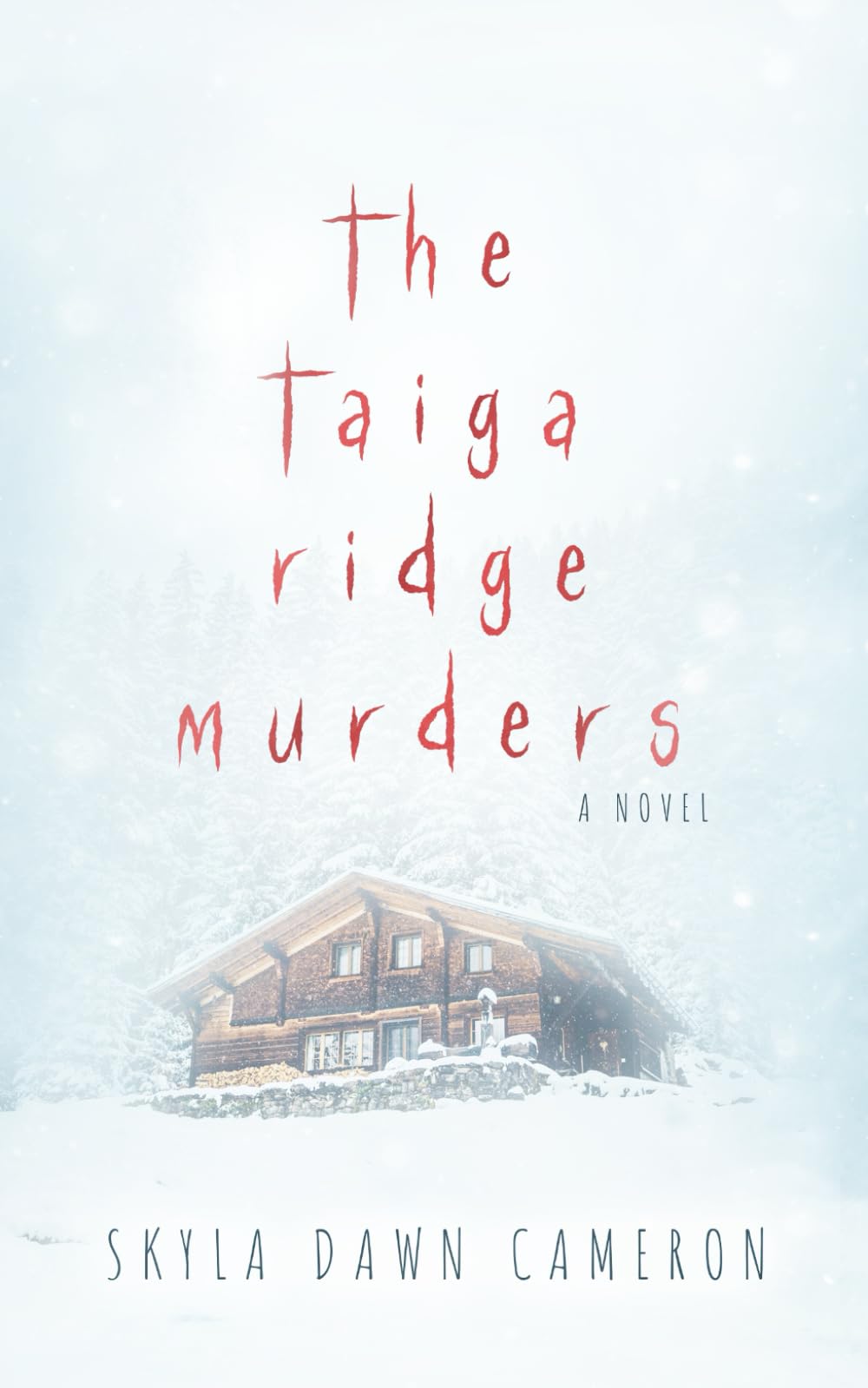
Good!
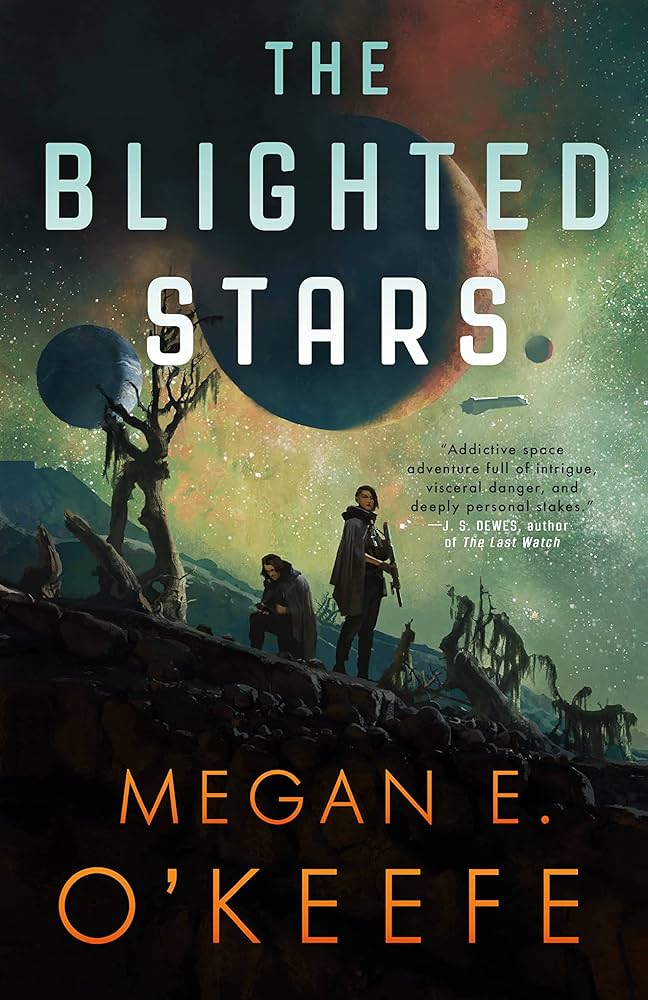
Also good!
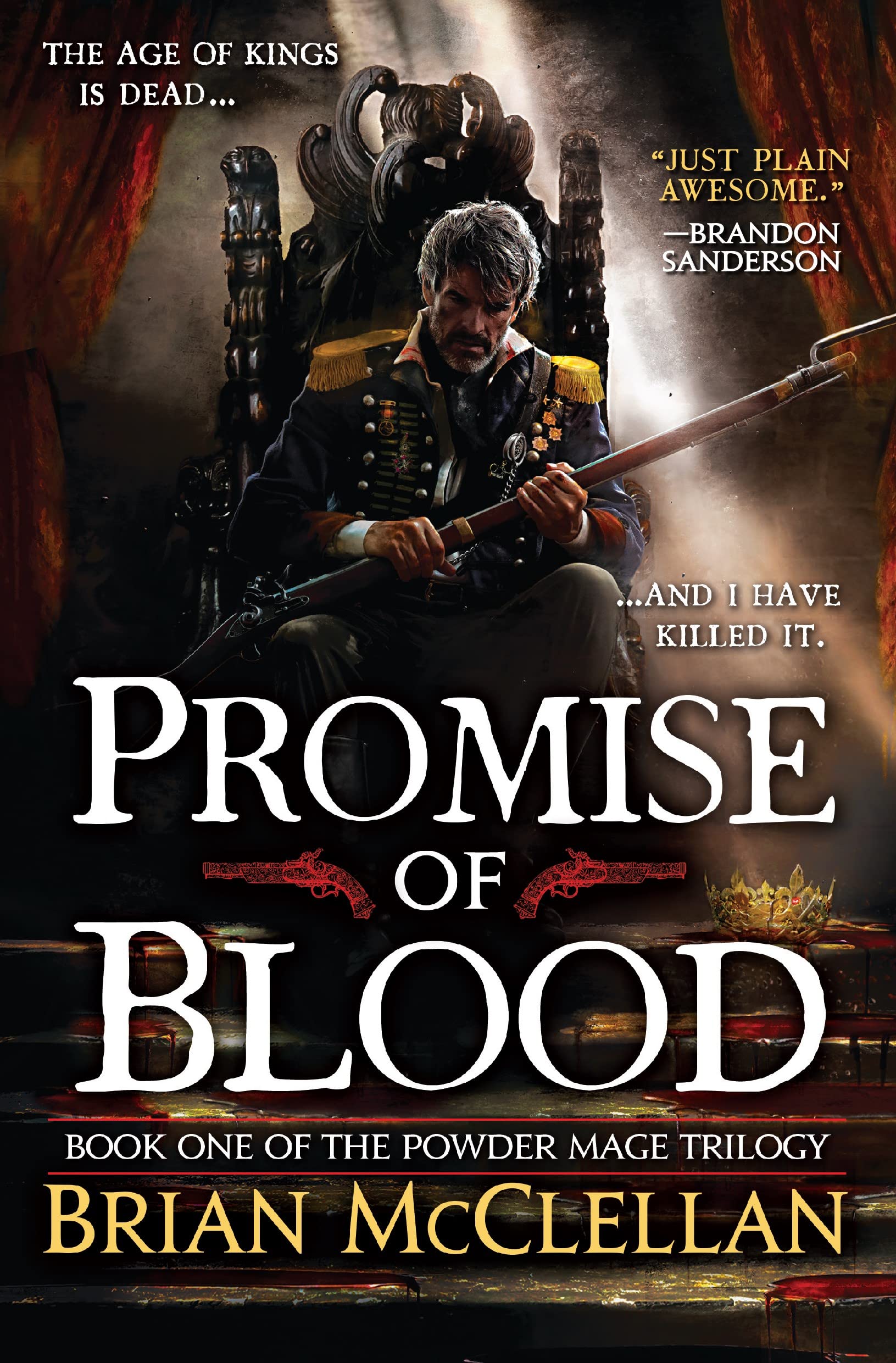
Really good.
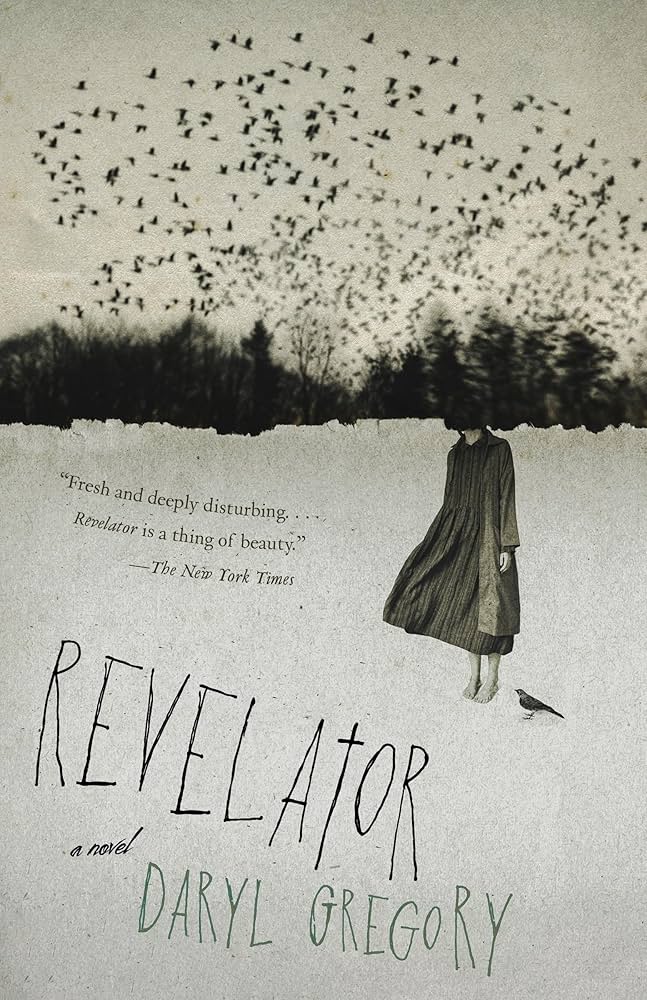
Really really good!
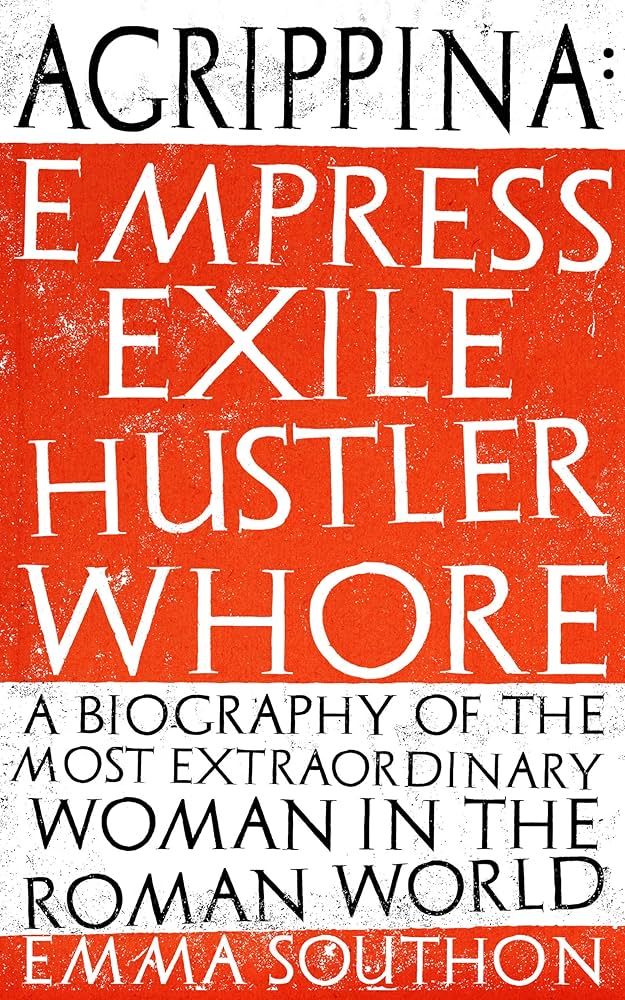
Only twenty pages in, but showing some serious promise.
(And the hardback cover is infinitely superior to the paperback one, which lacks the mid-title, which is a crime.)
The blog of Luther M. Siler, teacher, author and local curmudgeon
Good!
Also good!
Really good.
Really really good!
Only twenty pages in, but showing some serious promise.
(And the hardback cover is infinitely superior to the paperback one, which lacks the mid-title, which is a crime.)
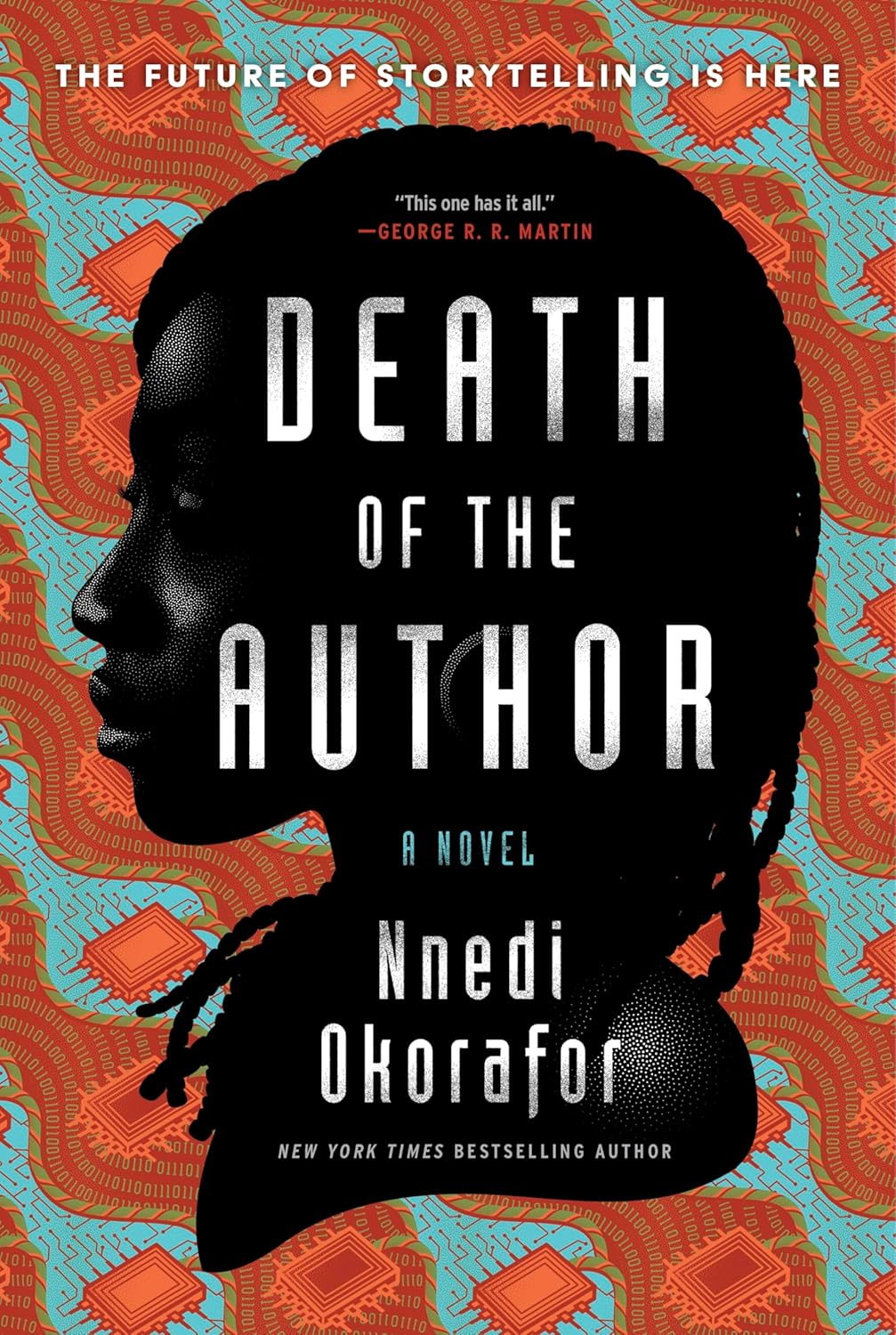
I have spent a couple of days trying to think of a time where I thought a story-within-a-story structure worked for me, and for the life of me I’ve been unable to come up with one. The main character in Nnedi Okorafor’s Death of the Author is– get this– a Nigerian-American female author who lives in Chicago and is in a wheelchair due to a childhood injury, and at the beginning of the book she writes a science fiction novel that is a massive success. A massive, massive, massive success, propelling her to J.K. Rowling or Stephen King levels of fame. Portions of the book are given over to excerpts from her book, Rusted Robots.
The problem is Rusted Robots is terrible. It’s unreadable. By the end of the book I was skipping all of the Rusted Robots sections, and I generally don’t skip or skim parts of novels. And, man, it’s really damn hard to read a book that is all about how amazing and life-changing some other book is, especially when they keep giving you parts of that other book and you keep skipping them. The obvious self-insert doesn’t really make any sense (Okorafor doesn’t use a wheelchair, but had a surgery for scoliosis go bad as a young woman, and she needed crutches to walk for a long time) and Zelu as a character is generally unbearable. She’s selfish and impulsive and her family is terrible, so you’re confronted with a situation where you don’t like the main character and think her family treats her poorly and think they’re mostly right even though they’re terrible about the way that they’re right.
It’s also really weird to read about the various ways Rusted Robots affects Zelu’s life, because as an actual science fiction author Okorafor has to know that this isn’t how this shit works. Okay, granted, Nigerian women in wheelchairs aren’t terribly common sights, and Nigerian women with the experimental leg exoskeleton devices she acquires midway through the book are even less common, but Zelu gets recognized repeatedly every time she leaves the house, by people who a lot of time are reading her book right at that very second so they can shove it in her face to sign. Zelu’s relationship with her Internet fans makes more sense, especially as the wait for Book Two of her unplanned trilogy gets longer, but no debut author has ever gotten this famous this fast. It’s nutty.
I three-starred it on Goodreads because despite my complaints it’s still an Okorafor novel, and it was one of those books that despite not liking it very much I didn’t want to put it down, but a twist at the end very nearly made me knock it down to two, and I still might.

Sigh. I really like all three of the authors in this post! Scalzi, in particular, is someone who I have referred to as “one of my favorite authors” more than once, but When The Moon Hits Your Eye marks his second miss in a row after Starter Villain, which was mostly underwhelming.
The biggest problem is that When The Moon Hits Your Eye actually is the book that Scalzi’s online detractors want to tell you all of his books are– it’s slight (I read it in three hours or so, and not because it was so amazing I couldn’t put it down), all of the characters feel exactly the same, and all the dialogue is bantery and quippy in a way that’s okay for one or two characters in any given book but not for damn near everyone. The concept of the book is that the moon suddenly turns to cheese, and the book talks about the next thirty days after that. There’s no main character, although some people are revisited a few times, but Day Fourteen might talk about a character that you never see again, or you might jump back to the people from Day Three on Day Twenty-Two and it’ll take you half of the four-page chapter to realize you’ve seen them before.
Oh, and I knew a girl once whose nickname was Mooncheese, for reasons I no longer remember, and I spent the whole book thinking about her, which wasn’t entirely unwelcome but was kinda distracting.
I dunno. The whole concept of the book is kind of deliberately dumb, and you can take something like that and play it kind of straight if you want to, but the characters in the book keep talking about how fucking stupid it is (those exact words) that they have to take the idea of the moon turning to cheese seriously, and after a while it’s really wearying. It’s just … it’s blech. It’s not very good, and it pains me to say that about a Scalzi book.
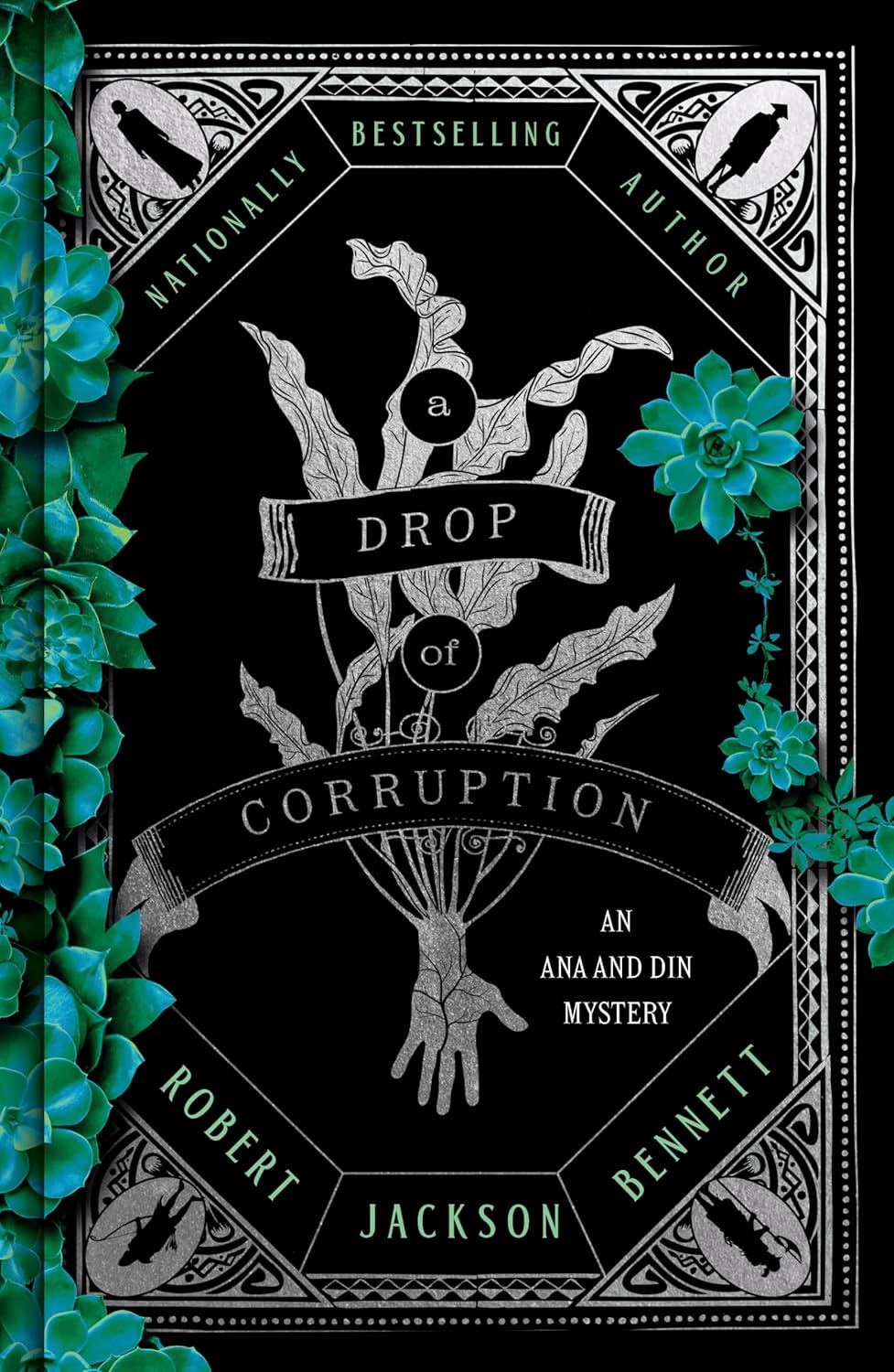
This, on the other hand. Go buy this immediately, and if you haven’t read the first book in what are apparently called The Ana and Din Mysteries, go grab it right now; it’s called The Tainted Cup and it’s really damn good too. The series hails from one of my favorite subgenres, “Sherlock Holmes, but …”.
This time our crime-solving pair are representatives of an Empire on a fantasy world with lots of biopunk “grafting” tech and occasional attacks by what are basically kaiju but they call Leviathans. Jackson Bennett leans heavy into body horror here– the victim in the first book died when a literal tree suddenly grew out of his body– and the Holmes of the series, Ana Dolabra, is a drug-addicted and probably genetically modified ubergenius who wears a blindfold because she can’t handle the constant visual input of the world around her. Dinios Kol, the Watson, is an Engraver, possessed of perfect recall but with a neat little twist where he needs to anchor his memories with scents to be able to describe them in a way that makes sense to anyone else. Ana is delightfully nuts and the world itself is fascinating as hell, and the Macguffin of this book is Leviathan marrow, which is just a great thing for characters to be chasing around and trying to find. I love this series, and right now this book is on my shortlist for 2025.
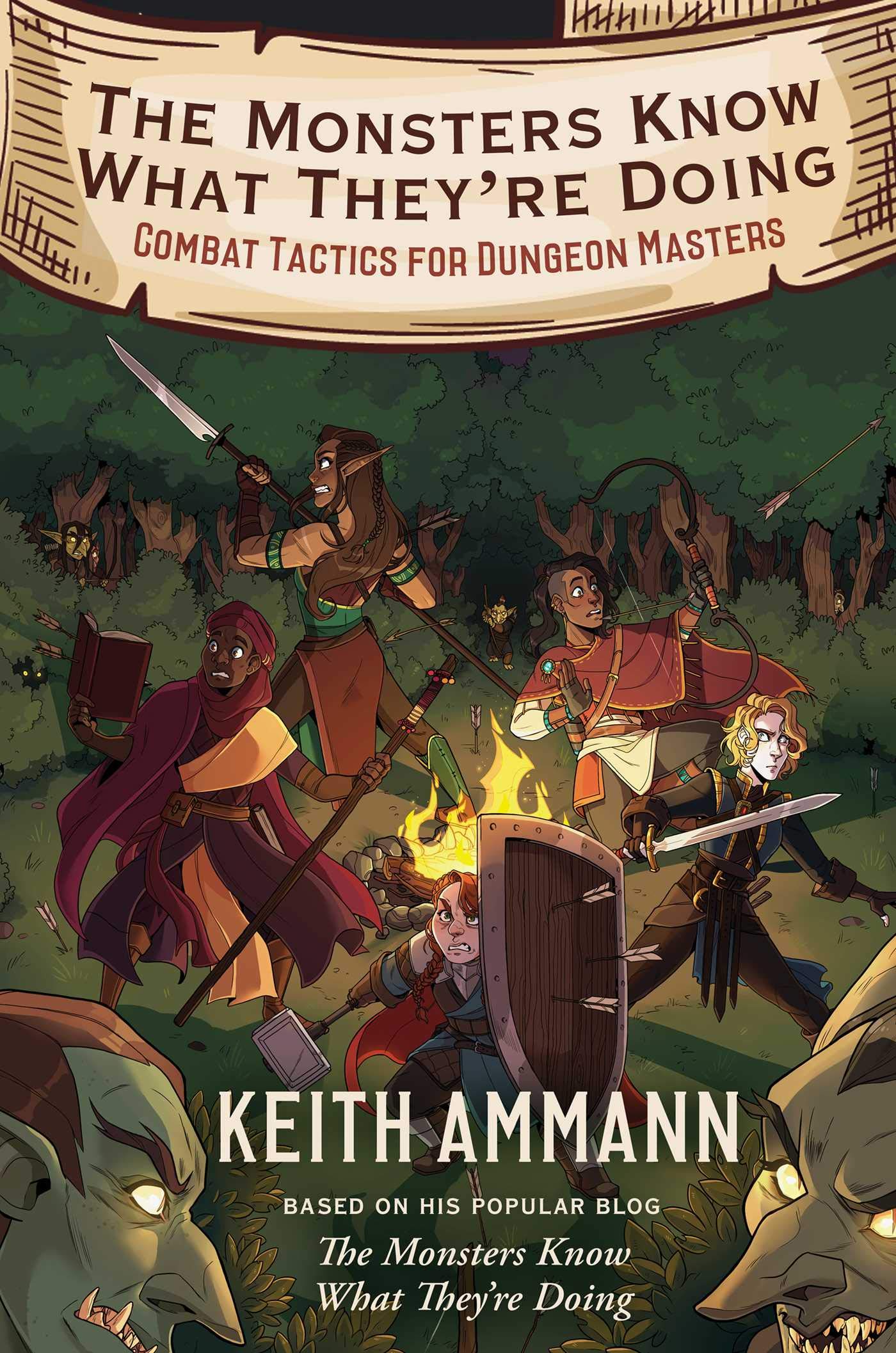
This is a new one: I’ve started reviews before by pointing out that I know the author, but in this case, I really know the author, as in “he knows my real name, was in my ed school grad program, and he’s been to my apartment.” Keith and I essentially had the exact same day-to-day schedule for two solid years, and while we’ve fallen out of touch other than occasional social media interactions since graduating in 2005, it’s simply not possible for me to leave my relationship with him aside while talking about this book. The Monsters Know is, in a lot of ways, possibly the Keith Ammanniest thing Keith Ammann could possibly have written, and while that’s a compliment, it’s very likely not one that’s going to be salient to anyone other than me.
Here’s the tl;dr: If you play Dungeons & Dragons, and especially if you’re a DM, you’re highly likely to really enjoy this book. If you do any sort of fantasy roleplaying that isn’t exactly D&D but is D&D adjacent, it’s probably going to be useful anyway. The book– five hundred-plus pages– is filled with essays on what feels like the entire Monster Manual (it probably isn’t, but still) breaking down various fantasy monsters based on their provided stat blocks, and providing suggestions on how they might act, what tactics they might use, and how they might react to any number of possible actions by your player characters.
There is also math. I’ll get to that in a bit.
Now, to be clear, I did not read this entire book. Why? Because it’s more of a sourcebook than something you sit down and read straight through, and if I have a criticism of it it’s not of the writing or the subject matter but the physical format of the book, which looks like a novel or, like, a “regular” book, when I really feel like it ought to be formatted more like a roleplaying sourcebook of some sort. I probably read … half of the entire thing, skipping around to different monsters I was interested in and occasionally occasionally passing over sections that were a little more power gamey than I’m interested in. Ordinarily I wouldn’t review something if I hadn’t read all of it, unless it was an actual DNF, but again: that’s not what this book is. The section on the kuo-toa will be there whenever you actually decide to include kuo-toa in your game; you don’t really need to read every word of that to appreciate what the book is doing. I am fairly certain that if I told Keith, word for word, “I liked your book but I didn’t read all of it,” he would not be a bit surprised, nor should he be.
Let’s be a touch more specific, though: based on, for example, the description of a species as being high Dexterity but low Strength and medium Intelligence, and the different combat abilities that a species or monster might have, The Monsters Know might suggest that this species prefers to attack from ambush, using sniping tactics and a high likelihood of retreat once injured. From there the section might move more specifically into D&D language, suggesting that Dash and Disengage actions might be used frequently in combat, and sometimes it’ll go so far as to map out a model encounter of sorts. A lot of the time it’ll then get into the actual mathematics behind various attacks, spells, etc, using those numbers to suggest which abilities a monster might prefer to use and which would provide a bit more utility and a higher reward to risk ratio. A lot of the time it’ll suggest a hit point threshold at which point a monster might retreat, too. I haven’t DMed much at all, really, but this was still fascinating to read and to think about, and I may suggest my son look through it, as he’s starting his first homebrew campaign soon. The book loses me a bit when it gets super granular about the numbers behind the abilities, but that’s the beauty of a sourcebook; you can ignore the stuff you aren’t as interested in. I was never a power gamer, and was always more interested in the abilities that felt fun or cool than whatever might be strictly the most effective move at any given time, so that stuff isn’t for me as much.
So yeah. My buddy wrote a book. If you’re into the same kind of nerdery we are, you should definitely check it out, and you can also go to Keith’s blog (the source of a lot of this material) at themonstersknow.com. If you’re in, he’s on his … fourth or fifth book by now, I think, so there’s a lot more where this came from.

I got a second copy of Antonia Hodgson’s The Raven Scholar on the day I started reading it. And it wasn’t quite on purpose– the copy on top there showed up on release day, since I’d preordered it after it caught my attention somewhere at some point in the last few months, and then Illumicrate sent me another copy as part of their monthly box. This is the first time that’s happened; the unofficial rule for Illumicrate books seems to be that they only send me books I’ve never heard of, and this is the first time they’ve sent me one I already owned, although I have bought a couple after reading them so that the series were sure to match. One way or another, though, the Illumicrate edition is fucking gorgeous, one of the prettiest books they’ve sent me, so I’m not pressed about it.
… and suddenly I want to change the title of this post and take the word “review” out of it, because the more I think about it the less interested I am in writing even a traditional-by-my-standards book review. This book is weird; I enjoyed reading it, and I’ll pick up the sequel– which may be, in and of itself, enough of a review for anyone who cares at all about my opinion– but there’s a lot about it that makes me reluctant to star-rate it. For one, it’s a Magical Tournament book, and I am tired of books that can be boiled down to the name of a trope. On top of that it’s a People Are Sorted Into Categories book, although it’s not the entire society, at least, but nearly all of the main characters in this book represent the devotees of one of the eight animal gods (creatively named “the Eight,” although it’s fun seeing the word “eight” used as a swear word) and some of the ones who don’t used to. Which leads me into another gripe, which is that every character effectively has three names, since sometimes they’re referred to by their first names, sometimes by their last names, and sometimes just by their faction, so you might see someone talking about “the Hound” and you have to remember who that is. Spread that out over the eight people involved in the tournament (which is how they pick their emperor, who appears to be a king, and I wish people would learn the difference) and keeping track of everyone can be a little more complicated than maybe it should be.
But! There’s a murder mystery at the heart of this book, and the murder mystery is wrapped around the succession tournament and the eight-faction worldbuilding thoroughly enough that it’s hard to extricate from it– this story only works in this world– and main character Neema, the titular Raven Scholar, is tasked with untangling the mystery as well as trying to become emperor on the side, a job she’s not even interested in, because the outgoing Emperor has ordered her to try to become his successor, which makes more sense in context than it might sound. Only Neema’s not much of a scholar– she’s more of an autistic nerd, which isn’t quite the same thing– and occasionally she gets really good at physical combat because she has to.
Oh, and there’s a Shoehorned Enemies-To-Lovers Romance, because everything has a name nowadays.
I dunno. I liked this book, as I said, but every ten pages or so something jumped out and kind of annoyed me? But not enough that I didn’t five-star it, although right now I’m not sure why? Because maybe I don’t know what a five-star is, and of course I’m writing this, when I could have just not talked about the book.
Maybe I should just go back to bed.(*)
(*) It is 6:18 PM.
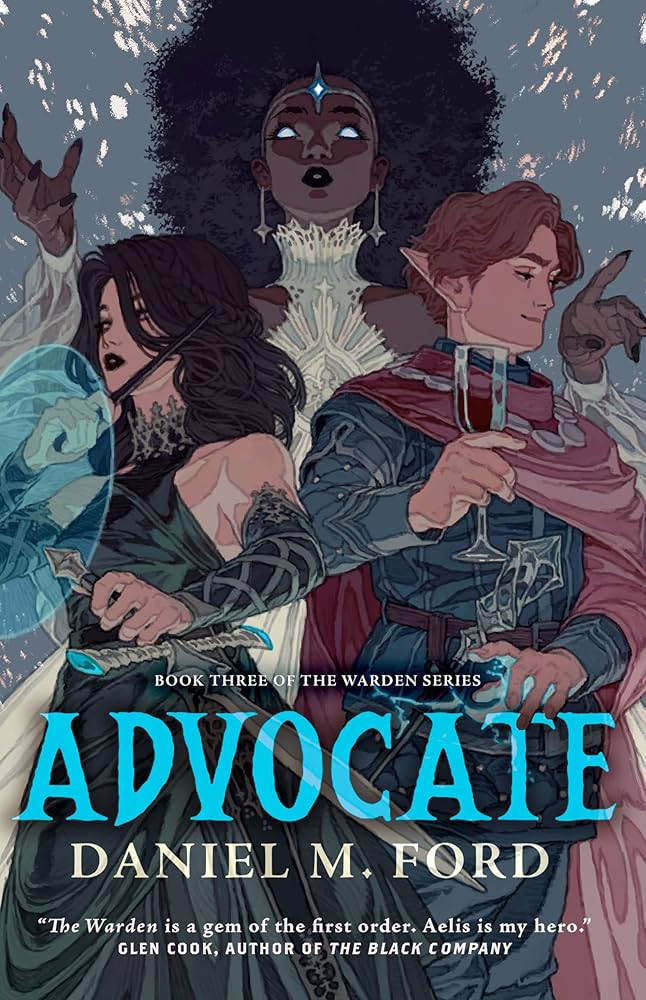
The standard disclaimers apply: Dan and I are Internet Mutuals, the origin of which is lost to time but almost certainly involves Twitter somehow. I spend a fair amount of time hanging out in his Discord server, which is, in fact, the only Discord server I spend any time in. And while I reviewed The Warden, the first book in this series, I somehow did not review Necrobane, the second book. My vague recollection is that I had kind of complicated feelings about it and the review just kind of got away from me; I didn’t dislike it, although I do have to talk about it in order to talk about Advocate.
Which, by the way, I’m gonna screw this up: the name of the book is Advocate, not The Advocate. I keep wanting to put that The in there.
So let’s rip the Band-aid off here: viewed on its own, I really enjoyed Advocate, for much the same reasons I enjoyed Warden, and the rest of Dan’s work. Aelis is a fabulous asshole, of a type I enjoy reading about, and a couple of the new characters, particularly an alcoholic gnome named Mihil and a fellow Warden (and ex-girlfriend) of Aelis’ named Miralla, are also a lot of fun. That’s Miralla in the back on the cover, although the elf on the right is not Mihil, even though he should be.
(I get why he isn’t; that’s Amadin, another Warden, and he’s a fairly important character, but I suspect the real reason Mihil isn’t on the cover is that including a gnome in the composition would make placing the cover text tricky.)
The bulk of Advocate unfolds like a mystery, although we know who committed the crime from the first pages of the book, and Aelis’ job is less to prove her former mentor innocent than to convince the court that no crime was committed in the first place. The story is satisfyingly twisty-turny and Aelis gets plenty of time to show off her two best character traits: her utter confidence in her own ability to outwit literally anyone and her tendency to make a snap decision, get in over her head, and then somehow come out on top anyway. There’s lots of swordplay and quite a bit more actual necromancy than what we saw in the last couple of books.
Advocate‘s biggest problem is that, while the cover calls it “Book Three of the Warden Series,” it is, for now at least, the final book of the Warden series, and it’s structured much more like Book Three of Six than Book Three of Three. But let’s back up a little bit and talk about Warden and Necrobane.
Warden ended with Aelis screwing up in a fairly spectacular way, potentially unleashing a continent-wide zombie plague. I was expecting the rest of the series to be focused on that not-minor problem, and the book went an entirely different way than I expected, dealing with what I thought was going to be a two-book problem in about a hundred pages or so and then pivoting into something else. At the end of Necrobane, Aelis’ love interest is magically bound to a particular plot of land in the midst of a wild forest a fair distance away from Lone Pine, and Aelis is unable to figure out how to free her. Then, at the end of the book, she is summoned to the city of Lascenise, a major (and wealthy) metropolitan area, to serve as an Advocate for her old mentor, who has been accused of murder. An Advocate is basically a Warden lawyer; Bardun Jacques has a lawyer but is entitled to a Warden defending him (and investigating his case) as well. He has asked for her specifically. She has no real choice but to go.
This was another left turn, and I was concerned with what it meant; that Book Three would be taking place in an entirely different place and with, importantly, an entirely new cast— Maurenia being magically stuck on a couple acres of land a week or two away, and half-orc werebear Tun being entirely unsuited to life in a city. And, in fact, that’s exactly what happened. The two stories do end up knitting themselves together, but Tun’s presence in the story is minimal and Maurenia’s role is basically to be something else that Aelis has to worry about in addition to the rather significant number of new problems the story is dumping on her head. It’s probably important to point out that Aelis was going to have to head toward civilization anyway, as she was going to need access to libraries to figure out how to release Maurenia, but she’s more or less stuck there until her Advocate duties are discharged. Making things worse, in her last scene with Maurenia before leaving it’s made clear that there’s a time limit on how long she has to break the spell before Maurenia is, effectively, taken over by the forest.
(Side note: Necrobane also features a fight with one of the creepiest monsters I’ve seen on-page. The book contains a tooth golem, which is every bit as awful as you might think, and maybe worse.)
So your appreciation of Advocate is going to be contingent on how much you like Aelis, and how willing you are to lose the supporting cast we’ve grown to like over the last two books. This is what I mean by it being a better “book three of six” than an end to a trilogy; there’s lots of expansion to the worldbuilding and lots of character development for Aelis (we meet her family!) and all of that is cool but if you were really vibing with her and Maurenia’s relationship, or her mentor/mentee relationship with the little girl she’s teaching to read at the end of Necrobane, you’re gonna have a hard time. And this would be much easier to bear if we knew there was Book Four on the way out there, but Tor has really screwed this series over(*) and right now there isn’t one. I decided to star-rate it on its own merits, mostly because no one can stop me, but I can imagine other readers being less happy.
I want more books in this series, in other words, not only because the world is fascinating and I want more but because I think the story and the characters deserve it.
(*) Not my story to tell, unfortunately, but I feel like they owe Dan another trilogy to make up for how they treated this one. Even if I didn’t know him, the simple fact that somehow I have bought five copies of the three books in this trilogy and still don’t have a matching set to put on my shelf would have me deeply pissed.
You may have noticed this about me by now: I love me a good heist story. Any time a book is about a charming rogue whose job is to rob somebody, I’m pretty well in from the jump with no further information needed. Breaking into somewhere? Breaking out of somewhere? Scamming the local merchantry or rich assholes into, well, anything? Yep, here’s my debit card, we’re good.
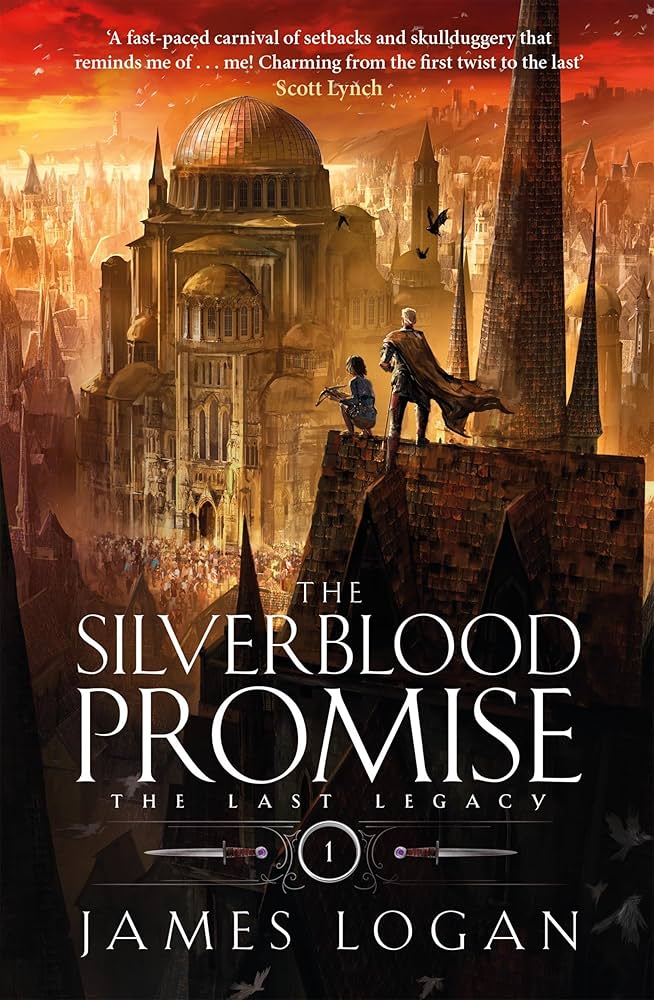
The Silverblood Promise is not quite a heist novel, at least in the sense that it’s not about a single overarching act of scammery. Main character Lukan Cardova is a bit of a con man and certainly a charming rogue, but the story kicks off when his estranged father dies and sends him off on a wild quest to a hive of scum and villainy on the other side of the continent, in search of … well, Lukan’s really not sure at all what he’s in search of. He has a last-words type of note written in his father’s blood with three names on it: his, the name of the city, and another he doesn’t recognize. This is very much a “one thing leads to another” type of book, where he finds out who he’s looking for, but she’s in jail, and then he deals with that, and then there’s this whole other thing that he needs to do, and everything he manages to complete leads to another quest, much to his great annoyance. The story keeps moving along at a pleasantly rapid clip, and by the end of it Lukan is not only hip-deep in local and possibly inter-dimensional politics as well as a thieves’ guild or two but he’s acquired a combination minion and surrogate daughter in an eleven-year-old named Flea, who tries to rob him early on and then just … sticks around after that. There’s no One Big Scheme, but there are literally five or six smaller ones; maybe this is a heists novel, and not a heist novel, who knows.
There are enough ideas for five or six books packed into this book, which is Part One of (I believe) a trilogy, with the second volume to follow this fall. If anything, the book might be overstuffed, as every side character and local power structure Lukan runs into is something I wanted to know more about, but as far s I know the second novel takes place in an entirely different city. The book’s biggest weak spot is, unfortunately, Lukan himself, who can tend toward being whiny (he’s thoroughly exasperated with the plot of his book by the end) and is also a bit of a drunk, but the book at least knows that being the drunk is a character flaw. This is Logan’s debut novel and there’s also a bit of that thing where Lukan occasionally basically replies to the third-person omniscient narrator. The type of thing where the book drops a bit of worldbuilding and then Lukan will think Yeah, that sucked, or something along those lines. It can certainly be overlooked and some people won’t even notice it, but if it’s the kind of thing you notice, it’s gonna knock you out of the book once in a while.
That said, my gripes are minor and I chewed through this book’s 500+ pages in two days, losing some sleep along the way. I had a feeling, picking it up, that this was going to be one of those books that I regretted leaving on my Unread shelf for so long, and … yeah. I’ll be reading the sequel pretty close to immediately, when it comes out in November.

My lovely wife has returned from her long sojourn, and all is right with the world again. After lazing about and whining all day yesterday, I was a veritable dervish this morning, managing to tidy, vacuum and dust every room in the house other than the office, which still got a lick and a promise. I read two books today and built half a Lego set on top of everything else. I think I can call the last Saturday of break a success.

Reading two books in a day isn’t the accomplishment it might sound like, because both of them were novellas. I’ve seen a bunch of students over the last couple of years reading these two books, and because the covers are striking (and I pay attention to what they’re reading regardless) I asked a couple of kids about them last year, and was greeted with enthusiastic recommendations. I didn’t get around to it last year and then when I recently found another couple of kids reading them before Spring Break decided to jump on them.
I … don’t get it.
So, Osamu Dazai was born in Japan in 1909, which already places him well outside of anything my students are usually willing to read. His books are obviously translated, and both of these books were written post-war, in 1947 and 1948, right before Dazai died of suicide at 38, in a scenario that appears (I haven’t done a ton of research other than reading a Wiki article) to precisely match a suicide attempt described in No Longer Human. The books sound like they were written in the late forties, frankly, which isn’t a criticism but is another reason why I’m surprised that my students are reading them, because the style of a novel from the 1940s and 1950s is wildly different from the modern YA or romantasy that I catch them with most of the time, and that’s before you have to deal with the cultural unfamiliarity of being translated from Japanese.
The closest analog to No Longer Human that I can think of is that it feels like a Japanese Catcher in the Rye. It’s about a young, profoundly alienated man, and it’s casually misogynistic in the way work from that era frequently is. It’s written in first person and is semi autobiographical; the framing device is that it’s written as three notebooks by the narrator, covering a couple decades of his life, and there’s another unnamed individual in the preface and epilogue who talks about how the notebooks were given to him. I read The Setting Sun cover to cover in a single sitting and I can’t tell you what the hell its deal is. I mean, I can describe the plot, that’s simple enough– it’s another first-person narrative, this time of a woman named Kazuko in her late twenties, a member of a formerly aristocratic family that has fallen apart after World War II. Her mom dies. Her brother is a drunken mess who eventually kills himself. She tries to have some love affairs. Then she gets pregnant and the book ends. There’s some obvious symbolism scattered throughout– a bit about burning snake eggs, and snakes constantly showing up around moments of despair– but it’s mostly a pretty straightforward narrative.
So, yeah, I get the plot. I just can’t tell you why it’s a book, if that makes any sense. I feel like I get No Longer Human, and part of me can sort of see why it might appeal to teenagers, who respond to alienation narratives. I don’t know why the hell there’s a copy of Setting Sun in our school library or why the kids are professing to enjoy it as much as Human. There are strong themes of addiction and alcohol abuse through both books and a ton of suicidal ideation and successful suicides along with some genuinely terrible family situations. I dunno; I’m gonna ask some questions on Monday and maybe send an email to the kid who was most interested in me reading these last year. Don’t misunderstand me; neither are bad books, and No Longer Human is genuinely good, but I don’t see the appeal to 14-year-olds in 2025. I need answers here, y’all.
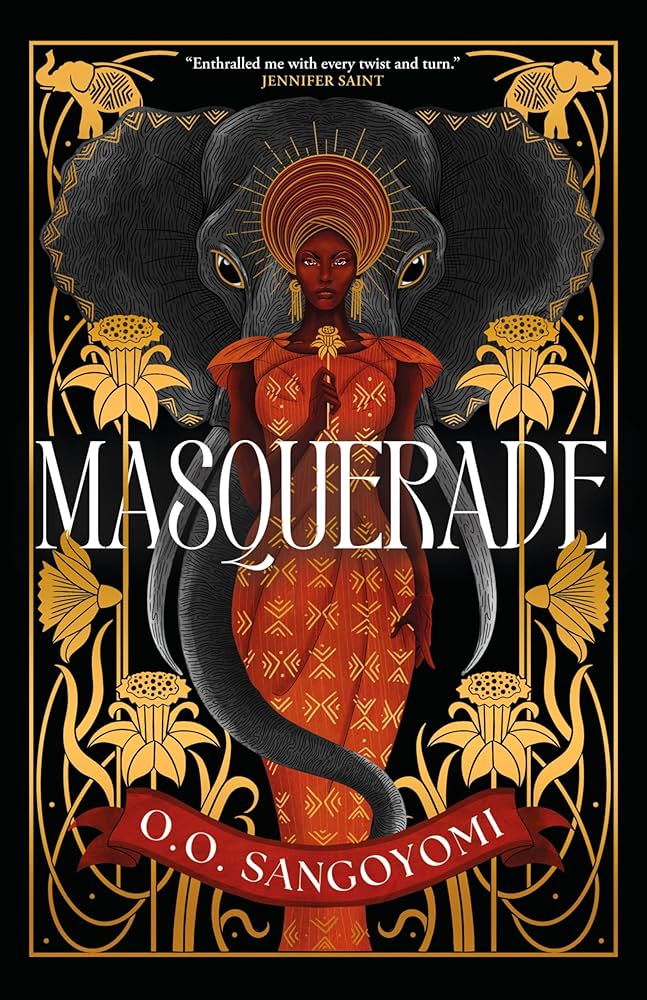
First things first: I’ve said this before, but if you’re not tapped into all the sci-fi and fantasy coming out of Nigerian and Nigerian-descended authors in the last five years or so, you are missing out, and you should fix that. This is going to be a somewhat mixed review of O.O. Sangoyomi’s debut novel, Masquerade, but the damned thing oozes with potential, and even if I had liked this less than I did I’d still be in for the sequel. Which sort of feels like “I like less than half of you half of what you deserve,” but I promise it’s a compliment.
The book jacket describes Masquerade as a “richly reimagined 15th century West Africa,” but I’ve got to be honest, despite what I just said about Nigerian fantasy this feels very much like historical fiction to me, and the speculative elements are minimal at best. I’m not precisely sure what’s being reimagined here. It falls under the fantasy genre because everyone is fighting with axes and machetes and spears, and when that happens we just call it fantasy regardless of how well it fits. It’s very low on the “low to high fantasy” axis, in other words.
Now, I’m not going to claim to have a lot of knowledge about West African history– I probably have more than your average American, but the average American knows nothing, so that’s not much of a brag. The book is set in Timbuktu, which was a real place, and the countries and city-states that show up as adversaries are all real, and the Yoruba are still around. If Sangoyomi has played around with history at all, it’s subtle enough that I can’t tell you about it. I can tell you that the main character, Òdòdó, is a blacksmith at the beginning of the book, and blacksmiths are consistently referred to as “witches,” but … I was never exactly clear why? Everybody’s still using smithed tools like it’s not a big deal, but they’re more or less the dregs of society for some reason.
A quick word on orthography: note all the accent marks in Òdòdó? They’re in nearly every word in the book of remotely African origin and there’s no pronunciation guide. The word I’ve rendered as “Yoruba” up there is Yorùbá in the text, for example. The city they live in is Ṣàngótẹ̀, and I don’t even know how to reproduce that S properly– I had to copy and paste it. I hope everyone will forgive me if other than the main characters’ names I don’t bother reproducing all the accents. If I knew how to pronounce them I might, but I don’t.
So anyway, Òdòdó is busy making herself a life as a blacksmith when she is abruptly kidnapped and brought to Sangote to be the wife of the Alaafin, who is basically the emperor. He’s picked her out while pretending to be a vagrant and having a brief conversation with her at her forge.
She is … surprisingly okay with this. I kind of need to rain some abuse down on the blurb-writers for this, who make the book feel like a revenge tale of sorts, and pay no attention to the “loosely inspired by the Persephone myth,” because once you get past the kidnapping there’s not a lot of there there. But no! Òdòdó is surprisingly cool with being kidnapped, she just wants her mom to be at the wedding, and her naïveté (goddammit!) at her fiancé’s (DAMMIT) insistence that he can’t find her mother to get her blessing is rather annoying. Òdòdó gets pulled into some political maneuvering, falls for a couple of truly amateurish stunts from the Alaafin’s mother, and accidentally helps touch off a revolution, and then somehow the book redeems itself entirely at the end, catching me by surprise in such a way that guaranteed the sequel was getting picked up.
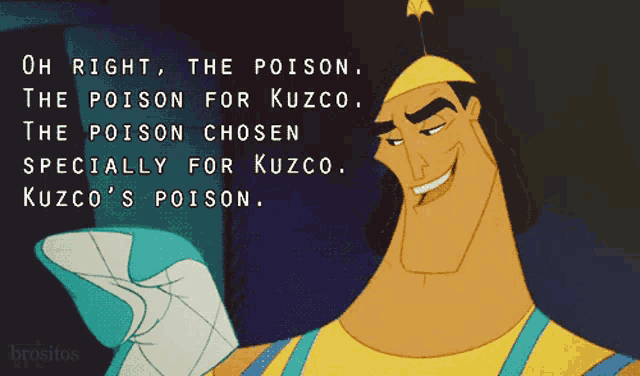
Strengths: the worldbuilding, other than the weird witchery of blacksmiths, was really interesting, and the basic novelty of the setting was great. Sangoyomi’s prose is excellent, and the book managed to include some romantic elements without descending into full-blown romantasy. The weaknesses are the characters, particularly Òdòdó herself, who careens back and forth between being a silly little girl and a seasoned political operative. It’s also unclear how much of a time frame the book takes place over, and you’d be forgiven for thinking it’s just a few months at best, which is not enough time for her to learn some of the things she learns how to do. She’s really good at anything she needs to be good at for the plot to move forward, including occasionally outsmarting actual generals (and coming up with war tactics they haven’t thought of) and defeating grown men in combat, and then she’ll turn around and drink from a cup that the mother-in-law has handed her that may as well have this on the side:
If this hadn’t landed the dismount, I’d probably have just put it on the shelf and moved on, but the ending really was well-done, if perhaps again a bit out of character, maybe? Who knows! But I’d have kept an eye out for this author’s next series. As it is, I’m in for the next book. This isn’t the best thing I’ve read this year or anything like that, but it’s solid and it’s a fast enough read, at about 330 pages, to be able to forgive its flaws.
 Welcome to infinitefreetime dot com