My friend Keith posted this on Facebook the other day, and he gave me permission to use it as a guest post when I asked.
It’s impossible to separate racism from the long train of abuses and usurpations that police departments in this country have perpetrated, but even if racism could be made to go away overnight, that by itself would not be enough to solve the problem with policing. There’s another dimension that needs urgently to be addressed.
If you ask a police officer to tell you what his job is — or, for that matter, ask the average person what the job of a police officer is — he will most likely say something like, “To get criminals off the streets.”
This is a serious problem.
“Criminals” is a category of beings. Suppose a police officer has a certain idea in his head of what a “criminal” looks like. That idea may be influenced by either conscious or unconscious bias. The officer has to make dozens of snap judgments a day, under stressful conditions, of whether the person he’s dealing with is a “criminal” or not. And if he decides that person is a “criminal,” he understands that it’s his job to “get the criminal off the streets,” by whatever means necessary.
A “criminal” is a bad person. A “criminal” is dangerous. A “criminal” doesn’t deserve respect. A “criminal” has no rights. A “criminal” abuses the public, so abusing a “criminal” is righteous vengeance. It’s justice.
There are many things wrong with this mentality, but one salient flaw in it is that deciding who is and is not guilty of crime is the exclusive domain of the judicial system — the courts. Jurors are supposed to decide guilt, not the police. Sentences are supposed to be handed down by judges, not by an officer’s service weapon.
Moreover, “criminals” DO have rights. These rights are spelled out explicitly in the Fifth and Sixth Amendments to the U.S. Constitution and, indirectly, in the Fourth. “Due process of law” means that criminal defendants have the right to be judged guilty or innocent not on impulse or emotion but by standards of evidence, honestly obtained and fairly presented in court. And once they’ve served out their sentences, they’re not supposed to be considered “criminals” anymore.
But this is hard to remember and harder to honor, because we’re so accustomed to thinking of “criminals” as the enemy, the destroyers of peace and order. And if it’s difficult for us regular folks, it’s even more difficult for police, who fight an unending battle against “criminals” every day of their lives.
This is why the thinking — and, crucially, training — of police needs to undergo a fundamental shift.
We, and they, need to stop thinking of the job of police departments and police officers as “getting criminals off the streets.”
We, and they, need to start thinking of it as restoring citizens who are committing crimes to the status of citizens who are not committing crimes.
There are two elements to this change in framing.
One is the recognition that all the people whom a police officer interacts with are citizens with rights that he must respect. (Of course, not all of them are U.S. citizens — and it’s not only U.S. citizens who have rights. But this is a matter to confront another day. For now, let’s settle for defining “citizen” loosely, as a human being with social and political rights and responsibilities.)
The second is the emphasis on criminal activity rather than criminal identity. There are not “criminals” and “civilians.” There are citizens who are committing crimes and citizens who are not committing crimes. Citizens who are not committing crimes must be treated with respect, dignity and full recognition of their legal rights. Citizens who are committing crimes ALSO must be treated with respect, dignity and full recognition of their legal rights even as they must also be made to cease their criminal activity and to submit to the process of law for what they’ve done.
A person who is not committing a crime should not — must not — be treated like a “criminal.” An African-American man driving a nice car, a teenager hanging out on a streetcorner, a protester in the street: none of these people is committing a crime. There is nothing that they need to be made to submit to. Their compliance is not an end in itself. They are free people, citizens with rights. Unless and until they commit an actual crime, there is no reason and no justification for the police to make them do anything.
As for people who have committed or are in the process of committing crimes, the domain of the police is to investigate and apprehend, to stop the crime in progress and to hand the perpetrator over to the court system for judgment. That’s it. Because the perpetrator is still a citizen, just one who at the moment is not abiding by the law and needs to be restored to the status of one who is. It is not the domain of the police to administer punishment.
Refocusing the mission of the police from what people “are” to what they are doing or have done will make it more difficult to justify police brutality and detention without charge. It will dismantle the logic underlying racial profiling. It will lay a foundation on which police and communities can build mutual respect and trust. It will bolster people’s freedom to exercise their rights of conscience. It will make evident the moral necessity of restoring people’s right to vote and right to free choice of employment after they’ve paid their debts to society.
It’s something we need to do right now.


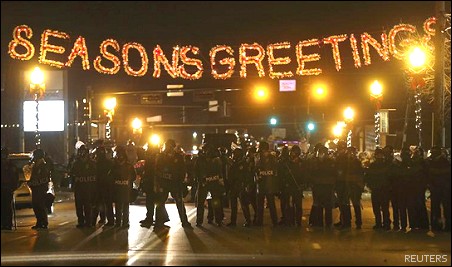 I keep needing to remind myself of something: I have liked every cop I’ve ever known. The number’s not large, mind you; four, perhaps five people, one of whom’s faces I can remember clearly but whose name has escaped me. At least one is a Facebook friend who may read this. Alternate universe me actually is a police officer; if you Google search my real name most of the results you’ll get are for the other guy since I’m as diligent as I can be about keeping my name off the Web.
 I know for damn sure that I’m far from alone if I look at the last week and just have no goddamn idea where to even start. I could probably generate half a dozen posts from national and local/semi-local news events alone, and that’s before we get to the part where I turned 40 this week and my mom had surgery on my birthday and I don’t even remember if I mentioned it around here (she’s fine) and after eight months of sick leave and unemployment I was at work for 54 hours last week and it was both week 3 at a new job (certainly within the learning curve for anyone, right?) and my first week on the sales floor.
 Welcome to infinitefreetime dot com