On rare books, Mark Twain, and penises

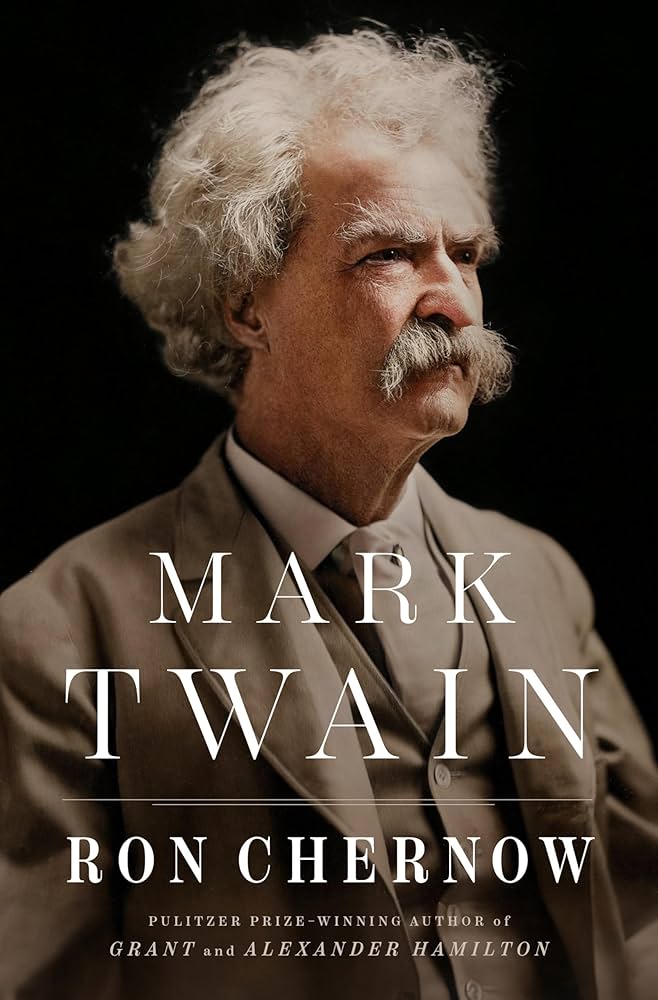
I am not quite halfway through with Ron Chernow’s 1200-page biography of Mark Twain, so it would be unfair to call this a “review” per se, but … c’mon. It’s a book by one of America’s preeminent historians about very likely the most important writer ever born on American soil. I’ve already read and loved his biographies of Hamilton and Washington, and I’ll get to the Grant and Rockefeller books sooner or later. There’s no universe where this isn’t a magnificent book, and it’s not like there’s going to be any plot twists in the last five hundred pages. This is a great biography already and it’s enormously unlikely I’m going to encounter anything that will change my mind– and if I do, it’ll change my mind about Mark Twain, and not about Chernow’s book about him.

All that said, I learned something today, and I fell down a rabbit hole looking for more information about it, and I need to share this information with you.

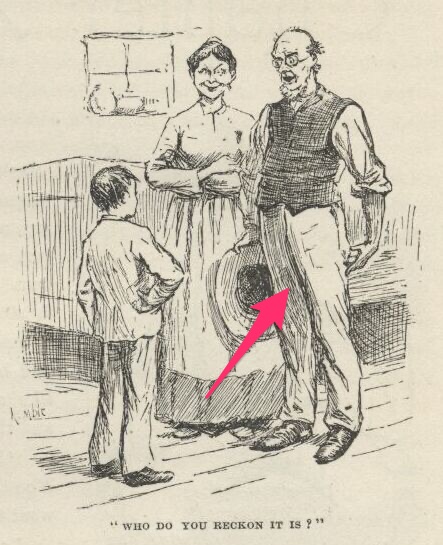
If you buy one of the approximately one billion available editions of The Adventures of Huckleberry Finn that include the original engravings, you will encounter at some point this image of Huck, his Uncle Silas, and his Aunt Sally:

You will note the arrow pointing just underneath Uncle Silas’ crotch, and you will note the straight line of his pants. You may also note the look on Aunt Sally’s face, which I feel deserves more attention in general.

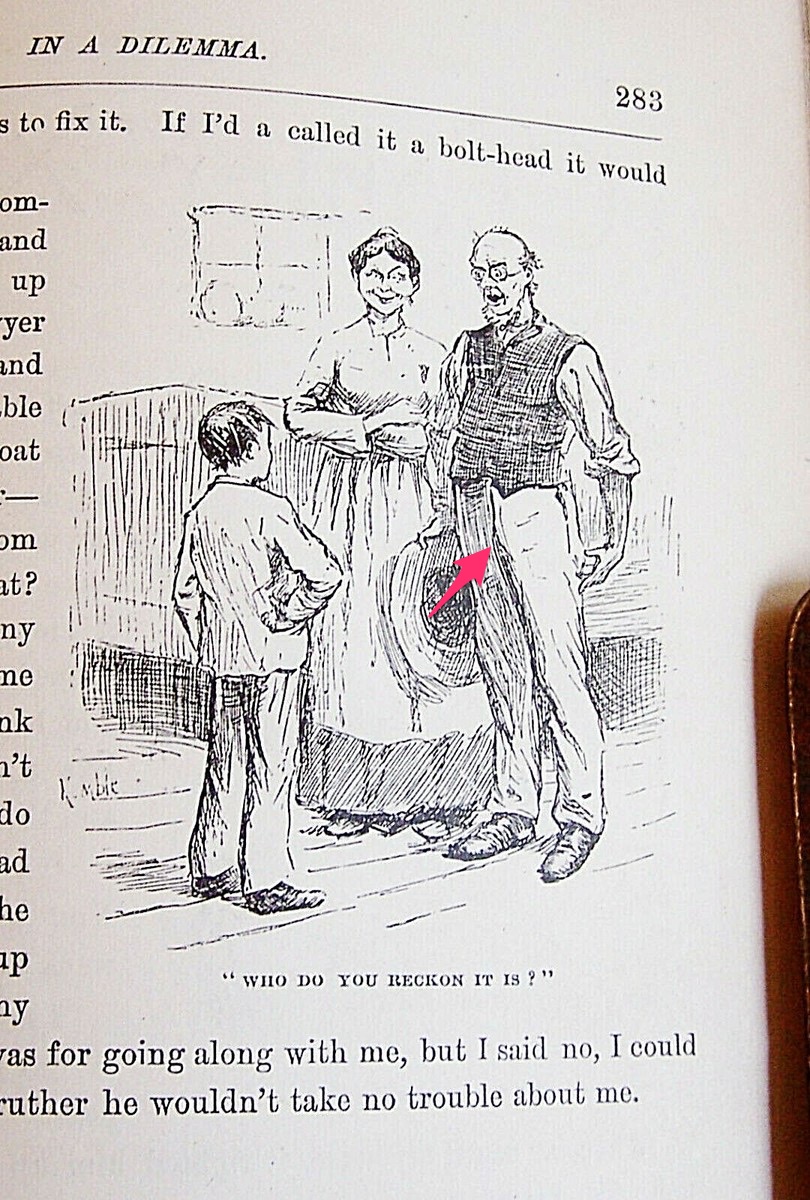
This is not the image that was in the first printing of the book. That image looked like this, known as the “curved fly” engraving:

See that curved line? That’s the original engraving by E.W. Kemble, whose name you’ll note in the lower right. Twain selected Kemble himself, and presumably did not vet this image of Uncle Silas for a single slightly, barely bulgey line in his pants.

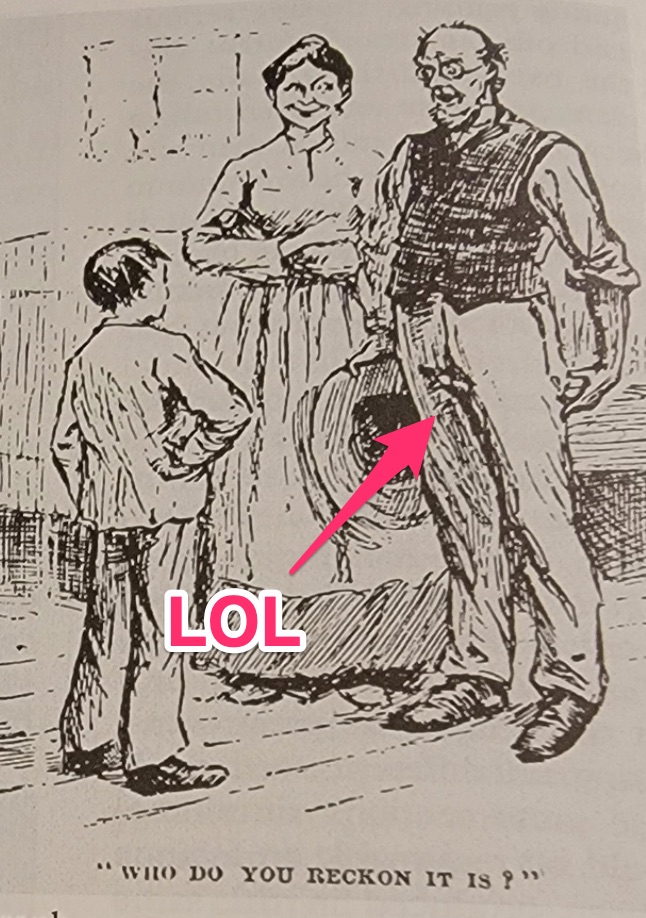
After a few hundred copies of the first edition were printed, a salesman noticed that someone had somehow changed the engraving to … well, this:

That right there, folks, is Uncle Silas’ cock, although it appears to be growing out of his leg rather than in the usual location. Maybe that has something to do with the look on Aunt Sally’s face, I dunno. Maybe dicks were different in 1884. You’ll note that said penis is pointed directly at Huck, which isn’t relevant to the story but adds an extra little twist of creepy to it.

Anyway, the edition was very speedily recalled, and the offending pages destroyed, although an unknown number of copies remained in the wild. A book with the offending penis in it has never made it to auction or been sold publicly, and it’s not known how many might be out there. (Check out this absolutely amazing contemporary article about the controversy from New York World. The euphemisms. My God, the nineteenth-century euphemisms.)

The University of Virginia has at least one copy of the edition with the penis, which is where the image came from. They had to redo the engraving for the rest of the no-longer-“first” edition, and the new version of the engraving had a straight fly.

Copies of the “curved fly” edition (without the penis) go for lots and lots of money. My favorite detail about that $15,000 listing? Shipping is $4.00 and they accept returns within thirty days.

The person who altered the engraving was never identified.

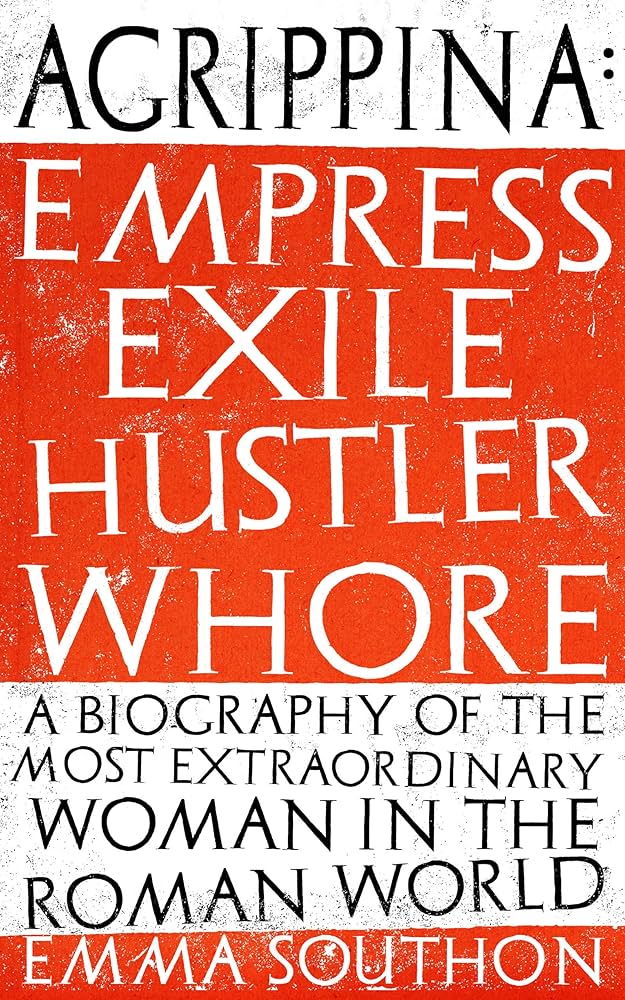
#REVIEW: Agrippina, by Emma Southon

Looking at this cover, what would you say the title of the book is? Because before I get into the actual book, I want to talk about this cover. I had this book on my wish list at Amazon for a while before I got around to ordering it, and this is the cover of the first hardback edition. The version I have looks like this, and is just titled Agrippina: A Biography of the Most Extraordinary Woman in the Roman World. The “Empress/Exile/Hustler/Whore” text of the original cover is gone, which makes me wonder if that was always just supposed to be a text element of the cover or if they actually retitled the book when they released it in paperback. Either way, this cover is nowhere to be found any longer, and in fact, actual copies of the hardback are going for hundreds of dollars right now.

There are several reasons, it seems, why I wish I had ordered and read this book much earlier than I did. I feel like this shouldn’t be true, but it is: it has been hard for me to find books about Rome and the Romans that aren’t paralyzingly boring, and this book even employs the traditional Pegasus font, which I absolutely associate with dreary, charmless older works of history, usually ones that were released in half a dozen 500-page volumes. You might as well.

You will hold on to that impression for only a very small number of pages, and then you’ll hit a passage like this:

I defy you to find any other history book, other than perhaps another of Emma Southon’s works, that uses the word spunking. And I will tell you right now that if that sentence brought a smile to your face, and if you have even the slightest interest in the subject matter of this book, you should hie thee to a bookstore immediately (perhaps a used one, to see if they have a hardback) and grab a copy, because this is easily the most profane and irreverent work of history I’ve ever encountered, and it’s surprisingly refreshing to read. Also, Emma Southon kinda loathes Suetonius, and her ongoing vendetta against a historian who has been dead for close to two thousand years is absolutely hilarious. But there is an amazing amount of profanity in this book, so just be prepared for that.

It’s not as if Agrippina, who was sister to Caligula, wife (and niece, because Romans were creeps) to Claudius, and mother to Nero, really needs the help. I’m fairly certain a lesser writer would have been able to put together a passable biography of her, y’know? That subtitle isn’t a joke; Agrippina was basically the only female Empress of Rome and was an absolutely fascinating person to read about. Southon is impressively adept at navigating the complexities of 1st-century Rome in a way that make things clear for the nonspecialist, which I should make clear that I absolutely am– my religious studies degrees overlap temporally with her tenure but are a continent away, so I’m gonna get lost a lot in the hands of a less clear writer. The book is clearly aimed at the non-historian audience, too, and ends up being a pretty effective primer on Roman culture and the early history of the Empire as well. I tore through it in a day, and it’s gonna be on my list at the end of the year– the only question is how high, and to be honest I can imagine a world where this is the first nonfiction book to sit at the top of the list when I write my Best Books of 2025 post. Again, if you’ve got even the tiniest amount of interest in the subject matter and her let’s-be-euphemistic-and-call-it-earthy language isn’t going to get to you, grab it sooner rather than later.

#REVIEW: Galileo’s Daughter, by Dava Sobel

I’m trying to decide which overused sentence I should start this post with, and I can’t make a decision.

Because unfortunately, while I haven’t read this book before, I feel like I’ve written this post before. Dava Sobel’s excellent Galileo’s Daughter is a biography of a genius, and, well, I think you probably already know if you want to read a really good biography of Galileo. The title makes it sound like a thousand different literary fiction novels– there are so many The So-and-So’s Daughter novels out there that I’m surprised that there isn’t a parody of them with that exact title– but no, this book is at least a third or so about Suor Maria Celeste, Galileo’s oldest daughter, through the prism of the surprisingly large corpus of letters we have from her to him. Suor Maria was a cloistered nun, and her letters, or at least the translation of the letters in this book, show her to be a woman of lively intellect and wit, and starting each chapter with an excerpt of one of her letters was an inspired choice.

But ultimately this is a book about Galileo– a book called Suor Maria Celeste’s Father would not have sold many copies– and, well, Galileo was Goddamned fascinating, so if the author is of even middling talent writing a good book about him should not be especially difficult, and as it turns out Dava Sobel possesses far more than the typical allotted share of talent. So maybe this isn’t as comprehensive a review as I might have thought I was going to write when I sat down, but I assume the You Should Read This is still coming through at sufficient volume for you to hear it. Because you should.


Most of us have some sort of memories of Spring Break, although I suspect for most people they involve parties, or beaches, or some form of public drunkenness. For me, on the other hand, my strongest memory of Spring Break, one I reminisce about every time my own break rolls around, involves going to see a movie on the first night of a Spring Break in grad school with a good friend of mine who is a professor at Oxford now. We had to stand outside to wait for tickets in a driving, wet, utterly bullshit snowstorm in downtown Chicago, and Bill stepped out of line for a moment, threw his arms over his head, yelled “SPRING BREAK!” at the top of his lungs, and rejoined the line without another word.

I may not have partied enough as a young man, is what I’m saying here. And I openly laughed at anyone who asked me what I was “doing” for my break. I’m going to be sitting in a damn chair reading a book, that’s what I’m going to be doing. And it will be glorious.

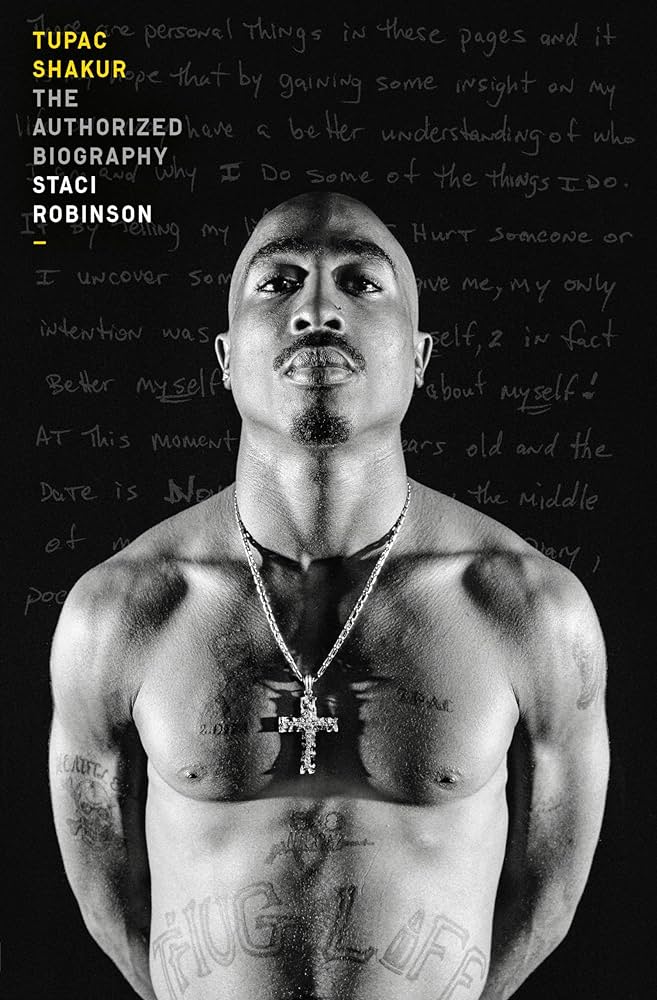
#REVIEW: Tupac Shakur, the Authorized Biography, by Staci Robinson

I’m not generally the type to gatekeep, but it’s not hard to find out whether someone is a Tupac fan or not. Ask them his birthday.

June 16th, 1971/ Mama gave birth to a hell-raising heavenly son/ See the doctor tried to smack me but I smacked him back/ my first words was thug for life, and Papa pass the Mac

That’s the first lines of Cradle to the Grave, the penultimate track from his album Thug Life, and … okay, you can be a Pac fan and not know that line right off, but I think more of us do than don’t. And I’ve taken a moment to myself on more June 16ths than not, since he passed away. Not a big thing, mind. Just a moment. But he made sure we all knew his birthday so I figure it’s worth remembering.

There have been a lot of words written about this man since his death. Take a look at Amazon; a search for “Tupac books” will provide you with half a dozen self-published books about him, mostly full of conspiracy theories, and any number of other works written by more, uh, authoritative entities. It was the words Authorized Biography on the cover that got me to pick this one up; turns out Tupac’s mother Afeni Shakur hand-picked Staci Robinson to write this book, which immediately gives it a hell of a lot more authenticity than the usual.

Part of me didn’t want to read it, to be honest. Pac is one of a very small number of people whose deaths made me cry. I don’t remember exactly where I was when I found out Kurt Cobain had killed himself. I don’t remember where I was when I found out Christopher Reeve or Stan Lee had passed. I remember where I was when I found out about Chadwick Boseman, but there were no tears. I remember exactly where I was and what I was doing when I found out Tupac was gone. I wasn’t completely certain I wanted to revisit everything, to be honest.

And the thing is, it’s not going to be that difficult to write a biography of Tupac Shakur that doesn’t properly respect him, “authorized” or not. Afeni Shakur died in 2016 so it’s not as if she was around to review the manuscript. A whole lot of people he was close to are gone, as a matter of fact. And … well, let’s be real. Pac was messy. At best. He wasn’t the violent, unrepentant criminal that the news media portrayed him as, but he had a hell of a self-destructive streak that was showing itself very early in his life and that he never really got control of as an adult, particularly in his last few years. If he hadn’t been shot in Vegas in 1996, the cops would have gotten him by now. There was never a universe where Tupac Shakur lived to die of old age, and he knew it.

It was a moment, the day when I realized I’d outlived him.

This is a worthy memorial to him, I think. Robinson had access to what must have been an enormous volume of Pac’s own writings dating back to his childhood– one thing I’ve heard about him from every single person who ever knew him is that the man was never without a notebook close to hand, and could shut out the rest of the world when he got something in his head that needed to be written down. I’m not going to dig up the video right now, but Shock-G tells a great story about Pac disappearing for a while, walking around looking for him, and finding him in the bathroom, sitting on the toilet, buck naked, and writing lyrics in a notebook.

The book is stuffed full of poems and fragments of lyrics and drawings and other writings, so many that I’m pretty confident that I’d recognize Tupac’s handwriting if you put it in front of me. It’s difficult to write biographies of writers and musicians, honestly, especially when they died young– it’s easy to fall into a rhythm of and then he wrote THIS, and then he wrote THAT, and sales charts and blah blah blah, and the book ends up in a lot of ways being a history of his intellectual development as much as anything else. He could have been one of history’s greatest intellects, born at a different time and in different circumstances. Robinson talks about his voraciousness for reading and his compulsive need to write in a way that, fifteen years ago, would have put me in mind of Thomas Jefferson and nowadays can’t help but remind one of Alexander Hamilton.

I never knew that he’d gotten married while he was in jail. Never knew that he’d dated Madonna, either, which I find hilarious. And I fell down a hell of a rabbit hole this afternoon when I realized that the book never mentioned Juilliard– I knew that he’d attended, but not graduated from, the Baltimore School for the Arts, which was where he met Jada Pinkett, who became a lifelong friend, but I thought that he’d attended Juilliard at least briefly. This story turns out to be false, and I’d love to know where the hell it came from– if you search for “Tupac Shakur Juilliard” you’ll find dozens of people confidently revealing that he’d gone there, often under a full scholarship, but Juilliard doesn’t seem to know about it, and it’s not mentioned on Wikipedia, and it wasn’t mentioned in the book. Pac never graduated high school, as it turns out, although he did eventually get his GED. I know I’ve told people that he went to Juilliard. I really do wish I had a way to track down the source of that story.

If I have a criticism of the biography, it’s that the book ends as abruptly as Tupac’s life did; he dies on the literal last page, and while I don’t think Robinson had any responsibility to get into any of the rumors and wild conspiracy theories about his death, especially once The Don Killuminati: The 7 Day Theory(*) came out posthumously, I feel like something about the police (lack of) investigation and his legacy would have been warranted. His ashes are buried in Soweto, in South Africa. I didn’t know that, and I found out from Wikipedia today, not from this book. The man has released more albums since he died than he did when he was alive; I feel like one chapter in his book after his death isn’t asking too much.

That’s what I’ve got, though. No other real criticisms, and while I wasn’t initially sure I wanted to read this, in the end I’m glad I did. I haven’t taken the time to listen through his discography in a while, and I’ve been bobbing my head to Me Against the World while I’ve been writing this. All Eyez On Me is next, and that one needs to be LOUD, so I may need an excuse to take a drive for a couple of hours. We’ll see. In the meantime, this is well worth your time and money.

(*) If you really want to gatekeep Tupac fandom, ask somebody what the actual name of this album is, as I think most people just call it “The Makaveli album,” and I admit I just typed out The 7 Day Theory and had to stare at it for a minute to figure out what I’d left out.

So this is happening

My son, who clearly does not realize what he has gotten himself into, has to do a report on a Famous Person from Indiana, and has somehow chosen Axl Rose, born in Lafayette in 1962. The ensuing discussion among my wife and I about what GnR song is their most iconic led to my brother suggesting that I get an immediate divorce. While I suspect I’m probably not going that route– I would be homeless in a month without my wife– her opinions on GnR are Wrong. My son, at one point during the conversation, looked at us and, I swear to you, quietly mumbled “What have I started?” to himself.

The correct answer is Sweet Child O’ Mine, by the way.

I think what’s probably going to happen is I’m going to write a 75-page pamphlet on GnR and give it to him, and he can edit it down to three pages or a hundred words or whatever passes for hard work in fourth grade nowadays.

I don’t have to go in to work tomorrow, as I have a training thing in the morning, which means that I’ll actually have my afternoon to myself. I’m going to take the rest of the night off after I finish this brief post and curl up with a book; I started John Scalzi’s The Kaiju Preservation Society last night and it’s going to demand my full attention until I finish it, I think.

#Review: African Samurai, by Thomas Lockley and Geoffrey Girard

I have talked a couple of times about how recent trends in my video game habit have led to a minor fascination with the Japanese language and Japanese history. Specifically, I have the Nioh games and Ghost of Tsushima to blame for this, both of which hang very fictional video game storylines on top of actual people and actual events in Japanese history. Yasuke, a (real) African who rose to be a samurai in the service of the (real) sixteenth-century warlord Oda Nobunaga is actually someone you fight in both of the Nioh games. The real Yasuke did not have lightning powers or a magical bear spirit that fought with him, but he was a real dude who actually existed.

I’ve gone looking a couple of times for a recent biography of Nobunaga in English, a book that does not seem to actually exist, but during one of those searches I happened upon this book, and it languished on my Amazon wish list for quite a while until it finally came out in paperback a bit ago and I ordered it. And considering what the book turned out to be, it’s really interesting that I only know about Yasuke through heavily fictionalized accounts of parts of his life– because while African Samurai is definitely a history book, it’s not at all like any of the books about historical figures that I have read in the past.

Thomas Lockley, one of this book’s two authors, is an American historian currently living in Japan. Geoffrey Girard, on the other hand, is a novelist, and while I didn’t delve into his background too deeply it doesn’t seem that he has any particular academic training in either history or Japan. While there are contemporary sources that attest to Yasuke’s existence– he is depicted in artwork and there are a handful of letters from a very prolific Jesuit monk who lived in Japan that discuss him, among a small number of other sources– there really isn’t enough information about him out there to fill up a 400+ page book without finding some way to provide more detail. And this book handles that dearth of source material in two ways: one, by making this a book that is nearly as much about Oda Nobunaga as it is Yasuke (which was a treat for me, since that’s what I was originally looking for) and two, by making the book almost more a piece of historical fiction than it is a traditional history. It is clear, in other words, that a novelist had his hand in writing this, and if I had to guess I’d suggest that the majority of the words on the page are Girard’s and not Lockley’s– although, to be clear, I would be guessing.

How is it historical fiction? Because far more of the book is about Yasuke’s thoughts and feelings and day-to-day life than the extant evidence we have about him would ever allow. For example, we know, because the Jesuit monk talked about it, that Nobunaga granted Yasuke a house on the grounds of his home and provided him with a short sword and a couple of servants. That’s factual, or at least as factual as a single secondhand account from five hundred and some-odd years ago can be presumed to be. But that’s all we know, and the two-page scene where Nobunaga summons Yasuke and then surprises him with the house, and Yasuke falling asleep on his new tatami in his home and awakening to find his new servants bowing at his feet, is pure invention. It’s not necessarily unreasonable invention– there was no point in the book where I thought that the authors were going too far in constructing a narrative out of what they had, and they only very rarely go so far as to utilize actual dialogue anywhere, but the simple fact is that that whole sequence is fictionalized, and the book is riddled with things like that. Yasuke is traveling with Nobunaga, and he reflects upon something-or-another that allows the authors to inject a piece of necessary historical background. We know that at one point Yasuke fought with a naginata, and so there’s a paragraph at one point where he’s thinking about buying one. That sort of thing.

So it’s necessary to be aware of what you’re reading while you’ve got this book in front of you– it never quite crosses over to the fabulism of, say, Dutch, Edmund Morris’ “memoir” of Ronald Reagan that actually literally inserted the author into Reagan’s life and pretended he was a witness to events that he wasn’t there for, but it’s absolutely not a straight work of history. (And while I’m comparing African Samurai to other books, I want to mention Ralph Abernathy’s And the Walls Came Tumbling Down, which is another book that is supposed to be about one person and ends up being someone else along the way.) And there are several places where the authors are forced to bow to simple historical uncertainty: we lose track of Yasuke in the historical record at some point, and we don’t know how or where or when he died, so the authors actually mention multiple possibilities about what might have happened to him after the brief Nobunaga era ended; stories about enormous African warriors (Yasuke was 6’2″, and would have been easily a foot taller than anyone around him in Japan) in places where such people usually weren’t found, but they explicitly paint them as possibilities, of varying levels of likelihood, rather than picking one and ending the “story” with it.(*) But once you internalize that lightly-fictionalized aspect of the book, it’s a hell of an entertaining and informative read on a whole bunch of levels, and I’m really glad I ended up picking it up. I don’t know how big of a group of people I’m talking to when I say something like If you’ve ever wanted to know anything about sixteenth-century Japan, pick this up, but … yeah. Go do that.

(*) I wish they’d gotten more deeply into his name rather than relegating it to a footnote, but as you might have guessed, “Yasuke” almost certainly wasn’t his actual name; it’s likely that “Yasuke” is “Isaac” filtered through Japanese pronunciation, and “Isaac” almost certainly wouldn’t have been his African birth name either, for obvious reasons. So just because we see a story of a similarly large and skilled African warrior somewhere near Japan in the right time frame, knowing that other person’s name doesn’t automatically exclude it from being Yasuke, because Yasuke wasn’t Yasuke, and might have abandoned that name after leaving Japan.

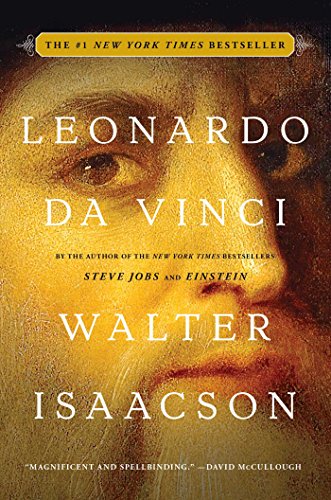
#REVIEW: Leonardo da Vinci, by Walter Isaacson

2020 thus far has been an interesting year for reading. 2019 had so many stellar books in it that I had to expand my traditional end-of-the-year Best Of list from ten to fifteen. In general, the quality of what I’ve been reading this year has been reasonably high, but there haven’t been all that many books that I was doing backflips over so far. There have definitely been standouts, of course, but nothing where I was rattling cages and shouting you must read this while running pantsless through the streets.

So it’s pretty cool to have identified my first major WHY DON’T YOU OWN THIS BOOK ALREADY of the year, finally, and even more interesting that it’s turned out to be nonfiction. There are usually a couple of nonfiction books in my top 10, but never one that I thought might be the best book of the year, and Walter Isaacson’s biography of Leonardo da Vinci is absolutely a book that I could see being my favorite of 2020 once the end of the year rolls around. Assuming we’re all still alive, that is.

I have read one other book of Isaacson’s: I was a big fan of his biography of Benjamin Franklin, and having now read this one I’ve got my sights on his book about Albert Einstein. You may notice a theme here; Isaacson very much enjoys writing about geniuses, and one of the best things about this book is the way his sheer enthusiasm for Leonardo shines through every page. This is a book about, with no real fear of contradiction, one of human history’s most interesting people, written by someone who is utterly fascinated by his subject, and it just cannot help but being a tremendously compelling and educational read.

(Two things I learned about da Vinci: I was aware that he was able to write backwards and mirror-imaged, but I was not aware that he always wrote backwards and mirror-imaged. He was left-handed and just taught himself to write that way to save time and keep from smearing ink. Similarly, one of the ways his work is validated when its source is unclear is to look for signs that it was produced by a left-handed person. Second, and I’m not sure how common knowledge this is and it’s possible y’all are going to be surprised I didn’t know this, but he was gay. Not, like, “for the times” gay, or “if he was alive now he’d be” gay, but out and fabulous gay. There apparently exists one of his notebooks where he’s put a to-do list on one of the pages, and one of the items on the list is “go to the bathhouse to look at naked men.”)

(Also, and I’ve Tweeted at him and I’ll update if he responds, but I’d love to know how much work in language Isaacson had to do specifically to write this. I suspect the differences between Renaissance-era Italian and modern Italian are not minor, even before you get to everything da Vinci wrote requiring a mirror to read, and given his other books Isaacson may not even have known Italian before writing the book– every other book he’s written was about someone who, at least, worked primarily in English.)

I can’t pass up talking about the book as a physical object, either. I got the book in paperback, and the paper used both for the cover and for the pages is thick and textured in a way that makes the book an absolute joy to hold. In addition, it’s full of pictures, as one would imagine it would have to be, but they’re scattered throughout rather than as a tip-in in the middle of the book, and every single one of them is in full color. I don’t recall how much I spent for this book, but I’m genuinely surprised it wasn’t $40. Amazon currently has it for twelve bucks. That’s madness for a book of this high quality; this could not have been cheap to print.

I am also in love with the way Isaacson talks about art. I had to take an art history class as a random requirement to get my teaching MA, and while I honestly didn’t do terribly well in the class, reading people who really know a lot about art talking about paintings is something that I will never get tired of even if to a large extent I don’t really know what the hell they’re talking about. Isaacson can drop a paragraph about the emotional resonance of a detail in someone’s eyebrows that I can’t even see, and a good proportion of this book is dedicated to analyzing da Vinci’s artwork, both finished and unfinished. His chapter about the Mona Lisa is a masterwork. I couldn’t have written something like this to save my life; I just don’t have the eye for detail or the vocabulary for it, but it was an immense pleasure to read.

Ten stars, six thumbs up, one finger oddly pointed toward the heavens, go find this and read it right away.


1:07 PM, Wednesday June 17: 2,143,193 confirmed cases and 117,129 Americans dead.