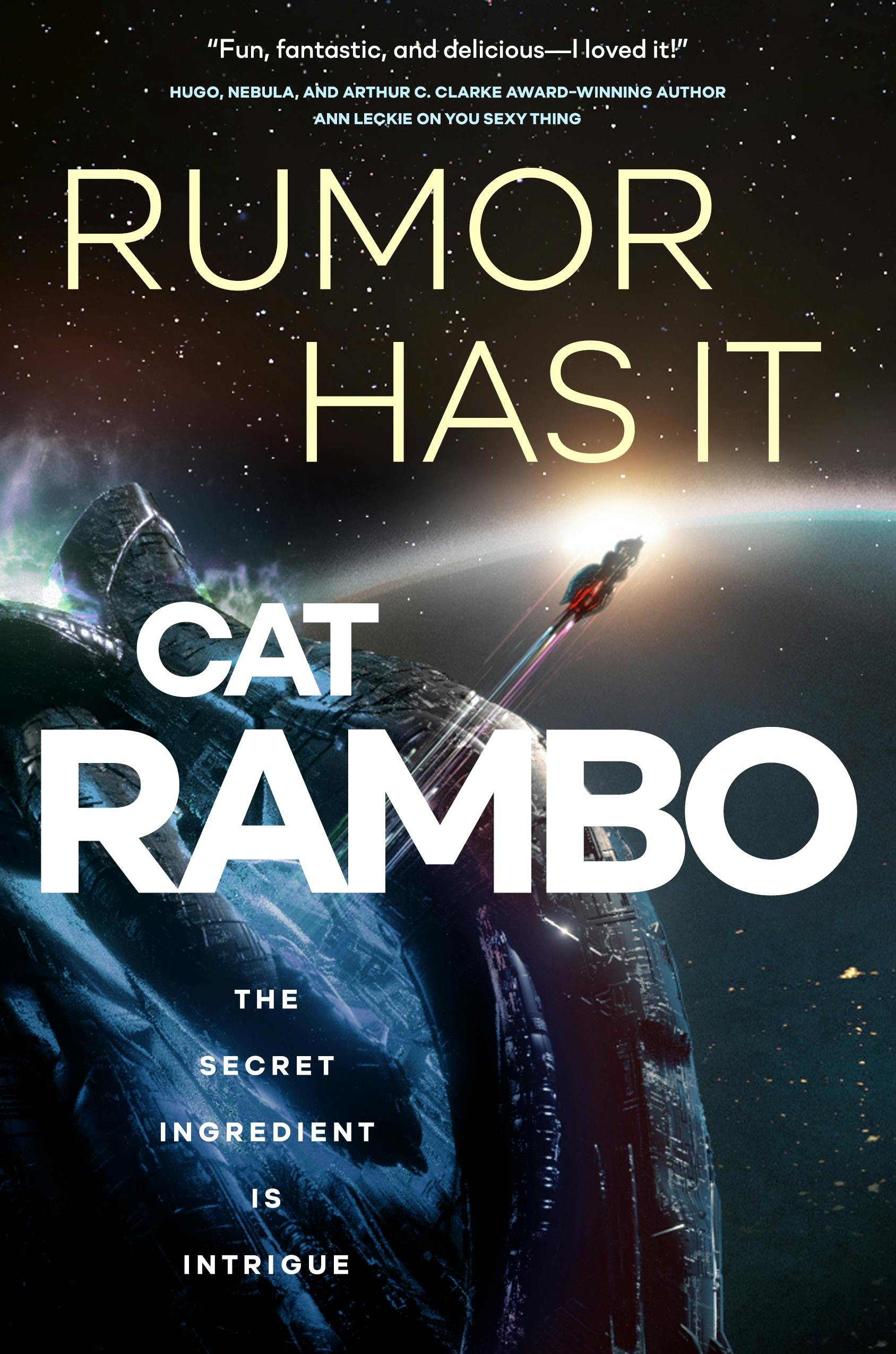
#REVIEW: Rumor Has It, by Cat Rambo

It’s possible that my review of this book is going to be slightly unfair. Rumor Has It is the third volume of Cat Rambo’s excellent Disco Space Opera series, which started with You Sexy Thing and continued with Devil’s Gun. It’s also the third volume that their publisher has been nice enough to send me an ARC of. Cat actually lives in South Bend, and they did a reading at my local Barnes and Noble last weekend, and unfortunately I didn’t find out about it until about an hour beforehand. I reviewed both of the first two books, and I’m a big fan of the series.

… which I thought was a trilogy, and I read the first 2/3 of Rumor Has It under that assumption, and only when I realized that there were not remotely enough pages left to wrap up the storyline did I Google around a bit and discover that nobody was calling it a trilogy. I currently have no idea how many books are planned in the series, as I can’t find that information anywhere; it’s possible that it’s meant to be open-ended. Ordinarily the idea that there was going to be more of something I liked is good news, but reading it with an ending in mind kinda screwed up my perception of the story. Also, while “the secret ingredient is intrigue” is a perfectly cromulent tagline for a book about a group of mercenaries turned interstellar restauranteurs, the secret ingredient is not intrigue. The secret ingredient is phone:

Every time and I mean every time I picked up the book, I heard Krieger’s voice in my head.

So here’s the thing: this book still has all of the strengths I talked about in my reviews of You Sexy Thing and Devil’s Gun. Rambo’s writing is punchy and funny, the characters are absolutely unforgettable, and the basic premise, elevator-pitched as Farscape meets The Great British Baking Show, is absolutely packed with flavor potential.

Unfortunately, it also has the weakness of the second book, which I referred to as “one of the most second-booky second books I’ve ever read.” The good bits are still good, but the overall story really isn’t advanced at all in Rumor Has It, and the book suffers from both being (remaining?) incomprehensible if you haven’t read the first two and it’s also quite wheel-spinny in a way that Devil’s Gun wasn’t. The characters spend the entire book at a single space station trying to drum up some money, and while that space station is cool, if you could have replaced the whole book with the ultra-rich owner of the intelligent bioship they’re riding around in simply cutting them a check, you have a bit of a problem. Some character arcs get advanced a bit, but what felt like the most important character storyline of the book ends up literally being nothing worth worrying about at the end. The big villain has now spent two entire books entirely offstage. I genuinely don’t even remember why they’re mad at him at this point.

(Okay, he sort of shows up. But not really, and going into further detail would be a spoiler, so I won’t do that.)

Anyway, what this leads to is that for the second book in a row I’m writing the phrase “It’s not a bad book, but …” about something I wanted to like more. Again, the strengths of the series are still here, and even if I don’t get sent an ARC I’m spending money on the fourth book. I’m invested, there’s no doubt about that, and it’s possible that had I realized that the series wasn’t coming to an end with this novel I’d have more positive feelings about it. But right now the entire book kind of feels like a subplot that went on for too long, and I’m really hoping the fourth book slaps the status quo around a little bit more. You Sexy Thing still retains my full-throated support, and you should pick this up if you’re into the series already, but know what you’re getting into before you start reading.

#REVIEW: Of Blood and Lightning, by Micki Janae

I don’t wanna write this, dammit.

I was sent author Micki Janae’s debut novel Of Blood and Lightning by her publisher in exchange for a review. It’s been sitting on my shelf for a while now, mostly because I wanted the review to come out close to release date and the book comes out next Tuesday. I felt like it was going to be right up my alley based on the description I got. And any time the cover of a book features a young Black woman holding a sword, I’m gonna pay attention. The blurbs about Micki Janae make it clear that a big part of the reason she wrote this book is she wanted to see representation of Black people and specifically Black girls in fantasy, and I absolutely, wholeheartedly support that goal.

The problem is the book really needs some more time to cook. Don’t misunderstand me; I know I was sent an uncorrected proof, and I’m not talking about, like, grammar errors or typos or the occasional clunky sentence. There aren’t that many to begin with, and “uncorrected proof” means uncorrected proof, and I’m not holding that against the book. No, this needs structural edits. Story-level edits. Big chunks of it need to be either beefed up or rethought entirely, and especially for something that boasts of the worldbuilding on the back of the ARC, I feel like a lot more thought needs to be put into the book’s basic premise.

And that’s all very general, I know, and it’s entirely possible that one of the problems is a me problem, which is that Micki Janae didn’t write the book I wanted her to write, or at least the book I wanted to read. And I don’t really like criticizing books for not being different books.

The problem is that my specific gripes about this book are probably not gripes that a white guy has any real business making about a book about a Black girl written by a Black woman. Particularly when it’s not like anyone is sending my books to her for review. And I think that rather than sticking my hand into the buzzsaw that that conversation could very well turn into, I’m going to refrain from going into details.

Of Blood and Lightning is not a bad book. But there’s a much better book hiding inside it, and I feel like it’s a missed opportunity, particularly in a world where Tracy Deonn’s Legendborn or Ladarrion Williams’ Blood at the Root exist, or, perhaps, a certain Greek mythology-themed megaseries that is already dominating the YA fantasy market. If you read those books already and you’re looking for more, or if you’ve got a young person in your life who you think might enjoy a book about a young Black woman who inherits the powers of Zeus, well, pick it up. I’d be happy to see this book be successful! I really would! I just wish I could be more enthusiastic about it.

Of Blood and Lightning releases October 8th.

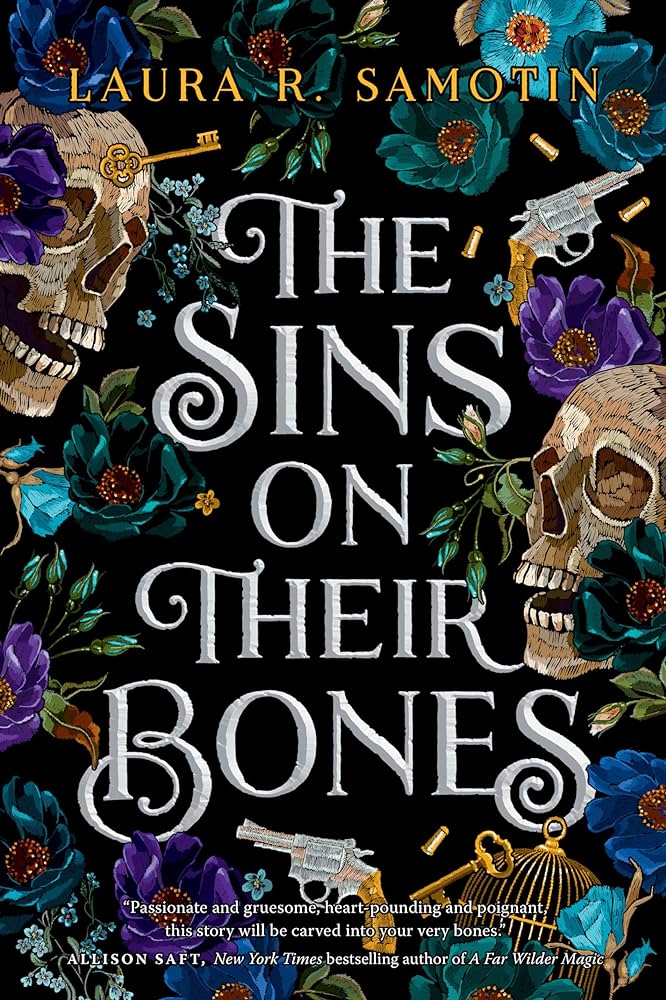
#REVIEW: The Sins on Their Bones, by Laura R. Samotin

This is going to be One of Those Reviews, I think. I am beginning this review at 7:30 PM on Saturday, which, you will notice, was yesterday. You may have noticed that yesterday-which-for-me-is-still-today’s post is also a book review.

I am writing the second book review of the day because I woke up this morning, read the last two hundred pages of To Cage a God, wrote a review, ate lunch, took a shower, and then read The Sins on Their Bones fucking cover-to-cover in what wasn’t quite a literal single sitting but may as well have been. The eArc I read was four hundred and eighteen pages. I read the entire book in roughly six hours, less if you deduct a couple of pee breaks, some light web surfing and doom scrolling, and a few pieces of frozen pizza for dinner.

The real miracle? I don’t have a physical copy of this book. I’ve read plenty of books in a single sitting before. I don’t think I’ve ever done that with an ebook. Like, literally never. This is the first time.

I also paused to order the book from Amazon, because I got sent this by a publicist in return for a review, and I don’t actually have a physical copy. It comes out May 7th.

You may be wondering what I meant by “one of those reviews” in the first paragraph, there. Here’s the thing: This book started out as an uh-oh, developed into something I was grudgingly respecting, and then moved into fuck it, five stars territory by ending very well. I’ll get into what it’s actually about in a few minutes but it’s very much the type of book that if I talk about too much you’ll think I hated it. I did not! I liked it a lot. But all of the interesting things I have to say about it are gonna feel like gripes. I’m annoying that way sometimes.

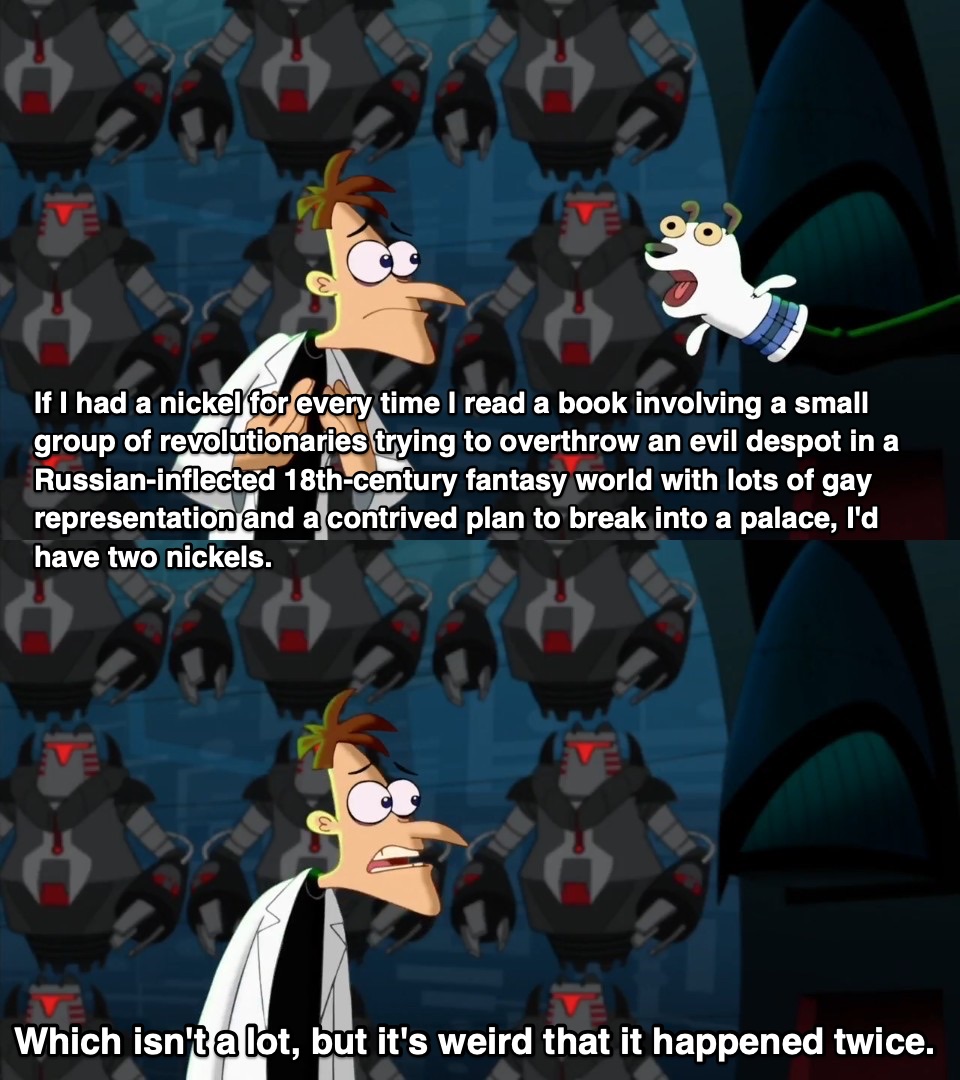
But let’s talk about To Cage a God for a second more, because, completely by accident, this book echoes that one quite a lot. Both are set in a proto-Russian setting, with roughly eighteenth- or nineteenth-century technology (guns are mentioned in Bones, but don’t really belong on the cover) and both are mostly about a plot to remove an unjust ruler. Both have substantial gay representation; both have magic, although we’ll get to talking about Sins on their Bones’ magic in a bit. The good guys even get into the bad guys’ palace at the end with more or less the exact same deception, which is one bloody odd coincidence. For a while, I was genuinely concerned that reading both of them in one day was poisoning my opinion of Bones, but as I said: once it heats up it heats up fast.

Let’s go back to the queer representation: I feel bad about complaining about this, but Sins on Their Bones might actually have too much, as I’m pretty sure that literally every character in the book with a speaking role is queer, including two tzars and the entire surviving court of the deposed one. One character gets to give a whole speech about being asexual. I did not notice any trans characters but the rest of the book is so gay that I genuinely think I probably missed an obvious clue somewhere; I refuse to believe everyone in this book is cisgendered. There’s a throwaway line at the end of the book about someone receiving a ton of marriage proposals from across the continent, implying that every other ruling family is super gay too. And there’s a point where someone has to convince a side character who has barely appeared in the book at all that they knew each other as kids, and he tells her that he remembers her first crush, which was on another girl, because of course it was.

And, like, the main character is the deposed tzar, who is married to the guy who deposed him, and he and his court are in hiding for most of the book. He’s very mopey about it. You’ve seen Monty Python’s Holy Grail, right? Remember the bit with the prince in the castle who just wanted to sing? Imagine that guy was the tzar of Russia, only instead of singing, he wanted to have sex with his husband. That’s the vibe for a lot of the book. He snaps out of it eventually, but he’s very sad for basically the whole first half. Also drunk. And the interactions between the main group of characters really don’t feel like an exiled potentate and his court. They’re more like a bunch of grad students in a polycule. At one point they go to a magic library– the magic library is probably my favorite part of the book and I would gleefully read an entire book about Aleksandr, the librarian, and his disembodied head coffee table, and no, I’m not explaining that. But they go to the magic library and they’re sitting in a room listening to the librarian talk and one character sits on another one’s lap. There’s a bit where they’re expositing at each other early in the book and three of them are basically lying in a cuddlelump on the floor.

I don’t know any kings and I definitely don’t know any tzars but I feel like typically the word “cuddlelump” doesn’t get applied to them often. And from now on whenever I think about Cabinet meetings I’m going to imagine Pete Buttigieg walking in and confidently sitting on Merrick Garland’s lap, and none of you can stop me.

Also, everybody’s Jewish, except they aren’t, and I don’t know how I feel about that. Now, Jewish mysticism and Jewish magic are a thing, and they are fascinating, and I have read several really goddamn good books that take inspiration from Kabbalah. The phrase “inspired by Jewish mysticism” was half of what got me to jump at the chance to read this early. But the word “Jewish” doesn’t show up anywhere in this book, and the place names are all clearly drawn from real places in Russia, and it’s not like it’s a pastiche on Judaism, these folks are Ashkenazi Jewish. They’re praying in Hebrew and wearing prayer shawls and the names of God play a big role and churches are called shuls and there are angels whose names are clearly only barely modified from their Biblical equivalents, and it’s so obviously Judaism that it’s really weird to me that the author didn’t just make them Jewish. There are literal Bible quotes scattered around, just without actual chapter and verse references. I mean, there wasn’t ever a Jewish tzar of Russia, but there wasn’t a gay tzar of Russia either, nor did the gay Jewish tzar of Russia have a nonbinary person and an asexual person and a bisexual person and the fourth person was probably the trans person and I didn’t catch it, in their inner court. If we’re gonna go with homonormative 18th century Russia, we can also have homonormative 18th century Russian Jews.

I dunno. The author is Jewish, and I’m not, and I’m not, like, offended by it or anything, but I feel like you can only draw so much “inspiration” from Jewish mysticism before you have to just admit that everybody is an actual Jewish mystic. Like, the big plan to stop the bad guy at the end, and I’m not going to get more specific because spoilers? I know exactly where that came from.

Also, and this is probably just me being petty, but the evil tzar is called “Moy Tzar” nearly every time he’s referred to in the book and there is no other Russian anywhere, and it’s italicized each and every time, and … blech.

So like I said: I have lots of gripes, but … six hours. One sitting. On an ebook. Which I then spent real money to get a physical copy of. I have not quite gone so far as to put this on my end-of-year list, but we’ll see how I feel about it in a week. Go pre-order it, and you can read it on May 7th.

And, finally, because I can’t resist:

#REVIEW: DEVIL’S GUN, by Cat Rambo

I don’t know how to talk about this book.

Okay, that’s not true. I really liked it and all of you should read it. I really liked it and … most of you should read it. Some of you should read it! All of you who have read You Sexy Thing, the original book in this series, should read it, and those of you who have not read You Sexy Thing should go read that and then read this in its proper context in the second book of what is going to be at least a trilogy. I have no idea what Cat Rambo’s contract for this series is; all I know is that as long as they keep writing these books I’m going to keep reading them.

I read speculative fiction, so I am well used to devouring books in trilogies if not longer series than that. And a trilogy in particular has a certain rhythm to it, and what that means is that the second book in a trilogy can be really hard to write in such a way that it doesn’t feel like moving pieces around on a board in preparation for book three, which will actually solve things. And the biggest weakness of Devil’s Gun is that it’s one of the most second-booky second books I’ve ever read.

What’s that mean? Well, most of the characters– the strong point of the series, about a ship’s crew that moonlights as the staff of an elite sci-fi restaurant, or maybe about the staff of an elite sci-fi restaurant that moonlights as a ship’s crew, it’s hard to say– are dealing with various and sundry traumas and/or life changes from Book One. Very few of these traumas are resolved in any meaningful way, although a couple of them definitely see very serious evolution over the course of this book. The titular “Devil’s Gun” is a MacGuffin that the crew is looking for so that they can eliminate the big villain of the first book, who is after them again. The big villain who never once appears on page in the entirety of Devil’s Gun. Not a single scene. They never see him. The whole book is relying on your memory of Tubal Last being terrifying in the first book.

Well, okay, and also on this one thing he did that was really bad, and which reverberates through the entirety of Gun, but he does that thing in You Sexy Thing.

In a way, all of this isn’t really a problem, because no one is going to pick up Devil’s Gun on its own, or at least if they do they’ll recognize that they screwed up. And to a certain extent it feels really ridiculous for me of all people to be criticizing book-two-of-a-trilogy for being, well, book two of a trilogy. But this one doesn’t stand up on its own at all, to the point where it’s notable. I mean, important stuff happens, it’s not like, oh, Book 2 of The Wheel of Time, which could be reduced to a single-page prologue of Book 3 without eliminating anything significant. It’s not filler. It’s just not a complete story on its own. And your ability to enjoy it will depend entirely on your ability to ignore that fact.

Beyond that, though, I genuinely do love this series– it was originally described as “Farscape meets The Great British Baking Show,” and bam, the second I heard that, I spent money. And I should probably have said this in the first paragraph, but I got this for free again, meaning that I’ve gotten both books in this series mailed to me early and then went out and bought both of them anyway. There’s still a sexy bird-creature and one character who is a sentient blob and another who’s an ape and the first mate/head chef is seven feet tall and has four arms and this was probably unfair of me but I spent most of the book picturing one of the characters as Lion-O. I can read about these people forever; they’re awesome. You should read about them too; just make absolutely sure you do it in order.

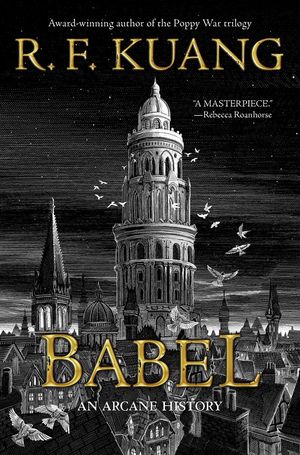
REPOST #REVIEW: Babel, or The Necessity of Violence: An Arcane History of the Oxford Translators’ Revolution, by R.F. Kuang

8/28/22 addendum: This book finally came out last week, and despite pre-0rdering it months ago it took until Thursday for my copy to show up, because Amazon is buttheads. I may actually end up with three copies of it eventually because the UK cover is absolutely amazing. At any rate, I still love this book, and you still need to read it, so reread my original review in case you missed it.


I admit it: I thought about just putting Babel in as the name of the book for the headline there, but really, when a book has this grandiose of a title and more especially when it earns this grandiose of a title, you really need to lean into it. So you get the whole thing.

First things first: this book does not come out until August 23rd. I have had absolutely incredible luck lately with getting advanced reader copies of books I was frothing at the mouth to read– first getting a copy of Jade Legacy several months early, and now lucking out and getting my hands on Babel by winning a Twitter drawing. I have reviewed all three books of her series The Poppy War, and two of the three ended up on my Best Of list at the end of the year. To be brief– because this book has nothing to do with those books except for some overlapping themes– they are an astounding achievement in fantasy, particularly when you take into account that even now, four books into her career, R.F. Kuang is somehow only 26 years old, meaning that I was in college when she was born.

Christopher Paolini, eat your fuckin’ heart out.

Anyway.

Babel is set between 1826 and, oh, the mid-1830s or so, primarily at Oxford, and is at least mostly a historical fiction novel. Why “mostly”? Because in the real world there wasn’t a gigantic tower in the middle of campus that housed the Royal Institute of Translation, which kept the British Empire afloat via a translation-and-silver-based magic program. That’s … new. And it’s weird to say that Kuang mostly adheres to real history other than this thing that literally touches every aspect of the British Empire, but she does. And this is where I’m kind of perfectly situated for this to be my favorite of her books: you might recall that at one point I was working on a Ph.D in Biblical studies– the Hebrew Bible, specifically– which means that while intellectually I can’t hold a candle to any of the four students who form the main cohort of this book, it does mean that I’ve had a lot of the same conversations that they have at various points in the book, and that I’ve spent lots of time thinking hard about a lot of the same issues that are inherent to the concept of “translating” something from one language to another, even before you get to the part where one of the things being translated is literally considered holy Scripture.

Also, one of my buddies from that graduate program is now an actual professor at Oxford, so while I’ve never set foot on the campus I know people who work there, which … doesn’t mean anything at all, actually, but I’m happy to bask in Bill’s reflected glory– and if you’re reading this, my dude, you must find a copy of this book when it comes out. And then send me one, too, because the UK cover is way better than the US one and books with sprayed edges make my jibbly bits feel funny.

The main character of the book is called Robin Swift, a Chinese orphan who is taken as a ward by a professor at the Institute of Translation and brought back to London, eventually to become a student at Babel himself. Why “called” Robin Swift? Because Dr. Lowell tells him that his actual name– never revealed in the text– is no fit name for an Englishman, and makes him choose another one. When Robin arrives at Oxford, he meets the rest of his cohort, composed of two women, one of which is Black, and a young Muslim from India. You may perhaps be raising an eyebrow at this, and you’d be right to, as Oxford didn’t admit women or anything other than white people in the 1830s, but Babel has different standards and different rules than the rest of the university. The book follows Robin and his friends through their first four years at the university, as they learn more about Babel’s workings and about how the silversmithing that underlies so much of Britain’s power works, all while living in Britain and attending a university while, for three of them at least, being visibly Not British.

So in addition to being another really good R.F. Kuang book about a young scholar in over their head (no uterus-removals in this one, though) this book is also about racism and colonialism. In fact, I’d say it’s mostly about racism and colonialism, and specifically the way both manifest themselves in the university, and about what it’s like to be complicit in the oppression of your own people, and what “your own people” even really means if you were raised away from them. And all of that sounds really deep, and it is, but it’s also a hell of a good story, with fascinating characters and lots of worldbuildy magic stuff that may as well be serotonin injected directly into my brain.

I loved the Poppy War books. I loved this more than any of them, and if R.F. Kuang wasn’t one of my favorite writers before, she absolutely is now. Pre-order this, immediately. You can have it in August.

#REVIEW: Babel, or The Necessity of Violence: An Arcane History of the Oxford Translators’ Revolution, by R.F. Kuang

I admit it: I thought about just putting Babel in as the name of the book for the headline there, but really, when a book has this grandiose of a title and more especially when it earns this grandiose of a title, you really need to lean into it. So you get the whole thing.

First things first: this book does not come out until August 23rd. I have had absolutely incredible luck lately with getting advanced reader copies of books I was frothing at the mouth to read– first getting a copy of Jade Legacy several months early, and now lucking out and getting my hands on Babel by winning a Twitter drawing. I have reviewed all three books of her series The Poppy War, and two of the three ended up on my Best Of list at the end of the year. To be brief– because this book has nothing to do with those books except for some overlapping themes– they are an astounding achievement in fantasy, particularly when you take into account that even now, four books into her career, R.F. Kuang is somehow only 26 years old, meaning that I was in college when she was born.

Christopher Paolini, eat your fuckin’ heart out.

Anyway.

Babel is set between 1826 and, oh, the mid-1830s or so, primarily at Oxford, and is at least mostly a historical fiction novel. Why “mostly”? Because in the real world there wasn’t a gigantic tower in the middle of campus that housed the Royal Institute of Translation, which kept the British Empire afloat via a translation-and-silver-based magic program. That’s … new. And it’s weird to say that Kuang mostly adheres to real history other than this thing that literally touches every aspect of the British Empire, but she does. And this is where I’m kind of perfectly situated for this to be my favorite of her books: you might recall that at one point I was working on a Ph.D in Biblical studies– the Hebrew Bible, specifically– which means that while intellectually I can’t hold a candle to any of the four students who form the main cohort of this book, it does mean that I’ve had a lot of the same conversations that they have at various points in the book, and that I’ve spent lots of time thinking hard about a lot of the same issues that are inherent to the concept of “translating” something from one language to another, even before you get to the part where one of the things being translated is literally considered holy Scripture.

Also, one of my buddies from that graduate program is now an actual professor at Oxford, so while I’ve never set foot on the campus I know people who work there, which … doesn’t mean anything at all, actually, but I’m happy to bask in Bill’s reflected glory– and if you’re reading this, my dude, you must find a copy of this book when it comes out. And then send me one, too, because the UK cover is way better than the US one and books with sprayed edges make my jibbly bits feel funny.

The main character of the book is called Robin Swift, a Chinese orphan who is taken as a ward by a professor at the Institute of Translation and brought back to London, eventually to become a student at Babel himself. Why “called” Robin Swift? Because Dr. Lowell tells him that his actual name– never revealed in the text– is no fit name for an Englishman, and makes him choose another one. When Robin arrives at Oxford, he meets the rest of his cohort, composed of two women, one Black, and a young Muslim from India. You may perhaps be raising an eyebrow at this, and you’d be right to, as Oxford didn’t admit women or anything other than white people in the 1830s, but Babel has different standards and different rules than the rest of the university. The book follows Robin and his friends through their first four years at the university, as they learn more about Babel’s workings and about how the silversmithing that underlies so much of Britain’s power works, all while living in Britain and attending a university while, for three of them at least, being visibly Not British.

So in addition to being another really good R.F. Kuang book about a young scholar in over their head (no uterus-removals in this one, though) this book is also about racism and colonialism. In fact, I’d say it’s mostly about racism and colonialism, and specifically the way both manifest themselves in the university, and about what it’s like to be complicit in the oppression of your own people, and what “your own people” even really means if you were raised away from them. And all of that sounds really deep, and it is, but it’s also a hell of a good story, with fascinating characters and lots of worldbuildy magic stuff that may as well be serotonin injected directly into my brain.

I loved the Poppy War books. I loved this more than any of them, and if R.F. Kuang wasn’t one of my favorite writers before, she absolutely is now. Pre-order this, immediately. You can have it in August.

IT’S HERE IT’S HERE MY GOD IT’S HERE

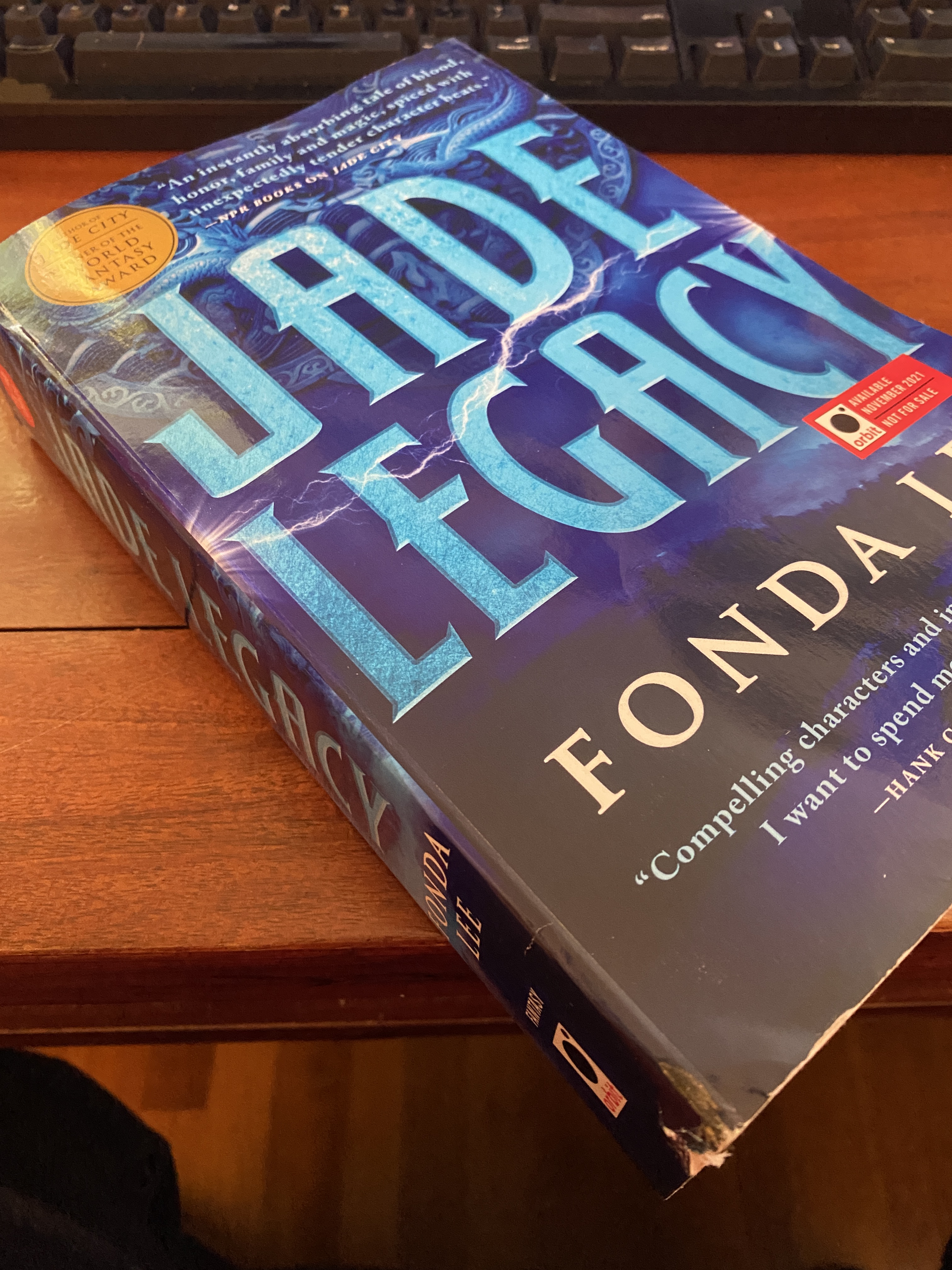
A couple of weeks ago, I got an email from a publicist at Orbit Books, who noted that I had read and favorably reviewed the first two books in Fonda Lee’s Green Bone Saga trilogy, and was asked if I’d like to receive an early promotional copy of the book.

An early promotional copy of the final book in a trilogy where both of the first two books were my favorite book released in the years they came out?

An early promotional copy of the single book I’m looking forward to most in 2021, if not the single literal thing I’m most looking forward to in 2021? Four months early??

I think the first line of my reply to her was “Oh, Jesus Christ, absolutely.”

Like, this makes every second of the last eight years of blogging, or however long it’s been, completely worth it.

And now it was here. It’s not in great shape– I was going to do a whole unboxing thing, but the book was supposed to be here yesterday, and from the condition of the packaging I think UPS had it strapped to the bottom of the truck, and it was halfway out of the package anyway, so I just took it out and gave it a little hug to make it feel better.

I will now go finish Empire of Gold, which I have maybe 50 more pages of, and then we’ll see how fast I can devour this book. If there’s not a review up by this weekend, it’s because something’s gone terribly wrong in my life.

#REVIEW: Upon the Flight of the Queen, by Howard Andrew Jones

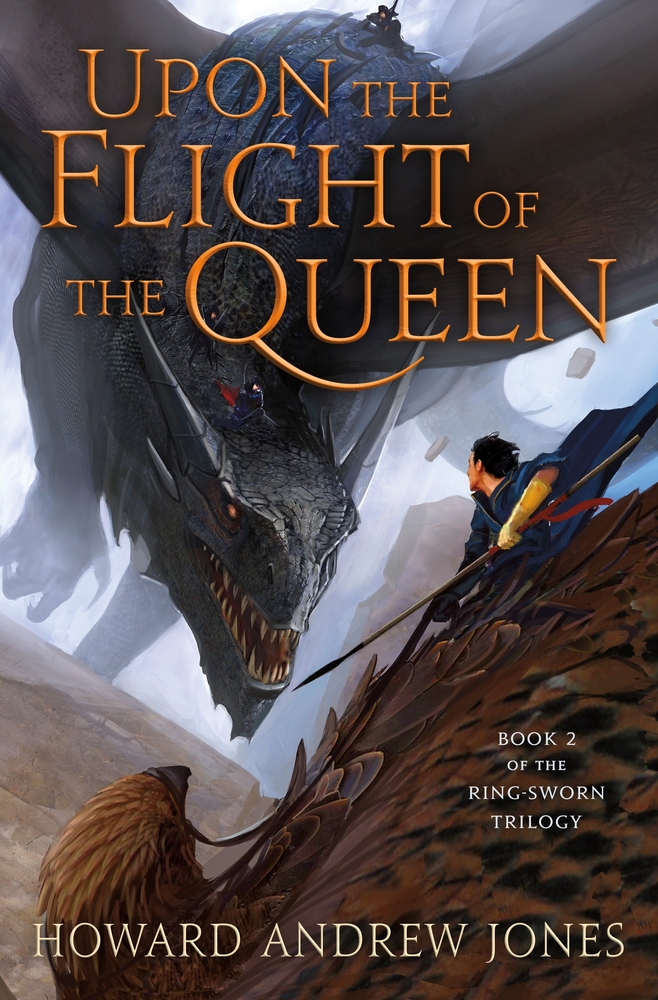
Back in February I was able to get my hands on an early copy of Howard Andrew Jones’ For the Killing of Kings. I enjoyed it quite a bit, and said so, as I’ve been known to do, and miraculously just recently ended up with an early copy of the second book in the trilogy, called Upon the Flight of the Queen. I finished it today, a few days before release– the book comes out on November 19, next week.

I’ve been a fan of Jones’ for a while; he basically writes modern sword-and-sorcery, which is a genre that’s directly up my alley. The Ring-Sworn books are a bit more European in tone than the previous books I’ve read by him, and the first one basically ended up being a sort of fantasy murder mystery for about the first 2/3 of it, only the setup was that most of the characters were pursuing the rest of them for the murder that the book started with, while the main protagonists were looking for the shadowy villains who were actually responsible for the killing.

Upon the Flight of the Queen is, unapologetically and directly, a fantasy war novel. Killing of Kings ends with an invasion, and the entirety of Queen bounces back and forth between several locations all simultaneously being invaded by a group called the Na’or, who are 1) generally not very nice, 2) have dragons, and 3) are sort of allied with the Queen, whose role in the story I’m not going to talk about all that much because spoilers and I’ve probably already said enough, although if you’ve read the first book you’re already aware that something not quite kosher is going on with her.

The strengths of the first book were the characters and the fact that Jones never stopped stepping on the gas for basically the entire length of the story. This is much the same, really, except that the book’s timeline is really compressed compared to the first book– it takes place over no more than a couple of weeks, at most, I think, and there’s absolutely no point where the author lets the momentum of the book flag at all. Now, one mistake I think I made: I’ve read, conservatively, probably 75-80 books since Killing of Kings, and it might have been smarter of me to have reread it before jumping back into the sequel. There are a lot of characters and a lot going on in this book, and I spent a bit more time trying to figure out what was going on than I generally like to, which I think is more my fault as a reader rather than the fault of the book– which is, after all, book two of a trilogy, which one might not reasonably expect to stand on its own all that well. I also could have benefited from a map. Fantasy books should always have maps, even if they don’t need them. This one involves war and invasions so it needs them.

The first two books in the Ring-Sworn trilogy came out ten months apart, so one assumes Volume 3 will be out sometime next year. I didn’t love this one quite as much as I did the first volume, but I’ll make sure to reread them before the third book comes out. If you enjoyed For the Killing of Kings, I’d go hunt Upon the Flight of the Queen when it comes out next week.