On Arabic, pedagogy and my new life goal

Something happened at work today that rarely happens in a middle school: I, the teacher, was bored. This is dangerous. I’d finished my grades, my kids were all quietly working on something or another, and other than randomly wandering around and talking to people, I didn’t have anything in particular that needed doing. Somehow I got thinking about Arabic again, and that led to me downloading a book called All The Arabic You Never Learned The First Time Around. This book is by James Price, but you’ll never know that from looking at the .pdf I downloaded, which never mentions the author’s name.

Y’all.

I need a print copy of this book, and I think I’m probably going to have to make one by going to Kinko’s (does Kinko’s still exist?) and printing all 564 pages and then binding the damned thing myself. Amazon wants over seven hundred dollars for the sole used copy they have, which also looks home-printed, and if there’s another copy out there on a legit site I can’t find it.

I have never encountered a bitchier textbook in my life, and I love it.

There will be a lot of images in the rest of this post. They are all from the first two chapters of, again, a .pdf that is five hundred and sixty-four pages long.

In general, this man despises all human life. It’s glorious.

Who does he despise the most? American journalists. Oh my God does James Price hate journalists.
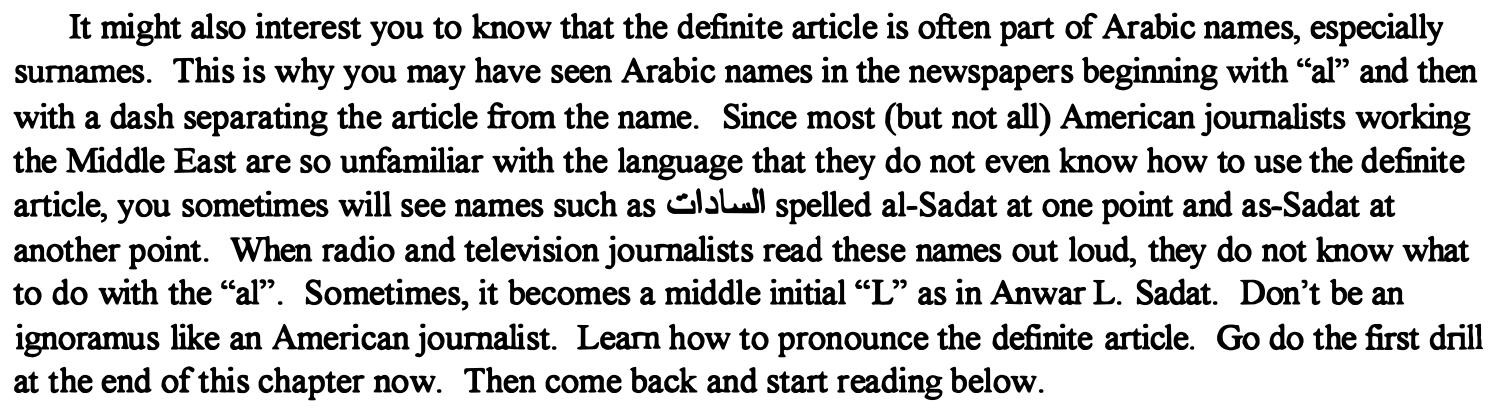
You know how most language textbooks pick a few basic words and use them for examples over and over? And how lots of times those are simple, easy words that everyone uses all the time? You will never guess the first three sample words this guy picks. Not if you try for a thousand years.

I’m not kidding. This is going to happen over and over again:

Any hint of confusion is met with immediate scorn, which is something all good teachers do:

This is the last paragraph of the first chapter:

Chapter Two starts getting into case endings and something called “Idaafa,” which I cannot explain just yet. I can tell you that James Price thinks idaafa is very simple and easy and does not have a whole lot of patience for people who do not understand it, to the point where this chapter starts using typesetting for emphasis along with the usual heavy doses of sarcasm:

I am going to start modeling all of my teaching after the last two sentences in this paragraph, including the use of all-caps, underlined bold text:
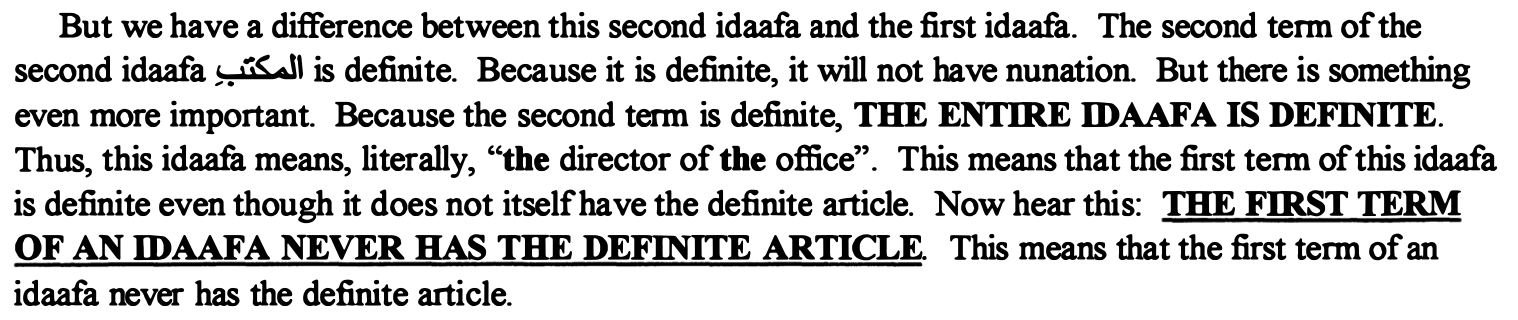
Shit, is that what it means? I understand now!

Toward the end of the chapter, we get this gem, where he makes fun of the reader for studying the text he wrote:
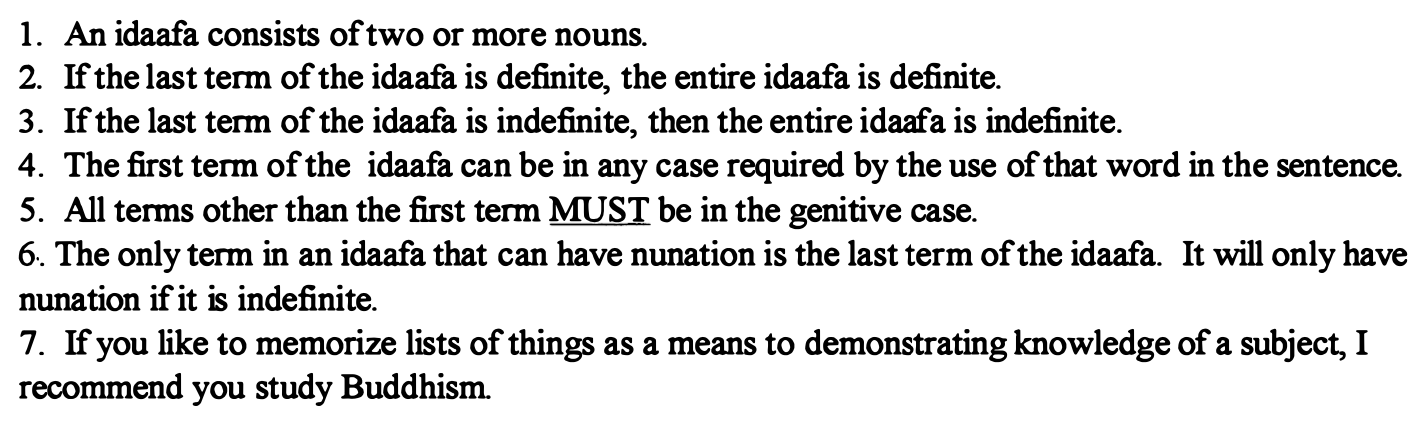
I’ve only read two chapters, remember, and I haven’t really thoroughly studied them, but I think I’m starting to detect a theme here, as this is how he ends chapter two:

This is the best textbook I have ever seen, and James Price is my new educational idol. Please, please, let someone find me a print copy of this, or I swear to God I’m making a leather-bound copy myself.
Summer Goals, Or: In Which I Write Fiction Again

With only four days of school left, none of which are really going to count for a damned thing– three days of babysitting and grade finalization and then a field day– it’s time to think about how I’m going to get through the summer without turning into a greasy lump. Since we all know I will turn into a greasy lump over the summer, let’s set some goals that I can feel bad about not fulfilling. Note that, for the most part, these are weekday goals; on weekends I still get to laze about.

  • Up by 9:00 AM every day. This actually won’t be that hard, as my body chemistry is finally starting to alter in such a way that I’m waking up earlier than this even if I don’t want to. I have tried to sleep past 8 AM for the last two days and not managed to do it. No, this is going to be the hard one:
  • In the shower within 20 minutes of waking up every day. The way my brain works, my day can’t start and I can’t do anything until I take a shower. The goal here is to have Things to Do and to Get Things Done. This means I need to bathe immediately, or close to it, every morning. I manage to do this every day during the week when school is in session and there’s no reason, or at least no good reason, why I can’t continue doing it over the summer. That said, I’ll be genuinely surprised if I manage to make it a week. Hell, I’ll be surprised if I pull it off on the first Monday of break.
  • Get licensed for high school math. This has a number of sub-goals. In case you’re not aware, I have a chance of being able to teach Honors Geometry next year, but in order to do that, I have to be certified to teach it, and as it’s a high school class and my math licensure is 5-9, I’m not. Therefore:
  • Pass the 5165 Mathematics Praxis Exam. Which I am currently not even remotely qualified for. I’m hoping to have this done by July 1. That should give me enough time to get the paperwork through the state board by the time school starts, even if I don’t pass on the first try. However in order to do that, I have to:
  • Study math for an hour a day, preferably in the mornings, after my coffee. I’m allowing myself some lounge time after getting out of the shower. Go sit in my chair in the library or on the back porch, drink a cup of coffee, idly fuck around on the web or read a book. But I want to spend an hour stuffing math into my brain each day. Right now the tentative plan is to take a practice test on the Monday after break to see just how far I have to go and see if an hour is realistic or I need more than that. That’s 20 hours of study during June for three years of high school math. One course a week plus some flex time. Sure, I can do that, right? I taught myself enough German to pass an exam in three days. I just need — heh– to be disciplined and to remember how to study.
  • Actual Arabic study, using some of the print resources I’ve purchased and haven’t paid much attention to. The apps have their place– which reminds me that I haven’t talked about an excellent vocabulary app I found– but I need some sustained grammar work and the apps genuinely don’t care about that.
  • Find some projects around the house. Stand by; we’ll see. There are tons of things I could be doing.
  • Maybe a part-time WFH job if I can find one. I don’t need more money, but if I could make enough to get this new computer completely paid for by the end of the summer that would make a lot of things easier. I need to remember that the overage pay goes away in a couple of paychecks. That’s not a problem– I was doing fine before I had it and I’ll be fine after it– but I’ll need to get a little more disciplined financially again. Luckily, summer is cheaper than the rest of the year most of the time.
  • Get the boy off the fucking couch. He will transform into a greasy lump if I let him– greasier than ever before, in fact, since he’s going to be a teenager in a few months and his Greasy Years are coming– and I should probably treat him like I’m his dad and not, like, a creepily older roommate who lives in the back office studying esoteric mathematics and languages he will never speak to anyone. He will literally spend the whole summer playing video games and watching YouTube if I let him; I should probably find a way to encourage other activities, even if that’s just making sure he has friends over every so often so that he interacts directly with people.

And, because not everything has to be serious:

  • I have video games to beat. I spend significantly less time on the PS5 since I turned off the YouTube channel, but I’ve developed this vexing habit where I play 90% of a game and then abandon it for something else, which means that I’ve got this vile backlog of games that I want to get off my plate and haven’t yet. Some of them are never going to happen– I’m looking at you, Baldur’s Gate III— but several of them are games I enjoyed and just got distracted by the next shiny. Literally all I have to do in the new Prince of Persia is beat the final boss! That’s, like, an hour or two! I can do this!
  • Reeeeeeeeead. Still making progress but God damn it I want the unread shelf cleared by the end of June. I can do this. I will do this. This is actually the thing on this list most likely to actually happen.

What about you? Any big summer plans?

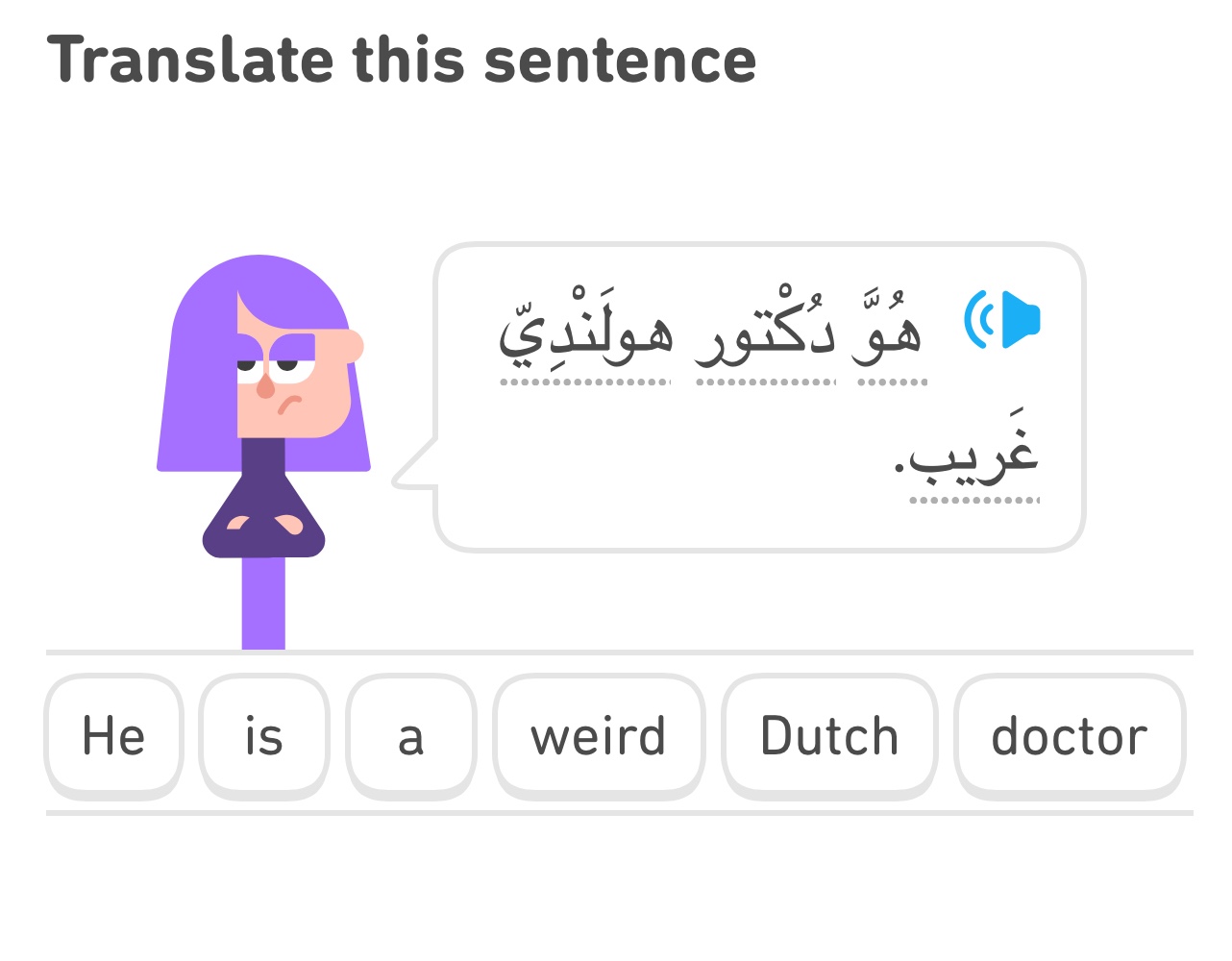
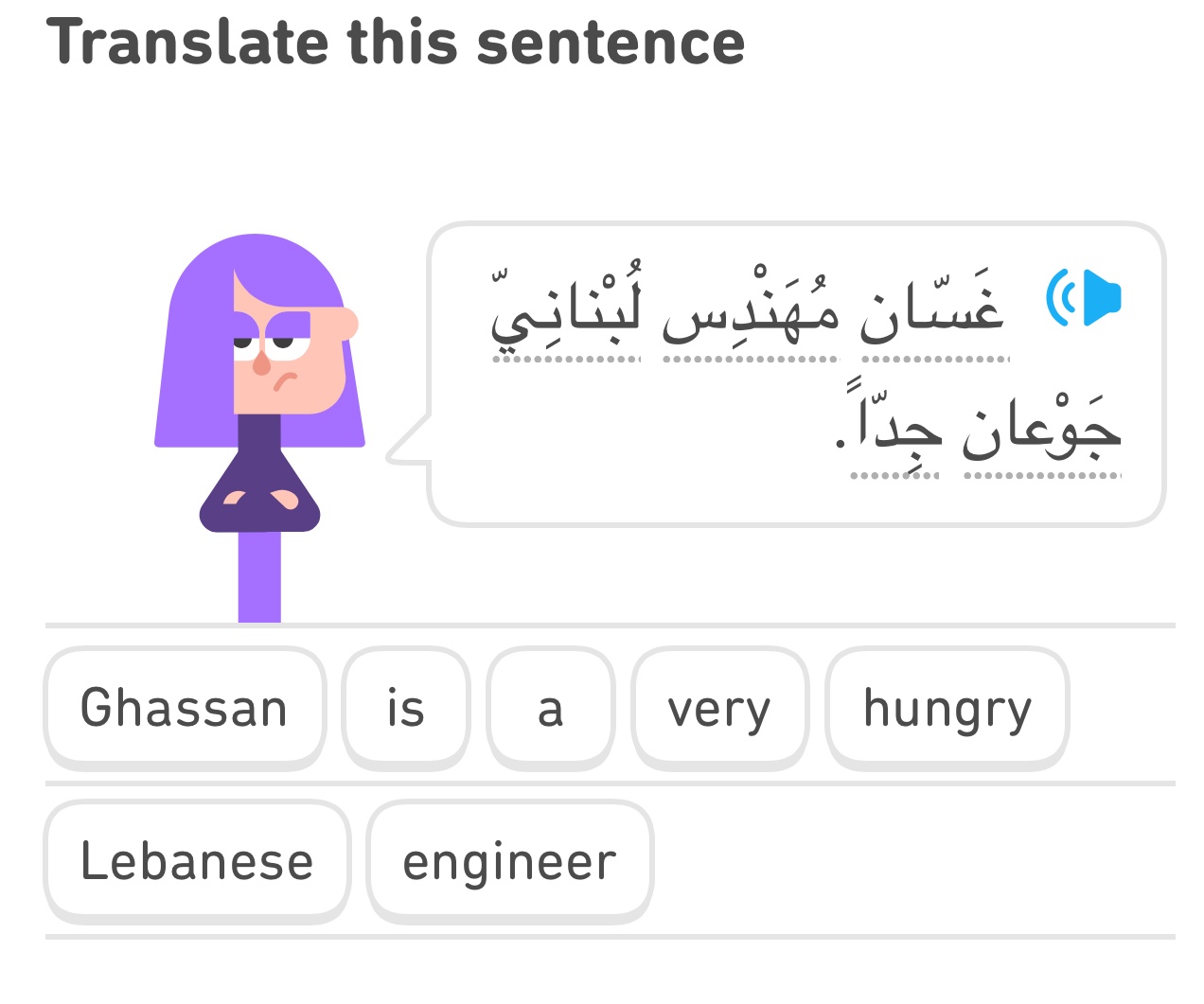
Never change, Duolingo

I can literally hear my students whining “When am I gonna use this?” right now.

Also, Duolingo, I think it’s fair to suggest that an American English speaker will never say “Ghassan a is very hungry,” and while I admit that that would be a genuine PEBKAC* error, it would be super cool if you could just fix it and move on.

*we may need a more phone-appropriate version of this acronym.

Break up with this dude

Never change, Busuu.

FRIENDSHIP ENDED WITH BUSUU

… now Lingodeer is my best friend.

(My life has just changed; while checking to make sure that I was using the right color to cross out the Busuu app, I discovered that new friend Salman in that famous picture is the guy on the left, not the guy on the right, and for some reason I can’t handle that.)

But anyway. The last time I rattled on about Arabic apps on here I was already starting to sour on Busuu, but things have gotten rather worse since then, and since I’ve also found a decent third Arabic-language app (I will never stop collecting them) I figured it was worth another post. Now, it’s worth pointing out: I’m only discussing the app’s approach to Arabic, as I’ve not tried it with any other language, and Arabic is fucking hard, so I can imagine writing an app about how to teach it is also pretty fucking hard.

But nonetheless. I’m not actually giving up on the app, because the (effectively) dictation sections are genuinely useful, but I don’t think it’s teaching me anything any longer. For example, yesterday’s unit was called “Making Plans.” It taught me the words for:

  • Plans;
  • To Be Free (one verb form);
  • “do you fancy”…
  • “let me know”
  • “give me a call”
  • “How about…”
  • Shall
  • “I’d love to,”
  • “Do you mind,” and
  • “Sorry, I can’t.”

It breaks these down into groups of three or so, and after each few words it’ll repeat one and I need to click on the definition. After a couple of groups will be one of the listening exercises I mentioned in the post above, and then it’ll go through all the words and I’ll have to pick the translation from three possibilities. A lot of the time a good test-taker with no Arabic could get these right; for example, if a phrase ends in a question mark, and only one of the answer choices is a question, that’s the right one.

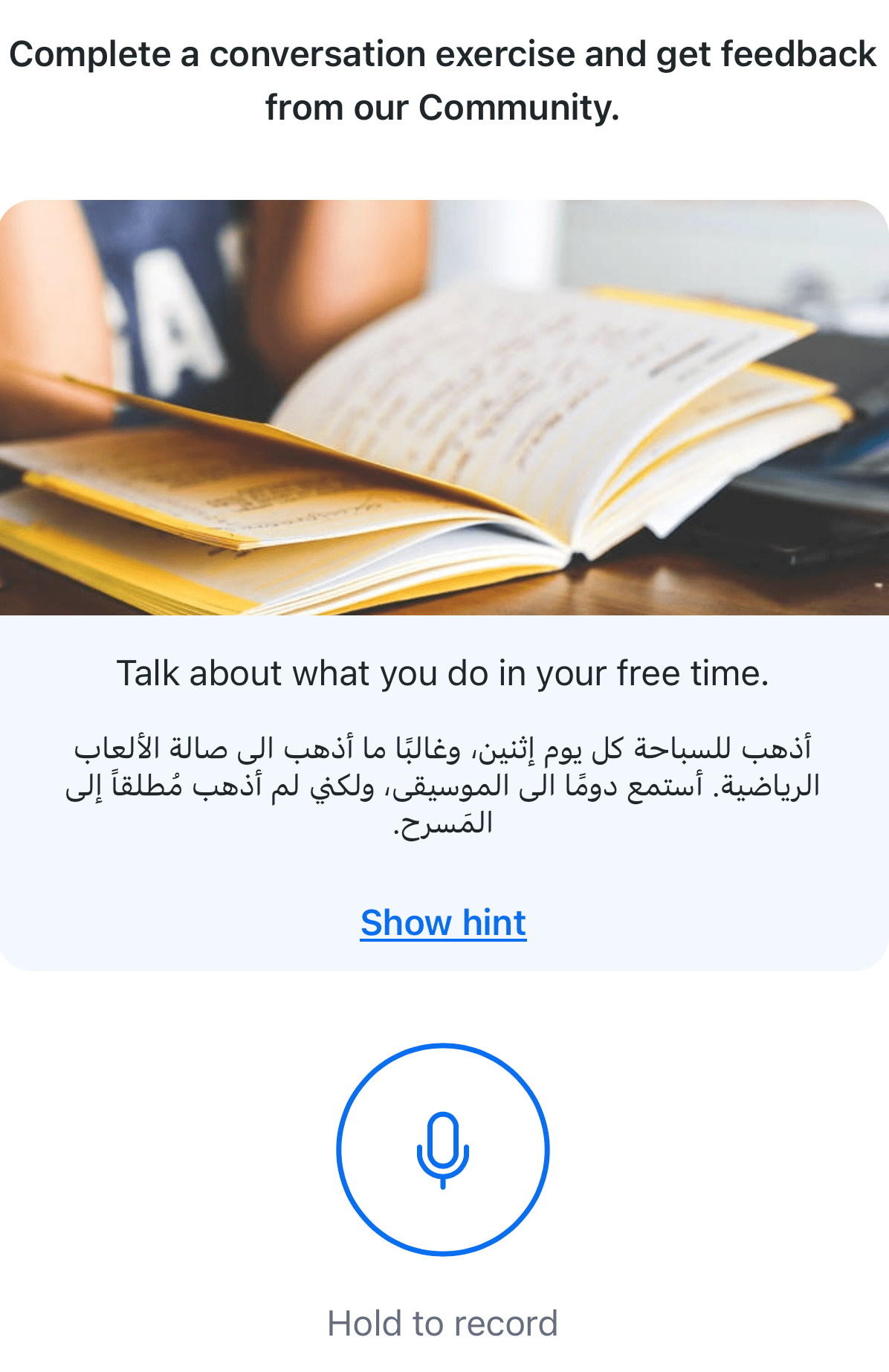
And I figured out the other day that this last flurry of multiple-choice questions will be in the order the words were presented, which … makes the whole exercise useless, frankly. And then there’s the social media functions, which I’ve abandoned entirely, because no one who has been using this app could possibly complete these exercises, particularly the written ones. You can record a few seconds of silence to get past the “record yourself talking about making plans with a friend” prompt, but if you write something it wants several sentences, which I am incapable of without literally typing them into Google Translate and copy-pasting what it gives me back.

Oh, and the community feedback had potential to be super useful, except for one little thing: the helpful people out there who want to work with me on improving my Arabic largely don’t speak English. Giving me pronunciation tips or correcting my grammar in Arabic isn’t actually helpful!

So, yeah. I’ll keep fucking with it because I paid for it, but fifty days into Round III of Learn Arabic I’m no longer stressing about this app.

That said, let’s talk about Lingodeer, which sounds dumb but which is the current big winner among my Arabic apps. Wanna know why? Here’s why:

You know what that is? That’s a fucking spelling test. Wanna know the best way to get me to learn to read this language? It turns out that it’s spelling tests. Every letter and vowel and pronunciation mark in that group needs to be used– as of right now, they haven’t started throwing distractors at me yet– and Lingodeer deliberately overpoints everything, focusing on teaching pronunciation much more than any of the other apps would. Many of those characters don’t even appear in standard (?) Arabic– I’m still not a hundred percent certain how the dialect differences work, and this app really wants lots of -un endings on words, but when I type “My sister” into Google Translate I get أختى, which has a few less vowels than they give me up there.

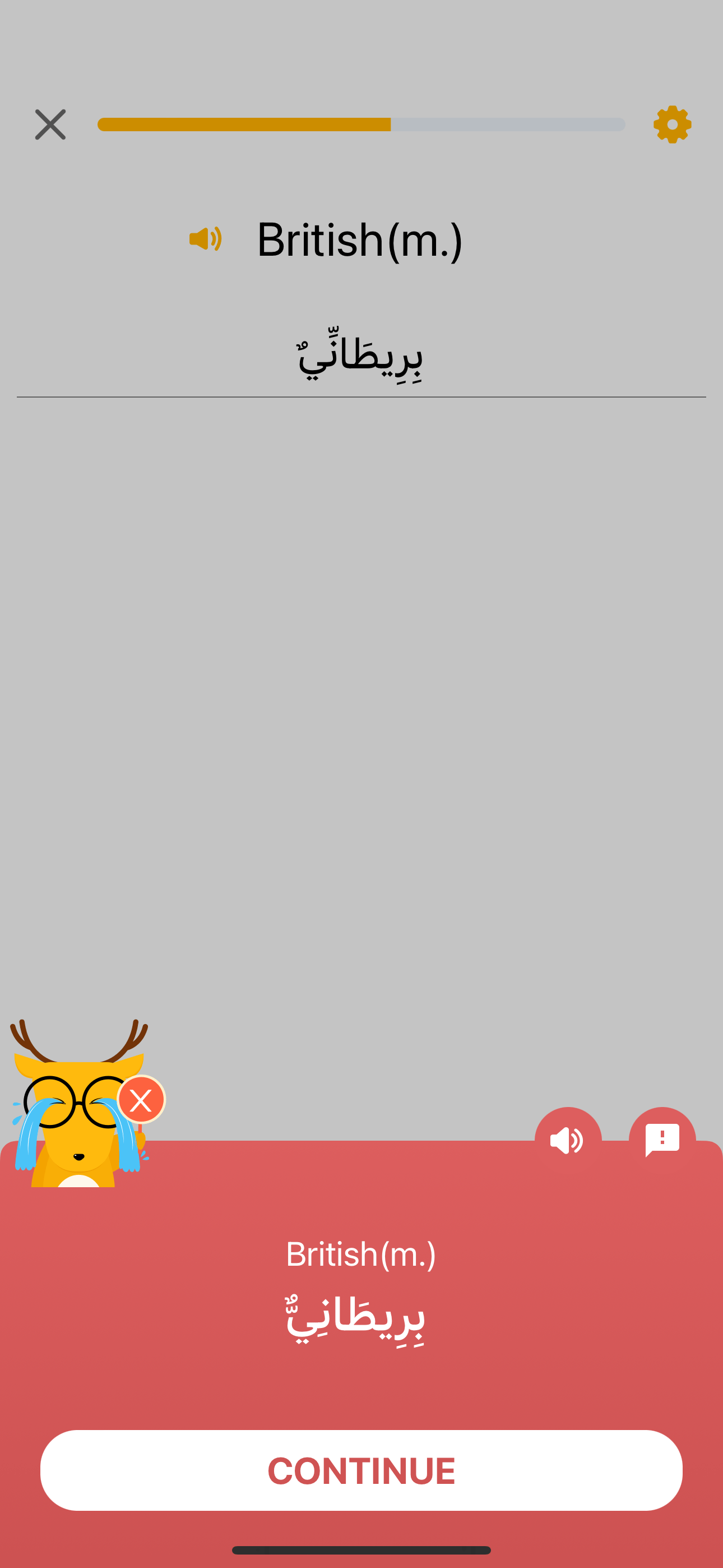
You might have to stare at it for a moment to figure out my mistake here; the Arabic masculine word for “British” is, roughly, biriitaaniyyun. That squiggle that looks like a W above the letter on the left indicates a doubled letter, and I put it in the wrong place– I wrote it as biriitaanniyun.

(Why the doubled vowels? Because there are three long vowels in there. In most cases a long vowel is represented as a doubled vowel when transliterated. Where Lingodeer gets weird is insisting on also including a short vowel every single time a long vowel appears, which it does several times here.)

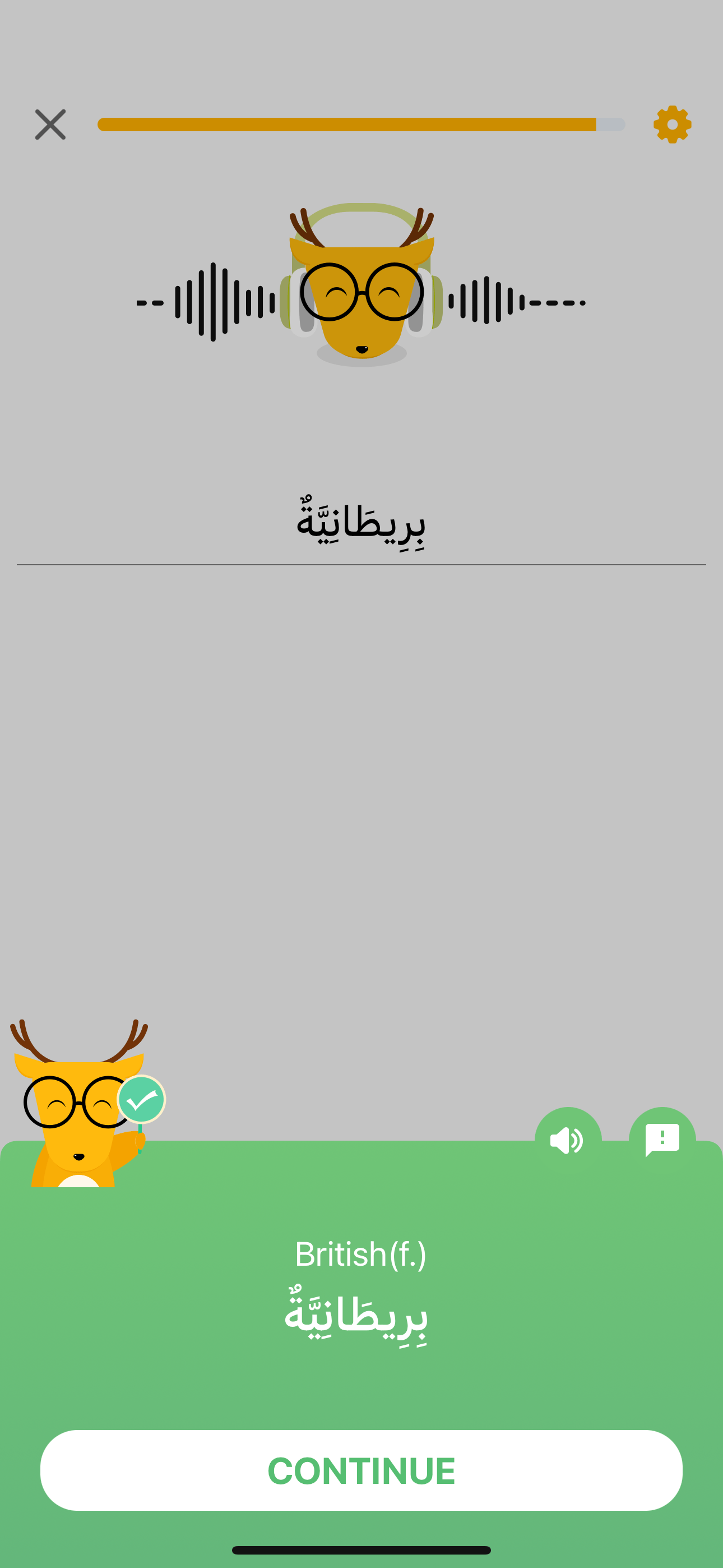
Anyway, there are thirteen individual characters that needed to be put in the right order to get that right, and I only missed one of them, which felt awesome. And then it hit me with the feminine version, which is even longer, and I got it right:

I give you biriitaaniyyatun.

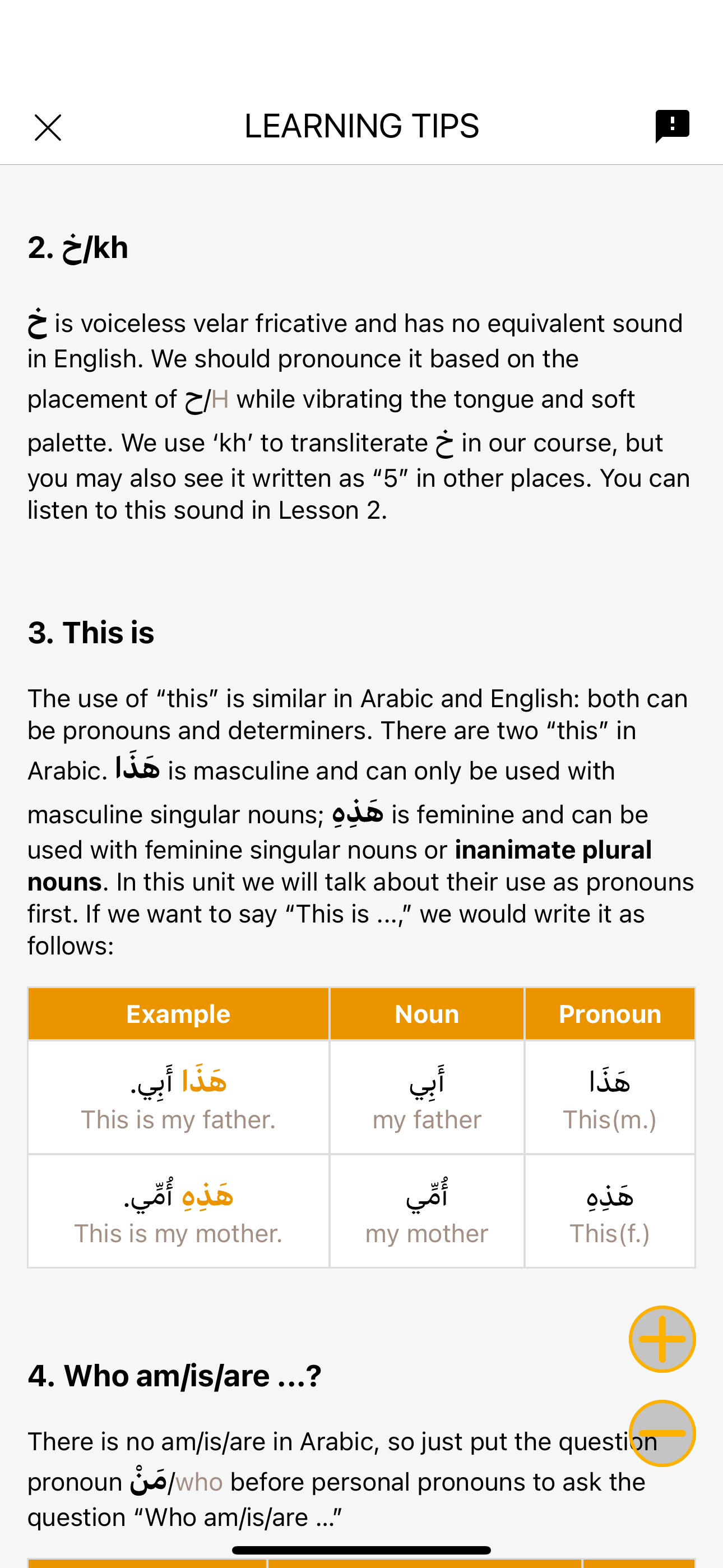
More hotness? I want lots more of this. Rub it on my face:

Every single section has stuff like this, that gets way into the weeds, and is fucking awesome. Even if I don’t look at it on every unit, the fact that it’s there is magnificent.

This is, slowly but surely, actually teaching me to read. I’m making progress here. Which is awesome. And is why Lingodeer is my new best friend.

Go ahead. Ask me questions. I might be able to answer them.

ETA: I just jumped back in and did some more spelling exercises. I’m proud of this, dammit:

Calm down, Busuu

Those three lines of Arabic are what you get when you click “Show Hint.” They are not what you need the hint for. Needless to say, I can’t translate a word of that. I can’t even sight-read it. That is not a hint, Goddammit.

I am just destined to fail at this shit.

Screw it, let’s give some examples

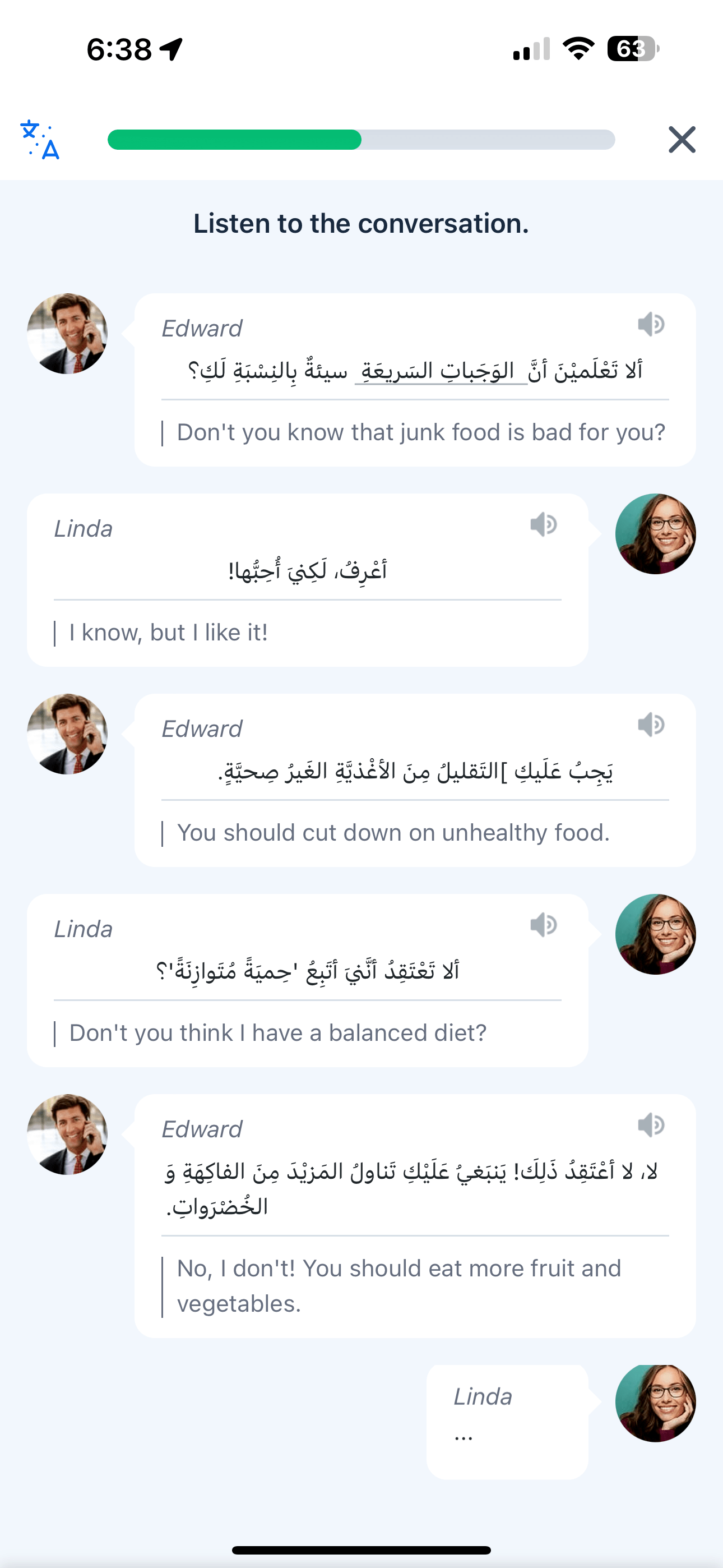
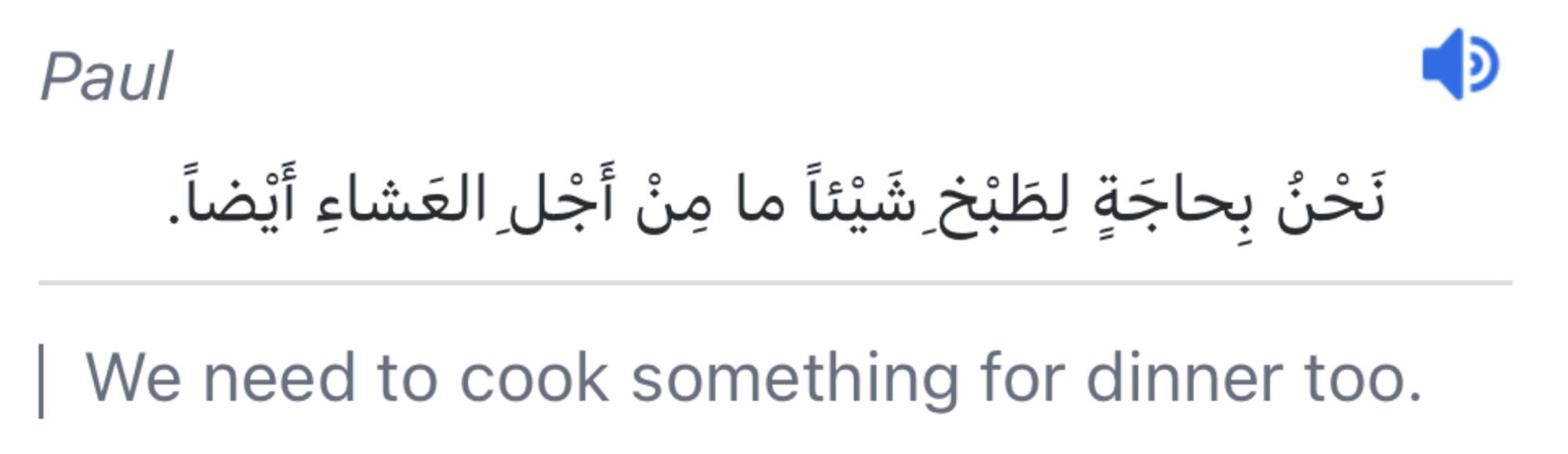
I pulled this from my post the other day about the conversation quizzes. Remember, the way this works is I get sentences one at a time, spoken by what sure sounds like a native speaker, and some of the words are blanked out. I get a word bank to choose from to fill in those blanks.

Let’s get into a few explanations, and I’m not looking any of this up right now— I’m typing this on my iPad while watching John Wick 3, so I’m not going to take the time to nail down the details. Basically any of the dots on those letters are for differentiation between different letters. So the difference between a d and a z or an s versus a sh might be how many dots are on the word. Some base letters have as many as three variants. I don’t think there are any with four (no dots, one, two, and three) but I might be wrong.

The little circles that show up here and there indicate a letter that does not have a vowel after it. This was never explained in Duolingo and has never been mentioned in Busuu; I had to look it up.

Dashes indicate short vowels. A dash under a letter indicates a short I, a dash above a letter indicates a short a, and there’s a little curlicue-lookin’ thing that appears above the letters that indicates a short u. I don’t see any of those in this sentence but that might be a font thing.

Here’s the problem: there are a bunch of symbols in those words that haven’t been explained in either of the apps, and I have no idea what they mean. The double-line above the vertical letter on the far left? No idea. The double line underneath the leftmost letter of the second word from the left? No idea. The symbol on the rightmost letter of the leftmost word? No idea.

I can’t read these words if you don’t explain what these symbols mean, guys, and while some of them are vowels, occasionally I feel like maybe some of them represent multiple letters together, or are maybe a contraction of some kind? I can’t just figure this out. Stop fucking with me.

In which I reconsider

I think it’s probably time to admit that if I want to take a serious shot at learning Arabic I’m going to have to 1) spend time with textbooks and 2) probably suck it up and take a class. I was pleased with the way Busuu introduced the alphabet, but it went from that directly to “Okay, you know this now, and you’re ready for entire sentences in this tiny-ass font, right? Plus a bunch of symbols that we never really discussed in the alphabet section? You won’t be able to make half of them out anyway so don’t worry about learning them.”

Like, guys, language learning apps should explain shit, and I don’t understand why they don’t. Busuu’s approach to anything that isn’t the alphabet has been to give a handful of examples that may or may not generalize, not explain them, and then just … move on. Like, my last unit was on comparatives and superlatives? It gave me bad/worse/the worst and, I dunno, maybe good/better/best and that was it. I liked the “pull words out of this conversation” feature the first time I saw it, but I just don’t know enough to be able to do that easily and I can’t read well enough to go from spoken word to one of four different words that may not differ from each other all that much. Especially when, again, I don’t know all of the vowels and diacritics. Every so often it will show me a picture and ask me to say something about it for one of the social media features, and, Christ, I don’t even know where to start.

There also might be a dialect difference between it and Duolingo, and I can’t figure that out either. Lots of the nouns end differently (-atun seems to get added to a lot of them, and sometimes just -a) and I can’t figure out what the ending means, or why Duolingo’s vocabulary never bothered with it, and gendered endings seem inconsistent, and … gah. I’m smart enough to learn this shit, but I’m not smart enough to figure it out, especially given limited examples and the weird fact that that ending doesn’t seem to be properly represented by the actual letters at the end of the word, which is probably a function of one of those symbols I never got an explanation for.

And, for the record, if you happen to understand Arabic, don’t worry about explaining how all of this works. Like, I have access to other sources of information, and to a certain extent this is a function of my own laziness. I want there to be an app that explains this at the depth and quality that a textbook would, because I want to learn Arabic five minutes at a time while sitting in a comfortable chair in my living room or my library, and not hunched over a textbook or sitting in a classroom that I have to pay tuition for. I shouldn’t be surprised when I can’t find that.