
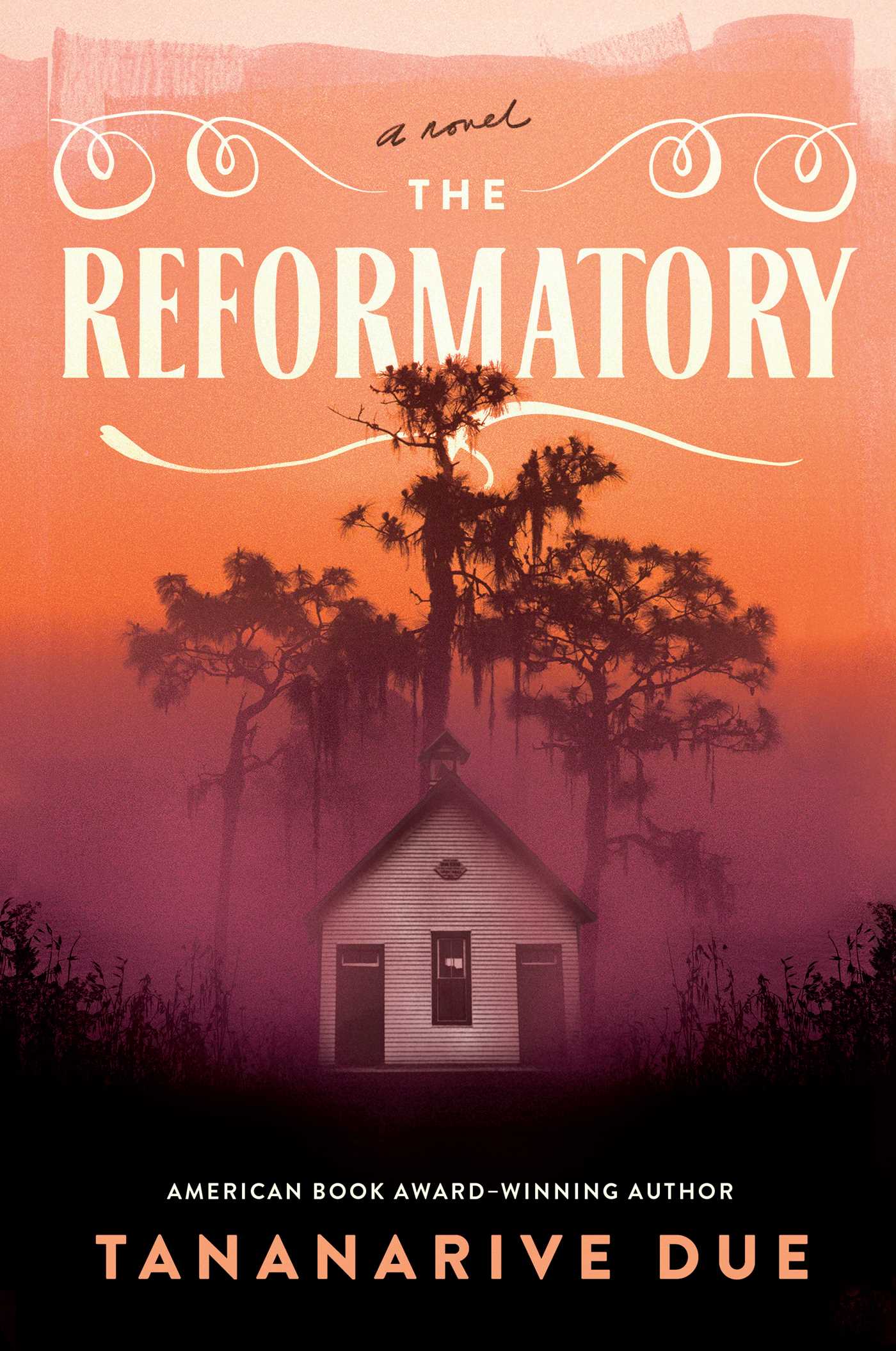
#REVIEW: The Reformatory, by Tananarive Due

I feel like I haven’t treated Tananarive Due with enough respect.

The Reformatory is the third of her books that I’ve read. I did not know that until just now! I remember reading her book My Soul To Keep way back in 2016, and at the time I really liked it, but for some reason every time I think of it now I feel like it wasn’t something I enjoyed. And I just discovered that I read her debut novel, The Between, in 2020.

When I tell you that I don’t remember anything about that book, I need you to understand that not only do I not remember any details about the story, I did not even remember the book existed. That cover looks unfamiliar. I cannot picture where my copy of it is in my house, and I surely read a print copy. I don’t know what the spine looks like. If you had asked me ten minutes ago what the name of Tananarive Due’s debut novel was, I would not have been able to tell you. My recall of books from years ago is not always great, I admit that, mostly because I read 100+ books a year. But forgetting a book existed or that I ever read it at all is not a thing that I do.

And that after my weird about-face on My Soul to Keep? I have no explanation for this phenomenon.

Anyway, The Reformatory is really good, and if six months from now I find that I’ve turned on it too, I’m gonna need someone to come get me.

The Reformatory is the story of Robert Stephens Jr., a 12-year-old boy who is sent to the Gracetown School for Boys for a supposed six-month sentence after kicking the son of a wealthy white man in the knee. The book is set in 1950 in Florida, thick in the middle of Jim Crow, and the Gracetown “school” is a segregated, haunted nightmare, run by a grotesque abomination of a man. It is widely understood that Robert won’t be getting out in six months, as the warden is renowned for finding excuses to hold on to any boy sent to him until their 21st birthday regardless of their original sentence. Beatings and torture are commonplace and the inmates prisoners “students” are encouraged to turn on each other at any opportunity.

The book bounces back and forth between Robert’s story and his sister, who Robert was defending when he kicked the other boy. She is trying her best to get him released, which is easier said than done in any number of ways. Their father has fled to Chicago after his attempts at unionization upset the Klan, and it’s fairly clear that part of the reason Robert is being treated as poorly as he is is because the authorities can’t get at his father.

The book would be scary enough without the haints, is what I’m saying, and the presence of a large number of ghosts at Gracetown becomes almost a distraction from all of the more grounded evil taking place there. Of course, a number of them are ghosts of children who were murdered or otherwise died while incarcerated there, and, well, a whole bunch of them bear quite a serious grudge against the warden.

I won’t go into much more detail, because (as usual for books I enjoyed) you deserve to experience the twists and turns on your own, but this really is a hell of a book, and I’ve not heard a lot of people talking about it. Give it a read.

#REVIEW: AND THE WALLS CAME TUMBLING DOWN, by Ralph Abernathy

Dr.-Martin-Luther-King-Jr.-and-Rev.-Ralph-Abernathy.jpgYou may not be aware of who Rev. Ralph David Abernathy is, but I guarantee you know his face.  Why?  He’s the guy standing just behind or just to the side of Martin Luther King, Jr. in every picture of Martin Luther King ever taken.  In many ways he was as influential to the civil rights movement as King was– he was even the guy who brought King in as the visible face of the movement during the 1955 Montgomery Bus Boycott, which was what made MLK a national figure– but because he was so often quite literally the guy behind the guy he’s not nearly as well known.

I just finished his autobiography, And the Walls Came Tumbling Down, a book I have owned for a while and really should have read a long, long time ago.  It’s one of the more interesting autobiographies I’ve ever read.  For example, here is the cover blurb:

The detail Mr. Abernathy offers about his life with Martin Luther King Jr. is enlightening and helps us understand what a remarkable man King was. 

You catch that?  It’s Abernathy’s book, about Abernathy, but even the blurb on the cover is about King.  So the book needs to be read on a few different levels: one, as an autobiography, two, as a biography of an entirely different person, and three, as a history of the Civil Rights movement, and specifically the Southern Christian Leadership Coalition, which King was President of and which Abernathy took over (at King’s explicit direction) after King was killed.

The ultimate result is a book that is most successful at item 3, I think, and, oddly, is weakest at item 1.  Abernathy discusses his early life carefully enough, I suppose, and you get a good picture of what growing up in Alabama in the thirties must have been like, although he’s careful to note that he was more privileged than most.  Once the SCLC enters the picture, though, any mention of Abernathy’s family or private life (or even his pastorship outside the SCLC) disappears.  The births of three of his four children go unmentioned, for example, and while his wife Juanita is present throughout the book she’s mostly there, along with Coretta Scott King, as a provider of home-cooked meals.

The book functions best, as I said, as a history of the major struggles of the SCLC, with one major caveat:  Abernathy, and it hurts me to say this because of who he was, was apparently a bit of a pompous ass.  There are a number of other important figures throughout the movement who Abernathy clearly loathed, and some, such as Stokely Carmichael, endure abuse virtually every time they are mentioned. Jesse Jackson has an entire chapter that, other than the final page, is wholly dedicated to how egotistical he was.  He treats the Student Nonviolent Coordinating Committee like it was overrun with Black Panthers from day one, which is manifestly untrue, yet neglects to mention the actual beginning of the black power movement, which he was present for.  Most amazingly, Abernathy managed to write an entire chapter about the March on Washington without mentioning Bayard Rustin.

There would not have been a March on Washington without Bayard Rustin, and his omission is shocking.  I can only assume that Abernathy disapproved of Rustin being openly gay, because otherwise he should have popped up way more often.  With Carmichael and Jackson, the differences were more clearly personal.

And then there’s the way he treats MLK, and that for me is both the worst and most interesting parts of the book.  Here’s the thing: Martin Luther King was not the perfect saint that modern media wants him portrayed as.  He was, as I’ve said before, human.  And he was, unfortunately, among many, many other things, the vast majority of them good, a philanderer.

Now: if you’re writing a biography of Martin Luther King Jr., you owe it to him and to your audience to not treat him as an unassailable, perfect person, and I think King himself would agree with that.  An biography of King, at least one intended for grown-ups to read, should deal with the man’s darker side.

But if your book is about you, and you were Martin Luther King’s best friend and constant companion through the most important years of his life, and if you were literally the last human person he touched and saw and tried to speak to before the assassin’s bullet took his life, maybe, just maybe you don’t devote a chunk of the chapter about the night he was killed to the fact that he slept with as many as three different women during the couple of nights before the assassination.  Maybe you leave that detail out.  Maybe you don’t devote several pages to it.  Just maybe.

It comes off kinda fucked up, is what I’m saying.

So, yeah: make no mistake, Ralph Abernathy was a pompous ass and one of the ways he uses this book is to settle some scores, and he occasionally takes some credit for things he wasn’t entirely responsible for, and I can’t help but think that I think some residual jealousy toward King was informing the way he wrote about the last few days of MLK’s life.  But I’m not star-rating Ralph Abernathy, and again, the man is allowed to be human, and the good he did in life far, far outweighs spreading some vitriol around in the autobiography he wrote the year before he died (and, possibly relevantly, after having had at least two minor strokes.)  As a book, AND THE WALLS CAME TUMBLING DOWN is fascinating, and any student of the Civil Rights Movement should have already read it.

Five stars.