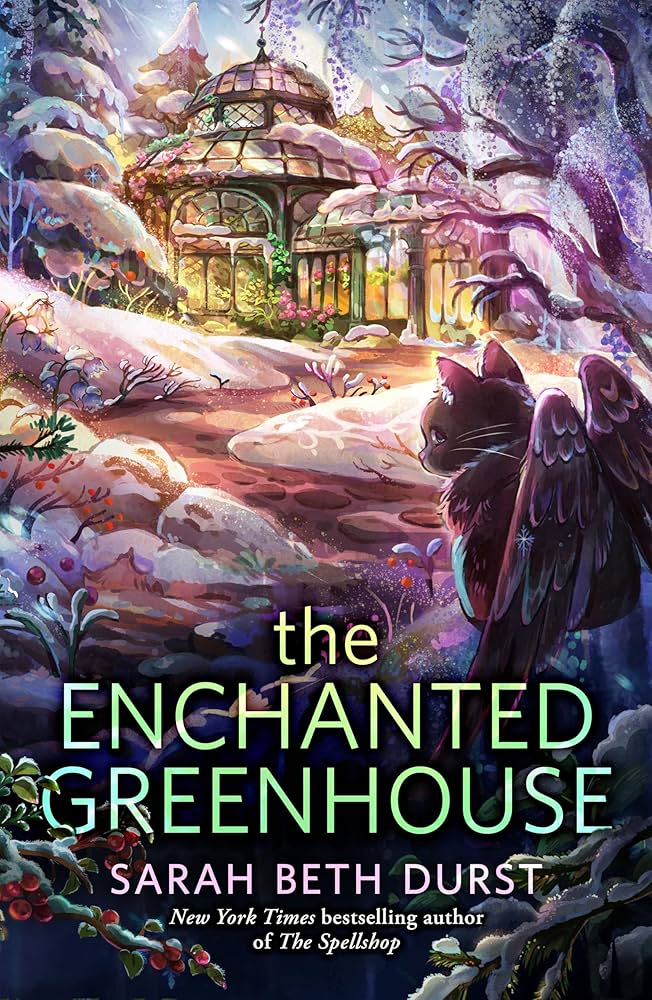
#REVIEW, sorta: The Enchanted Greenhouse, by Sarah Beth Durst

I’ve done not much but sleep this weekend, and at least one person in the house has Covid and at least two are sick, and I didn’t have a lot of grading to do today but what I had to do was immensely annoying.

So, please, forgive me, when I write a very short review, less than it deserves: that The Enchanted Greenhouse is delightful, and it’s a sort-of sequel (same world, different characters) to The Spellshop, which I didn’t review when it came out last year but was also delightful, and it was absolutely the antidote to having read a bunch of books lately that I didn’t like all that much. It is short (I finished it in less than three hours, easy), low stakes (sure, “cottage core” or “cozy,” either works) and has a romance angle without ever descending into smut, and there are talking plants and a cat with wings.

I loved it, but I’m too tired to say much more, so just go read it, and enjoy peeling the pages apart, because something about the way they stained the edges kinda locks them together a little bit, and I’m not gonna sit here and pretend that the physical feeling of splitting the pages as I was reading didn’t add to my enjoyment of the book, because it totally did.

Back to bed.

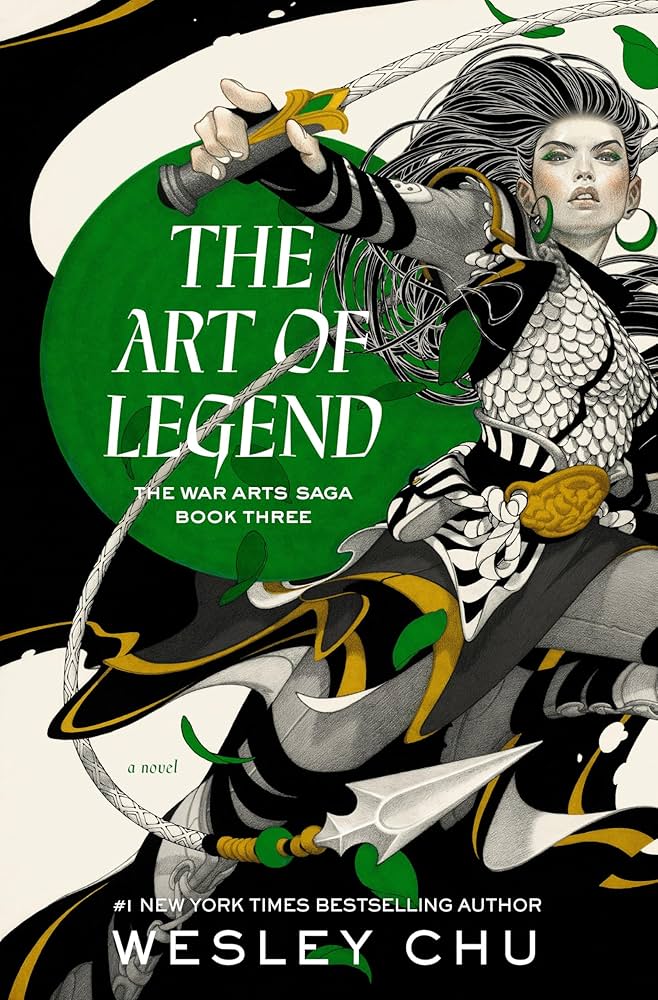
#REVIEW: The Art of Legend, by Wesley Chu

I take no pleasure in this.

I write negative reviews infrequently enough that almost every time I do I start with a disclaimer like this. Under any circumstances other than “The publisher sent me the entire trilogy because I asked for it,” I would simply not review this book. It feels ungrateful to make other people go to trouble to send me books for free and then say bad things about them. But while I really liked the first book in Wesley Chu’s War Arts Trilogy, I was mixed on the second and unfortunately I have to report that the series’ ending really ends up unsatisfying.

The problem is writing this without massive spoilers. I mean, in one sense I don’t really have to worry about that, I can just say “Hey, spoiler alert,” and then go about my day, but I don’t want to do that either. So we’re going to go the “mild spoilers” route; a lot of what you will see in the next few paragraphs could have been reasonably guessed going into the book, but I’m not going to completely reveal the story.

The Art of Prophecy begins with Jian, the Prophesied Hero of the Tiandi and the Champion of the Five Under Heaven. Jian has been prophesied since birth to be the one who kills the Eternal Khan, ending his dominion over the Tiandi people. And then the Khan goes and gets killed on his own, leaving Jian with no more destiny and setting the events of the whole trilogy in motion. In the second book, elements of the Tiandi decide that Jian is actually their betrayer, and he spends the entire series either running from capture or escaping it one way or another.

So, we all know that in Book Three the Khan is coming back, right? Of course we do. And he does. And then he confirms something that I had been wondering about since the first book: he was going to come back anyway. It’s even straight-up stated that even if Jian kills him he’s going to return in a decade or so. Now, one of the POV characters spends the whole first book trying to find out where the Khan has been resurrected and the second book trying to get a chunk of his soul peeled out of her body, so it’s clear that he’s “Eternal” because he keeps getting resurrected. But I had the idea that Jian killing him would be permanent, and … not so much? He’d have come back anyway? Really? What the hell was the point of making such a big deal about Jian, then?

Jian is a problem, honestly, and he’s at the middle of what I didn’t like about the book. The series can’t really decide if if he’s powerful or not– even during the inevitable final battle with the Khan the text itself bounces back and forth between “he’s ready, and this is a real fight” and “the Khan is obviously toying with him and the four other people he brought to the fight” and while Taishi talks about how much he has grown over the years she has known him, I kind of feel like the book doesn’t realize how annoying he is?

A brief diversion: did you watch Smallville or Buffy the Vampire Slayer? You know how Lana was actually really fucking annoying and Xander was kind of a creep, or to use another example, Barney Stinson was a predator and Ted Mosby was a huge loser in How I Met Your Mother, but the TV shows didn’t seem to realize that? That’s Jian. He started off as a pampered, callow youth, and for me, at least, he never improved– he actually faints when he is told the Khan is back. And this is as close as I’m going to come to a huge spoiler, but for a whole series about a prophecy about a dude, that dude has much less to do with the ending of the series than you might expect.

Some of my other gripes are artifacts of having read the trilogy more or less back-to-back-to-back; the bit where Qisami talks like an overenthusiastic memelord and her speech doesn’t remotely match anyone else in the book, or the fact that every insult in the series is inexplicably egg-based, wouldn’t have annoyed me as much had I not devoured 1600 pages of it over a few weeks. Seeing “Let them cook” in dialogue would still have been distracting as hell, though, or the way people keep “eating” punches and kicks.

I dunno, guys. I still stand by enjoying Prophecy, but given where it ends up I can’t really recommend the whole trilogy. I wouldn’t go so far as to call it bad— I three-starred it on Goodreads and Storygraph, and I feel like that’s about right– but it’s not something I’d have talked about had I not been sent the books, and I’d likely have DNFed the final book. I feel bad about it, but there you have it.

An admission

“Dipshit groyper in it for the lulz” was not one of the identities I had considered for the shooter.

I need to figure out what it is about the first test of the year that causes all my kids to turn their brains off. Because I’m pretty sure I’m four, maybe five years deep where after the first test I wanted to quit my job and go pick onions for a living. My next classes are going to be yet another one of those situations where I have to struggle to keep the words fucking idiots from escaping my lips. Tell me, gentle reader, what do you think about this statement:

Any number to the power of 0 is 1.(*)

I feel like that’s pretty unambiguous!

Can you explain to me why, in a question about the power of zero, where the notes stated that any number to the power of zero is one, some students said that no, this number wouldn’t equal one, or worse, that some of the example numbers would only sometimes equal one? Gentle reader, can you give me a single example in mathematics of the word sometimes showing up when we’re talking about something equalling something else?

Christ, I’m tired.(**)

(*) For the purposes of this conversation, remember this is 8th grade math, and we’re going to ignore the fact that there’s debate about whether 00 equals one or zero. They’re not going to get asked about that in 8th grade. Literally every other fucking number equals 1 when raised to the power of zero, and I’m willing to tolerate a tiny inaccuracy in what I thought, again, was a clear and unambiguous statement.

(**) I have had this exact conversation, multiple times: “The rule is any number to the power of zero equals one. What’s three to the power of zero?” “One.” “What’s twelve to the power of zero?” “One.” “What’s three hundred to the power of zero?” “One.” “What’s negative four to the power of zero?” “… negative one?” “The rule is any number to the power of zero is one.” “Oh, one.” “What’s point five to the power of zero?” “… point five?”

Any means fucking any, God damn it.

On dead assholes

I rejected a number of possible image choices for this post, one of which was a photo of the shitgibbon from today where it is very, very clear that half of his face is drooping in a way that absolutely screams “I’ve had strokes recently, and might be having one now.” I never ended up posting about the weird collective hysteria of a couple of weekends ago where the Internet all at once decided he’d died, and conspiracy theories and other forms of nonsense absolutely abounded for a few days. I myself got drawn into a conversation about whether a bunch of closed roads around Walter Reed Army Medical Center meant anything (answer: no) although I managed to avoid most of the really nutty shit.

Anyway, I wanted to take a moment to make what ought to be a really obvious point clear: that it is perfectly okay to be happy when absolutely fucking terrible people die, especially if said really terrible people die in the exact method that they have long suggested that it is perfectly acceptable for other, non-them people to die. My wife and I had a nice little moment together when it was confirmed that Charlie Kirk was dead, and accidentally viewing the video of him being killed a few minutes later (I don’t recommend looking, if you haven’t seen it) made it really clear that he’d been alive for maybe a few seconds after being shot and no longer than that. He could have been in the hospital with the trauma team standing next to him and already prepped for surgery and that shot would have killed him.

I feel bad for his kids. That’s it. And the truth is, I don’t even feel that bad for his kids, because they’re 3 and 1 and they will be better off without his awful influence in their lives, as will the entire rest of the world. I felt bad for them when he was alive, too. He literally died in a way that he had said was just fucking fine for other people to die. He had just said something racist and obnoxious seconds before dying. And he thought empathy was a personality flaw. So, cool. Fuck you, Charlie, I hope you’re in Hell.

(I’m having to be careful, as I’ve discovered that Kirk and Ben Shapiro are more or less the same person in my head. Shapiro is the one whose wife has never had an orgasm. Kirk is the “your body, my choice” guy, and someone else made a choice about his body today. I don’t care.)


And now, let’s engage in wanton speculation. No doubt me writing this and putting it on the internet will lead to being proved wrong immediately on most counts, so you can all look forward to that.

This was clearly an assassination; that’s not the speculative part. This was a deliberate and targeted shooting and was obviously planned carefully in advance. The shooter fired once, from a distance indicating at least some skill with his weapon, killed his target, and escaped completely undetected. Apparently the rifle has been found, but I genuinely don’t think Kash Patel’s FBI has enough institutional competence left to catch this guy and I’m also not convinced they’re trying very hard.

I do not have any trouble believing (which is not quite the same as saying “I believe”) that someone set this guy up to 1) give a nice little excuse for even more right-wing violence and fascism and 2) as much as I hate to say it, continue to try and knock the Epstein Files out of the news. Trump? Maybe not. Stephen Miller? Absofuckinglutely.

Dude got shot in Utah, which is not well-known as a bastion of liberalism, at a college that had not only invited him to speak in the first place but got what looks like a nice-sized crowd to hear him. It’s difficult to imagine why someone would deliberately target Charlie Kirk absent a specifically political motive, but I also have no trouble believing that he was killed because he wasn’t batshit enough for the shooter. I’m not interested enough in the rabbit hole this will take me down to do much research, but apparently he wasn’t super popular with some of the further reaches of the fever swamp for some reason. Feel free to enlighten me if you like.

And finally, if it was a leftist of any stripe who shot him, Kirk is not going to be the only one, and I’ll bet it’ll be no more than a few weeks until there’s at least another attempt. If you decided to start killing right-wing figures and were as successful as this guy was, would you stop with one? I kinda doubt it. I can’t wait to see the fucking nickname the press drops on the shooter if it happens again.

I apologize

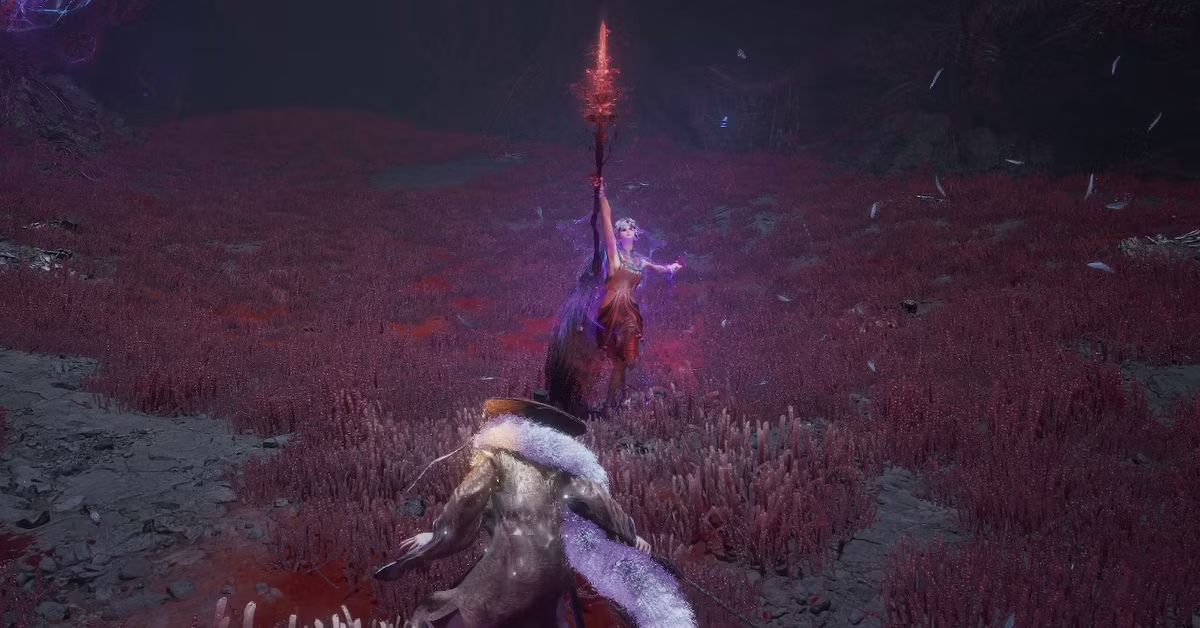
I have spent my Wednesday evening trying to put Wuchang to bed for good, failing because of a bug in the final trophy, somehow refraining from throwing my Xbox through a wall, and then … well, laughing a whole fucking lot at something that’s gonna get me in trouble if I talk about it.

(Forgive the movie clip; if there’s an actual video of Malcolm’s comments, I can’t find it.)

Too tired to even explain why

… but I’m taking the night off.

The dumbest possible reason to be stressed out

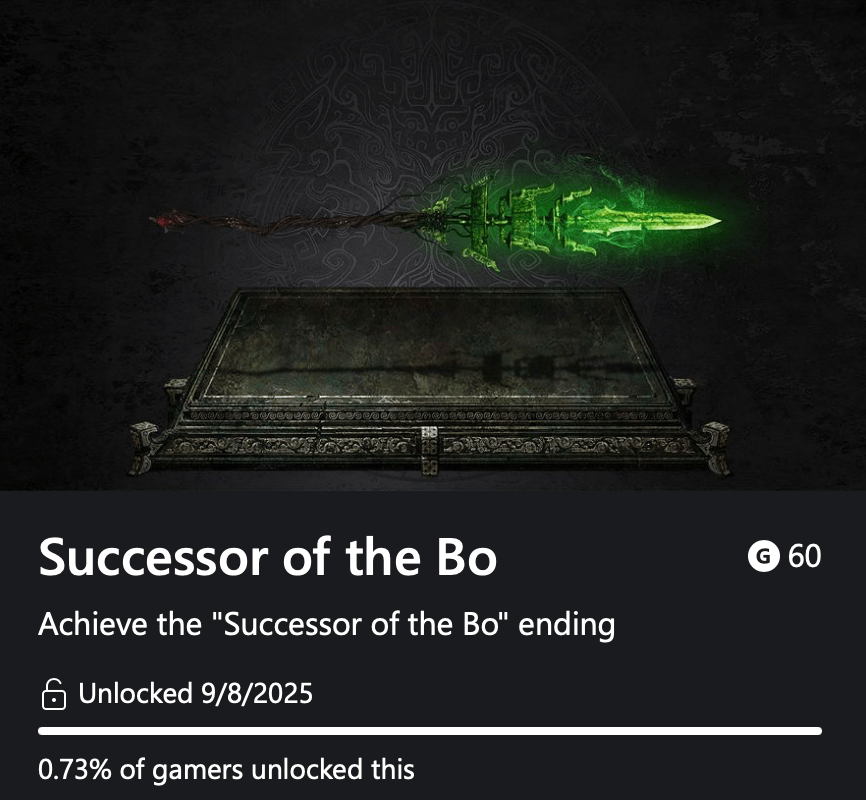
I am working on getting every ending on Wuchang: Fallen Feathers, and doing so either involves 1) playing through the entire game four complete times or 2) doing some fuckery with backing up your saves and, on an Xbox, preventing your game from automatically backing itself up to the cloud while you’re on a backed-up save that you don’t want to be permanent. There’s one ending that actually ends the entire game prematurely, and I wanted to snag that one tonight, but it involves being good enough with a particular boss that you can crush her more or less at will (on it) and making sure you understand exactly how the Xbox Series X’s cloud backup works and when it chooses to back up saves to the cloud. Because if you do it right, you let it back up, beat the game the way you don’t want to keep so you get the achievement, then back out of the game and delete your local save, forcing the game to go back to your previously cloud-backed-up save.

Do this wrong, and you’ve either locked yourself into finishing the game prematurely, meaning you need to play through again to get the other endings (bad) or in a worst case scenario you screw up badly enough to delete your save entirely, meaning that not only do you have to start over again but you have to do it from scratch.

Anyway, I successfully pulled it off, to wit:

Check that completion percentage out, yo.

Anyway, there’s still more game before those last two endings, where I have to do this over again, so I can still screw this up. But at least the most annoying one is out of the way.

#REVIEW: House of Diggs: The Rise and Fall of America’s Most Consequential Black Congressman, Charles C. Diggs Jr., by Marion Orr

This book represents an interesting milestone for me in a couple of ways. First, I am rarely offered nonfiction ARCs for review, something I’d like to encourage more of. Second, I don’t think I’ve ever read a biography of someone I was less familiar with prior to reading the book than I was with Charles C. Diggs. While I don’t think I could claim to have never heard of him– I have read too much about the Civil Rights movement to have never encountered his name before– I couldn’t tell you much other than that he was a Black congressman. I certainly wouldn’t have recognized a picture of him. I was a little worried that this might hurt my enjoyment of the book; as it turns out I have more than enough context around his life that that wasn’t a problem.

The interesting thing here is that, sitting here, I’m struggling with the urge to make this piece a review of Diggs rather than a review of the book. At the same time, though, you weren’t sent a copy of this for free, so I kind of feel like if I’m going to convince you to read it you probably need to know a little bit about the fellow you’ll be spending a few hundred pages with. To wit: Charles C. Diggs Jr. was the son of one of Detroit’s most influential Black businessmen. His father was the founder of the slightly-oddly-named House of Diggs, a funeral home that at one point handled just over half of the deaths among Detroit’s Black citizenry. Charles Sr. had a short-lived political career as a Michigan state Senator but mostly kept his business empire running; Charles Jr. started his political career in his father’s seat in the Michigan Senate but was elected to Congress in 1954 and never looked back. He would remain in office until 1980, when a financial scandal led to him being censured by Congress, forced to resign, and briefly imprisoned. He holds the distinction of being the victim of one of Newt Gingrich’s first acts of assholery, as the future Speaker of the House and fellow resignee-in-disgrace began agitating for Congress to expel Diggs almost as soon as he took office.

When Diggs entered office, he was one of only three Black congressmen, joining William Dawson of Illinois and Adam Clayton Powell, Jr. of New York. He proved himself to be skilled at coalition-building and incrementalist approaches to civil rights– one of his first legislative accomplishments was desegregating airlines, for example– and eventually became one of Congress’s foremost experts on and advocates for Africa as well. Soon after taking office he traveled to Mississippi to sit in on the trial of Emmitt Till’s murderers, which made national headlines, particularly as Mississippi at the time had absolutely no idea how to handle a Black Member of Congress.

But let’s talk about the book. House of Diggs is a very strong political biography and a worthy addition to my library about the Civil Rights movement and is somewhat less successful as a biography of a person. Which, honestly, kind of fits with its subject anyway, as Diggs was quite successful as a politician and much less successful as a person. His children are barely mentioned, but his four wives, three of whom had children with him, would have described him as a poor father anyway, and you won’t find out about any of the three divorces until nearly 80% of the way through the book. He had a gambling problem and was absolutely terrible with money, which is part of what led to his own downfall and at least tangentially led to his father’s business empire slowly disintegrating after the senior Diggs died by suicide in 1967. The finance issues that led to his resignation and jail time are a bit too complicated to go into detail about here, but I felt Orr did a really good job of explaining the details of what happened, both in a literal factual sense and in how Diggs’ own personality flaws led to his eventual indictment. It also seems to be true that the practices that took Diggs down were quite common in Congress at the time, and Orr doesn’t neglect the role of racism in his prosecution while never losing sight of the fact that, no, “everybody else was doing it” isn’t really a top-10 legal defense.

All told, I’m really glad I was sent this, as it’s from a university press and I likely wouldn’t have even encountered it otherwise. If political biography is your thing or you have an interest in the Civil Rights movement, I highly recommend taking a look.

House of Diggs releases September 16.