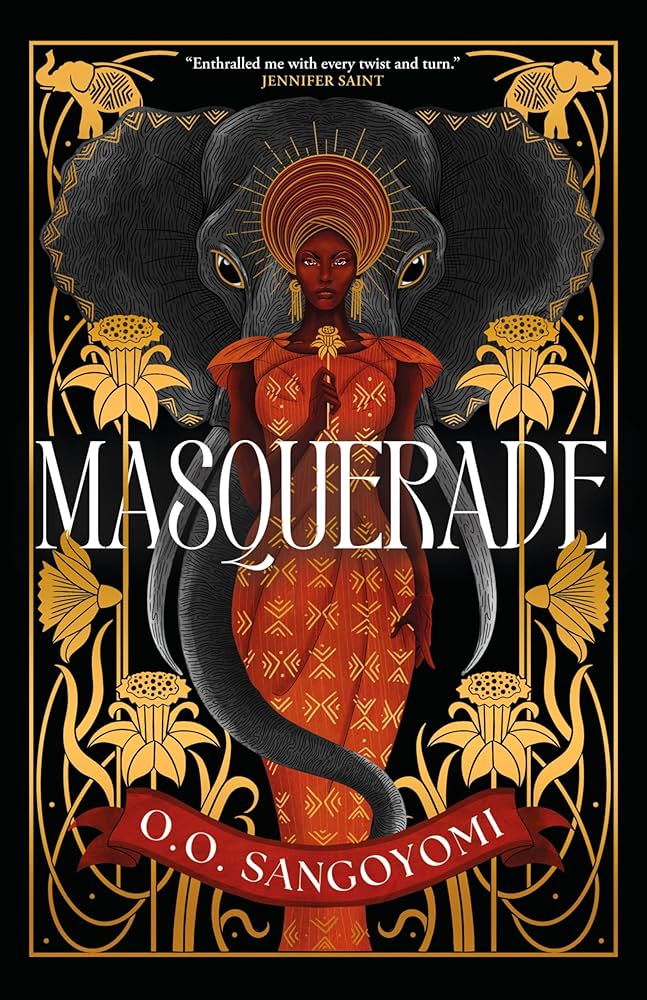
#REVIEW: Masquerade, by O.O. Sangoyomi

First things first: I’ve said this before, but if you’re not tapped into all the sci-fi and fantasy coming out of Nigerian and Nigerian-descended authors in the last five years or so, you are missing out, and you should fix that. This is going to be a somewhat mixed review of O.O. Sangoyomi’s debut novel, Masquerade, but the damned thing oozes with potential, and even if I had liked this less than I did I’d still be in for the sequel. Which sort of feels like “I like less than half of you half of what you deserve,” but I promise it’s a compliment.

The book jacket describes Masquerade as a “richly reimagined 15th century West Africa,” but I’ve got to be honest, despite what I just said about Nigerian fantasy this feels very much like historical fiction to me, and the speculative elements are minimal at best. I’m not precisely sure what’s being reimagined here. It falls under the fantasy genre because everyone is fighting with axes and machetes and spears, and when that happens we just call it fantasy regardless of how well it fits. It’s very low on the “low to high fantasy” axis, in other words.

Now, I’m not going to claim to have a lot of knowledge about West African history– I probably have more than your average American, but the average American knows nothing, so that’s not much of a brag. The book is set in Timbuktu, which was a real place, and the countries and city-states that show up as adversaries are all real, and the Yoruba are still around. If Sangoyomi has played around with history at all, it’s subtle enough that I can’t tell you about it. I can tell you that the main character, Òdòdó, is a blacksmith at the beginning of the book, and blacksmiths are consistently referred to as “witches,” but … I was never exactly clear why? Everybody’s still using smithed tools like it’s not a big deal, but they’re more or less the dregs of society for some reason.

A quick word on orthography: note all the accent marks in Òdòdó? They’re in nearly every word in the book of remotely African origin and there’s no pronunciation guide. The word I’ve rendered as “Yoruba” up there is Yorùbá in the text, for example. The city they live in is Ṣàngótẹ̀, and I don’t even know how to reproduce that S properly– I had to copy and paste it. I hope everyone will forgive me if other than the main characters’ names I don’t bother reproducing all the accents. If I knew how to pronounce them I might, but I don’t.

So anyway, Òdòdó is busy making herself a life as a blacksmith when she is abruptly kidnapped and brought to Sangote to be the wife of the Alaafin, who is basically the emperor. He’s picked her out while pretending to be a vagrant and having a brief conversation with her at her forge.

She is … surprisingly okay with this. I kind of need to rain some abuse down on the blurb-writers for this, who make the book feel like a revenge tale of sorts, and pay no attention to the “loosely inspired by the Persephone myth,” because once you get past the kidnapping there’s not a lot of there there. But no! Òdòdó is surprisingly cool with being kidnapped, she just wants her mom to be at the wedding, and her naïveté (goddammit!) at her fiancé’s (DAMMIT) insistence that he can’t find her mother to get her blessing is rather annoying. Òdòdó gets pulled into some political maneuvering, falls for a couple of truly amateurish stunts from the Alaafin’s mother, and accidentally helps touch off a revolution, and then somehow the book redeems itself entirely at the end, catching me by surprise in such a way that guaranteed the sequel was getting picked up.

Strengths: the worldbuilding, other than the weird witchery of blacksmiths, was really interesting, and the basic novelty of the setting was great. Sangoyomi’s prose is excellent, and the book managed to include some romantic elements without descending into full-blown romantasy. The weaknesses are the characters, particularly Òdòdó herself, who careens back and forth between being a silly little girl and a seasoned political operative. It’s also unclear how much of a time frame the book takes place over, and you’d be forgiven for thinking it’s just a few months at best, which is not enough time for her to learn some of the things she learns how to do. She’s really good at anything she needs to be good at for the plot to move forward, including occasionally outsmarting actual generals (and coming up with war tactics they haven’t thought of) and defeating grown men in combat, and then she’ll turn around and drink from a cup that the mother-in-law has handed her that may as well have this on the side:

If this hadn’t landed the dismount, I’d probably have just put it on the shelf and moved on, but the ending really was well-done, if perhaps again a bit out of character, maybe? Who knows! But I’d have kept an eye out for this author’s next series. As it is, I’m in for the next book. This isn’t the best thing I’ve read this year or anything like that, but it’s solid and it’s a fast enough read, at about 330 pages, to be able to forgive its flaws.

Considering that …

  • It is 7:30 7:45 pm …
  • I took a five hour nap this afternoon …
  • I have just now managed to put on socks and comfy sweat pants despite having spent the entire day uncomfortably cold …
  • And site traffic has been garbage for the last few days for some reason so no one is going to see this anyway …
  • I am going to declare the day a wash, decide that I am decompressing from work, and go to bed early without any real thought of accomplishing things today.

#REVIEW: Galileo’s Daughter, by Dava Sobel

I’m trying to decide which overused sentence I should start this post with, and I can’t make a decision.

Because unfortunately, while I haven’t read this book before, I feel like I’ve written this post before. Dava Sobel’s excellent Galileo’s Daughter is a biography of a genius, and, well, I think you probably already know if you want to read a really good biography of Galileo. The title makes it sound like a thousand different literary fiction novels– there are so many The So-and-So’s Daughter novels out there that I’m surprised that there isn’t a parody of them with that exact title– but no, this book is at least a third or so about Suor Maria Celeste, Galileo’s oldest daughter, through the prism of the surprisingly large corpus of letters we have from her to him. Suor Maria was a cloistered nun, and her letters, or at least the translation of the letters in this book, show her to be a woman of lively intellect and wit, and starting each chapter with an excerpt of one of her letters was an inspired choice.

But ultimately this is a book about Galileo– a book called Suor Maria Celeste’s Father would not have sold many copies– and, well, Galileo was Goddamned fascinating, so if the author is of even middling talent writing a good book about him should not be especially difficult, and as it turns out Dava Sobel possesses far more than the typical allotted share of talent. So maybe this isn’t as comprehensive a review as I might have thought I was going to write when I sat down, but I assume the You Should Read This is still coming through at sufficient volume for you to hear it. Because you should.


Most of us have some sort of memories of Spring Break, although I suspect for most people they involve parties, or beaches, or some form of public drunkenness. For me, on the other hand, my strongest memory of Spring Break, one I reminisce about every time my own break rolls around, involves going to see a movie on the first night of a Spring Break in grad school with a good friend of mine who is a professor at Oxford now. We had to stand outside to wait for tickets in a driving, wet, utterly bullshit snowstorm in downtown Chicago, and Bill stepped out of line for a moment, threw his arms over his head, yelled “SPRING BREAK!” at the top of his lungs, and rejoined the line without another word.

I may not have partied enough as a young man, is what I’m saying here. And I openly laughed at anyone who asked me what I was “doing” for my break. I’m going to be sitting in a damn chair reading a book, that’s what I’m going to be doing. And it will be glorious.

In which I suck and it’s a lot of fun

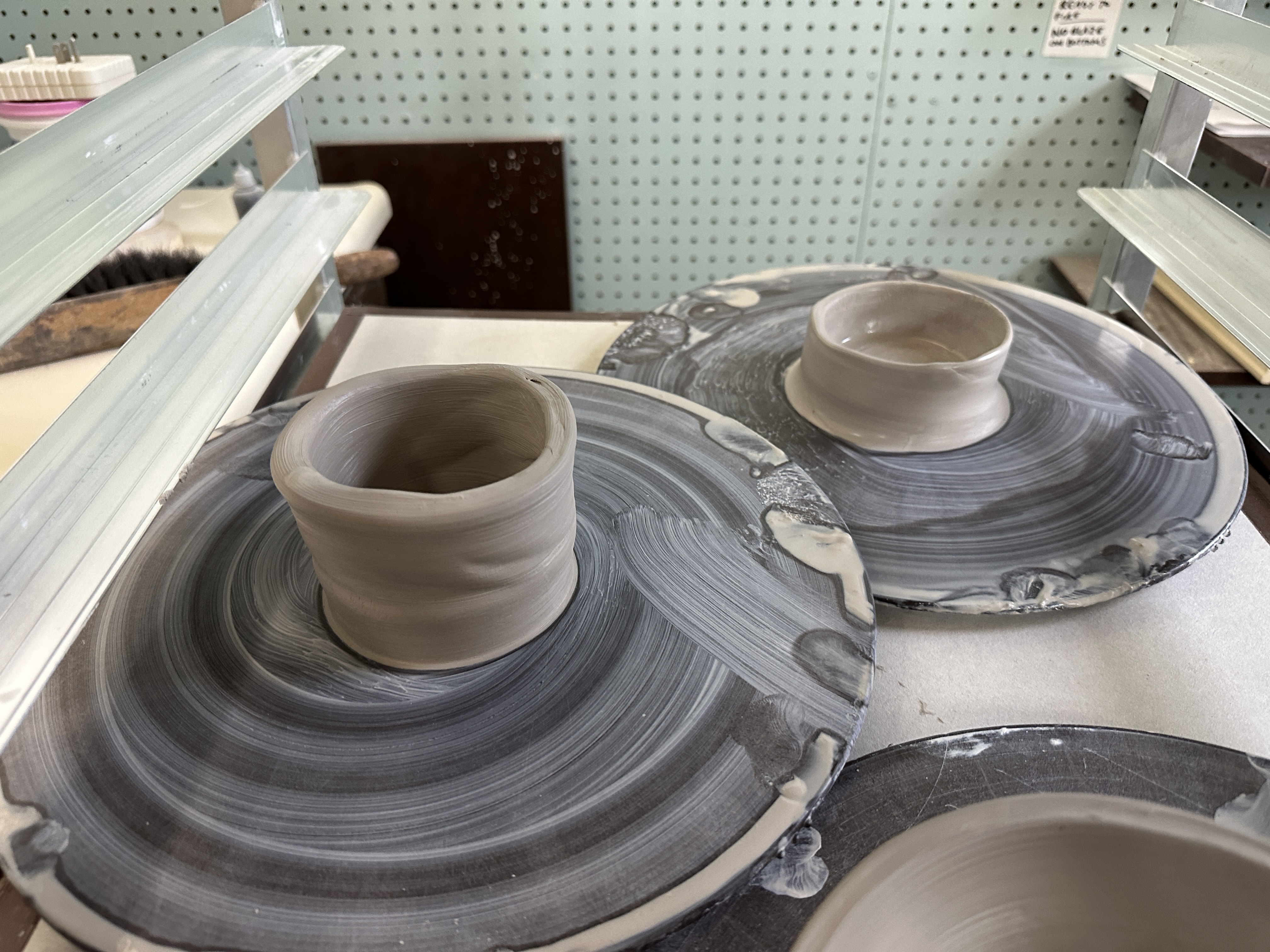
We finally, after a reschedule or two, had our much-anticipated wheel throwing class tonight– the final part of my Christmas present, four months later. My pot, such as it is, is the one on the left, and the second of my wife’s two is in the back right. My first attempt was too terrible to even make it to the drying room; I essentially just let it die and go back to the recycling pile, and while our instructor really thought MLW should save her first one too, she thought the second was better.

Throwing pottery is really hard, as it turns out. That doesn’t actually surprise me– I was fully expecting to suck at this– but it was still a bit startling just how difficult things like “keep your fingers the same distance apart” can be. That doesn’t sound hard! But it is. You can see on my pot that there are a few places in the middle where it thins out abruptly, and that’s the same on the other side too, but one way or another it’s still a vast improvement over my first effort and I’m glad I ended up with something at least a little passable.

We want to take a whole bunch of other classes at this place, and I can easily see myself wanting to take the throwing class again just to have an expert on hand for when I inevitably screw up again. It’s super cheap just to go in there, buy some clay, and rent the wheel for a while, and we can do it any time they’re open, but I feel like it’d be wasted money until I can at least internalize the various hand positions for the different steps in the process. I need somebody around to tell me what I’m doing wrong and how to fix it if that’s possible.

(One random fun thing: the way you remove a piece of pottery, whether it’s good or complete failure, from the “bat”– that’s the disc it spins on– is by sliding a thin wire underneath it to slice it away from the bat. That has, for some reason, always looked like an intensely satisfying experience, and the best thing about my first attempt being a terrible piece of crap is I got to slice it off the bat. I am proud to report that that’s the thing I was best at, and it was exactly as pleasing as I thought it would be.)

We also have our mugs now, from our last attempt at this. We will glaze both items at once when the pots are done drying.

Still raining!

We’re in the midst of Round Two of apocalyptic hellstorms, although as far as I know there haven’t been any trees knocked down nearby, but we did have to go into the basement for half an hour or so because of a tornado warning. One way or another, I’m half-expecting the power to go out again any minute now (we were out from about 1:00 in the morning Sunday night to yesterday afternoon, and spent Monday night in a hotel room) so I’m going to cut this short so I can turn my computer off. I do owe you a review of Galileo’s Daughter; the short version is that I’m starting to really enjoy reading biographies of geniuses.

Monthly Reads: March 2025

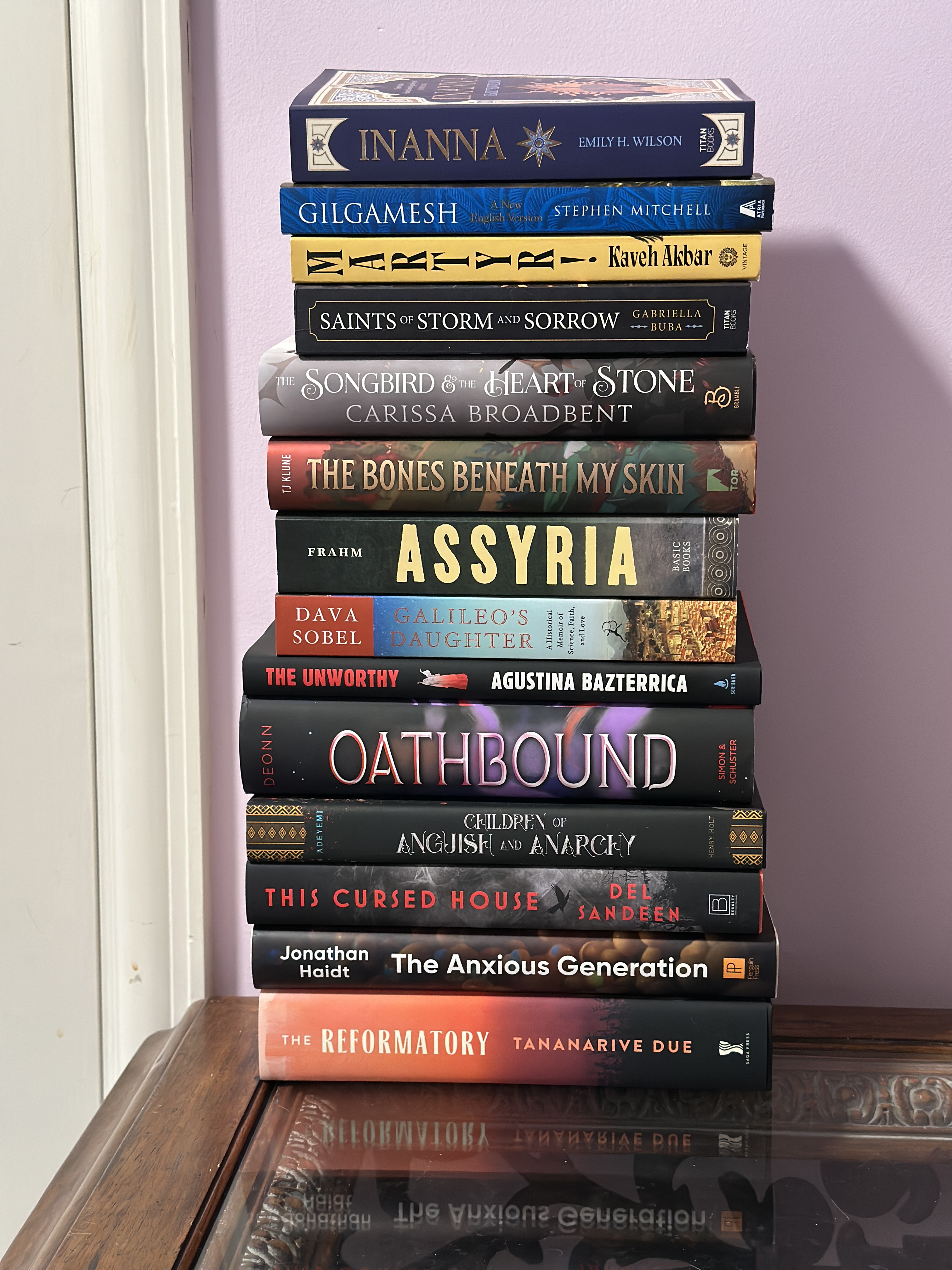
There are actually quite a few good choices for Book of the Month in here. The Reformatory? Oathbound? The Unworthy? Martyr!? The Bones Beneath My Skin? All are great choices, but I have to go with Galileo’s Daughter, by Dava Sobel. Review coming in the very near future. Lots of great books this month, though.