I’ll not bury the lede: this is the scariest fucking thing I’ve ever read.
My regular readers might be protesting already. Didn’t I just post a “review” of Josh Malerman’s Incidents Around the House that more or less boiled down to “Nope”? And then I named it Book of the Month? And, like, a week later, this book is the scariest fucking thing I’ve ever read?
Here’s the thing: Incidents Around the House is scary as hell. If you enjoy horror as a genre you should read it. But it’s absolutely, indisputably, fictional horror. None of that stuff is going to happen in the real world and you’re not going to learn anything terrifying about the real world while you’re reading it.
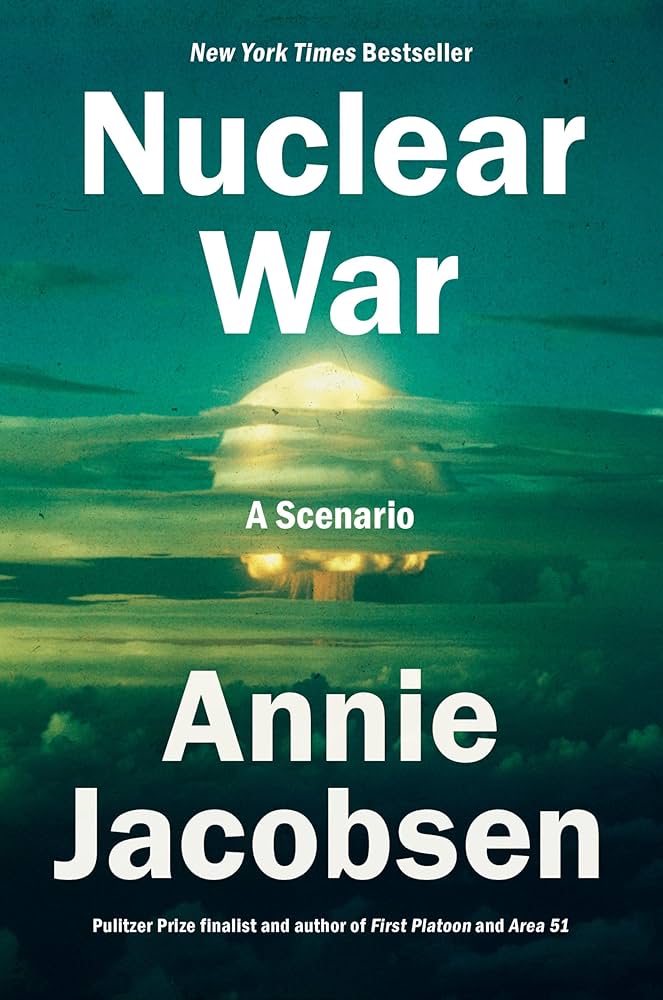
I am, meanwhile, not even sure whether I can classify Nuclear War: A Scenario as fiction or nonfiction.
I mean … okay, technically it’s near-future science fiction. And by “near-future” I mean “could, in theory, happen tomorrow.” But the book is so heavily researched and so thoroughly grounded in the world as it exists today that it feels nonfictional, and if you look at the categories it’s trending in on Amazon none of them are fiction categories. There are elements, of course, that are more fictionalized than others; some specific things that happen to, say, the President are not exactly likely to unfold in that exact manner, and there’s an unintentionally (I think) hilarious throwaway detail about the President pro tempore of the Senate that is a clear invention.
But this book starts off with the all-too-possible launch of an ICBM carrying a one-megaton nuclear bomb toward Washington DC, and the next 300 pages covers the next seventy-two minutes in more or less second by second detail, and by the end of the book human civilization is over and everyone you know and care about is either dead or wishes they were and reading about it is not fun. I had to force myself to put it down and go the fuck to sleep Monday night, and got home from work yesterday and sat down and finished it before doing anything else. It’s a propulsive, compelling read but Jesus fuck is it going to give me nightmares.
I will make one small complaint: by the end of the book– spoilers, I suppose, but whatever– Europe, Russia, the Korean Peninsula and the United States are smoking wastelands. However, it might not surprise you to discover that Australia, Africa and South America are more or less entirely unmentioned. There are no nuclear powers in Africa or South America, to start, and Australia just doesn’t get involved. Here’s the thing: I don’t really have a sense of how much of a literally global problem that amount of fallout would be, or whether the inevitable nuclear winter’s effects would possibly be mitigated somewhat in the Southern hemisphere. Jacobsen is clear that she thinks human civilization is fully past-tense after a multination nuclear exchange, but, like, would pockets of civilization be able to survive in, say, Brazil or sub-Saharan (and thus farther from fallout) Africa? Is it possible that the currently inhabitable parts of Australia would stay habitable? Or is everyone literally fucked from the fallout in the atmosphere? Maybe the jet stream keeps it in the northern hemisphere, or, like, something. I don’t know, and I’d like to.
You don’t want to read this book, because it’ll fuck you up hard. But you may want to read it anyway. I dunno. You do you. I’m gonna go crawl under the bed for a week.






 Welcome to infinitefreetime dot com