


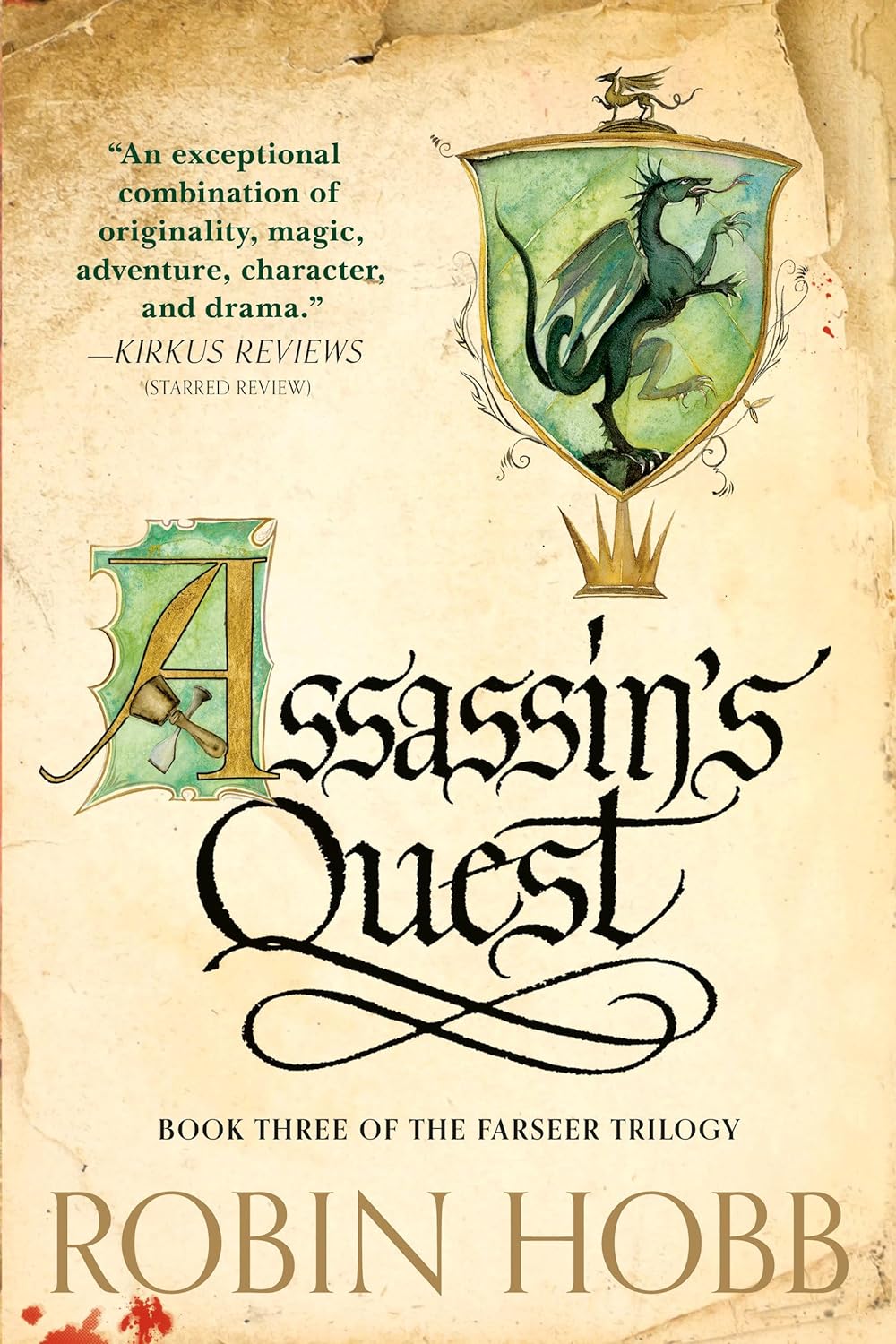
The alternate title that I almost went with was “In which I am disappointed, and disappoint”.
Here’s the thing: Robin Hobb doesn’t need my help, and it’s faintly ridiculous for me to be terming anything I write regarding the Farseer trilogy as a “review.” Assassin’s Apprentice turns 30 next year, and there are fully thirteen more books comprising four more series to go in her Realms of the Elderlings series. I read Assassin’s Apprentice many years ago, couldn’t really get into it, and I think I abandoned it, because there were lots of bits in the beginning that were familiar and that feeling vanished after the halfway point or so. (Spoiler alert: they killed a dog, and I think that’s where I bailed.) I have definitely never read Royal Assassin or Assassin’s Quest prior to the last couple of weeks.
The Farseer trilogy is the first use I’m aware of (go ahead, correct me) of a device I’ve previously referred to as “being like Name of the Wind,” a series narrated by the main character but from the perspective of a much older person writing about astonishingly well-remembered events from their youth. Recent examples include R.R. Virdi’s The First Binding and Richard Swan’s Empire of the Wolf series. It’s also an early example of another trend, that being a series supposedly about an assassin who does very little assassinating. Now, in the case of FitzChivalry, the main character of this series, technically he does a fair amount of assassinating, but it’s nearly always kept off the page– we’re told that he spent a summer or a year or whatever doing jobs for his grandfather/king Shrewd, and that he sure assassinated some folks real good during that time, but we almost never see it, and the one time we get to follow him along in a mission he decides, to my complete lack of surprise, that he isn’t going to assassinate anyone after all.
Lemme back up: the series begins when FitzChivalry, at the time referred to only as “boy,” is dropped off on the keep’s front door by his maternal grandfather, who explains to the guard who answers the door that he’s the prince’s bastard, and his mother and grandfather are tired of him so the prince gets him now. He looks just like his daddy, so he gets brought into the keep and basically handed over to the stable master for the early part of his life and ignored. Eventually King Shrewd decides he’d make a good assassin, and has him trained, and we’re off to the races, so to speak.
Here’s the thing: I really enjoyed the first two books, and I really wish I had just left it there, because — and just stop reading right now if criticism of this series is heresy to you, because I know a lot of people really love these books– Assassin’s Quest is Not Good, and it’s Not Good in the worst possible way: in a way that makes the books that came before it retroactively worse by highlighting all of their problems, which were previously able to be minimized or disregarded on account of all the other legitimately cool stuff going on.
Assassin’s Quest is eight hundred and sixty pages long and could have been an email easily half that length with nothing of value being lost. It’s bloated to a level that makes a disintegrating whale on the beach look svelte and demure. Nearly nothing happens, and most of what does is annoying or ultimately pointless. The second book ends spectacularly, with a whole bunch of shit going wrong and Fitz angrily swearing in front of Jesus and everybody that he is going to kill a certain dude or die trying, because That Guy has ruined his life and destroyed everything Fitz cares about and the only thing left is to make him good and dead.
Then Book Three starts and Fitz fails in this quest almost immediately, and fails in a particularly bewildering way– he is not able to directly kill the person, but the book goes into a bit of detail about just how many things in this guy’s bedroom Fitz poisons, right down to the studs of his earrings, and … nothing. No word about him barely surviving the poison, no word about him realizing it’s there and aggressively cleansing or throwing out everything he owns, nothing. He just isn’t dead. It’s as if the poisoning never happens.
Then they spend six hundred pages walking, with an interlude in the middle where Fitz takes an arrow to the middle of his back and convalesces for a hundred pages, and maybe he gets injured one other time, I barely remember. The villain damn near disappears from the narrative along with basically every problem mentioned in the first two books as Fitz and a handful of other relatively unimportant characters (and yes, I’m including the Fool here, because it’s never really very clear what his deal is other than to be mysterious and annoying) head off to go find his uncle, who has gone off on his own quest and gone missing.
Oh, and he’s in love with this one chick, and knocks her up and then abandons her, and he’s not exactly nice to her before the abandonment.
I didn’t like Fitz very much, and that was a problem even before book three.
I don’t mind travelogue fantasy, y’all. I love worldbuilding for its own sake. My love for The Lord of the Rings is unparalleled and pure. But they spend so. much. time in this series just walking and walking and walking, and there’s a road made of magic or something and it feels like it’s important but it’s really not, and then after six hundred pages of walking he finds the dude he’s looking for, who then proceeds to solve all of the problems of the previous two books, off the page, in one of the most fucking ridiculous and epic Deus Ex Machinas I’ve ever seen. Aeschylus himself might suggest that maybe they tone it down. The villains themselves are hella weak as well; there are Red Ships raiding the coast and sometimes they turn people into these conscienceless zombie-things and turn them loose? Where do they come from? What are their motivations? Who exactly are they?
Never discussed; never mentioned, ignored in the last eight hundred pages of this series, and I’m starting to think I’m angrier about how this ended than I previously thought. We aren’t at How I Met Your Fucking Mother Oh Never Mind I’m Gonna Fuck Aunt Robin, Kids, Even Though It’s Been Made Clear We’re Goddamned Terrible Together levels, but it’s close.
Magic is called Skill in this series, right? It’s basically telepathy except when Hobb needs it to be something else in which case it’s that too. Fitz and his people are being tailed by this group of Skilled individuals through most of book three. They’re presented as really dangerous. There’s a bit during that last fifty or sixty pages where it’s Suddenly Revealed that oh no there’s not just one group of Evil Skillzards, there are three!!3!one!!!
You’d think that would be trouble, but they’re literally all dead two pages later, in a book that couldn’t make a sneeze take less than a thousand words. I don’t even remember if any of them got names. It’s just OH NO MORE SKILL WIZARDS oh they’re dead never mind.
Yeah, I’m definitely pissed.
The worst thing is I might still check out the next series at some point. Again, I liked the first two books until Assassin’s Quest ruined them, and the next series changes venues pretty severely from what I’ve seen. And again-again, this is a hugely influential and popular series and everyone loves it but me, apparently, so you may have wasted your time reading this. I dunno.
Discover more from Welcome to infinitefreetime dot com
Subscribe to get the latest posts sent to your email.
 Welcome to infinitefreetime dot com
Was this the series where the world map was a map of Alaska turned upside-down?
LikeLiked by 1 person
Oh, HOLY SHIT.
LikeLike