#REVIEW: Enotria: The Last Song (PS5, 2024)

I wasn’t expecting to actually beat Enotria: The Last Song last night when I posted about needing to play video games, but beat it I did; I had beaten a late-game pair of bosses before putting the controller down the last time I had played, and the game made it clear quickly that the next place I was headed was going to be the game’s last destination. I’m going to jump straight to the chase and say this is a solid 7/10 as a game, with the caveat that a couple of the problems I had with it are potentially fixable.

The basics: Enotria is a Soulslike, which remains my current favorite genre of video game; these types of games are apparently never going to get old for me. The conceits with this one are as follows: 1) It’s sunny sometimes, and in fact one of the first things you’ll do is wander through a field of sunflowers, so it’s not quite as bleak as the genre usually gets; and 2) your builds are controlled by wearing different masks; the whole game is built around acting, and you’ll collect masks from boss enemies and mask shards from basic enemies that can eventually be built into masks. They basically take the place of your armor; if you put on a particular mask you take on the entire appearance of whatever you’re wearing the mask of. It’s pretty, there’s a lot of different weapons and magic to play with, the combat is solid; no complaints of any kind there, really.

Here’s the problem: the game starts by asking you to pick a difficulty level, which is the least-Soulslikey part of the whole thing– these games pick a difficulty, usually “brutal,” and you learn to adapt to it or you don’t. The two difficulty levels are “Story” and “Soulslike,” which … okay, “Story” difficulty is usually a shorthand for baby mode, but “Soulslike” sounds like hard mode, and the game doesn’t really give you any details, but a quick Google search made me think that “Story” was the base difficulty, so I went with that.(*)

Y’all, Story difficulty is crazy easy. There is a particular bridge at about the 2/3 part of the game that is broken in two places, and the jump is just a little bit harder than it looks like it should be– in a game with really no platforming to speak of, I almost wonder if the devs just missed how on-point you had to be to make the jump. I died more on those two bits of bridge than the entire rest of the game put together. No boss beat me more than twice, and I never once in the entire game died before recovering my stuff. I beat the final boss on my first try. There were bosses that I ran into by accident and low on heals and beat on my first try. Now, an easy Soulslike isn’t automatically a bad thing! The game’s still fun; there’s something to say about being a badass, obviously, and not every game has to involve beating your head against a wall. But I’d suggest if you’re used to these games, go with Soulslike mode to start.

Second, the game has a sort of paper-rock-scissors thing going with the elements. Enemies can be linked with certain elements, and if they are, they’re supposed to be immune to their element and weak to another. I say supposed to be because I never once found myself unable to hurt an enemy, no matter what weapons I was using. The elements all have Italian names and each element can proc a different effect if you get hit with enough of it, and those have different names too. Unlike most games, where, just for example, poison might slowly kill you and freeze might slow you down, the elemental effects have positive and negative side effects that, to be honest, I never bothered to memorize. The paper-rock-scissors thing is on the screen at all times and I never paid any attention to it. The game goes so far as to provide you with three different roles– effectively different builds that you can hot-swap between at will– with the idea that you might use each one to specialize in different elements. I never kept more than one active. There was no reason to.

It is, of course, entirely possible that this was because of Story mode, but … are you really gonna take out this big of a part of your gameplay for the kiddo mode in your game? Because it really seems like that’s what they did unless the whole thing is just broken from the jump. All I know is, I never paid attention to half of the subsystems the game uses. The game does have a New Game + mode, but I don’t know if that bumps you up to Soulslike difficulty or is just Story with spongier enemies or what. I might do a second run at some point to see what the other difficulty is like. I’d like to eventually platinum this, and I missed a bunch of story-related trophies on the first pass.

It’s probably worth pointing out that this is currently free through Playstation Plus, and it’s definitely worth recommending as a free game. Just start it at Soulslike, and hope that it forces you to learn the game’s systems a little bit better and doesn’t let you just go Big Hammer Goes Bonk or Fast Sword Goes Brrrrrr through the whole game. Or do that! Like I said, easy is fun sometimes.

(*) Do not allow yourself to be fooled; just because they called the difficulty “Story” does not mean that the story is going to make any sense(**). But you’re not playing these games for the story, are you? I hope not.

(**) Another missed opportunity; the game has a ton of little lore things you pick up all over the place, but unless you decide to invest the time to stop playing the game and read them– and I mean it when I say there are a ton of them– you’re not going to have any idea at all what the hell is going on.

#REVIEW: Pragmata (PS5)

Ooooofffffff.

I started Pragmata a little under a month ago, and when I did I called it the biggest Dad game since The Last of Us. I beat it tonight, and that opinion remains true; the basic plot of the game is that you end up stranded on the Moon (roll with it) and you end up rapidly adopting, more or less, an android girl who you name Diana. All of the enemies on the moon are robotic in nature (AI GONE WILD is a good-enough description of the wider plot) and Diana helps you throughout your mission by hacking your robot enemies so that you can blow them to pieces with guns. The basic game structure is not quite a Soulslike (die, and you just reappear at the hub) but it’s definitely Soulslike-adjacent; lots of customization of your equipment (no ability scores, though) which gives you a ton of flexibility for how you approach combat throughout the game. Mods can be applied to your suit, all of your guns can be upgraded, Diana’s hacks can be upgraded, and so on. There’s a hub you can return to that acts similar to the bonfires you find in Soulslikes, although it’s more of a hub base than anything else.

This hits right in my sweet spot, honestly; the different zones you can reach are separate and you can’t go in between them without going to the hub in between, but there’s hidden stuff to find everywhere and your inability to travel from zone A directly to zone D doesn’t end up being annoying at all. The exploration is great, and the combat is not like anything I’ve seen before. You’re essentially fighting as two characters as once; Hugh (the guy) controls like any main character in any shooter you’ve ever played, but Diana’s hacks require you to open up a grid and then navigate though it using the face buttons, hitting various nodes that power up the hack as you’re moving through. Successfully completing the hack does damage on its own and also opens the enemy’s armor up, allowing you to do damage with your guns.

I feel like that description’s unclear. Here’s what the hack interface looks like:

It’s important to realize that while time is slowed down, it’s still happening, so you will sometimes have to interrupt your hack to dodge away from an enemy attack, and there are mods that will allow you to start from where you left off if you get interrupted, by losing connection or getting hit. This makes combat really frenetic and super satisfying, especially once you gain the ability to overheat your enemies, which allows you to do critical attacks. And there’s another mod that makes critical attacks also damage nearby enemies, and … man, combat is fun in this game.

The technical aspects are all solid; graphics are pretty stellar and I didn’t encounter any bugs. I’ve talked about this before; so long as I can tell what I’m doing, I don’t really worry about graphics in video games any longer. Diana and Hugh’s animations and facial expressions are great and while the environments are kinda samey (you’re on a moon base, after all) they do manage to work in a forest level via some nanotech-related shenanigans. Certain items have audio cues that help you find them and the game doesn’t actually tell you to listen for the audio cues, which was a nice touch. Voice acting is great– any time a game has a little kid in it (Diana’s not human, but comes off as being eight or so) you could be in some serious trouble with voice acting, but it’s really solid here, even in the more heavy emotional scenes.

And … yeah. About that. The game didn’t make me cry, but it bloody well could have. I’m not spoiling anything; the ending doesn’t exactly come out of nowhere but it still managed to take me by surprise, if only because holy shit, I didn’t think they were really gonna do that.

My tendency toward heavy exploration and trying to find everything led to about a 20-hour play through on this one; you need two of them to platinum the game, which I don’t think I’m going to do, but I might. You could probably get done in 10-12 hours if you weren’t poking your head into every nook and cranny. Definitely check it out.

#REVIEW: Ender Magnolia: Bloom in the Mist (PS5, 2025)

I’m finding myself weirdly not in the mood to write about this, but in the absence of anything else not involving profane ranting and raving, I’m just going to tell you that Ender Magnolia is a quality if not life-changing Metroidvania, and that it excels mostly in the exploration side of things. The combat and build styles are really interesting– you bond with AIs called Homunculi throughout the game, and each of them will give you either a travel ability or some sort of new approach to combat, and on top of that each combat homunculus will have three different and sometimes wildly divergent abilities to play with. You’ll have ten or so available by the end of the game, so that’s thirty different abilities, plus items called Relics that can add buffs or tweak your build in other ways, so this is also a game that’s big on build customization.

I liked it, and I platinumed it today, and if you’re into Metroidvanias as a genre at all it should definitely be on your list. Unfortunately I’m tired and kinda crabby at the moment for no particular reason, so I’m going to cut this shorter than I originally had planned. What should I play next? Both of these are on sale right now:

Very quick #REVIEW: Ghost of Yotei (PS5, 2025)

Game of the God damned year.

I mean, come on. This year had some slight competition, but there was no way that the sequel to Ghost of Tsushima wasn’t going to be my GOTY. It’s not close. This was the sequel to one of the best games I’ve ever played and was at least of equal quality. The only thing holding it back from being obviously better than the original was I had some idea what to expect going in.

Absolutely fucking amazing. Fifty-eleven stars out of five.

#REVIEW: Silksong (2025)

I’m too old for this shit.

#REVIEW: Wuchang: Fallen Feathers (Xbox Series X, 2025)

The tl;dr: this was so close to perfect, but probably needed another month or so to cook before getting released.

I beat Wuchang: Fallen Feathers last night after 60 or so hours of gameplay, and for the most part, I was really, really happy with it. Most of my gripes are technical, and the things this game does right, it does very right. This is a Soulslike through and through, which is currently my favorite kind of game, and it hits all the buttons: deep combat, wildly variant weapon builds, obscure quest lines, difficult boss combat, and an emphasis on exploration. The exploration is the best part; Wuchang may have the best interconnected world map I’ve ever played, and it’s incredibly rare that you’ll see a path fork off and one of them end a little bit later in a dead end with a treasure in it. Everything loops around and leaves you somewhere, and it was harder to keep a mental map going (note: this is a good thing) than I’ve seen in a game like this in a long time.

There’s three different major things that this game does that distinguish it from a run-of-the-mill Soulslike. First, what the call the Skyborn Might system. All of your spells and some of your combat abilities are based on how many stacks of Skyborn Might you have at any given time. You can have up to five, and spells will cost from one to all five stacks and weapon abilities generally cost between one and three. Skyborn Might is earned mostly by perfectly-timed dodges, although most weapons have at least one other way you can earn it and there are different items that can add to Skyborn Might as well. One that I kept equipped for most of the game automatically generated Skyborn Might on kills, which came in really handy. Skyborn Might deteriorates over time if you don’t use it, which was good and bad– it encourages you to use your abilities, on one hand, but on the other I felt like it deteriorated too fast, and I’d have liked some way to slow down that deterioration, whether it was a more permanent item or a consumable.

The second is the Madness system. Killing human enemies and dying both generate Madness, and killing nonhuman enemies and various items and locations can decrease it. Increasing your Madness has two major effects: it increases your damage noticeably the higher it is, and it at least supposedly increases how much damage you take, although I went through the whole game without ever feeling like that had caused a death. I never really even noticed it.

On top of that, if you die, you lose a percentage of your currency (Red Mercury as opposed to souls, or blood echoes, or whatever) and that percentage is based on how high your Madness is. If your Madness is less than 100% you can pick your resources up from wherever you died. If it’s at 100%, though? You’re gonna generate a Madness Demon when you go back to get it, and if that Madness Demon kills you, your shit is gone. On the other hand, if you kill the Madness Demon, you get a bunch of other stuff on top of your lost materials, and Madness Demons can be baited into attacking anything, so there are places where generating one on purpose (there are items that raise Madness as well) can be a sound strategic maneuver against an enemy that you can’t find a way to beat. This won’t work on bosses– you can’t generate demons inside a boss arena– but there are occasional more powerful red-eye enemies scattered around, and letting one kill me, generating a demon, then triggering her and running away to watch the two of them fight was fun.

The third is the upgrade system, which runs off of an upgrade tree. Each weapon style (Spear, Greatsword, Axe, Dual Blades, and Longsword, and I spent most of the game in Greatsword) has its own tree but you can go anywhere you want on the tree and you can respec any time at will. Weapon upgrades are also built into the skill tree, and the awesome thing is that 1) any weapon upgrade affects every weapon of that type, even if you get a new one later, and 2) you can respec your weapon upgrades just as easily as your own abilities. So unlike, say, Elden Ring, where if you make a change to your preferred weapon late in the game you’d better hope you have enough upgrade mats available to level that weapon up, if you had a +9 axe and you want to switch to greatsword your greatsword will automatically be +9. In fact, all five of the greatswords you’ve found will be +9, and if you find a sixth that’ll be +9 when you pick it up. In every other Soulslike I’ve played, just because you leveled up Longsword A doesn’t mean Longsword B is improved as well. This is a huge improvement.

The problem is the performance. This game, at least on Xbox (I picked it up here because it’s currently free on Game Pass) is very poorly optimized, and while you can lock the framerate at 60, you’re going to see constant blurriness and focus issues as the game struggles to keep up with itself. I played without the frame rate locked for a little while and the frame drops were so bad I had to switch back. This is on the Series X, mind you, which is supposed to be the beefy one; I can’t imagine what this would play like on the less powerful Series S. There are some balance issues– there’s a huge difficulty spike with a boss about a third of the way through the game, and the game really expects you to use a certain mechanic to beat that boss, only all weapon types don’t have access to that mechanic. As it turned out, I’d started with a Spear build, and the Spear build is the one least capable of managing this boss. I had to respec, and once I did I sailed past her. Now, again, the game encourages painless experimentation, and I could have switched back afterwards, but it left a sour taste in my mouth. I don’t object to the idea that certain bosses are weak to certain styles and stronger against others; that’s a staple of the genre– but “you need this type of ability to win here, and this weapon doesn’t have that at all” is a problem.

There’s a few other things; it’s way too easy to fall off of ledges, which is partially a skill issue, and until very recently the icon that shows where you dropped your resources was really hard to see against some level backgrounds and invisible if you were unfortunate enough to die in shallow water, but they’ve patched that problem out in the last couple of weeks. I know Soulslikes aren’t for everybody, and if they aren’t your thing you’ll want to stay away from this, but if they do, and especially if they do and you’re on Game Pass? Hooooooly shit. And it’s only $50 at full price, and it’s a good enough game that I’m considering picking it up for the PS5 anyway. Check it out.

#REVIEW: Crypt Custodian (2025, Xbox Series X)

For the record, I did see Fantastic Four: First Steps today, and it was magnificent. Full review coming, probably tomorrow.

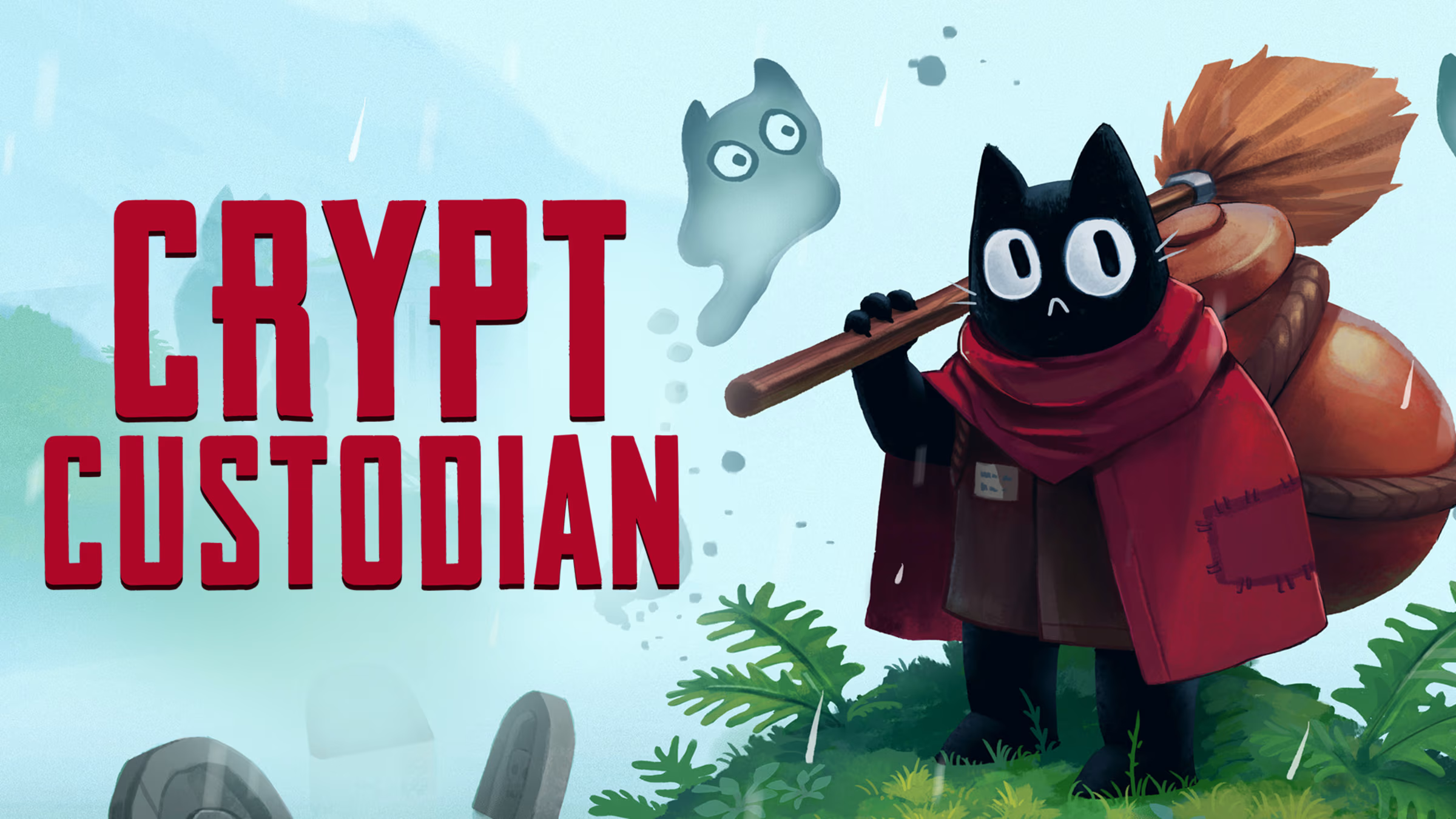
I finished Crypt Custodian yesterday, hitting 100% after about fifteen hours of play, although there’s a boss rush mode I’ll need to dip into if I want to get all the trophies, and I’m probably not going to. It’s one of the nicer surprises of the year, because I basically just grabbed it for free from Game Pass based on the image you see up there.

It’s a Metroidvania. You play a cat. You’re dead and a ghost. You’re prevented from entering paradise by a really bossy dead frog (that’s not a joke) and you spend the entire game cleaning up trash with your broom and whacking monsters with it. In classic Metroidvania fashion, you unlock a bunch of abilities over the course of the game that let you go back and get into areas you couldn’t reach before, and while I have no intention of spoiling the ending, it revolves around making 10 friends so that you can invade Paradise and visit your still-living loved ones, and the ending will make you cry a little bit.

I play these games for the exploration, right? This is the map:

Or, if you prefer a slightly more abstract, right-click-for-much-larger version, you can have this one:

Don’t worry about the Chinese, the words don’t matter. The point is the map is ridiculously large, and the different areas are wildly different, some with environmental challenges (one area reverses its polarity every time you dash, making walls and floors either appear or reappear along with roughly half of the enemies at any time) and some that just look cool. There’s rainy forests and castles and tombs and enormous retail backrooms and an amusement park. You can teleport to save spots at any time and there’s no penalty for dying, and you can even unlock a power-up late in the game that prevents missed jumps from hurting you, so there’s a strong incentive to just pick a direction and go. Your power-ups can be equipped using little upgrade spheres that can be found or purchased, so there’s an element of switching back and forth between them depending on what you need to do– I found myself with an exploration build and a boss fight build after a while, for example– although by the end of the game you can find enough of the spheres that you can equip nearly everything you need, and you might be able to buy as many spheres as you want; the one vendor doesn’t seem to run out of them.

So, yeah. Games like this are why Game Pass is worth the money; this game is delightful and everyone should play it, whether they have to pay for it or not, but if you can get it for free then you really have no excuse. Give it a shot.

#REVIEW: Crime Scene Cleaner (Xbox Series X, 2024)

I can’t believe I mean this: right now a game called Crime Scene Cleaner is somehow one of my favorite games of 2025. That sentence is true. I have spent twelve hours or so mopping up blood, moving bodies, and picking up broken glass in a video game, and it may be the most chill and genuinely relaxing game I’ve ever played.

The premise is real, real simple: you’re a janitor who gets hired by a mob boss to clean up after his people. You take the job because you need money to pay for your daughter’s hospital bills, which makes this the most American game of 2025. You accept jobs through your computer and the occasional phone call from “Big Jim,” the guy who signs your checks. You have a dog. There’s an achievement for petting the dog 15 times. The crime scenes range from a small apartment to an entire museum to a giant warehouse. At the end of each job you get paid based on how thorough a job you did; money can be used, not to pay for your daughter as you might think, but to upgrade your cleaning tools, accomplished through a skill tree, so you honest-to-God might pay for an upgrade to how much blood your mop can clean up before you have to wring it out in a bucket, and you can also upgrade how many detergents you can add to the bucket at once. By the end of the game you’re able to dual-wield sponges, which is not a phrase anyone had ever said or thought of before this game came out.

There is something primordially satisfying about walking into this:

and walking out an hour later with the floor and walls spotless, the broken tables whisked away, the bodies safely stored in your truck, and everything that wasn’t broken put back exactly where it belonged. There are some collectibles– every level has a few cassette tapes hidden away, and there are secret areas all over the place that you can uncover, and exploration is a lot of fun, especially once you unlock the– again, I’m not kidding– upgrade that lets you walk across blood without leaving footprints all over the goddamned place afterwards. You’ll need to find keys and the occasional key card, and oh, you’ll also rob everyone blind while you’re cleaning. The great thing about working for the mob is the people they send you after tend to have piles of cash and jewelry and stuff just sitting around! They’re all dead, they don’t need it any longer.

There’s no real point in talking about graphics or sound; they’re good enough and no better. The rag doll physics can occasionally be kinda ridiculous. You can jump or fall from any height and be fine; it’s impossible to die, so there were definitely times where I was moving a body and just chucked it off a balcony and then jumped after it rather than carrying it down the stairs. My only real gripe is that if you’re a completist, like me, and you want to 100% everything, every so often there’s a single bullet that you accidentally knocked somewhere with your mop that takes an hour to find, or a single spot of blood that you just missed that is too small for your UV lamps or your “Cleaner Vision” (no, seriously) to spot easily. Having to end a level at 99% blood cleanup because you just could not find that last spot is kinda annoying, especially when the game really does need about an hour to an hour and a half per level.

But yeah. This was a blast. Twelve hours or so was enough to 100% every level and get all but five of the achievements; I’m gonna jump back into finish those off just because I’m that guy. It’s on Game Pass right now, so if you have that, you don’t have to pay for it, but it’s worth the $20 or so you’d pay if you actually buy it.

Oh, and I vacuumed the whole house today, because I’d been cleaning in a video game for several days and felt kind of guilty about the condition of my actual house, which is a real place with cats in it that needs vacuuming way more often than I actually do it.