

In which god I’m tired of this (part 3 of 3, sorta)

22913I took yesterday off because I spent all day asleep and then had to go to work; it’s 1:43 as I’m starting to type this and I’ve only been out of bed for about three hours.  This annoying goddamn just-wanna-sleep-all-the-time illness is getting old, folks, and the inexplicable sore throat it decided to throw at me yesterday out of nowhere isn’t fair.  Also, there’s a chance I might have pinkeye again for like the fourth fucking time this year.

I will be the first in line to transfer my consciousness into a machine.  There’s gotta be a mad scientist out there working on that.  Get moving, dammit.

So, that in mind– let’s get this Tony Bennett post out of the way.  Not spending time on my Facebook feed lately?  Okay.  He’s Indiana’s former superintendent of education.  “Former” because he got tossed out on his ass last year, after all of Indiana’s teachers rioted against his lying, crooked ass.  Turns out we have enough friends and relatives that the new Superintendent got three hundred thousand more votes than the new governor did.  He then went to Florida, the worst place on Earth, which is where all of the world’s shit and evil goes to die.  And less than a year later he’s had to resign that job because his evil lying corporatist ass got caught cheating, too.

You didn’t click on the link, I know; I’ll nutshell:  one of the schools that Tony just knew should have been an A school ended up with a C under his new, bullshit school grading system.  That school just happened to be run by an influential Republican donor, who just happened to have donated several hundred thousand dollars to the reelection fund that wasn’t enough to keep Tony from getting tossed out on his ass.  The entire grade system therefore got revised until Tony’s buddy’s school got the A that he’d already predetermined it deserved.  Meanwhile, several Indianapolis public schools in basically the exact same situation got taken over by the state for their poor grades.  Coincidentally, I’m sure, the new system managed to lift the grades of several other charter for-profit schools.  Amazing, innit?

Here’s the thing: honestly?  I ain’t mad.  This entire “school accountability”/charter school thing has nothing to do with educating children.  It is solely and singularly concerned with shoveling taxpayer money into the pockets of corporations and people who are already rich.  The system is already so corrupt and evil to begin with that it’s hard to imagine anything that would make me see it as worse.  I already knew these people were lying scum who were out to get me and enrich their friends.  Additional proof of same isn’t gonna make much of a difference.

Wanna hear a secret, though?

All grades are arbitrary bullshit.

Lemme say that again:  All. Grades. Are. Arbitrary. Bullshit.

We all know this, but we don’t like to talk about it much, because everybody likes to pretend that that grades actually mean something.  But every teacher on Earth has at some point or another adjusted something because somebody who should have gotten some grade got some other grade instead.  And if they haven’t done that, they’ve set their grade system up to prioritize some sort of behavior over some other sort of behavior.  It’s all gamed, one way or another; the only thing is how honest and how transparent you are about it.

Lemme give some examples.  The easiest way to grade is just to make everything worth the same number of points as the number of questions in the assignment.  So if I give you fifteen questions tonight, that’s worth fifteen points, and the 50-question test is worth fifty points.  At the end you divide the total number of points earned by the total number of points possible and then you have a score.  Problems with this:  one, it’s a lot of grading, and two, it leads to weird inequalities like Monday’s homework being worth a lot more than Thursday’s just because Monday’s worksheet had a lot more questions on it.  It also leads to difficulties in quantifying anything that isn’t a worksheet or a textbook assignment, and makes grading things like essays a huge pain in the ass.

So, okay, use rubrics, or something?  And make every paper worth X points, where some percentage of that is grammar, some is “style,” some is awarded for some nebulous idea of how well the essay adheres to whatever the essay was supposed to be about.  You’re still making arbitrary determinations here about how much you prioritize papers over other things.  You’re still gonna give the kid who turns in every single assignment but can’t write to save his life a “C” because his papers weren’t good enough, where Billy who is a decent writer but misses assignments and half-asses everything gets a “B” because papers are worth more than the assignments he skipped.

And you’re gonna make some sort of decision about how to change your grading based on your feeling that Kyle deserves a better grade than Billy because he works harder.

Let’s throw some special ed kids in the mix.  What if Jenny’s got an IQ of 60 and doesn’t have a chance in hell of being able to do the same assignments that Monica can handle?  Should she just automatically fail?  Or do you alter your grading policies somehow to account for the fact that she’s doing the best she can do and that ought to be worth something?  Maybe she on her best day on Earth can’t do better than Billy-the-halfasser can do.  Should Billy get better grades?  Is the sanctity of your precious grading system worth more than convincing Jenny that trying at school is worth something and tossing her a little bit of success once in a while?

What kind of person are you if you determine that not breaking the Rules of Your System is more important than keeping a kid from tuning out school altogether?

What happens if you give an assignment that you plan to grade a certain way and then all your kids bomb it?  What if some of the kids who bomb it are kids who habitually get everything done right?  Is that your fault?  Can you change your grading system to give some kids better grades?  Or just throw the whole thing out?

How do you tell the difference between Amber-the-A-student getting a C on something because your grading system was BS and Amber getting a C because she’s slipping?  And, again, do you care about the difference?

How do you handle missing work?  Do you accept it?  Because you’d better be prepared, in some schools (mine’s one of them) to fail 2/3 of your kids if you don’t take late work and if you record it as a zero.  Or do you have a “floor” beneath which no assignment can fall?  Where do you set that?

For the record, here’s my grading system, for whatever it’s worth:

  • I accept late work up until a formal progress report goes out; this basically divides a quarter in half, so you can turn in late work from the first half of a quarter until halfway through it and then those grades are locked.  I send informal PRs home every couple of weeks.  Late work gets docked two points from a turned-in assignment.
  • Missing work is a 0.  No turned in assignment receives less than 50% as a score unless it’s clearly halfassed or not finished.  It’s incredibly rare for ANY turned-in assignment to receive less than 30%.
  • Assignments from the textbook are worth five points, period, and are graded on completion.  I do not grade them item-by-item and do not correct them.  If they’re turned in and done roughly according to instructions (ie, work is shown, stuff like that) it’s going to get full credit unless I can tell you just wrote some shit down and hoped I didn’t notice it.
  • Assignments from the workbook are worth ten points and are graded on partial correctness:  in other words, I arbitrarily choose ten problems from the two pages and grade those.  Not every problem will count.  I grade the same ten problems for everyone, though.
  • Tests are usually worth fifteen or twenty points and are graded completely.  Occasionally I will give bonus points for spelling your name right if a test happens to have twelve questions or something like that.  Tests are the only exception to the grade-floor rule; if you turn in a test with no correct answers you are going to get a zero for it.
  • Occasionally I will collect morning bell-ringer work and grade that on completion; it’s usually worth a point or two and cannot be made up.
  • Extra credit is crazy-rare and is only given if it’s available to everyone.  I won’t make up an assignment for you specifically.

Here’s what I’m prioritizing:  I put a heavy emphasis on effort, which is why those textbook assignments are pretty much automatic As if you turn them in.  Similarly, the grade floor: if you tryyou’re going to get some points for your effort.  I accept late work because I feel like kids should be able to make up for their mistakes; I don’t accept it after a certain point because those mistakes should cost you something.

And, yeah, I’ve taken a look at my grades, gone “Damn, Chelsea should be getting an A, what happened?” and taken a look at how to fix it.  Not to the degree that Bennett did, obviously; his shit was pretty egregious no matter how you look at it.  But I can’t pretend I don’t get it.  Because grades are arbitrary.  Period.  We shouldn’t pretend otherwise.
In which I am still a bad student (pt. 2 of 3)

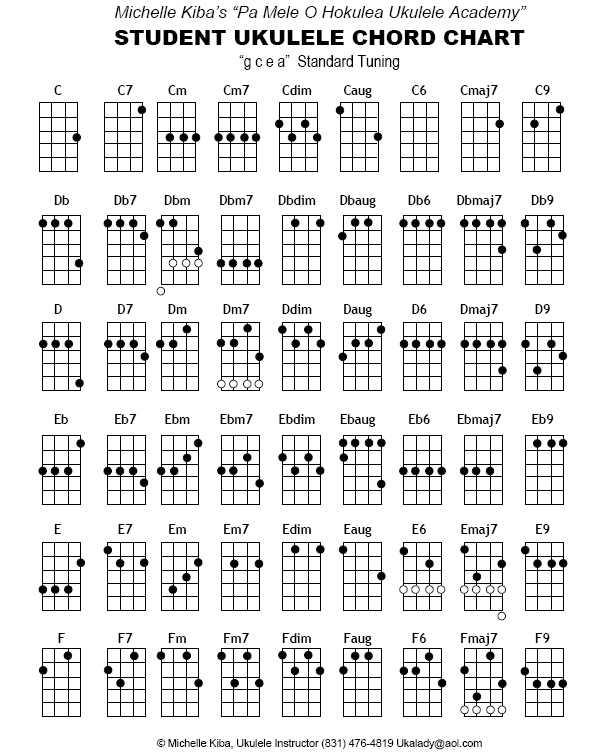
Ukulele Chord Chart page1 If you haven’t read yesterday’s post yet, you probably ought to; this is part 2 of at least 2 and it may turn out to be three. We’ll see how I feel when I’m done writing it.

We’ve established two things about my ukulele classes: first, that I am a poor student, and second, that Dale is, at least for me, a poor teacher. Current “reformer” theory in teacher training states that so long as we get people who are trained in subject matter and good at said subject matter, it’s not actually very necessary to actually have any training in teaching. Teaching’s just something you can pick up– after all, anybody who knows a lot about something should be able to pass that knowledge on, right?

Well… obviously not. There is a hell of a lot more to my job than mere subject matter. Now, I’m both smart and arrogant, so I’m not going to pretend that the wealth of knowledge that I bring into my classroom doesn’t help– but it simply is not sufficient to make me a good teacher. Dale’s a perfect example here; someone with an immense amount of practical and technical and theoretical knowledge of his field who is, nonetheless, entirely incapable of passing that knowledge on to someone who lacks it. This is what we lose when we, as Indiana does, start suggesting that all you need to be a math teacher is to major in math, or that a competent engineer ought to be able to teach science. It’s truthy: it sounds right, but it’s bullshit. Teaching doesn’t work that way.

Conversely, you get people with comparatively little subject knowledge who are nonetheless great teachers provided that they’re in the right position. I couldn’t teach kindergarten or nursery school to save my life; does anyone really feel that you need to be an especially book-smart person to do either of those jobs successfully? Hell no. You need a firm knowledge of child development, a hell of a lot of patience, and more compassion and empathy than any two normal people should have. Many of the band and orchestra teachers I’ve met haven’t necessarily struck me as musical prodigies but they don’t need to be to make kids love music. They need to be able to teach.

In my career I’ve taught computer classes to preschoolers through eighth graders, language arts and social studies to seventh graders, math, science and social studies to sixth graders, and now I’m about to start teaching math to seventh and eighth graders. I did not take a single math or computer class in college. And I am better at my job than you are at yours. (Also more of an asshole, but that’s neither here nor there.) I’m not a good computer teacher or a good math teacher because I have exceptional skills in either area. I’m good at communicating my knowledge. That’s the important part. And that’s what we need to focus our teacher training efforts on– not on acquiring knowledge, but at developing the skill to pass that knowledge on. It ain’t the same thing.

And, for a rough segue into evaluation: let’s pretend that Dale isn’t just teaching uke classes on the side at a little community music center. Let’s assume he’s trying to make a career of this. Does he, regardless of whether I actually think he’s skilled at teaching, deserve to be evaluated by how well I play the ukulele after I’m done with his class? I’ve already been clear, I hope, on both my own initial lack of skill and– importantly– the fact that I really haven’t done much of anything to make myself better in between our sessions. Is me being bad his fault? Is my lack of trying, my lack of practice, my fuckin’ ridiculous schedule what with my jobs and my two-year-old and (let’s own it) my laziness toward improving at his craft Dale’s fault?

Should I count toward his evaluations, if they give me a uke test at the end of his class and I fail it? How much? A little? A lot?

Tomorrow (yeah, this is going three, since I still haven’t gotten around to talking about Tony Bennett yet) we discuss grading. And cheating. It’ll be fun! Assuming this damn thing uploads and doesn’t delete itself.

(Make with clicky for part three.)

In which I am a bad student (pt. 1 of 2)

viva_la_ukulele_by_rathawk

Lemme put the tl;dr right at the beginning: I had a ukulele lesson yesterday, it didn’t go well, and I’ve turned it into an exemplar for everything that’s wrong with teacher training and evaluation nowadays.

I am not musically talented.  I am an at-least passable singer; I believe this is true because I have been complimented on my singing by people who had no reason to lie to me about it.  But that’s it.  I have, in my life, attempted to play the violin, the French horn, the trombone, the recorder, the harmonica, and the ukulele, with scattered examples of sitting in front of a piano and tapping at keys until I figure out how to play whatever song is in my head.  I can play none of those instruments.

Important secondary fact: I am an autodidact.  The way I learn best is by trying to figure out shit by myself, and I never learn anything unless I am interested enough in it to work on it on my own.  My ideal circumstance for learning (and this, incidentally, is precisely how I have “learned to cook” over the course of 2013) is to muddle through on my own but to have a clear set of guidelines for what to do and– and this part’s important– to have access to an expert (generally, my wife) nearby who can either answer my questions (“does this look done to you?”) or occasionally check on me and note terrible mistakes in progress or provide advice for things I have missed.  Everything, and I mean everything, that I am good at doing or know a lot about, I taught myself to do.  It’s how I learn.  I know this about myself.

But back to the lack of musical talent thing: I know nothing about music theory; talks of diminished chords and As and flats and sharps and such goes right the hell over my head.  I also, and this is super important for learning a stringed instrument, have very little dexterity in my left hand.  My fingers, even when I’m at my thinnest, tend toward the short, chubby, and clumsy.  I am also the most right-handed person I have ever known; my left hand is basically useless for most tasks.  How the hell I’m such a good typist I’ll never understand (honestly: this fact– I type faster than you, and that person you’re thinking about right now who types really fast? I’m faster than them too) and, in fact, typing may be evidence that this whole “can’t get my left hand to cooperate” thing may be wrong.  But anyway.  My point is that being able to fluidly and quickly move the fingers on your left hand to precise spots along the neck and the frets of a stringed instrument is, obviously, critical to being able to play.  I can’t do that.  I used to be really into Guitar Hero and Rock Band, right?  I topped out at Medium difficulty.  I could 100% basically any song I wanted on Medium, because I didn’t have to move my left hand– but as soon as I moved into Hard and that blue fret came into play, meaning that I’d have to move my hand and remember where it was if I wanted to keep playing, I failed completely.  The jump was too big.  And I tried really, really hard to master that difficulty level, or at least get decent enough at it that it was playable.  Never happened.

For these and other reasons, I am a poor student for anyone trying to teach me the ukulele.  This is a fact.  It is undeniable.  I am also busy and, at least lately, not terribly prone to use free minutes to pull out my uke and practice.  This is also an undeniable fact.

Now let’s talk about my teacher, and I’m going to try very hard to be fair, because despite everything, I actually quite like the guy.  I’m gonna call him Dale.  That’s not his name, but it’ll do.

Dale is clearly impressively musically talented.  He plays five or six different instruments and appears to have working knowledge of many more.  He has perfect pitch; he’s had me retune my uke a few times based on something that he heard and has then pronounced satisfactory a change in tone that I couldn’t even hear.

He’s also, at best, incredibly socially awkward.  He’s a giant of a man, probably a few inches over six feet tall, and bulky even at that height, he’s got a lazy eye, and it’s clear within a moment or two of talking to him that this is a guy who has always felt like he’s stuck out.  He doesn’t like to touch people; he was clearly uncomfortable when I tried to shake hands with him when we first met, and did not have a confident man’s handshake.  I did not repeat the experiment for our second meeting.  I wouldn’t be surprised– no, let me rephrase that; I would be surprised if he were not on the autism spectrum.

Now, again, I want to make absolutely sure I’m being clear here:  none of these things make Dale a bad person.  Okay?  Is that obvious?  On top of everything else, he’s nineteen at most, and heading off for college this fall, and I am willing to cut alllll sorts of slack to high school students for being gawky and awkward.  It’s entirely possible that I’m completely off on the autism thing and the kid’s just been the oversized music nerd his entire life and is socially withdrawn as a result, and a few years in the music school he’s headed toward will turn him around.  I wasn’t exactly a fuckin’ butterfly at nineteen either, y’know?

Unfortunately, this combination of high amounts of technical and practical knowledge combined with little to no skill at communicating them mean that Dale is a bad teacher.  He can show me how to play the ukulele and the mandolin and the guitar and hell probably the aquaggaswack all day long; he cannot teach me.  It may be that if he had a student who had similar levels of musical talent to his, who knew how to play other instruments but didn’t know the uke specifically, that he could teach that student.  He cannot teach me how to do it.  His method is to sit there with his uke– which, complicating things, is about 2/3 the size of mine, constantly out of tune (so he claims) and lacking many of the frets that mine has, which makes it impossible for me to follow what he’s doing– play something in some way, then say “or you could do this,” and play it another way, then spend a minute talking about what he just did, using vocabulary that loses me so instantly and completely that I can’t actually give you an example, then do it again, then do another thing.  It hit me about halfway through my lesson yesterday that I couldn’t come up with a way that Dale might do things differently if I hadn’t brought my ukulele with me at all.  He never actually asks me to do anything.  He’ll show me something, I’ll try to replicate it (poorly) on my own, he’ll tell me what I did was right, most of the time, even if it’s wildly apparent to me that it wasn’t, then he’s off to some other thing.

It is a sign of my own utter confusion and his lack of teaching skill that I don’t even feel like I can complain adequately about how this lesson went.  I don’t have the vocabulary; I can’t even tell you what he was trying to show me.  I can’t tell you what he was doing.  He would play, look at me for a second, I would strum something, then he would go right back to what he was doing.  Both of us checked our watches a lot.  I think both of us felt like we were wasting each other’s time.  It was awful.  Ugh.  I literally can’t tell you the last time I was in a situation where I was supposed to be learning something and been so completely in the dark as to what the hell was going on around me or what I was supposed to be doing.  Complete, total failure.

(That’s as critical of Dale as I’m going to get, by the way.  Again, I like the guy.  He’s very very talented.  But he’s not a teacher.)

..actually, you know what?  This is already too long.  I’m going to break it into two parts.  We’ll talk about how this is relevant to the state of education in Indiana tomorrow, I think.

(Click here for part two.)