On the final

I have crunched the numbers, or at least calculated my pass rates, and of the 139 kids who took the 8th grade Math final, 55.4% of them managed to pass it. I curved the test to 20 points instead of 25 before putting it into the actual grade book, and with that adjustment, 66.2% of them managed to pass. This from a test that upon looking at it the first time, I was fairly certain that 2/3 of my students if not 3/4 of them would fail it.

(Only one student failed the Algebra final, before or after the modest two-point curve. I’m not worried about that class right now.)

Furthermore, and I’m not going to post the graphs here because they’re vaguely incomprehensible without the information that I’d have to strip out of them, my kids did pretty respectably compared to the other 8th grade Math teachers in the district. The data I get through the dashboard is incomplete but still a little more fine-grained than just pass/fail rates, but at worst we’re tied for the best performance in the district, at least of the teachers I can see data from, and depending on how you measure, you could make an argument for first or second. I’ll take “tied.”

A couple of other things: first, my 8th graders are unused to the concept of “final exam” or “midterm” to begin with. 7th graders did not have to take either last year. They are also, and I think this might be a place where my current grade policies might be hurting me, not used to the idea of a test they can’t retake in my room. I told them over and over again that they were only getting one shot at this and a bunch of them asked me if they could retake it anyway. I think I’ve managed to create some kids who just sort of breeze through tests the first time, knowing they can redo them if they have to, and if they don’t get a good enough grade the first time, they actually try on the second attempt.

Second, I may need to rethink the way I teach my classes from the ground up, so long as the guy who is in charge of writing these tests remains in charge of writing these tests. I am a big fan of Everyone Who Tries Can Pass, which, honestly, probably shouldn’t be true no matter how much I want it to be. He is a big fan of Rigor, which I generally find to be nothing more than artificial difficulty with no particular instructional utility.

To put this in simpler terms, if the objective is “prove you can multiply,” I’ll likely ask you what 7×8 is. His questions are more likely to be 7.13 x -18.014, that is if he’s not writing something utterly demonic like -7/18 x 8.12.(*) Both are “multiplication,” of course. Mine lacks Rigor. His lacks common sense. I feel like maybe if the kids are seeing a particular mathematical concept in 8th grade, maybe we ask them some simpler questions about that concept to see if they get the idea before we jump to the Rigor shit. Not so for my compatriot; the ILEARN is gonna be Rigorous, so our assessment must be as well.

This is the point where I generally throw my hands up and point out that if you want me to fail half of my students, please have the balls to actually say that. I’d ultimately rather have them feel like they have a chance to pass, and (slightly more importantly) a chance to understand the math I’m supposed to be teaching them. If every test question is high level and Rigorous, I can point at ten kids in every class who are already done before I pass the tests out, and that’s not including the ones who just don’t give a shit one way or another. That’s a whole different conversation, and one I might have sometime during break depending on whether I get around to analyzing my ILEARN data the way I want to.

So what did I do? Detailed guided notes. Detailed guided notes. Here, take a look at them if you want:

Basically every question in those notes is a test question on the final that has been slightly rewritten, basically just changing the numbers. In other words, if you paid fucking attention during the four days that we spent going over that nine page document, you had the entire test in front of you. And yes, the test was open notes. 45% of my kids failed with this document in front of them; most of them because they didn’t even glance at it during the test. (You may recall the test I gave a couple of years ago where I literally wrote the answers on the board and 23% of them failed. There is nothing I can do to get some of these kids to pass.)

Anyway. If you’ve read this far, go ahead and look through those notes, and keep in mind that I didn’t exactly keep that document a secret. I shared it with my boss and I gave it to my 8th grade partner teacher. I don’t think she used it with her class; I could be wrong.

You tell me: is this cheating? Meeting the kids where they are? Something else? I don’t know. They did a lot better than I thought they were going to do initially, and there are still a bunch of questions on that test (not all of them, to be clear) that I think are manifestly unfair for 8th graders. Looking at the kids who failed anyway, honestly, I’m not sure how many of them were possible for me to get short of taking the test for them.

The question is whether I just give up on those kids next semester and leave them behind so that I can have the rest of them ready for a test like this without this degree of a crutch, or if I keep providing the crutch. I genuinely don’t know. I really don’t.

(*) To get a little bit further into the weeds, converting decimals to fractions and vice versa isn’t in 8th grade standards, and I don’t have time to teach it. So there is zero chance that I’m going to give my kids a question where that must happen in order to get the right answer. Because it introduces a source of error that is not “do the kids understand this 8th grade standard” and I’m not about that life.

In which I want to vomit forever

I got hammered by the digestive side effects that Mounjaro is famous for so hard this morning that I had to stay home. Suffice it to say that I spent most of the morning in the bathroom and at least once seriously contemplated taking a picture of my bodily effluvia so that I could submit it to Guinness. I have never witnessed anything of the quantity that I was producing this morning. I’ll leave it at that.

Just now, I looked up my scores for the second ILEARN checkpoint, and really, there’s no reason for me to go to work tomorrow, because my kids are clearly learning not a Goddamn thing from me this year.

And tomorrow they’re going to take a test, and then I can start preparing them for the final, which 85% of them are going to fail.

So, yeah, I hate everything, how are you?

Tomorrow

I get to spend my entire day tomorrow giving my students standardized tests, and I mean that literally– every single one of my classes, all day, except for my 30-minute lunch, which is going to be delayed a bit from its usual time because of Reasons. I will have to read several pages of instructions six times and ask over a hundred and thirty students “Do you have a cell phone?” and hope none of them are lying to me, because I get to catch all the bullshit from everybody if we have to invalidate a test.

You’ve all heard the rants before; I’m tired and I don’t wanna. I’m going to predict my sixth-hour kids have the worst test scores I’ve ever seen, though, because giving a standardized test at the end of the day is fucking professional malpractice.

And then Thursday the process will repeat, with the ELA teachers giving their half of the test, and I’ll be in my classroom instead, trying to figure out how to keep the bastards busy and quiet for class periods that are ten or so minutes longer than usual. I’m thinking color by numbers. I’m already pre-annoyed by Thursday behavior issues that haven’t even happened yet– that ten minutes don’t sound like much but they’re going to be. My current ability to tolerate bullshit, as well as the ability of the other adults in the building, is calibrated for 53-minute blocks. There will be a lot of damn referrals during the last ten minutes of class over the next couple of days.

Also, I just ate about two thousand calories of deep dish pizza, and it was a bad idea.

The end.

Today’s moment of screaming inside my brain

Many years ago– I have told this story before, but in a previous version of this blog, I think– I had a deeply weird conversation with a second-generation Vietnamese student in one of my classes where I had to convince him that he was Asian. This was long enough ago that you still had to fill out a bunch of bubbles with a pencil in order to take a standardized test, and he wasn’t sure what he was supposed to fill out in the Race category. His first guess was that he was white, since he had been born here. And if the kid was younger I’d make an argument that I could see it; he was not born in Asia, which may in and of itself have short-circuited his brain out of choosing “Asian,” particularly if his parents only ever referred to their family as Vietnamese, which of course would not have been an option on the list.

He was an eighth grader at the time.

At any rate, no, son, fill out Asian, please, and then go home and have a conversation with your parents about whether there is anything else about your identity that they have not mentioned in the last fourteen years.

Today, out of nowhere, I had a student (Puerto Rican, I think) walk up to me during passing period and ask me if I was white. The look I gave her must have answered her question, because before I actually said anything she clarified with the following:

“No, I mean like real white. All white. White-white.”

Just in case you’ve forgotten, this is what I look like:

So … yes. Completely white. All the white. Flat White. Damn near pink, really.

I did not press the child for an explanation.

In which I knew that already

I passed my Math test, officially, with exactly the same score I had “unofficially” on July 1st. Delayed fully 40 days for no Goddamn reason at all. Remember, kids, ETS is the devil.

That’s all I’ve got for today, as we have family in town and we will have more family in town tomorrow. Must sleep.

In which it looks like I can do this

I ended up having some spare time this afternoon, and I found a free practice test online through the same people that sold me my study guide (so I figure it’s at least reasonably reputable) so I went ahead and took it, and if I’m understanding the scoring methodology correctly … it looks like I passed, although not exactly with flying colors– I got 42/66 questions right, or 63.34%, for a final score of 163, and a 159 is a pass in Indiana. I could have gotten a 39 and still passed, so I had a three-question cushion on my first try.

Now, granted, no one is ever going to look at my Praxis score again after I’ve passed the thing, so it really doesn’t matter if I pass it by the skin of my teeth or by flying colors, but I want a little bit more of a cushion than that. I was able to go through the practice test after taking it, and I printed out two categories of questions: questions I had gotten wrong, and questions that I got right but I know good and well that I got right by being lucky. That gave me about 27-30 questions to study tomorrow; in there are a handful that I absolutely shouldn’t have gotten wrong, including one thing I’ve taught fairly recently (!!!) and one where I just flat-out calculated something incorrectly and didn’t notice it, but I figure being fully confident of over half the test is better than I expected going in. I missed nearly all of the calculus questions, of course, but I got a couple of the trigonometry ones right without guessing and there were one or two of the harder ones where I was guessing between, say, two answers instead of all four and managed to get the right one. I figure I’m going to do this twice more– I’ll study my wrong answers tomorrow and see which ones I can get comfortable with (some are a matter of just not understanding certain kinds of notation, so those will be easy points) and do another practice test on Thursday, then maybe one more over the weekend, and if my numbers move in the right direction I don’t see why I can’t move ahead with the real thing next week sometime. Which, on one hand, will wipe out one of my big plans for June, but on the other hand will let me focus more on Arabic, curricular stuff, and Spanish.

The other thing I need to make sure I understand is the actual rules for taking a Praxis from home. I know they have a proctor monitoring you but I’m not sure what the tech rules are and I suspect on at least two questions I may have broken a rule, depending on how picky they are. This organization has made me incandescently angry with them on multiple occasions so I need to make sure I’m prepared for literally anything. Hopefully things go smoothly, but I need to prepare for them not to.

Oh god I’m a nerd

It is Friday night, and I am sitting at my computer, listening to the first concert of Pearl Jam’s new tour, featuring the first live performances of half a dozen tracks from Dark Matter, and interpreting data from charts and spreadsheets.

In other words, this is very close to the perfect evening, and at 47 I may as well accept what I am because it’s not changing.

I am a rock star, ladies and gentlemen. We took the final NWEA of the year on Wednesday and Thursday, and … goddamn. I was elated by last year’s scores. I am fucking ecstatic with these. I have never seen results as good as what I got on this year’s spring NWEA before. And the really awesome thing is that I could go a dozen different ways after that sentence and they’d all be just as awesome.

Let’s back up a bit. The NWEA is administered three times a year and eats up a grand total of about twelve hours of instructional time over the course of the school year. It is primarily a growth test, with no concept of success or failure– the scores are indexed against grade levels, but you can’t fail the NWEA; you only show high achievement or low achievement compared to your grade cohort and high growth or low growth compared to other people in the score band of your grade cohort.

This is the kind of test I want. I get kids all over the map– kids taking a class two years above grade level and kids with 60 or 70 IQs. I don’t care whether or not my kids are successful against some arbitrarily designated cut score that can be manipulated depending on whether the politicians think we’re passing enough kids or not. I want to know whether they got better at math under my instruction. And the NWEA provides me with that data.

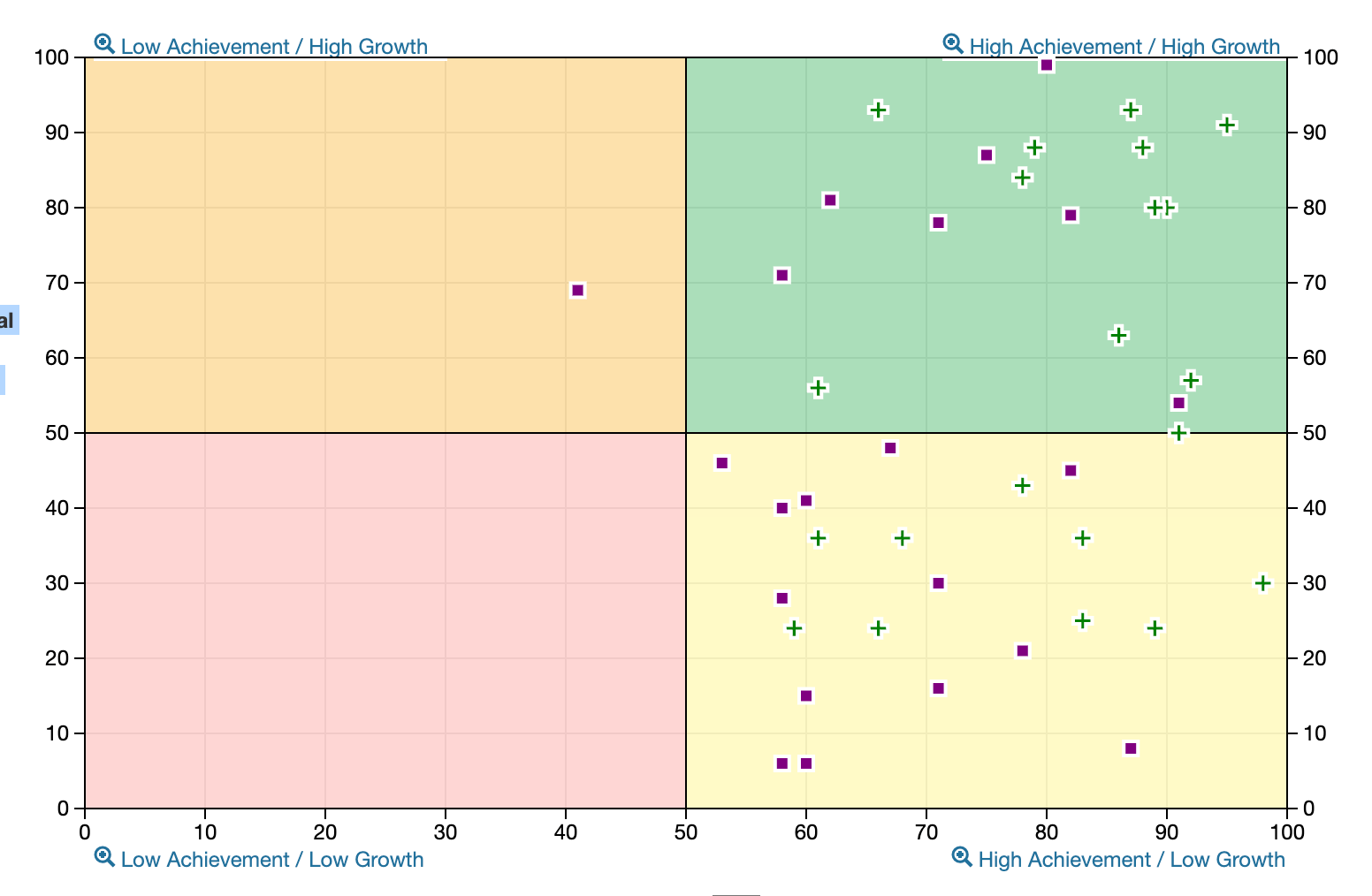
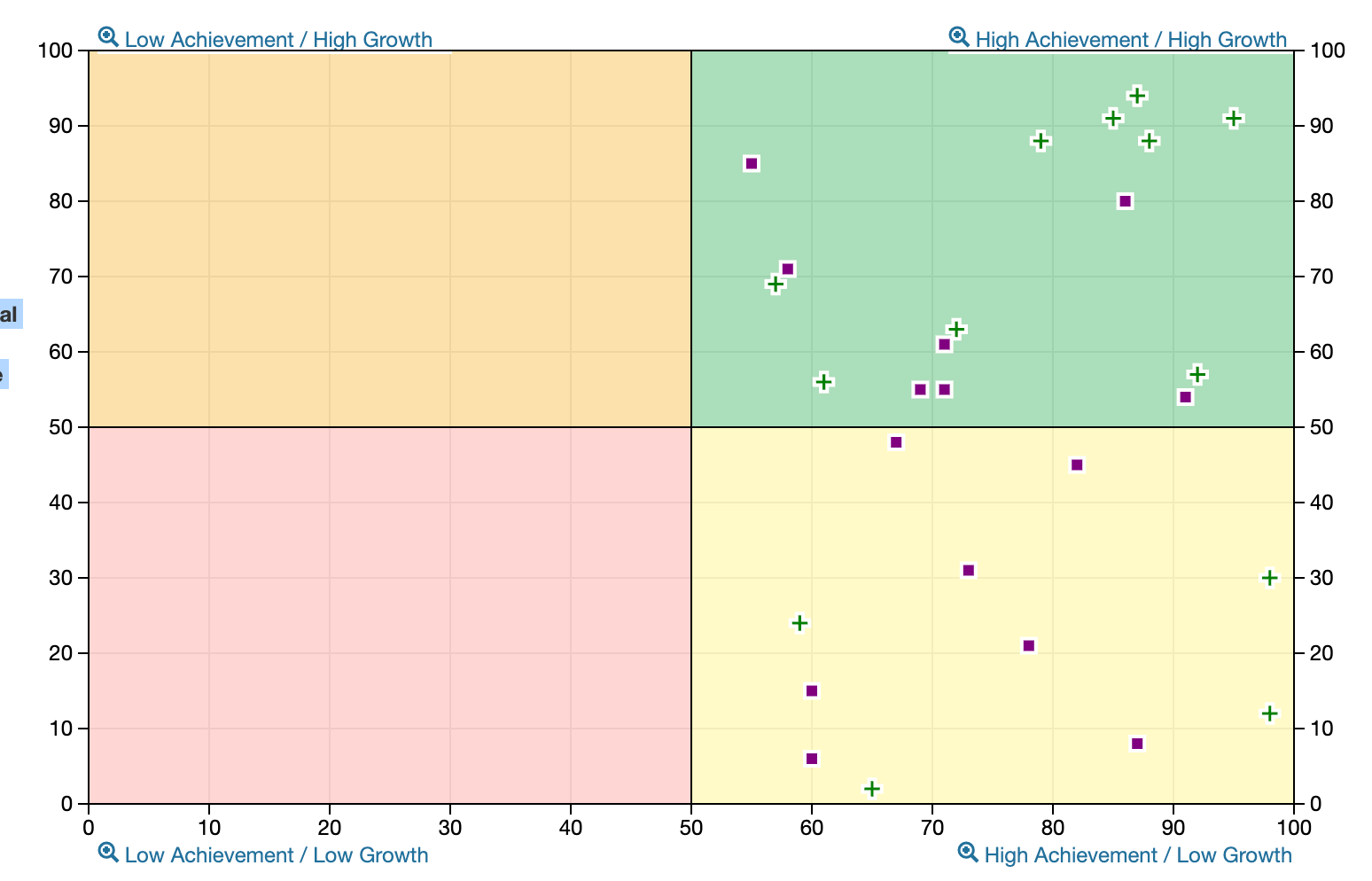
And it also provides me with something I really like– the ability to compare my own kids’ performance in Math against their performance in Reading, which I don’t teach, which is as close as I can get to an unbiased check on whether I’m doing my job right. Two years in a row now my kids’ Math growth has kicked the shit out of their Reading growth. It was rough last year; it was staggering this year. Which brings me to that chart up there. That’s my second hour. The pluses are their Math scores and the squares are their Reading scores, so each kid is represented twice on the graph. The farther to the right their boxes are, the better they performed, and the higher they are, the more their growth was. In other words, you want them in the green box and maybe not so much in the red box. Orange and yellow are on-one-hand-on-the-other-hand territory.

Here, let me clear the Reading scores out:

Now, this particular chart shows the two things I want to highlight more clearly than the rest of my classes, but believe me, these are common threads across all of my students. First, look at how many of them are high growth. I have four fucking kids at the 99th percentile in growth– in other words, kids who showed more growth than 99/100 of kids who took this test, nationwide. I have eleven across the 117 kids I have scores for. There were nine of them at the 90th percentile or above, just in that class. There were 26 across all of my classes– in other words, 22% of all of my students were in the top ten percent in growth in America.

I want a fucking raise.

The other thing I want you to notice is that yellow box, the one for kids who are high achievement but low growth. Notice that that fucker is empty.

If we look at my low-achievement kids, 44 of them were high growth and 44 were low growth. Which sounds exactly like you might expect, but “what box are they in” is kind of a blunt instrument. Almost 2/3 of my high achievement kids– 19 of 29– were also high growth. And the high-achievement kids are widely considered to be much more difficult to get to show growth.

This is interesting to me in terms of what it says about me as a teacher. I did a good job with my low-achievement kids. I want to dig into those numbers more and look at averages and medians to get a little more detail, but I’m still pretty damn happy with a 44/44 split. But I did a fantastic job with my high achievers. I am doing a mathematically demonstrably better job achieving growth with my high-achieving kids than with my low-achieving kids. Which, believe me, I’m going to make a point of when I campaign to get a Geometry class and maybe the other Algebra class back next year. I would love to see numbers from the guy who teaches the Geometry class at the only middle school in the district where it’s actually taught. If he’s beating the numbers I put up this year, I need to be sitting in on his class.

God, I love being a numbers nerd, and God, I love it when I get a chance to brag about my kids.

Two pieces of undeniably good news

I got my evaluation back from my assistant principal today. We don’t really need to go into the details of how our evaluation system works; suffice it to say that my final score was 3.88/4, which is the highest final score I’ve ever received, and my third or fourth year in a row at Highly Effective. I will probably never manage a perfect score for various reasons so only losing twelve hundredths of a point over the course of the four classroom observations and two official goals is pretty damn good.

I also spent parts of sixth and seventh hour crunching NWEA data. I’ve talked about the NWEA before; it’s one of the standardized tests I at least kinda like– it’s over fast, it’s given multiple times a year (but still eats a lot less time than the single administration of the ILEARN does) and it focuses on measuring individual student growth and doesn’t bother with a pass/fail cutscore. It also does this thing where everybody is measured on the same scale– it goes up to like 350 or something like that but a 230 or so is about what an 8th grader is expected to get on the Math test at the beginning of the year, where a first grader might be shooting for a 180 and a high school senior a 270. Two of those numbers are made up but you get the basic idea.

Long story short, my numbers were phenomenal. I got an average of a year’s growth out of these kids between the test that was administered the week before I got there and the one I gave them a couple of weeks ago– a year’s worth of growth in basically one semester. My two Honors classes in particular posted huge gains. This is probably getting too far into the weeds, but check this out:

This is my first hour class. The plus signs are Math and the squares are LA. Now, you’d expect everybody to be to the right on the “achievement” part of the graph, since they’re honors kids, but there’s nothing about honors classes that guarantees high growth, and compare how high the pluses are to how high the squares are. It’s even more stark in sixth hour:

Only four kids from that group didn’t manage high growth. That’s outstanding. And by comparing my kids to their own LA scores I know I’m not running into any statistical bullshittery; they flat-out improved more in Math than they did in LA, and by a pretty good margin once you pull all the numbers together. That’s as clear a teacher effect as I know how to demonstrate.

“But wait, Mr. Siler!” you might point out. “Didn’t your kids have a month with no teacher, and therefore possibly score more poorly on the second administration than they might otherwise, thus leading to high growth as they get back what they lost?”

A reasonable question, and while I’m not going to post the graphs, I also looked at how they did against the first test of the year, when a missing teacher wasn’t a problem, and the gains are still as stark. My other classes don’t look quite this good– again, the honors kids really came through for me– but they still look pretty goddamn good.

I may just have my mojo back, y’all.

Remind me of this post in three days, when I’m drained by the last week and never want to teach again. 🙂