
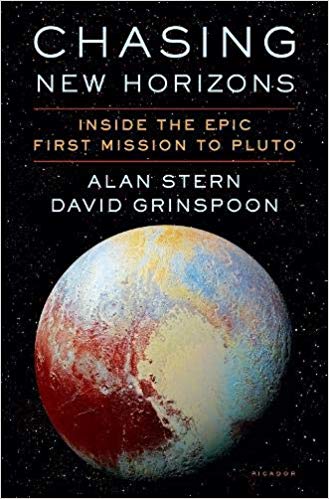
Longest post title ever? Possibly. Gotta love nonfiction books.
This is known: there exists an alternate-universe version of me who has a Ph.D and works as either an astronomer or a planetary geologist. I’ve been fascinated by this stuff for as long as I can remember, and every now and again I really wonder how it is that I didn’t take all that much math and science in college.
(Actually, I know why that’s true. My current enjoyment of mathematics dates to realizing how fascinating statistics was when I had to take a stats class for my … oh, wait, I was a Psychology major, among other things, so I guess I did have to take a fair number of science classes in college.)
(Let’s say “hard science” classes and piss off the psychology people. Like, science with math, which– other than stats– Psychology really doesn’t trouble itself all that much with. Shut up you know what I mean.)
Anyway. I followed the New Horizons mission with no small degree of fascination, and the data they’ve acquired about Pluto and its associated moons is endlessly interesting. Earlier this year the spacecraft did a flyby on a Kuiper Belt object now known as Arrokoth, and I believe there’s at least one more KBO flyby planned before the craft is shut down. Stern and Grinspoon’s book isn’t so much about the science, or about Pluto, however; it’s about the 20-plus-year effort to get the mission to explore the ninth planet(*) approved and the political and scientific process by which the mission itself actually came to be. As it turns out, there were a lot of people who for one reason or another didn’t want New Horizons to happen, and the mission was either actually cancelled or nearly cancelled five or six times, to say nothing of the number of times where something went wrong with the craft itself. For example, I wasn’t aware that they lost contact with the craft just a few days before the Pluto flyby began, and the book’s description of the mad scramble to not only reestablish contact with the by-then-several-billion-miles-away craft but to then slowly re-upload a bunch of mission-critical code updates before the thing sped by Pluto at thousands of miles per hour is compelling as hell.
So, yes– this book is less a work of popular science or a textbook about Pluto than it is a book about history and politics. It’s about the mission, not the planet, and while I wasn’t quite aware of that when I picked it up it’s no less of a good read for it– I’m always down to read something about NASA’s inner workings, and some of the squabbling that takes place between Caltech’s JPL (Jet Propulsion Laboratory) and the Applied Physics Laboratory (APL) at Johns Hopkins over who was going to actually design and build the spacecraft that eventually became New Horizons is pretty damn cool. One way or another, while I haven’t read a ton of nonfiction this year I’m glad I finally let this stop languishing on my shelf and picked it up. You’ll probably see it mentioned again in a month or so, when I write my 10– or possibly 15– best books of the year post for 2019. In the meantime, check it out.
(*) For most of the book, Pluto is very much considered a planet, and the authors’ open derision toward the new definition of “planet” that reclassified Pluto is hilarious. Needless to say, for these guys Pluto is the ninth planet and it ain’t going anywhere.




 Finally got the new glasses today, which was exciting up until the point where I remembered that having a new prescription for my glasses is basically exactly the same as being super duper baked. I’m spending all my time staring at my hand and the floor seems like it’s farther away than I’m used to it being and there’s this weird haze around the edges of my vision that comes from not having trained my brain to not notice the edges of the new glasses yet. One interesting development: these lenses have some sort of new coating on them that is supposed to both screen out certain kinds of light emitted by digital screens and sharpen those images, and holy cow my iPhone has never looked so good before. So I’m staring at my phone like I’ve never seen it in addition to anything else in the world with fine detail. My old prescription wasn’t that out of date, but it’s been long enough since I’ve changed it that I’m way out of practice, if that makes any sense at all.

 None of these are really worth posts on their own– well, one, maybe– but I wanna record them, so here you go.
 Welcome to infinitefreetime dot com