It’s rare that I pick up a Lego set specifically because I want to build it, and not necessarily because I want it on display, but I took a look at the soccer ball set that hit stores in time for the World Cup and then a conveniently timed double points weekend rolled around and my money disappeared. Because look at the inside of this thing:
That looks a lot more complicated than it was, surprisingly enough, and it was tremendously satisfying to put together. Then there’s the bit that goes in the middle:
If you press that little tan piece sitting right in front of the green, the players jump up and down and the fireworks swing from side to side. Then the whole thing can close up, and honestly, the ball looks pretty cool closed up, too:
We aren’t going to do the math on how much this cost vs. how many hours it took to put together or anything like that, we’re just going to say it was a fun way to spend an evening and an afternoon, leave it at that, and … sigh, figure out somewhere to put it.
Book review coming tomorrow; I’m waiting for the high to die down a little bit.
Ghost of Yoteiwas Game of the Year. It wasn’t close. I played a fair number of really good games this year, but the sequel to the best game of 2020 and one of my favorite games of all time was the best game of 2025, and I feel like that’s probably not something that’s going to surprise anyone.
The big story for me this year was how much more use my Xbox got compared to every previous year; I leaned into Game Pass a lot more than I have in the past, and anything that I could get for free on Xbox ended up being played on that console. I’m still pretty agnostic as far as the virtues of the two consoles go; how well a game runs really seems to be more dependent on the game itself than the system I’m running it on, and I’m well beyond the point where gigaflorps and raytraces and whatever the graphical buzzword of the day might be is particularly impressive. The biggest graphical moments of the year for me were a character moment in Clair Obscur and realizing that the light coming through a stained glass window in a church was actually reflecting off my character in the right colors in whichever Sniper Elite I played this year. 6, maybe? Let’s say 6.
For the second year in a row, I did not touch the Switch, and my son showed no interest at all in picking up a Switch 2, so we haven’t. I am strongly considering a Steam Machine when it comes out in 2026, though.
Clair Obscur: Expedition 33 was probably Yotei’s closest competition, and was definitely the most unique game I played this year, as damn near everything else was either a Soulslike or a Metroidvania or a combination of both– I am nothing if not consistent with my preferred genres. It had the best turn-based gameplay I’ve ever encountered and combined it with a stunningly good story and hauntingly beautiful graphics and if it wasn’t for the bit where it used up all of its goodwill in the amazingly misconceived grindfest that is Act III, I’d probably still be playing it.
Khazan: The First Berserker does not involve any berserking but hooooooooly shit was it a lot of fun and I put more hours into it than anything else I played this year, including Yotei. I played through it completely twice before moving on to the next game. That doesn’t happen very often. What kept this one from GOTY? The lack of depth to the story, mostly. The combat was exceptionally good but the story didn’t hold a candle to the emotional resonance of Yotei or Clair Obscur, leaving the game just a touch below both of them.
I also played the shit out of Wuchang: Fallen Feathers, and loved 95% of it, and for the other 5% I was staring at a blurry mess of pixels as the game struggled to keep up with itself. There was also a bug in the platinum trophy, which meant that after doing absolutely everything in the game and getting all of the other trophies, I didn’t get the trophy that you get for getting all the trophies. Look, game, they’re right there. They did finally push through an update months later that gave me credit for everything, and I keep hearing there might be a big story DLC that will absolutely pull me back into the game, but a bug stopping me from getting the final trophy in this one stuck in my craw a bit. The game itself was great, though.
This is the entire map for Crypt Custodian, a game where you play a ghost cat that beats up enemies with a broom. I assume that you can tell how much I loved the game just from looking at how huge and complicated this map is. I love exploration-heavy games. This one was amazing.
And finally …
This is a screenshot from Crime Scene Cleaner, a ridiculous little game where you are tossed into the role of a guy whose job it is to clean up after heinous mob crimes. This includes getting rid of all the bodies, picking up anything broken, restoring anything that isn’t, and cleaning up every tiny little spot of blood. Upgrading your abilities includes things like getting better mops and bags that can hold larger volumes of garbage.
It was, and this is a great way to find out if you and I are people or not, one of the most relaxing games I played this year. Walk into utter fucking nightmare chaos and restore order? Sign me up. I want a sequel. They can do a new version of this game every year if they want to, I’ll keep playing it.
And, for the second day in a row, I’ve written “I want more of this” in a post, then gone and looked, and found out there was more! They apparently released a big DLC back in June and it never crossed my radar. Hooray!
I bought 59 albums in 2025, way off of last year’s pace, which was admittedly kind of insane. Here’s the list, and then I’ll talk specifically about a few of them. This isn’t a “best of” list by any means, just some albums I find interesting.
And yes, “bought” is the right word, as I generally don’t stream music. I played around with Spotify for a bit this year and then cancelled it when they started showing ads for ICE, and I currently have a Tidal account that I’m not really using.
Let’s start with the band of the year, an award that isn’t even meaningful enough to be rendered in capital letters and which I spent no time thinking about prior to writing this sentence:
In the absence of a new Pearl Jam album this year (and I got one last year, so I can’t complain) a new Counting Crows album is about the best thing I could have asked for– and I not only got that, I got a tour, which I had tickets to. I saw two concerts this year, both in the same venue in Indianapolis; Weird Al was the other one. The Crows have still absolutely got it. There are other bands from my era that are still making music and touring, but … not all of them should be, if you know what I mean, and I think you do.
I’m only picking Problematic because the cover has his face on it, but Norman Sann was absolutely my big discovery in hiphop this year. Dude is phenomenally talented and he’s also a huge geek without really letting it take over his music– like, he’ll drop a reference to Baraka from Mortal Kombat into the middle of a verse, but Nerd Rap is a genre all to itself and this, I think, is not that. I picked up five full-length albums by this guy this year and I very much am impatiently anticipating more.
(Goes and looks, discovers a sixth album came out in September!)
So make that an even 60 for the year, then.
The Sinners soundtrack sparked a sudden and fairly intense interest in streaming Irish rage music, which has cooled a bit, but I’d never really listened to the Dropkick Murphys before this year and I should have started before now. For the People, their latest release, and The Warrior’s Code from 2005 got the most plays. I’ll pick up the rest of their catalog sooner or later but haven’t done it just yet.
I think this is the second time Olivia Rodrigo has shown up on one of these things. I still have issues with how the adults around her handled her first album, but she’s an adult now and she dropped a live album on us late in the year. Live pop isn’t completely my thing– I will never get completely used to the idea of singing over your own voice as a backup track– but there’s a ton of energy in this recording and Robert Smith randomly showing up for a couple of duets in front of a very young crowd who appears to have no idea who the hell he is is a nice touch.
Finally, I just picked up the deluxe edition of Mad Season’s Above last week, and it’s long enough that I haven’t even listened to the whole thing yet, but it’s a Goddamned crime that I had never heard of this album until recently. Do you know who Mad Season is? They released one album– this one– in 1995. They’re a supergroup: Layne Staley from Alice In Chains, Mike McCready from Pearl Jam, Barrett Martin from Screaming Trees on drums, and John Baker Saunders from The Walkabouts. The album is fifteen meaty tracks (the shortest is 4:11, and two are over seven minutes) and one of the very few concerts they did. I’m just now starting to listen to the concert. It’s a remarkable fucking project and I’m pissed that I didn’t completely internalize it in 1995 when I should have.
The tl;dr: this was so close to perfect, but probably needed another month or so to cook before getting released.
I beat Wuchang: Fallen Feathers last night after 60 or so hours of gameplay, and for the most part, I was really, really happy with it. Most of my gripes are technical, and the things this game does right, it does very right. This is a Soulslike through and through, which is currently my favorite kind of game, and it hits all the buttons: deep combat, wildly variant weapon builds, obscure quest lines, difficult boss combat, and an emphasis on exploration. The exploration is the best part; Wuchang may have the best interconnected world map I’ve ever played, and it’s incredibly rare that you’ll see a path fork off and one of them end a little bit later in a dead end with a treasure in it. Everything loops around and leaves you somewhere, and it was harder to keep a mental map going (note: this is a good thing) than I’ve seen in a game like this in a long time.
There’s three different major things that this game does that distinguish it from a run-of-the-mill Soulslike. First, what the call the Skyborn Might system. All of your spells and some of your combat abilities are based on how many stacks of Skyborn Might you have at any given time. You can have up to five, and spells will cost from one to all five stacks and weapon abilities generally cost between one and three. Skyborn Might is earned mostly by perfectly-timed dodges, although most weapons have at least one other way you can earn it and there are different items that can add to Skyborn Might as well. One that I kept equipped for most of the game automatically generated Skyborn Might on kills, which came in really handy. Skyborn Might deteriorates over time if you don’t use it, which was good and bad– it encourages you to use your abilities, on one hand, but on the other I felt like it deteriorated too fast, and I’d have liked some way to slow down that deterioration, whether it was a more permanent item or a consumable.
The second is the Madness system. Killing human enemies and dying both generate Madness, and killing nonhuman enemies and various items and locations can decrease it. Increasing your Madness has two major effects: it increases your damage noticeably the higher it is, and it at least supposedly increases how much damage you take, although I went through the whole game without ever feeling like that had caused a death. I never really even noticed it.
On top of that, if you die, you lose a percentage of your currency (Red Mercury as opposed to souls, or blood echoes, or whatever) and that percentage is based on how high your Madness is. If your Madness is less than 100% you can pick your resources up from wherever you died. If it’s at 100%, though? You’re gonna generate a Madness Demon when you go back to get it, and if that Madness Demon kills you, your shit is gone. On the other hand, if you kill the Madness Demon, you get a bunch of other stuff on top of your lost materials, and Madness Demons can be baited into attacking anything, so there are places where generating one on purpose (there are items that raise Madness as well) can be a sound strategic maneuver against an enemy that you can’t find a way to beat. This won’t work on bosses– you can’t generate demons inside a boss arena– but there are occasional more powerful red-eye enemies scattered around, and letting one kill me, generating a demon, then triggering her and running away to watch the two of them fight was fun.
The third is the upgrade system, which runs off of an upgrade tree. Each weapon style (Spear, Greatsword, Axe, Dual Blades, and Longsword, and I spent most of the game in Greatsword) has its own tree but you can go anywhere you want on the tree and you can respec any time at will. Weapon upgrades are also built into the skill tree, and the awesome thing is that 1) any weapon upgrade affects every weapon of that type, even if you get a new one later, and 2) you can respec your weapon upgrades just as easily as your own abilities. So unlike, say, Elden Ring, where if you make a change to your preferred weapon late in the game you’d better hope you have enough upgrade mats available to level that weapon up, if you had a +9 axe and you want to switch to greatsword your greatsword will automatically be +9. In fact, all five of the greatswords you’ve found will be +9, and if you find a sixth that’ll be +9 when you pick it up. In every other Soulslike I’ve played, just because you leveled up Longsword A doesn’t mean Longsword B is improved as well. This is a huge improvement.
The problem is the performance. This game, at least on Xbox (I picked it up here because it’s currently free on Game Pass) is very poorly optimized, and while you can lock the framerate at 60, you’re going to see constant blurriness and focus issues as the game struggles to keep up with itself. I played without the frame rate locked for a little while and the frame drops were so bad I had to switch back. This is on the Series X, mind you, which is supposed to be the beefy one; I can’t imagine what this would play like on the less powerful Series S. There are some balance issues– there’s a huge difficulty spike with a boss about a third of the way through the game, and the game really expects you to use a certain mechanic to beat that boss, only all weapon types don’t have access to that mechanic. As it turned out, I’d started with a Spear build, and the Spear build is the one least capable of managing this boss. I had to respec, and once I did I sailed past her. Now, again, the game encourages painless experimentation, and I could have switched back afterwards, but it left a sour taste in my mouth. I don’t object to the idea that certain bosses are weak to certain styles and stronger against others; that’s a staple of the genre– but “you need this type of ability to win here, and this weapon doesn’t have that at all” is a problem.
There’s a few other things; it’s way too easy to fall off of ledges, which is partially a skill issue, and until very recently the icon that shows where you dropped your resources was really hard to see against some level backgrounds and invisible if you were unfortunate enough to die in shallow water, but they’ve patched that problem out in the last couple of weeks. I know Soulslikes aren’t for everybody, and if they aren’t your thing you’ll want to stay away from this, but if they do, and especially if they do and you’re on Game Pass? Hooooooly shit. And it’s only $50 at full price, and it’s a good enough game that I’m considering picking it up for the PS5 anyway. Check it out.
You should play this game, regardless of how much time I spend dwelling on its mistakes in this review. Despite the … uh … let’s go with unwieldy name (“Clair Obscur” just means “light dark” in French, which is not better) this is a smart, tremendously well put-together game with a great story and impressive game mechanics that stumbles in an equally impressive fashion at the end. It’s turn-based, which is normally a sign for me to stay far away from a game, but it manages to throw in a few mechanics that depend on timing and skill anyway– your characters can parry or dodge attacks and there are a couple of other special attacks that you can avoid in specific ways as well. Dodge everything and you won’t take any damage; parrying successfully can lead to automatic counter-attacks. If people haven’t started doing no-damage or even no-attack runs on this game yet, they will be soon.
But the most impressive thing about Expedition 33 is its story, and I’m not telling you a damn thing about it other than the game is set in a vaguely post-apocalyptic France, except it’s not, and even the reason it’s not really set in post-apocalyptic France is a whopper of a spoiler, so I’m not going to say anything about it. Usually when a game is set specifically in a non-English-speaking culture I’ll do the audio in that language, but there are a couple of big names in the English voice acting team and I’d recommend you stick with that.
There were at least two times in this game where story developments knocked me flat on my ass. Prior to playing this, the most jaw-dropping moment I’d ever encountered in a video game’s story was the “would you kindly” moment in Bioshock, which came out in 2007. (If you don’t know what I’m talking about, find something that can play Bioshock and get on that. Right now.)
At any rate, the Bioshock moment held a record for 18 years. The first moment in Expedition 33 held its record until the second moment. The game’s story is going to rip your heart out and stomp on it, more than once. Be prepared for that.
On a technical level, it’s one of the best-looking games I’ve ever played, particularly in its renditions of the game’s people. Everyone looks great, and the facial expressions especially are masterfully done. There’s a moment in the final battle where I think the game really wants you to notice someone having second thoughts without drawing direct attention to it, and it’s just incredibly well-done. The characters are memorable, and Esquie, who is a giant sentient balloon-thing who basically acts as transportation for your group, is probably the most adorable character I’ve ever seen in a video game before.
Here’s the problem, though: The game has three acts, and the story is effectively over at the end of Act 2. All you have to do at that point is go beat the main boss, and the game tells you exactly where to go to find that person. You are probably already leveled up enough to be able to get the job done, too. But there is a huge amount of content left– you’re no more than 50% of the way through the available locations and the handful of collection objectives the game has cannot be completed before the end of Act 2. The problem is, with no story left to get you to go anywhere, you’re either just grinding until you get bored or kind of flailing about because suddenly most of the “new” areas are way too tough for you. And that’s a damn shame. I ended up beating the game because I didn’t want to play anymore, and that’s not how this game should have ended. On top of that, because of the amount of extra stuff I’d done and some fiddling with optimizing my characters, when I finally got to the final boss I beat the shit out of him because he was scaled to be able to fight him right after completing Act 2. The climactic battle of this great game was over in no time because I was so overpowered– and had I maxed out my character’s available levels (I wasn’t even close) it would have been so much worse. I hadn’t even found the best available weapons for two of my five, and the ones I had weren’t fully leveled up. I never even found the materials necessary to hit max level on weapons, and beating the boss before that happens is nuts.
The pacing in this game is really unforgivable, and it’s amazing to me that no one caught it in play testing. All they would have had to do is move some of the major story beats back a bit, or given Esquie the ability to fly earlier in the game– he gets it automatically at the end of Act 2, but again, if you want, the game is effectively over at that point. And it’s a damn shame to be thinking that a game is a shoo-in for Game of the Year for the first two acts and then beat it because you’re bored five or six hours later.
So yeah: mostly successful, and hugely successful at what it’s good at, but with that one huge caveat you should be aware of. Play it anyway.
I can’t believe I mean this: right now a game called Crime Scene Cleaner is somehow one of my favorite games of 2025. That sentence is true. I have spent twelve hours or so mopping up blood, moving bodies, and picking up broken glass in a video game, and it may be the most chill and genuinely relaxing game I’ve ever played.
The premise is real, real simple: you’re a janitor who gets hired by a mob boss to clean up after his people. You take the job because you need money to pay for your daughter’s hospital bills, which makes this the most American game of 2025. You accept jobs through your computer and the occasional phone call from “Big Jim,” the guy who signs your checks. You have a dog. There’s an achievement for petting the dog 15 times. The crime scenes range from a small apartment to an entire museum to a giant warehouse. At the end of each job you get paid based on how thorough a job you did; money can be used, not to pay for your daughter as you might think, but to upgrade your cleaning tools, accomplished through a skill tree, so you honest-to-God might pay for an upgrade to how much blood your mop can clean up before you have to wring it out in a bucket, and you can also upgrade how many detergents you can add to the bucket at once. By the end of the game you’re able to dual-wield sponges, which is not a phrase anyone had ever said or thought of before this game came out.
There is something primordially satisfying about walking into this:
and walking out an hour later with the floor and walls spotless, the broken tables whisked away, the bodies safely stored in your truck, and everything that wasn’t broken put back exactly where it belonged. There are some collectibles– every level has a few cassette tapes hidden away, and there are secret areas all over the place that you can uncover, and exploration is a lot of fun, especially once you unlock the– again, I’m not kidding– upgrade that lets you walk across blood without leaving footprints all over the goddamned place afterwards. You’ll need to find keys and the occasional key card, and oh, you’ll also rob everyone blind while you’re cleaning. The great thing about working for the mob is the people they send you after tend to have piles of cash and jewelry and stuff just sitting around! They’re all dead, they don’t need it any longer.
There’s no real point in talking about graphics or sound; they’re good enough and no better. The rag doll physics can occasionally be kinda ridiculous. You can jump or fall from any height and be fine; it’s impossible to die, so there were definitely times where I was moving a body and just chucked it off a balcony and then jumped after it rather than carrying it down the stairs. My only real gripe is that if you’re a completist, like me, and you want to 100% everything, every so often there’s a single bullet that you accidentally knocked somewhere with your mop that takes an hour to find, or a single spot of blood that you just missed that is too small for your UV lamps or your “Cleaner Vision” (no, seriously) to spot easily. Having to end a level at 99% blood cleanup because you just could not find that last spot is kinda annoying, especially when the game really does need about an hour to an hour and a half per level.
But yeah. This was a blast. Twelve hours or so was enough to 100% every level and get all but five of the achievements; I’m gonna jump back into finish those off just because I’m that guy. It’s on Game Pass right now, so if you have that, you don’t have to pay for it, but it’s worth the $20 or so you’d pay if you actually buy it.
Oh, and I vacuumed the whole house today, because I’d been cleaning in a video game for several days and felt kind of guilty about the condition of my actual house, which is a real place with cats in it that needs vacuuming way more often than I actually do it.
The first book of this trilogy sat on my Unread Shelf for way too long, mostly because I knew it was book one of a trilogy and if I read it and liked it I was locking myself into the next two books. And, well, yeah, in accordance with prophecy, I ordered The Fractured Dark and The Bound Worlds within the first couple hundred pages of The Blighted Stars, and … well, yeah. This is real good stuff.
The Blighted Stars starts off as a combination of a corporate espionage book (it’s one of those worlds where five big ultra corps control basically everything, and the leaders of those corporations are basically royalty) and an eco-disaster book. The Mercator corporation holds a monopoly on mining a material called relkatite, which is more or less completely essential to human civilization; it powers starship drives, for one thing, and it’s essential in printing human bodies as well.
… yeah, roll with that for a minute, I’ll come back around, I promise.
The two main characters are Tarquin Mercator, the scion of the family, who would prefer to not actually have anything to do with the family business and just study geology for a living, and Executor Naira Sharp, a monstrous badass who acts as a personal bodyguard, more or less, to Tarquin’s father. She’s also a revolutionary who wants to tear down the entire system from the inside. The Mercators are battling a major problem on their mining planets; a fungus that they’re calling the Shroud has begun appearing anywhere relkatite is mined, and it’s been overwhelming entire planets, rendering them more or less biologically sterile and preventing further mining from taking place. There are not many planets where humanity is actually able to live and thrive (the Earth has been rendered inhabitable a long time ago by the start of the series) and so the Shroud’s spread poses a genuine threat to the further existence of humanity.
That’s where it starts. It gets really fucking wild after a while, trust me.
For me, though, the most interesting thing about the series is the whole “human printing” thing. Basically nobody is in the body they are born in; if I understand the process correctly, once a kid comes of age they can be reprinted into new bodies that are more to their tastes, and people back up their own minds with some regularity, so that if they die the body they get reprinted into will have memories that are as close to “up to date” as possible. This isn’t necessarily unlimited; for one, it’s quite expensive, and especially traumatic deaths (or too many of them) can lead to a psyche being “cracked,” which basically drives the person irretrievably insane. The same will happen if someone is accidentally (or deliberately, as it turns out) double-printed, so that their mind is in more than one body at the same time. The fact that a cracked mind cannot simply be restored from a backup sounded like a weird sort of cop-out at first and ended up being really important later on.
The thing I like the most about this plot device is that O’Keefe really appears to have carefully though through its implications on society, to the point where I spent the whole first book trying to poke holes in this idea and make it retroactively dumb and every time I came up with something she’d anticipated it and dealt with it. Society is completely queernormative, for one thing; when you can simply reprint yourself into another body any time you want it’s hard to be against trans or gay people, and it’s heavily hinted that Tarquin was not born into a male body. There are a couple of prominent gay married couples as side characters as well.
The second thing, and I suspect some people might really be bothered by this, is the wide acceptance of suicide. Because you’re not really killing yourself; you’re just killing that print (the word “print” is used much more often than “body,” if not, possibly, every time) and you’ll be back soon anyway. In fact, a quick and clean suicide is a much better idea than several other ways you could be killed, because remember, really traumatic or messy deaths can lead to cracking. I feel like slitting my own throat might be kind of difficult, but it happens repeatedly across these books.
This blasé attitude toward death extends to murder as well, which is probably still illegal but not as much? This is probably a bigger deal for the poor, who can’t afford what are called “phoenix fees” to reprint, but all of the book’s main characters effectively have access to infinite money and so the characters kill each other with astonishing regularity. There is at least one point in the book where a character gets killed at the end of one chapter and then is the POV character of the next chapter after being reprinted in between the chapters.
My two biggest critiques of the series are both connected to reprinting. One, shit can get really confusing when a character dying does not have any actual impact on whether that character continues to show up or not. There are also occasional jumps forward or back in the timeline– not a ton of them, but they happen– and when you aren’t the world’s most careful reader (ahem) there can be a lot of rereading happening because something confusing has happened and you’re not sure if you missed a detail or not.
Second– and literally as I’m typing this I’m realizing what the answer is, but I’m going to do it anyway– is the notion that reprints are literally being loaded back into bodies from a “map,” which is their word for a personality download or backup, and maps can be altered through various nefarious means, but no one is against this whole idea, which I would think would be a thing. It’s the Star Trek problem– is the transporter really moving you from one place to another, or just killing you at location A and reconstructing you at location B? Personally, I’ve always been of the “killed then rebuilt” school, but people in this world really just treat reprinting as an inconvenience that might cost them some memories– and that’s occasionally even used strategically from time to time.
(The book does answer this, but kind of obliquely, to the point where I really did just realize what was going on, and I think they’re just relying on the tech having been around for so long that nobody thinks in these terms any longer, much like by the time Star Trek: The Next Generation rolls around absolutely no one is fighting against using transporters.)
I really enjoyed this series, and Megan O’Keefe has been around for a while, so there’s a bunch more where this came from, although these are currently the only books in this series. Strong recommend, especially if you’re in the mood for some complex, twisty sci-fi.
I would typically expect to be Sundaying pretty hard at the end of Spring Break, but that’s not what’s happening. I’m not stressed at all. That said, I’ve had one hell of a time figuring out what the hell I’m going to do with my students this week, and more specifically what I’m going to do with them tomorrow, and I finally settled on a super basic, 20-question paper assignment with a mix of stuff from the last quarter on it. I’m titling the assignment “I Hope You Remember Math.” They’re all going to be lethargic and asleep tomorrow anyway so I think trying to start anything new (and the next unit is probability) is probably going to work against me. Then Tuesday through Friday on the basic principles of probability, skip the test, and two weeks of ILEARN review? Sure. Why not.
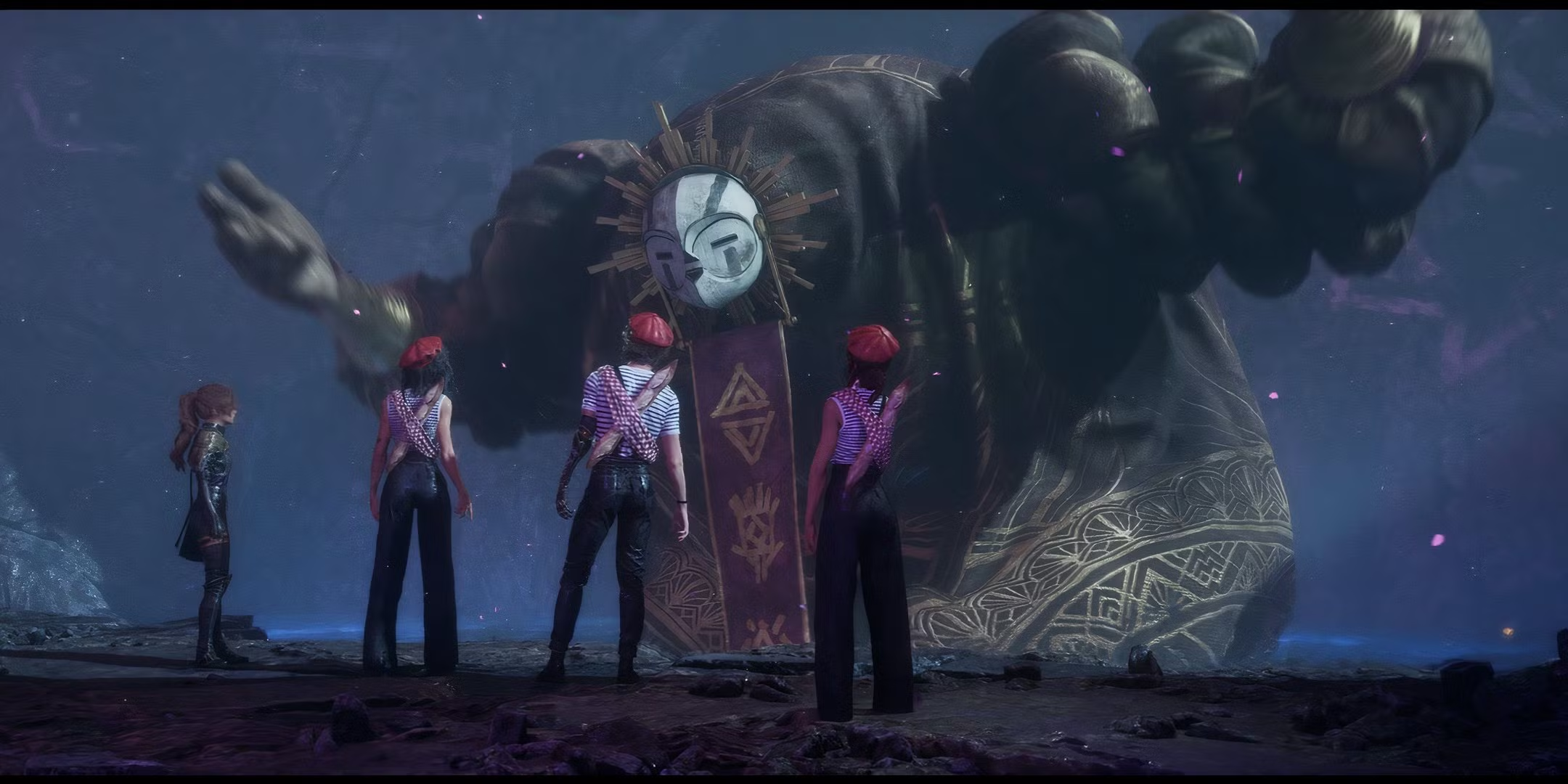
And after that … well, I chose the image up there for a reason. Right now I don’t even know what classroom I’m supposed to be in tomorrow (I was supposed to be back in my original room, but the weekly staff bulletin says otherwise, but the weekly staff bulletin also shows significant signs of having been copy-pasted from the last weekly staff bulletin) and that makes it really hard to plan. So tomorrow is going to have to be the last gimme day for a while, but that’s fine. It’s all fine. It’ll all be fine.
Unless the world blows up or something, but I’m gonna try not to worry about that too much.