
#REVIEW: The Raven Scholar, by Antonia Hodgson

I got a second copy of Antonia Hodgson’s The Raven Scholar on the day I started reading it. And it wasn’t quite on purpose– the copy on top there showed up on release day, since I’d preordered it after it caught my attention somewhere at some point in the last few months, and then Illumicrate sent me another copy as part of their monthly box. This is the first time that’s happened; the unofficial rule for Illumicrate books seems to be that they only send me books I’ve never heard of, and this is the first time they’ve sent me one I already owned, although I have bought a couple after reading them so that the series were sure to match. One way or another, though, the Illumicrate edition is fucking gorgeous, one of the prettiest books they’ve sent me, so I’m not pressed about it.

… and suddenly I want to change the title of this post and take the word “review” out of it, because the more I think about it the less interested I am in writing even a traditional-by-my-standards book review. This book is weird; I enjoyed reading it, and I’ll pick up the sequel– which may be, in and of itself, enough of a review for anyone who cares at all about my opinion– but there’s a lot about it that makes me reluctant to star-rate it. For one, it’s a Magical Tournament book, and I am tired of books that can be boiled down to the name of a trope. On top of that it’s a People Are Sorted Into Categories book, although it’s not the entire society, at least, but nearly all of the main characters in this book represent the devotees of one of the eight animal gods (creatively named “the Eight,” although it’s fun seeing the word “eight” used as a swear word) and some of the ones who don’t used to. Which leads me into another gripe, which is that every character effectively has three names, since sometimes they’re referred to by their first names, sometimes by their last names, and sometimes just by their faction, so you might see someone talking about “the Hound” and you have to remember who that is. Spread that out over the eight people involved in the tournament (which is how they pick their emperor, who appears to be a king, and I wish people would learn the difference) and keeping track of everyone can be a little more complicated than maybe it should be.

But! There’s a murder mystery at the heart of this book, and the murder mystery is wrapped around the succession tournament and the eight-faction worldbuilding thoroughly enough that it’s hard to extricate from it– this story only works in this world– and main character Neema, the titular Raven Scholar, is tasked with untangling the mystery as well as trying to become emperor on the side, a job she’s not even interested in, because the outgoing Emperor has ordered her to try to become his successor, which makes more sense in context than it might sound. Only Neema’s not much of a scholar– she’s more of an autistic nerd, which isn’t quite the same thing– and occasionally she gets really good at physical combat because she has to.

Oh, and there’s a Shoehorned Enemies-To-Lovers Romance, because everything has a name nowadays.

I dunno. I liked this book, as I said, but every ten pages or so something jumped out and kind of annoyed me? But not enough that I didn’t five-star it, although right now I’m not sure why? Because maybe I don’t know what a five-star is, and of course I’m writing this, when I could have just not talked about the book.

Maybe I should just go back to bed.(*)

(*) It is 6:18 PM.
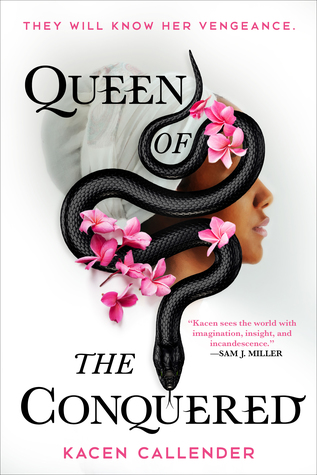
#REVIEW: Queen of the Conquered, by Kacen Callender

I generally don’t write reviews of books that I didn’t really like. There are a couple of exceptions here and there, where I really hated something and wanted to let others know of said hatred, and at least one bad review of a book by an author I really like that has honestly gotten more attention than I’ve wanted it to. And while I certainly didn’t hate Queen of the Conquered, I didn’t like it very much either, but there’s enough about it that’s interesting that I’m writing about it anyway.

Let’s start on a positive note: this book’s struggles are all with structure and character, but the writing itself is of high quality. Feel free to take this review with as much salt as necessary, because the things that bothered me may not bother other people, and Callender’s skills as a wordsmith are above average. While I’m not certain I have any further interest in this particular series, I’ll be keeping half an eye on them in the future and I can imagine buying more of their books later on. And, again, the subject material and setup is pretty damn interesting; getting to a point where you’re writing a book I pick up is half the battle.

So, that subject: Queen of the Conquered is set on an archipelago that has been conquered and colonized by people who aren’t specifically identified as Dutch or maybe Scandinavian (the book isn’t set on Earth) but certainly scan that way, and the dark-skinned natives are held as slaves. The main character, who has several names throughout the text and who I’m going to call Sigourney for consistency, is half-native but because of Reasons is effectively a member– if a despised member– of the ruling, white-skinned colonialist class. She is also one of a smaller number of people, some colonizers and some colonized, who have what is referred to as Kraft and what are effectively (non-superheroic) X-Men style mutants, as no one’s Kraft works like anyone else’s. There’s a woman who can make anyone feel pain at any time, and a dude who can ask questions that must be answered honestly, and another who can create fear in other people, but no, like, metal skin or laser blasts or anything like that. Sigourney’s Kraft allows her to see into the minds of other people and influence their thoughts or sometimes take over their bodies; there are scenes where she is attacked and she fights back by sequentially taking over her attackers and having them kill themselves.

See the tagline on the book up there, “They will know her vengeance”? The basic plot of the book is Sigourney’s plan to be named as regent by the king of the archipelago and take over the islands, then to slowly destroy the ruling class from within, even though from the beginning all of them hate her– including a husband who she basically forces into marriage– and the plan is rather underpants gnomey throughout the book.

Spoiler alert: they will not know her vengeance, at least not in this book. They will know some vengeance, but it won’t be Sigourney’s; one of my major gripes with this book is just how passive she is throughout the book. She talks a lot about her plan to be named regent, but never really does anything about it, and the really weird thing is that throughout the book someone else is killing off a lot of the ruling class and while Sigourney is getting blamed for it by all the white people she doesn’t actually have any idea who is doing all the killing and spends good chunks of time hiding in her mansion and being worried that someone is going to cut her head off.

There’s a lot going on here that is interesting: Sigourney’s relationship with her husband, who hates her, and her relationship with her husband’s black half-brother, who also hates her (everyone hates her; be prepared for that) and the simple novelty of a book written from inside the head of someone who is of the same blood as all the enslaved people around her (many of whom are enslaved by her) and who is therefore despised by literally every other character in the book, even her closest allies, and who is trying to navigate the racism of those in her class and the (entirely reasonable) class-and-oppression based hatred of her own slaves– it turns out that “you look like us but are enslaving us anyway” is not a reason for people to like you– along with trying to bring her own plan to conquer the islands and free those slaves, but without anyone who she can confide in about that plan, because, again, everyone hates her.

(There is also a really interesting conversation where her husband’s half-brother, who, remember is enslaved by that half-brother and therefore by her as well, forces her to cut through the underpants gnomery of her plan and think about what she’s going to do with all these former enslaved people once– if– her plan works, and her utter befuddlement at the idea that she’d lose some of her privileges is really a thing to read.)

Figuring out who is doing all of the killing by the end of the book is an interesting measure of how much you buy into the racist structure of the world Sigourney lives in, by the way, and the fact that she herself doesn’t figure it out demonstrates nicely where in that structure she really thinks she belongs.

Ultimately I think the weight of all of this just became overwhelming for the author; this is a really interesting setup but it’s balancing an awful lot and the combination of narrative complexity with a fairly passive main character who can’t really talk to anyone so she just spends a lot of time thinking and reflecting and living in her own head– which is kind of boring, honestly– ends up really hurting the book. This was a three-star for me; not at all bad enough that I’d call it bad, as what it is is a novel with a lot of promise and some serious problems, but not good enough to really recommend it. If after reading this you think this might be worth a look at anyway, I’d go ahead and follow that impulse, but maybe try and get it from the library if you can.