I’m finding myself weirdly not in the mood to write about this, but in the absence of anything else not involving profane ranting and raving, I’m just going to tell you that Ender Magnolia is a quality if not life-changing Metroidvania, and that it excels mostly in the exploration side of things. The combat and build styles are really interesting– you bond with AIs called Homunculi throughout the game, and each of them will give you either a travel ability or some sort of new approach to combat, and on top of that each combat homunculus will have three different and sometimes wildly divergent abilities to play with. You’ll have ten or so available by the end of the game, so that’s thirty different abilities, plus items called Relics that can add buffs or tweak your build in other ways, so this is also a game that’s big on build customization.
I liked it, and I platinumed it today, and if you’re into Metroidvanias as a genre at all it should definitely be on your list. Unfortunately I’m tired and kinda crabby at the moment for no particular reason, so I’m going to cut this shorter than I originally had planned. What should I play next? Both of these are on sale right now:
I told myself it was beating Ender Magnolia or bust tonight, and now that it’s 9:30 and I’ve somehow failed to eat dinner I’m forced to admit that my choice is “bust.” Bah.
For the record, I did see Fantastic Four: First Steps today, and it was magnificent. Full review coming, probably tomorrow.
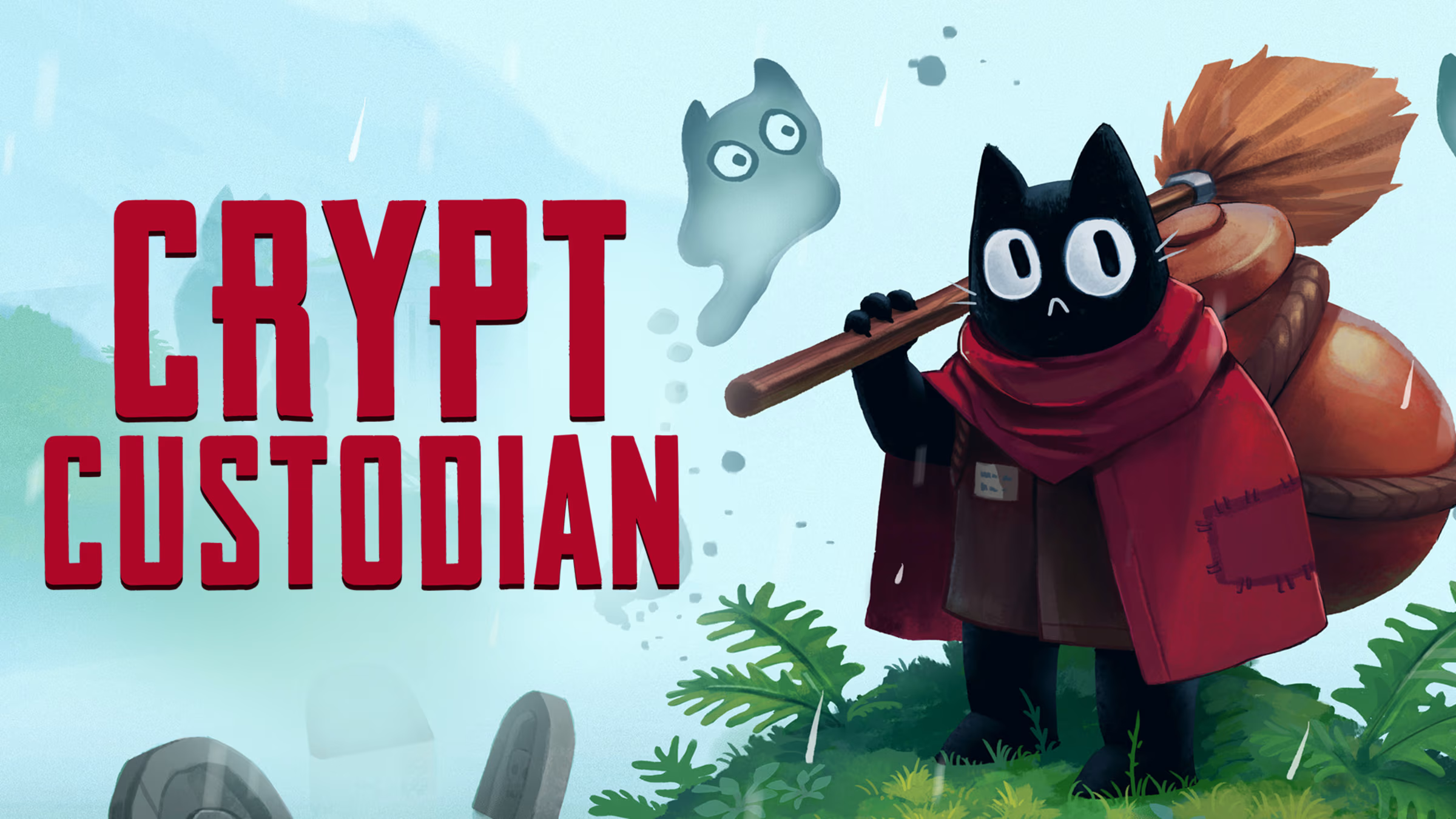
I finished Crypt Custodian yesterday, hitting 100% after about fifteen hours of play, although there’s a boss rush mode I’ll need to dip into if I want to get all the trophies, and I’m probably not going to. It’s one of the nicer surprises of the year, because I basically just grabbed it for free from Game Pass based on the image you see up there.
It’s a Metroidvania. You play a cat. You’re dead and a ghost. You’re prevented from entering paradise by a really bossy dead frog (that’s not a joke) and you spend the entire game cleaning up trash with your broom and whacking monsters with it. In classic Metroidvania fashion, you unlock a bunch of abilities over the course of the game that let you go back and get into areas you couldn’t reach before, and while I have no intention of spoiling the ending, it revolves around making 10 friends so that you can invade Paradise and visit your still-living loved ones, and the ending will make you cry a little bit.
I play these games for the exploration, right? This is the map:
Or, if you prefer a slightly more abstract, right-click-for-much-larger version, you can have this one:
Don’t worry about the Chinese, the words don’t matter. The point is the map is ridiculously large, and the different areas are wildly different, some with environmental challenges (one area reverses its polarity every time you dash, making walls and floors either appear or reappear along with roughly half of the enemies at any time) and some that just look cool. There’s rainy forests and castles and tombs and enormous retail backrooms and an amusement park. You can teleport to save spots at any time and there’s no penalty for dying, and you can even unlock a power-up late in the game that prevents missed jumps from hurting you, so there’s a strong incentive to just pick a direction and go. Your power-ups can be equipped using little upgrade spheres that can be found or purchased, so there’s an element of switching back and forth between them depending on what you need to do– I found myself with an exploration build and a boss fight build after a while, for example– although by the end of the game you can find enough of the spheres that you can equip nearly everything you need, and you might be able to buy as many spheres as you want; the one vendor doesn’t seem to run out of them.
So, yeah. Games like this are why Game Pass is worth the money; this game is delightful and everyone should play it, whether they have to pay for it or not, but if you can get it for free then you really have no excuse. Give it a shot.
The tl;dr verdict: 7/10, but I think it’s my fault.
On paper, I should have absolutely loved this game. Nine Sols is a combination of a Metroidvania and a Soulslike– two of my favorite genres– with a combat system that is basically a 2D version of Sekiro bolted onto it. The level design is great (although the ability to leave markers on the map would have been greatly appreciated,) the enemy design and overall graphics are wonderful, and the bosses are basically perfect, the kind of boss design where you get utterly annihilated in the first five or six fights and then it slowly starts to click and by the time you win it’s because you can see into the future.
So how come I turned the difficulty down to “infant” 2/3 of the way through the game and rushed through the back part as quickly as I could?
The storytelling is interesting in this game, and I can easily imagine it being someone’s favorite part of the game. The story is deep and twisty-turns and has a fascinating fusion of future-inflected Taoism with high technology and weapons like spears and swords and bows, and the relationships between the main characters are awesome– I haven’t seen an exploration of fatherhood, albeit unintentional fatherhood, done this well in a game since The Last of Us, and the story motifs of revenge and regret and colonialism are all done really well.
But, man, the main character is a dick, and after a while I really got tired of Yi. He’s a scientist in a religious culture, which is cool, and he’s kind of an irascible ass, which is cool– Aloy from Horizon Zero Dawn is one of my favorite characters, remember, and her main personality type is “impatient asshole”– but he’s got this weird dismissive, arrogant atheism about him that somehow managed to make him a turn-off to me, an arrogant atheist. Combine that with no voice acting at all, meaning that I was fast-forwarding through massive amounts of dialogue all the time, a very rare opportunity to choose a dialogue option that I almost always missed because I was hammering a button to get past the word bubbles (and which, 95% of the time, made no difference at all, and 5% of the time chose the ending for you) and a general predilection for pontificating and meandering philosophizing, and … ugh. I lost patience with it after a while, and again, I can absolutely see someone else really digging the story in this game, but I just wanted to be done with it after a while.
I spent 34 hours with this, picking up 30 of the 36 trophies along the way (a second play through is required to 100% if you’re not savescumming, and turning down the difficulty lost me one of the trophies as well) and I think if it had been a 25 hour game I’d have been singing its praises from the firmament. It just wore out its welcome after a while, and once it did even some of its strengths turned against it– if I’m getting tired of a game and just want to finish it and move on, the boss design that is one of the greatest things about it becomes a problem, because I don’t want to spend an hour or two (or more like four, looking at you, Lady Ethereal) learning a boss’s patterns. I want to turn my attack power through the ceiling and three-shot the final boss in the game. Which I did.
So, yeah, ultimately this was a game that I should have really enjoyed that I didn’t, but if you feel like this sounds like your type of thing, I’d follow that instinct anyway, and if you’re a story person, it’s definitely worth a look, especially at $30.
The slightly longer version: The Last Faith is a mix of my two favorite genres, as a Soulslike and a Metroidvania, of much the same ilk as Blasphemous and Blasphemous II, with which it also shares a weirdly religious background, a relatively incomprehensible story, and pixelated art design. And, to be completely honest, I could end this review right here by saying that if you liked Blasphemous II, you should pick this up, and expect a game that is about 85% as good. Which is a compliment! Both of those were good games. This is not quite as good– it’s easier, for starters, and it’s a little too fond of instadeath spikes in obnoxious locations (although part of that was my fault, for not figuring out a way across an obstacle in a really annoying place) and the graphics aren’t as good. Your inventory can be really rough, for example:
Okay, a few of those are obviously guns, but if I told you that the item that’s highlighted is a grenade launcher, more or less, would you have any idea? Can you tell that the item next to it is a bow? What about the one above that? Or the one to the left of what is pretty clearly a minigun?
The spell icons aren’t super clear either, and this isn’t the worst example of the inventory screen, but you get the idea. I don’t complain about graphics often, but even for something with retro graphics this game can be pretty muddy. Combat is excellent and the variety of weapons available is pretty good– superior to both Blasphemous games, so long as we’re making comparisons, although I never really got into the guns very much and I’m not convinced a gun build is really viable since bullets are limited. Control is snappy and sharp, though, especially on some of the later bosses where dodging a barrage of lightning bolts is going to depend on near-pixel-perfect positioning (say that four times fast) and without good controls that would have been hellaciously annoying and frankly a little unfair. Fair is a critical component of a good Soulslike, of course: if you can find lots of videos of people beating a boss without being hit when you can’t get a quarter of the way through its health bar without getting melted, chances are it’s a pretty good Soulslike. Soulslikes love bosses who are hard until you figure them out and then become trivial. This game does that quite well.
One slightly less fortunate aspect of Soulslikes that it brings with it is super obscure side quests, unfortunately, including one that I wasn’t able to finish because it just abruptly became unavailable on me. I was two achievements away from Platinum on this game; one of them was for that side quest and another was for fifty parries, a mechanic I never used, as this is very much a dodge-and-jump game and if I was standing still and close enough to parry something that was attacking me I was doing it wrong. I’m probably not going to do another playthrough just to collect those two trophies and the Platinum. I might, you never know, but probably not.
But yeah– we’ll call it an 8/10, easily, and at $24.99 for full price for about a 25-30 hour game depending on your skill level and willingness to do some farming (progression was pretty quick one way or another, although I don’t think I actually lost any … uh … nycrux, whatever that is, to deaths during the game, and if you’re dying a lot YMMV) you’re getting pretty good value for your money if you like these genres. I finished the game at 98% completion before hitting the final boss and I assume that last 2% is probably related to the quest I missed as I’m pretty damn sure I hit the whole map.
Well, this was an unexpected little bit of awesome.
I don’t know what caused Carrion to catch my eye– I mean, it was on sale for $5, and still is until tomorrow, but that’s usually not enough– but if somehow you happen to be the reason I found this fun little game I need to thank you. Carrion is a pixel-art Metroidvania and a “reverse horror game,” where instead of playing the intrepid scientist or lone soldier trying to kill the horror that wants to eat you, you play the monster. Your goal is to escape the giant facility you’re imprisoned inside, and if you happen to eat every living thing inside it along the way, more the better. You are, effectively, playing a shoggoth; a giant Lovecraftian creature made of flesh and teeth and eyes and tentacles, and over the game you acquire powers ranging from defensive spikes (which I don’t think I ever used, come to think of it) to different movement abilities to growing protective chitin to just getting real, real big and terrifying.
It is gross, in a pixelated sort of way, and your attacks can literally rip your enemies in half. I encourage eating every little part of them, but if you rip someone in half and then just eat their head I think you get the same benefits (health and size upgrades) you get from eating the whole body, so if you decide to toss the legs across the screen, go ahead:
Most screens end up covered in blood after a while, because even your non-offensive moves will cause your shoggoth to leave blood behind; if you smash through a door it won’t actually affect your health but you will leave bloodstains behind.
Your various enemies range from unarmed humans, who will hide and cower, to unarmored people carrying handguns to shotgun- and flamethrower-toting soldiers to the occasional drone and mech. Nothing ever respawns, which led to what at first I thought of as a cheap tactic when facing a ton of enemies– run into an area (your monster moves crazy fast most of the time,) rip someone, anyone in half, and then dart back out before the three guys with flamethrowers and the one guard with a shield and machine gun can kill you. Head to the nearest save point (you basically make your way through areas by unlocking all the save zones, at which point you can get to the next area) and save, which gives you your health back, then rinse and repeat.
It felt cheap until I realized that it was exactly how monster movies work a lot of the time. The monster shows up, kills somebody, then disappears for a few minutes until coming back and killing someone else. The fact that there were generally multiple ways to approach any given zone full of food enemies just made this even better. Of course I can come back at full strength! Did any of the monsters in the Alien movies ever limp? Obviously not. This is a monster movie. My job is to terrorize motherfuckers, not to get killed.
Oh, and you can also smash through a door, then grab the door and beat the hell out of something with it. The way to beat drones is to grab them and bash them into other things, like walls, and floors, and civilians, until they’re broken. It’s a blast.
I had a lot of fun with this, obviously, but there were a few points where the game got in its own way. To start, at the maximum size, your monster can get tricky to control. Check this screenshot out:
You tell me: which end of that thing is the front? Is it going clockwise around that block in the middle or counterclockwise? At maximum size, you can easily stretch most of the way across the screen, or bunch up into a big blob, and this leads to occasional control hiccups, especially when trying to squeeze into small holes or (especially) flip switches at maximum size. There are a couple of places where you need to squeeze into an elevator and flip a switch just outside the elevator to move it, and hitting the switch with a tentacle was more annoying than it should have been. The most frustrating part of the game was a sequence where you needed to be at full size (abilities are tied to the size of your monster, which … was not my favorite design choice) in order to grow armor that would keep a little exploding harpoon-thing from one-shotting you, but the harpoon-thing respawned, and it respawned faster than your armor ability, so if you didn’t get your entire body past the radius of where the harpoon would shoot at you, you could survive the first shot and then get killed by the second one before you could do anything about it. Most of the time, though, traversal was a lot of fun; you can basically move in any direction at any time, as the beast just flings out tentacles and pulls you toward wherever you want to go.
If you have a PS5, there’s literally no reason not to grab this right now while it’s $5. If you like Metroidvanias, it’s maybe a little short, at 5-6 hours, for the full $20 price, but I suspect it’ll be on sale again soon, and even if it’s a little short for the price it’ll be a good time.
I wrapped up my Let’s Play of Blasphemous today, which is going to run 30 episodes, and since Episodes 10 and 11 just dropped today I’ve got a minute before I have to start the next thing. If you haven’t paid any attention to my videos, the thing you need to know about the game for the purpose of understanding this post is that it’s loaded with collectibles and secret rooms and all sorts of things that my lizard brain covets because I am that type of player. When I beat the game I had a completion percentage in the high nineties but was still missing several clearly unimportant but still not in my damn inventory items, and I spent a good chunk of this afternoon finishing off finding the last handful of things and finding every single spot on the map.
This was, mind you, a lot of stuff, and required not one, not two, but four different “here is where all this stuff is” websites and/or YouTube tutorials to find everything. Most of this, for the record, was not filmed, but was done for my own edification and because I am insane. After all of it my completion percentage was an agonizing 99.81%. Not acceptable! I must have 100%.
So I found another video that purported to show the hardest-to-find spots on the map; mostly out-of-the-way places that don’t scan “HEY LOOK HERE FOR A SECRET” on the map or on the screen and require you to whack a wall or a corner of a wall that you might not have any good reason to go near so that you can open up a single, small room.
After finding two new rooms, the 100% achievement popped for me. Thank God, I thought, thoroughly tired of this by now. I can stop playing and move on to something else for a while.
And then I quit out of the game, then went back to reload my save, because that’s where the most detailed completion percentage is shown for you.
And it was 99.95%. Despite me having gotten the trophy for 100%ing the game.
I have no idea why this might have happened.
And now– only now, after all that– do I feel like perhaps I might have wasted some of my time today.
Part of me feels like reviewing this game is pointless, because it came out way the hell back in 2016, but I never pay attention to the year books came out before I write about them, so to hell with it: I first downloaded Salt and Sanctuary for my PS4 a couple of months ago, played it for a couple of hours, and for whatever reason it felt unreasonably hard and didn’t click. I jumped back into it for no good reason a week and a half or so ago, and it immediately proceeded to eat about 20 hours of my life between then and beating it on Sunday. So I’ve been playing quite a bit of it later, and watching videos about it when I wasn’t playing it. I don’t know why it didn’t hit at first, but maybe running a mage build made all the difference.
Anyway: S&S is a 2D Soulslike combined with a Metroidvania, which is an utterly impenetrable sentence if you don’t speak fluent Gamer Nerd, so let me unpack it for you: difficult combat, tons of different ways to build your character that will lead to you fighting with anything from magic and giant hammers to whips and guns and scissor-swords, difficult boss encounters, penalties at death, collecting materials (in this case, salt) from defeating enemies that you can use to level up and are lost if you die unless you defeat the beast that killed you, and an absolutely enormous map (that’s only maybe 2/3 of it, if that; I don’t think there’s a complete map on the internet anywhere yet, which is unreal) with tons of shortcuts and secrets and replayability and lots of backtracking. Combine all that with a seriously cool, unique art style and we have something I’m going to be very into:
It’s an interesting combination of cartoony with gory; killing enemies results in a surprisingly satisfying explosion of blood and body bits, and the overall aesthetic is just Lovecraftian enough that it never got old, although in general I found it a bit too dark a lot of the time– you will be lighting a lot of torches in this game, and there’s a particular enemy that lives in completely dark areas and keeps a light on its forehead like some sort of bipedal angler fish, and the way my build worked out I often had to choose between being able to see and being able to attack it, because you can’t hold a torch and a two-handed weapon at once, and all of my weapons were two-handed. Which got complicated.
Another thing the game does well is the addition of what it calls Creeds, which are basically your character’s religion; there are about seven of them, three or four of which are available at the start of the game. When you find a safe area in the game (a “sanctuary”, where you can level up and there aren’t any enemies) sometimes they are already dedicated to a creed and sometimes you can choose what creed to dedicate them to; you collect items throughout the game that can let you add things like blacksmiths and vendors and fast-travel points to sanctuaries, but you can only add them to sanctuaries that belong to your creed. Sanctuaries can be converted between creeds, too (and you can change yours,) but that can lead to violence if done too many times to the same creed. Connecting vendors to a collectible item leads to a bit of strategic thinking about where to place them, but if you find all of the guides you can put a guide at nearly every sanctuary, so it’s not as big of a deal: more important is that the vendors and such also add bonuses to areas, so you get a salt bonus if you add a Stone Leader at a sanctuary, for example.
I just finished my first run, and it’s distinctly possible that I’m about to dive right in with a second, although I’ve got my eyes on a couple of other games too. But any game I play through twice before heading off to something else is pretty special. If you’ve found that your tastes in games line up with mine in the past, check this out.