
#REVIEW: Cursed Daughters, by Oyinkan Braithwaite

This is going to be one of those reviews where I talk more about myself than the book, so … brace yourself, I suppose.

I frequently make snap decisions about books. I learn of their existence and thirty seconds later money has left my bank account and a couple of days later I have a book. The problem comes when I don’t read that book immediately, and it gets worse when it sits on my Unread Shelf for four months.

(There are two books on that shelf that have been there longer. Soon. I swear.)

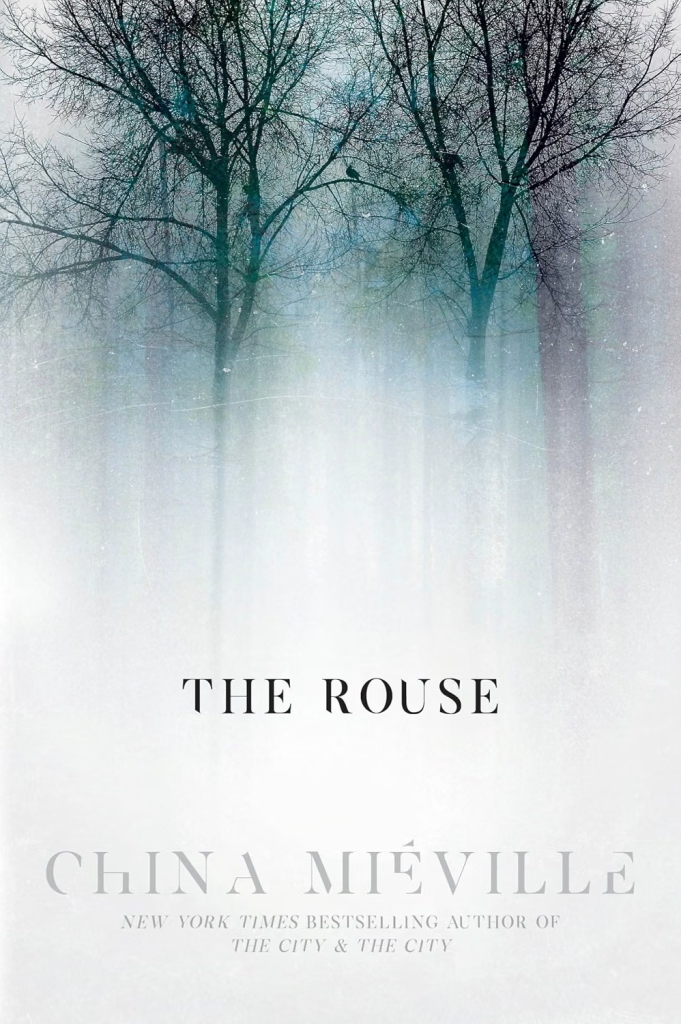
I have no idea why I purchased Oyinkan Braithwaite’s Cursed Daughters. No idea if someone recommended it to me, if I came across the author on BlueSky and decided I liked her … nothing. And by the time I got to it, I’d also completely forgotten what the book actually was. See, that cover kinda yells “fantasy” at me? And the book has the same physical format and size as every hardcover YA book I’ve bought for years. And note the “from the author of” at the bottom. Come on! You’re telling me My Sister, the Serial Killer somehow isn’t genre fiction??

Cursed Daughters is not a fantasy novel and it is absolutely not YA. It is, in fact, hated Litratcher.

It’s fucking brilliant.

I keep saying this, over and over: you should read more books by Nigerians, goddammit. The book scene out of Nigeria is amazing right now.

This is the second time this year I’ve had to apply the word “brilliant” to a work of genreless Literary Fiction. I remain salty about it. Because this is the only book I’ve read this year that came close to Tom’s Crossing. I need the swords and lasers and magic contingent to step up their damn game, is what I’m saying.

At the beginning of the book a Nigerian woman intentionally walks into the ocean to die. The same day, her cousin Ebun gives birth to a daughter. The baby resembles the dead woman, Monife, to such a degree that Monife and Ebun’s mothers immediately decide that the baby is Monife reincarnated. Ebun is … unconvinced, and frankly quite a bit upset by the entire thing. There is also the minor matter of a generations-old family curse, that no woman of this family can be happy in love.

It’s still not a fantasy book. There’s some traditional beliefs mixed into a book set in the modern day in Lagos, and there’s a juju woman as a minor side character, but it’s not a fantasy book. Ebun believes none of this nonsense, and her daughter Eniiyi wants nothing to do with it either, but has to live her entire life in her dead semicousin’s shadow. She dreams of Monife occasionally, and by the end of the book genuinely resents the effect on her life that this woman she’s never met has. She remains Monife’s spitting image, so when she occasionally runs into people who knew Monife she either provokes shock or is genuinely thought to be a ghost. And as her great-aunt gets older, she begins regularly mistaking Eniiyi for Monife, and eventually her dementia increases to the point where she forgets Eniiyi exists at all.

The book follows three generations of the family, with Ebun and Monife in the middle, and jumps back and forth from the nineties to modern day. You eventually learn why Monife chose to walk into the water, and I’m not going to spoil anything but God damn does it end well— like, “I gasped and had to put the book down for a minute” well. I started this yesterday afternoon, read a chapter or two and put it down. When I picked it up again in bed last night it cost me at least an hour of sleep, and I got home from work today and sat down in my chair and didn’t get up again until I finished it.

Absolutely phenomenal work. I ordered My Sister, the Serial Killer about ten minutes ago. It’ll be here tomorrow. Oyinkan Braithwaite is on my “buy immediately” list forever now, and I’d really like to know what the circumstances were that brought this book onto my radar. If it was you, thank you very much.

#REVIEW: Tom’s Crossing, by Mark Z. Danielewski

Buckle in, as this is going to be a bit meandering, but you’ve no doubt read my book reviews before and know to expect some degree of that, and frankly “a bit meandering” is a fair description of large parts of Tom’s Crossing anyway.

We’ll start with this: I bought this book out of spite. I don’t know anything about Mark Z. Danielewski as a person; as far as I know he has no social media presence, or at least I’ve never encountered anything from him, and I’ve never read an interview or anything like that. My only previous knowledge of his existence was from his book House of Leaves, a book I have never read and I kind of hate. The reasons I hate House of Leaves are probably not something I need to go into too deeply for this post, but I will give some brief notes:

  1. That the word “House” is supposed to be in blue; note that that is the case where the book is mentioned on the cover of Crossing up there.
  2. That the book frequently has blocks of sideways text;
  3. That the book’s fandom is excessively incel-coded and are very much the type of people who will recommend House of Leaves to you no matter what kind of book recommendation you have asked for. Dark fantasy? Have you read House of Leaves? Potboiler romance? Try out House of Leaves. 1940s etiquette manual? Let me tell you about House of Leaves.

These three things combine to make this book a big nope for me even if I might like it otherwise. I particularly refuse to read it because reading it might, somehow, make one of its fans happy, and I don’t want to do that.

A second thing: I like big books and I cannot lie. I currently have three other 1000-plus page books on my TBR, and at 1,232 pages I am pretty certain that Tom’s Crossing is the longest book I have ever read— Brandon Sanderson’s Wind of Truth has more pages, but the text on Crossing is smaller and denser and I’m pretty sure the wordcount is significantly higher. I saw this book in Barnes & Noble, thought “Oh, shit, Mark Danielewski wrote a new book,” then made the mistake of picking it up and noting the length and all the sudden I owned it. It is possible that I bought this book out of some bizarre need to stick it to House of Leaves, which is an inanimate object and does not have feelings.

This, an excerpt from page 34, is what you should expect from the prose in Tom’s Crossing. Yes, I read this on my Kindle; I bought the hardcover and then checked the book out from the library, because I’m not holding that huge fucking thing in my hands for twelve hundred pages.

Note a few things:

  1. There is not a single gerund in the book that ends with -ing. The g is dropped on every single one, including gerunds that are nouns; this book is very concerned with horses, and the word “geldin” really got on my nerves for some reason.
  2. Excessively long sentences. There are only nine sentences on this page, and sentences that take up entire pages or the majority of one are far from uncommon.
  3. That the narrator is the most highly-educated hick in the history of Utah. The dialect leads you to expect a certain kind of prose and then the book hits you with at least gettin a taste of a place where the bonds of birth and fortune have loosened their hold.

I rather expected to hate this book, to be honest, and I was hoping to hit something objectionable enough within the first couple hundred pages that I could put it down. By page 34 I was griping about it on a Discord I’m a member of. Around page 75 the language clicked.

This is one of the best fucking books I have ever read, and guys, I am so salty about that.

I am normally a Story Guy. I am a Setting Guy. I am rarely a Character Guy and even more rarely am I a Prose Guy. The story for Tom’s Crossing is serviceable but simple— it’s a Western, and it involves fulfilling a final promise to a dead friend by freeing two horses that are destined for slaughter. The main character is a teenager named Kalin, and his friend Tom tags along with him for most of the journey despite being dead. Tom’s sister Landry also comes along; she is not dead, at least most of the time. (Nearly every character in the book spends some time being dead, for the record.). Along the way the two get framed for a murder by the wealthiest family in town, the Porches mentioned in the above excerpt.

The setting? Sort of Utah, although it’s not our Utah, and the now of the book is also sort of the future, I’d estimate around 2045 or so, although the story being told is set in late October of 1988. Why is it not our Utah? Well, there’s some simple stuff, like there being a town in our Utah named Provo but none named Orvop, which is where the book is set, and then there’s weirder stuff like renaming Joseph Smith to Joseph Mith, which I thought was a typo for a while until it kept happening. Many of the book’s characters are Mormons, as you might expect from a book set in Utah, but the word “Mormon” is never used, although there is some criticism of The Church toward the end of the book. (Danielewski is not a Mormon, but apparently spent a good chunk of his youth in Utah.)

Also, when things that feel like specific references to Mormonism come up, they’re often changed too, beyond just the Joseph Mith stuff. The angel Moroni is renamed, and there are occasional scriptural references to books that don’t seem to exist. I actually went and found my copy of the Book of Mormon to check a few of the references; they aren’t in there, I swear.

Also, it appears that everyone in the world is fully conversant with all of the events in the book, even the ones that they would have had to have been present for; the book frequently cuts away to provide comments from random other people like the Reed Beacham mentioned above. Adding to the weirdness, nearly every time one of these random people is brought up, the book mentions how they died.

I also have the feeling that if I knew the Iliad and the Odyssey better I’d have picked up on some stuff. It’s been a while since I read either. This isn’t some kind of clever conjecture on my part; there is at one point a several-page conversation between three people about which characters in the book line up most precisely with characters from the Iliad. The book interprets itself. It’s nuts.

It’s the prose, y’all. I could bathe in this book’s language. About once every page or two Danielewski will hit you with a sentence or a phrase that will literally stop you in your tracks with its beauty. It’s 1200 pages long and I read it in eight days, during most of which I was also tearing apart my house.

I suspect I’m not quite smart enough to fully appreciate what’s going on in this book, to be honest. There’s a reason I make fun of Litratcher so often around here; I dislike pretentiousness in general, and while I’m very much not a The Curtains Were Blue guy, I also like my narratives nice and straightforward. I am not, as I frequently admit, the world’s most careful reader, and in fact the speed I read at frequently hurts me on more complex books. But, God, once this one had me, it had me, and I’m so glad I didn’t cave to my baser instincts and put it down after the first 40 pages just so that I could say I’d tried.

The worst thing? I think I might have to read House of Leaves now. And there is literally no higher praise that I can imagine giving to a book than that it made me decide to read House of Leaves.