#REVIEW: Chants of Sennaar (PS5)

This game made me, for the first time in quite a while, want to turn my YouTube channel back on.

I’m still not quite done with Khazan, thus the lack of a review yet. I’ve beaten it, and I want to get through New Game+ before I put it away, but I wanted a palate cleanser, something that wasn’t combat-focused and that didn’t brag about being difficult. Something chill, for lack of a better word.

How about a puzzle game about translation? How much more directly up my God damn alley could a puzzle game about linguistics possibly be? It’s unimaginable.

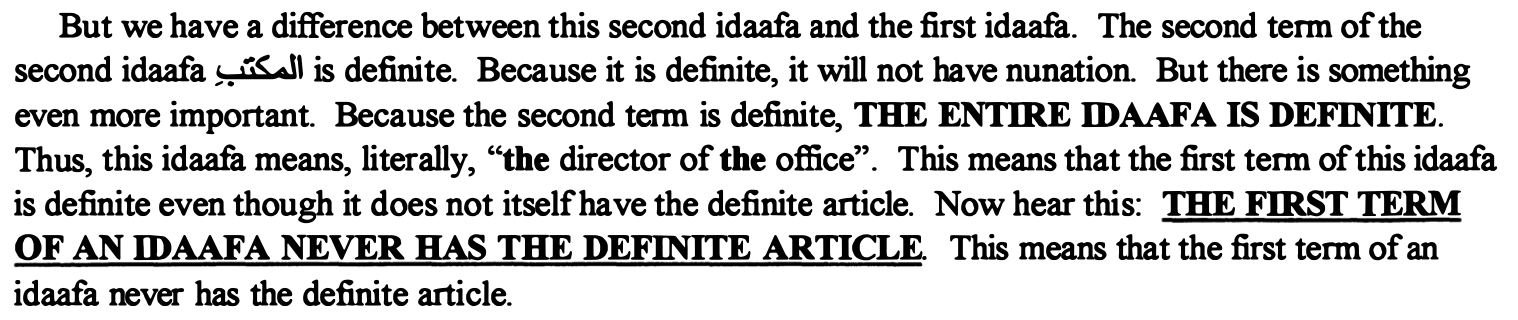
Here’s the premise of Chants of Sennaar: you’re the … person, of indeterminate gender and no name, in the faceless hood up there. You’re exploring what is effectively the Tower of Babel, which is occupied by five different groups of people, each of whom speak a different language. Your job is to 1) get to the top of the tower, 2) learn everybody’s languages on the way up there, and 3) get everybody to talk to each other. There’s a bit more of a story to it than that, but it’s a little on the obscure side, and gets downright weird towards the end of the game. That’s good enough as a gist.

Each language has 42 glyphs associated with it, and follows different rules as far as subject-verb order, plural marking, and other things like that. Sometimes the meaning of a glyph can be intuited by what it looks like, and one language lays glyphs on top of one another in a really neat way that, once you figure out what’s going on, lets you create glyphs correctly that you’ve never seen. Your avatar keeps pretty good notes, and glyphs are marked in your journal as you discover them while you explore. You can add your own notes to any glyph, and if you think you know what something means but haven’t proven it yet, your assumed translation will show up in a different font when you’re trying to read something, so that you can see what you’re still guessing at versus what you’ve definitely successfully translated.

(What will happen is every so often your notebook will have a page that will have three to five pictures on it, and if you match glyphs successfully to the pictures, it’ll confirm the meaning and translate that glyph automatically from then on. This will happen even if your guess at the meaning was wildly wrong. It does mean that it’s possible to brute-force your way through some translations, and there were definitely times where I was certain I knew three of the four glyphs and wasn’t sure about the remaining one, and just worked through my unknown glyphs until I got the right one.)

You will also occasionally find Rosetta Stone-style texts that will have the same thing written in more than one language, which can help you figure out new glyphs if you’ve already completed one of the two languages. This is where different word orders and different pluralization rules can really mess with your head, though, and there are two languages that use markers to make an entire sentence negative, which can also be fun. I loved this shit, y’all.

There are some non-language-related puzzles here and there, but they’re rare and generally not hugely challenging and the occasional very light stealth section; they weren’t difficult (and not very punitive when you screwed up) but I found myself kind of resenting them after a while just because they kept me from the stuff I was interested in. You’ll eventually unlock teleporters between the different levels, and you’ll be able to translate entire conversations between different groups that will cause the residents to start cooperating with each other and sometimes change things about some of the areas. These were my favorite parts, honestly.

Graphics and audio do their job; my wife commented at one point that she found the sound of my character walking around to be really satisfying, for whatever that might be worth, and the different areas are really visually distinct from one another, from a forbidding fortress area to a science lab to mines to a really futuristic area toward the very top of the tower. This took me nine hours to play through for $15, and I got a Platinum trophy out of it. I did have to consult a guide once, where I couldn’t figure out how to move forward and it turned out that I’d been meant to pick up an object that I didn’t realize I could interact with. That was it, so it really hit that sweet spot where some careful thinking could always get me past whatever obstacle had been thrown in my way.

This isn’t for everyone, I realize, but for me at least it was a hell of a game, and at just $15 you should definitely grab it if puzzlers are your thing.

On Arabic, pedagogy and my new life goal

Something happened at work today that rarely happens in a middle school: I, the teacher, was bored. This is dangerous. I’d finished my grades, my kids were all quietly working on something or another, and other than randomly wandering around and talking to people, I didn’t have anything in particular that needed doing. Somehow I got thinking about Arabic again, and that led to me downloading a book called All The Arabic You Never Learned The First Time Around. This book is by James Price, but you’ll never know that from looking at the .pdf I downloaded, which never mentions the author’s name.

Y’all.

I need a print copy of this book, and I think I’m probably going to have to make one by going to Kinko’s (does Kinko’s still exist?) and printing all 564 pages and then binding the damned thing myself. Amazon wants over seven hundred dollars for the sole used copy they have, which also looks home-printed, and if there’s another copy out there on a legit site I can’t find it.

I have never encountered a bitchier textbook in my life, and I love it.

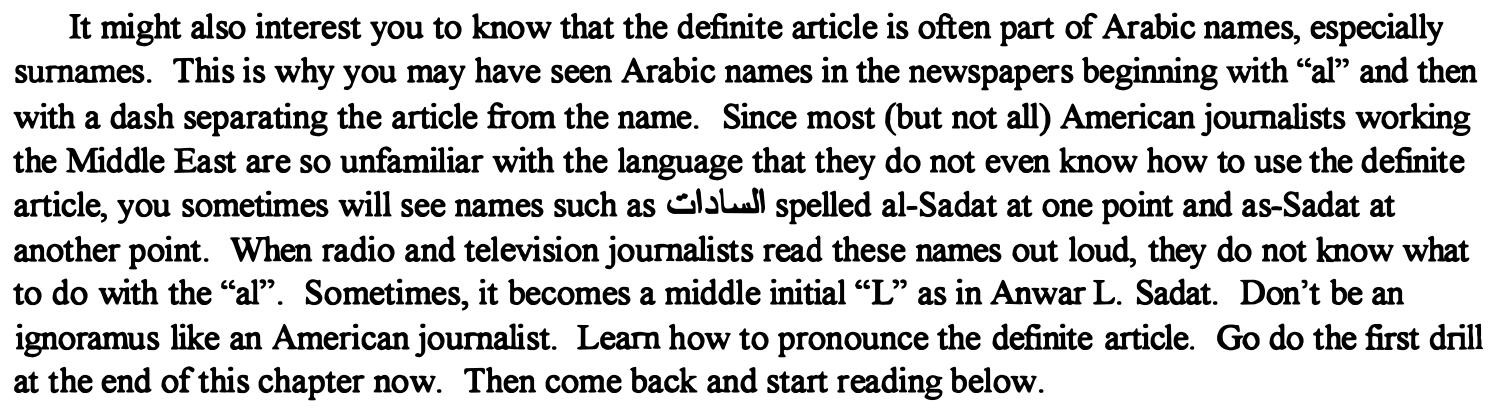
There will be a lot of images in the rest of this post. They are all from the first two chapters of, again, a .pdf that is five hundred and sixty-four pages long.

In general, this man despises all human life. It’s glorious.

Who does he despise the most? American journalists. Oh my God does James Price hate journalists.

You know how most language textbooks pick a few basic words and use them for examples over and over? And how lots of times those are simple, easy words that everyone uses all the time? You will never guess the first three sample words this guy picks. Not if you try for a thousand years.

I’m not kidding. This is going to happen over and over again:

Any hint of confusion is met with immediate scorn, which is something all good teachers do:

This is the last paragraph of the first chapter:

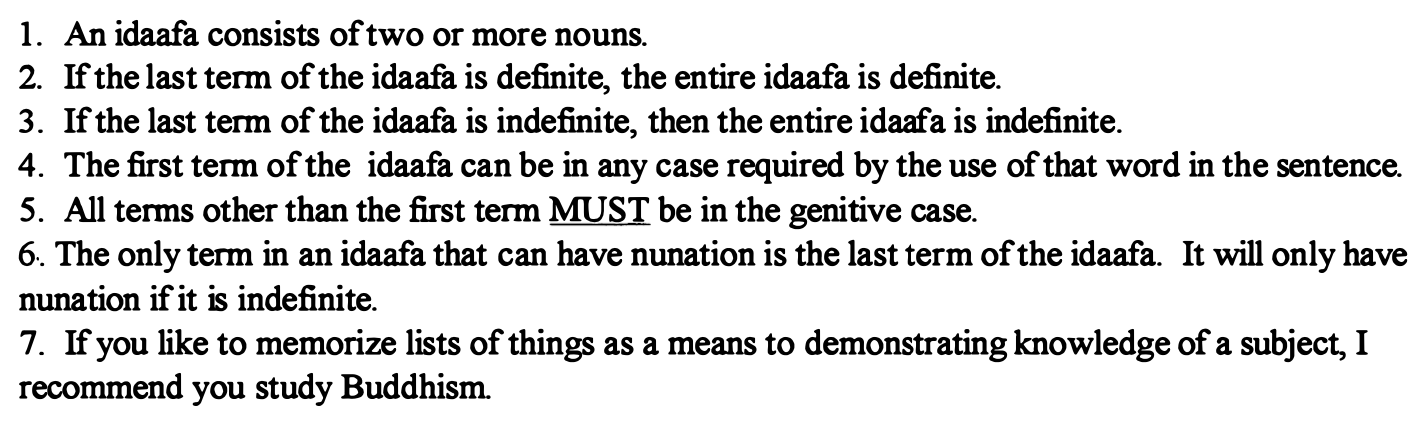
Chapter Two starts getting into case endings and something called “Idaafa,” which I cannot explain just yet. I can tell you that James Price thinks idaafa is very simple and easy and does not have a whole lot of patience for people who do not understand it, to the point where this chapter starts using typesetting for emphasis along with the usual heavy doses of sarcasm:

I am going to start modeling all of my teaching after the last two sentences in this paragraph, including the use of all-caps, underlined bold text:

Shit, is that what it means? I understand now!

Toward the end of the chapter, we get this gem, where he makes fun of the reader for studying the text he wrote:

I’ve only read two chapters, remember, and I haven’t really thoroughly studied them, but I think I’m starting to detect a theme here, as this is how he ends chapter two:

This is the best textbook I have ever seen, and James Price is my new educational idol. Please, please, let someone find me a print copy of this, or I swear to God I’m making a leather-bound copy myself.

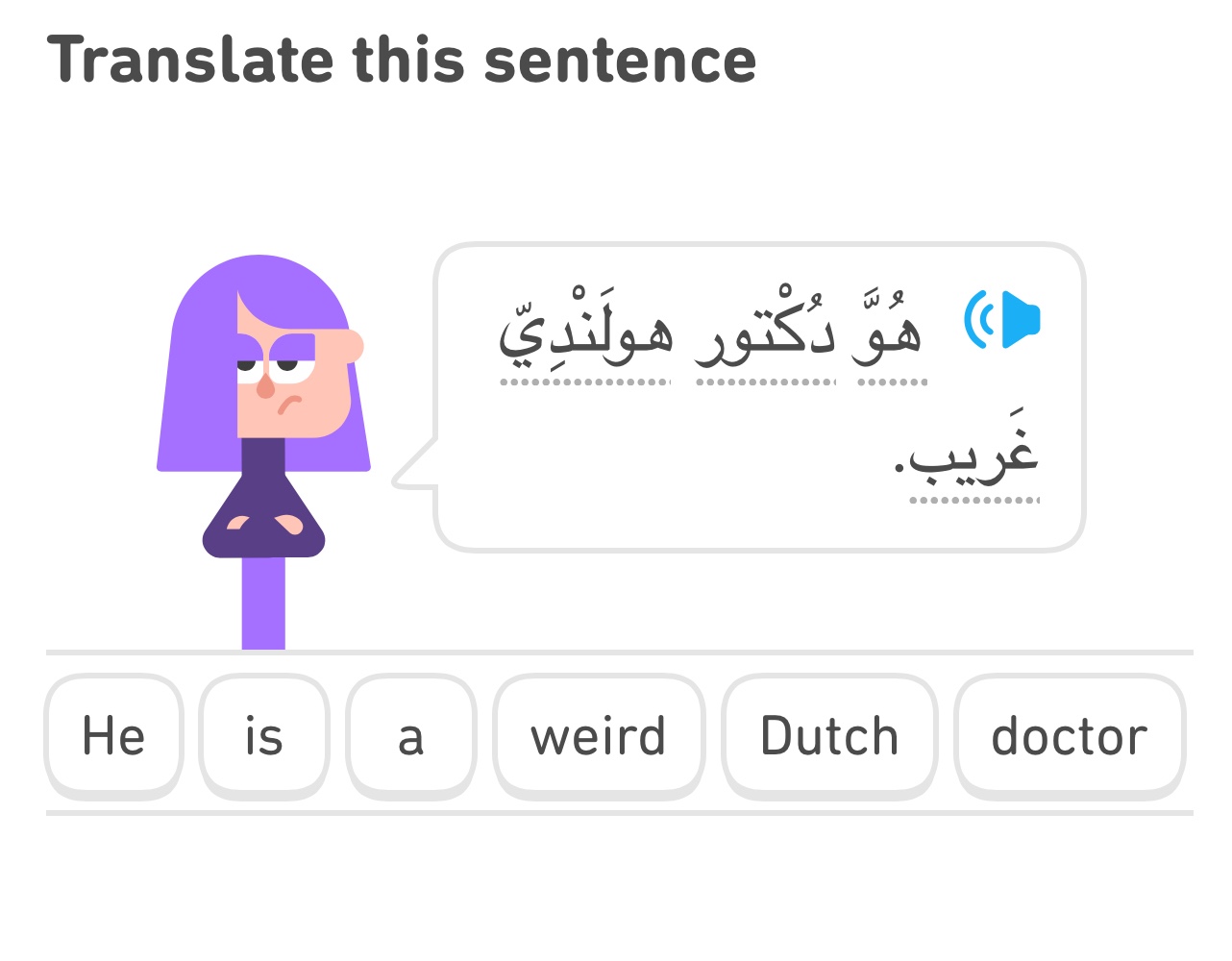
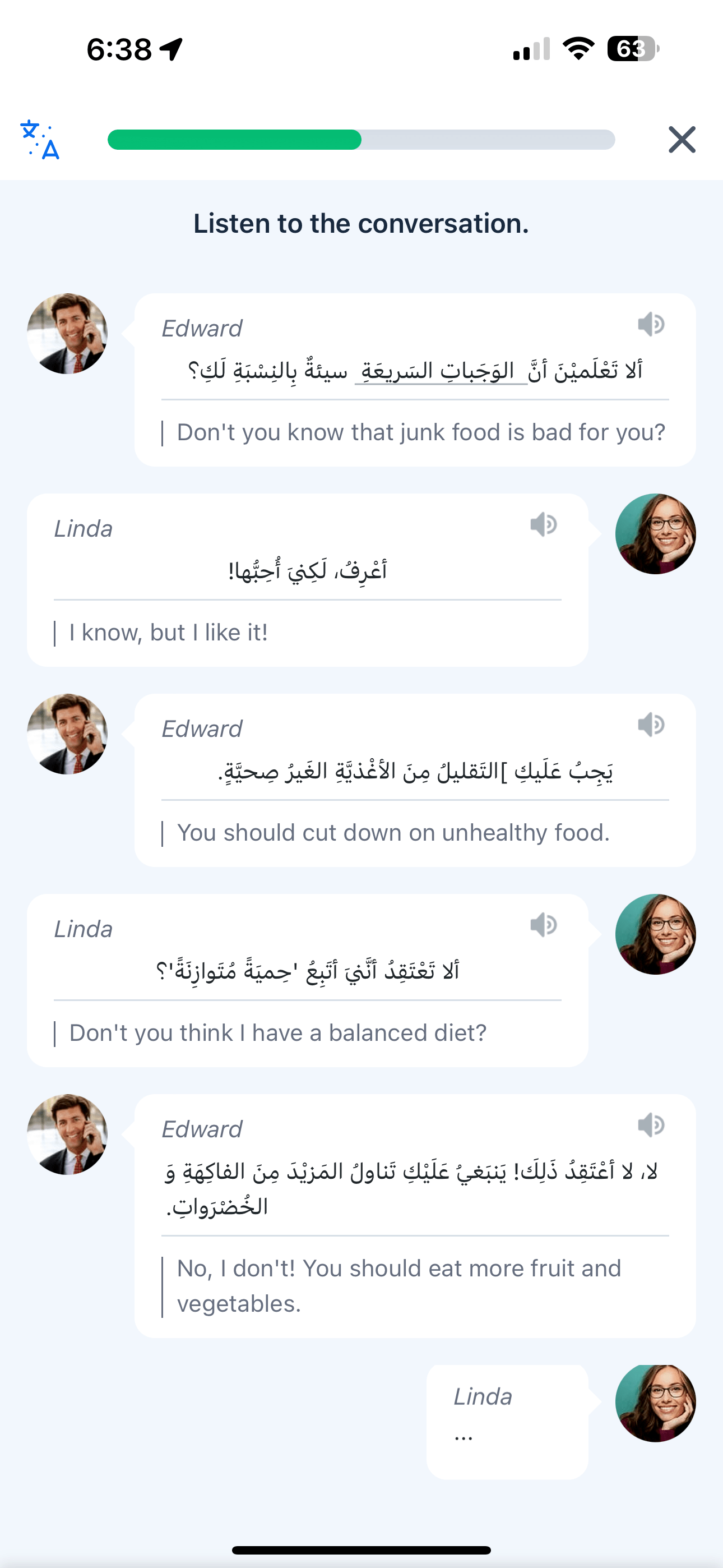
Never change, Duolingo

I can literally hear my students whining “When am I gonna use this?” right now.

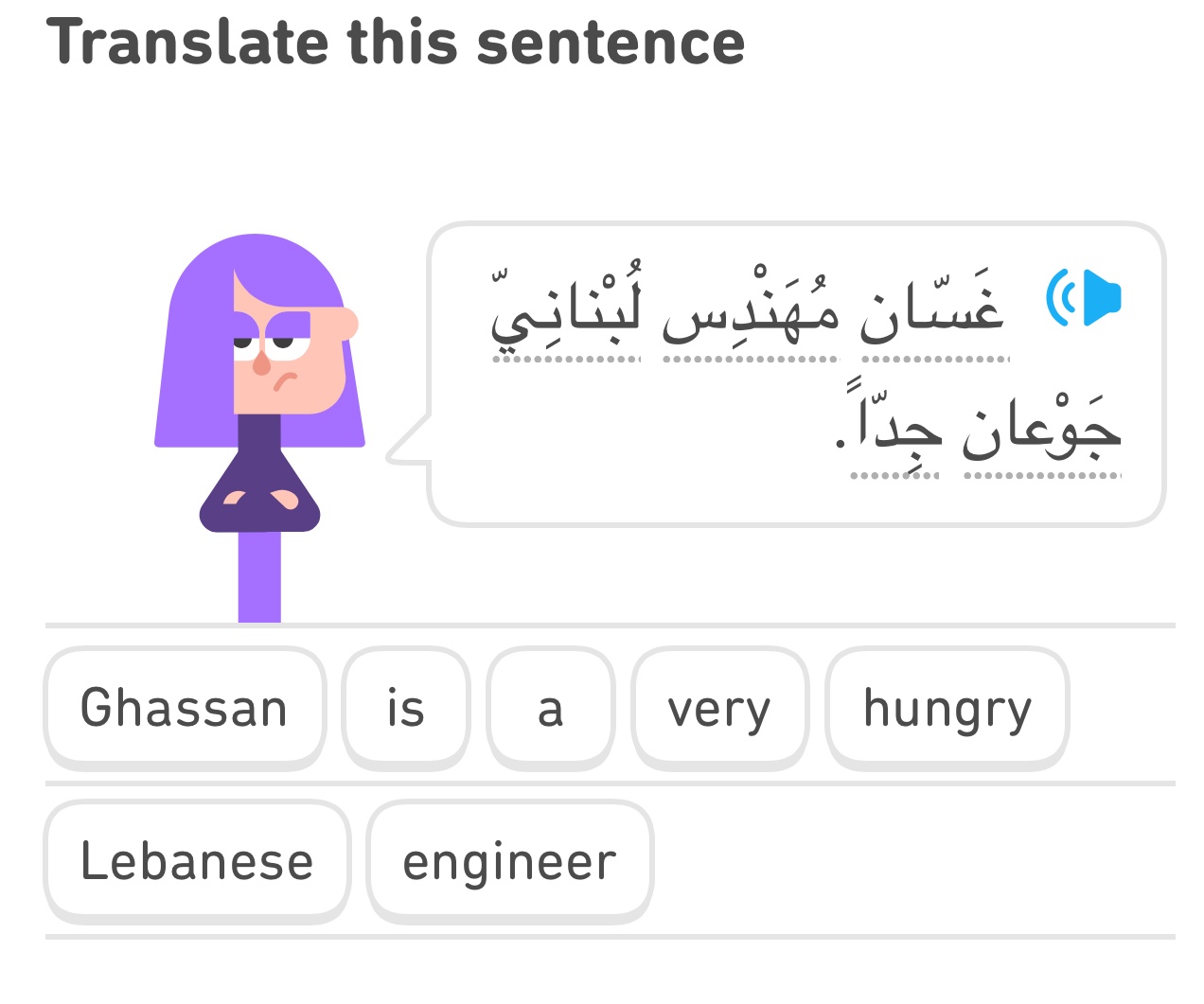
Also, Duolingo, I think it’s fair to suggest that an American English speaker will never say “Ghassan a is very hungry,” and while I admit that that would be a genuine PEBKAC* error, it would be super cool if you could just fix it and move on.

*we may need a more phone-appropriate version of this acronym.

Break up with this dude

Never change, Busuu.

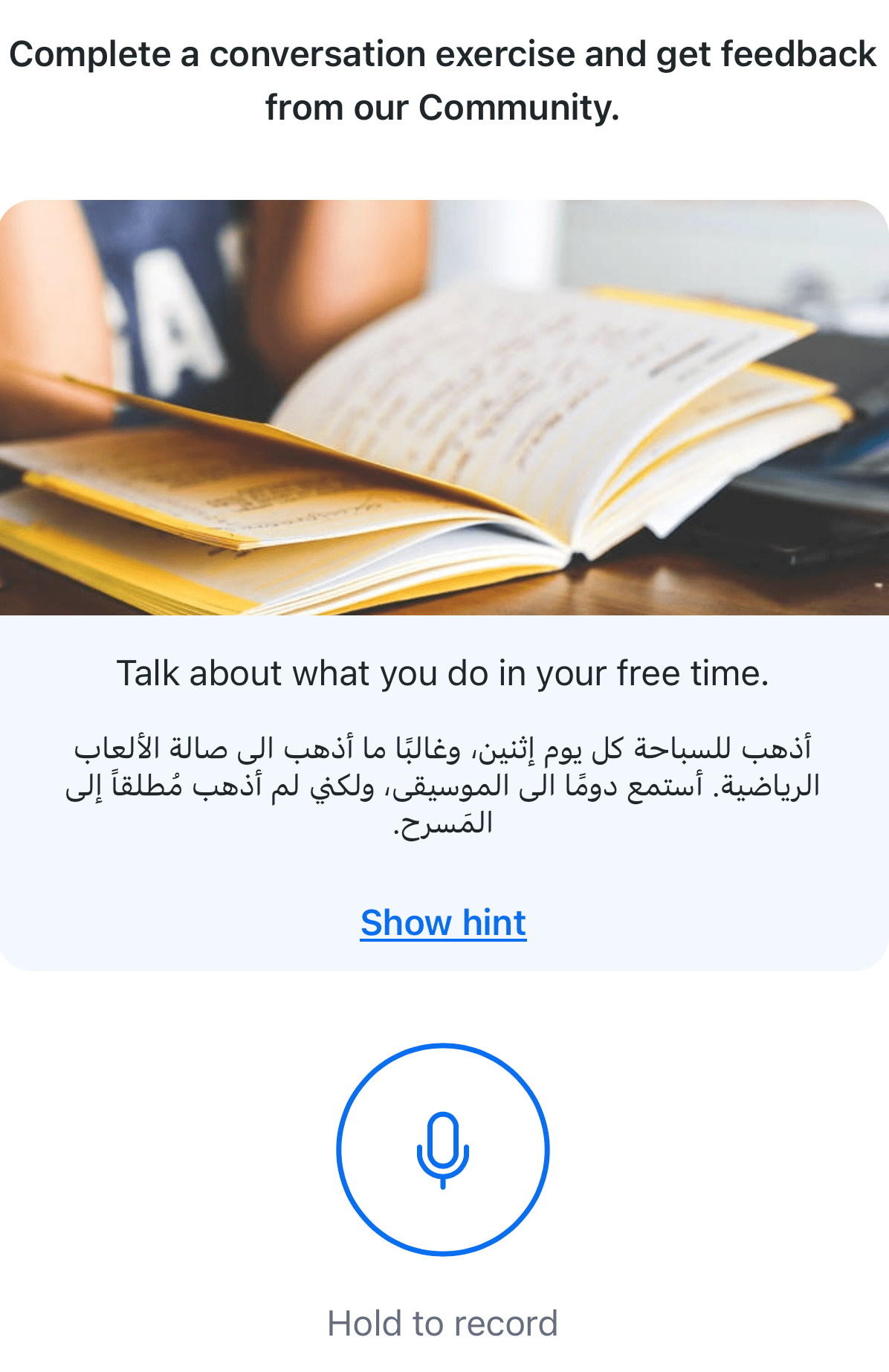
Calm down, Busuu

Those three lines of Arabic are what you get when you click “Show Hint.” They are not what you need the hint for. Needless to say, I can’t translate a word of that. I can’t even sight-read it. That is not a hint, Goddammit.

I am just destined to fail at this shit.

Screw it, let’s give some examples

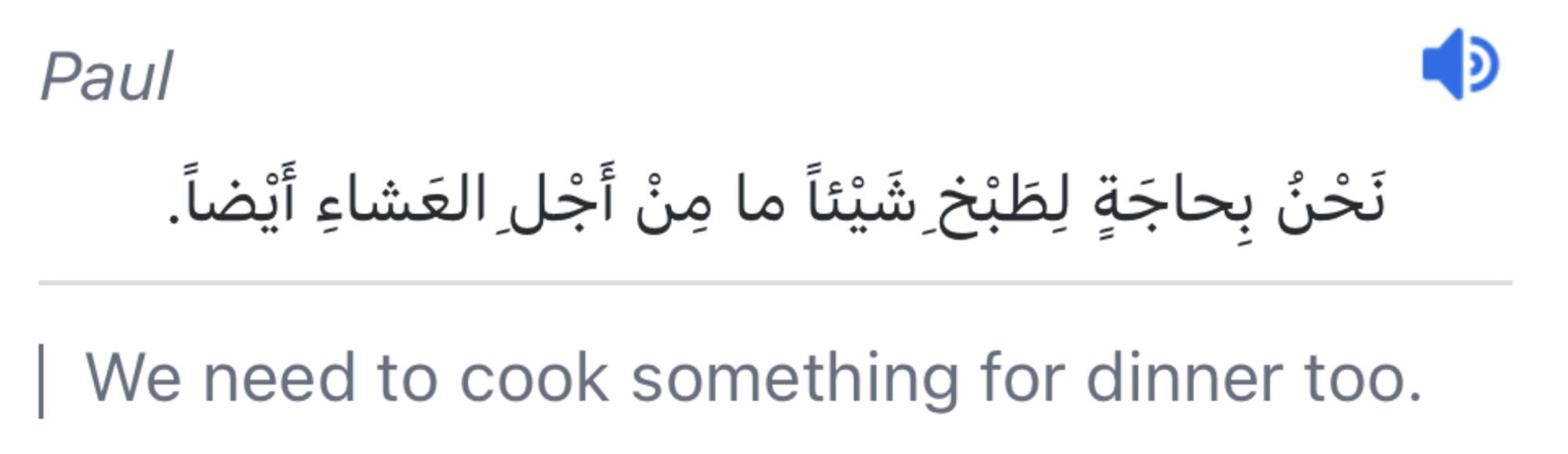
I pulled this from my post the other day about the conversation quizzes. Remember, the way this works is I get sentences one at a time, spoken by what sure sounds like a native speaker, and some of the words are blanked out. I get a word bank to choose from to fill in those blanks.

Let’s get into a few explanations, and I’m not looking any of this up right now— I’m typing this on my iPad while watching John Wick 3, so I’m not going to take the time to nail down the details. Basically any of the dots on those letters are for differentiation between different letters. So the difference between a d and a z or an s versus a sh might be how many dots are on the word. Some base letters have as many as three variants. I don’t think there are any with four (no dots, one, two, and three) but I might be wrong.

The little circles that show up here and there indicate a letter that does not have a vowel after it. This was never explained in Duolingo and has never been mentioned in Busuu; I had to look it up.

Dashes indicate short vowels. A dash under a letter indicates a short I, a dash above a letter indicates a short a, and there’s a little curlicue-lookin’ thing that appears above the letters that indicates a short u. I don’t see any of those in this sentence but that might be a font thing.

Here’s the problem: there are a bunch of symbols in those words that haven’t been explained in either of the apps, and I have no idea what they mean. The double-line above the vertical letter on the far left? No idea. The double line underneath the leftmost letter of the second word from the left? No idea. The symbol on the rightmost letter of the leftmost word? No idea.

I can’t read these words if you don’t explain what these symbols mean, guys, and while some of them are vowels, occasionally I feel like maybe some of them represent multiple letters together, or are maybe a contraction of some kind? I can’t just figure this out. Stop fucking with me.

In which I reconsider

I think it’s probably time to admit that if I want to take a serious shot at learning Arabic I’m going to have to 1) spend time with textbooks and 2) probably suck it up and take a class. I was pleased with the way Busuu introduced the alphabet, but it went from that directly to “Okay, you know this now, and you’re ready for entire sentences in this tiny-ass font, right? Plus a bunch of symbols that we never really discussed in the alphabet section? You won’t be able to make half of them out anyway so don’t worry about learning them.”

Like, guys, language learning apps should explain shit, and I don’t understand why they don’t. Busuu’s approach to anything that isn’t the alphabet has been to give a handful of examples that may or may not generalize, not explain them, and then just … move on. Like, my last unit was on comparatives and superlatives? It gave me bad/worse/the worst and, I dunno, maybe good/better/best and that was it. I liked the “pull words out of this conversation” feature the first time I saw it, but I just don’t know enough to be able to do that easily and I can’t read well enough to go from spoken word to one of four different words that may not differ from each other all that much. Especially when, again, I don’t know all of the vowels and diacritics. Every so often it will show me a picture and ask me to say something about it for one of the social media features, and, Christ, I don’t even know where to start.

There also might be a dialect difference between it and Duolingo, and I can’t figure that out either. Lots of the nouns end differently (-atun seems to get added to a lot of them, and sometimes just -a) and I can’t figure out what the ending means, or why Duolingo’s vocabulary never bothered with it, and gendered endings seem inconsistent, and … gah. I’m smart enough to learn this shit, but I’m not smart enough to figure it out, especially given limited examples and the weird fact that that ending doesn’t seem to be properly represented by the actual letters at the end of the word, which is probably a function of one of those symbols I never got an explanation for.

And, for the record, if you happen to understand Arabic, don’t worry about explaining how all of this works. Like, I have access to other sources of information, and to a certain extent this is a function of my own laziness. I want there to be an app that explains this at the depth and quality that a textbook would, because I want to learn Arabic five minutes at a time while sitting in a comfortable chair in my living room or my library, and not hunched over a textbook or sitting in a classroom that I have to pay tuition for. I shouldn’t be surprised when I can’t find that.

Just shoot me, ctd.

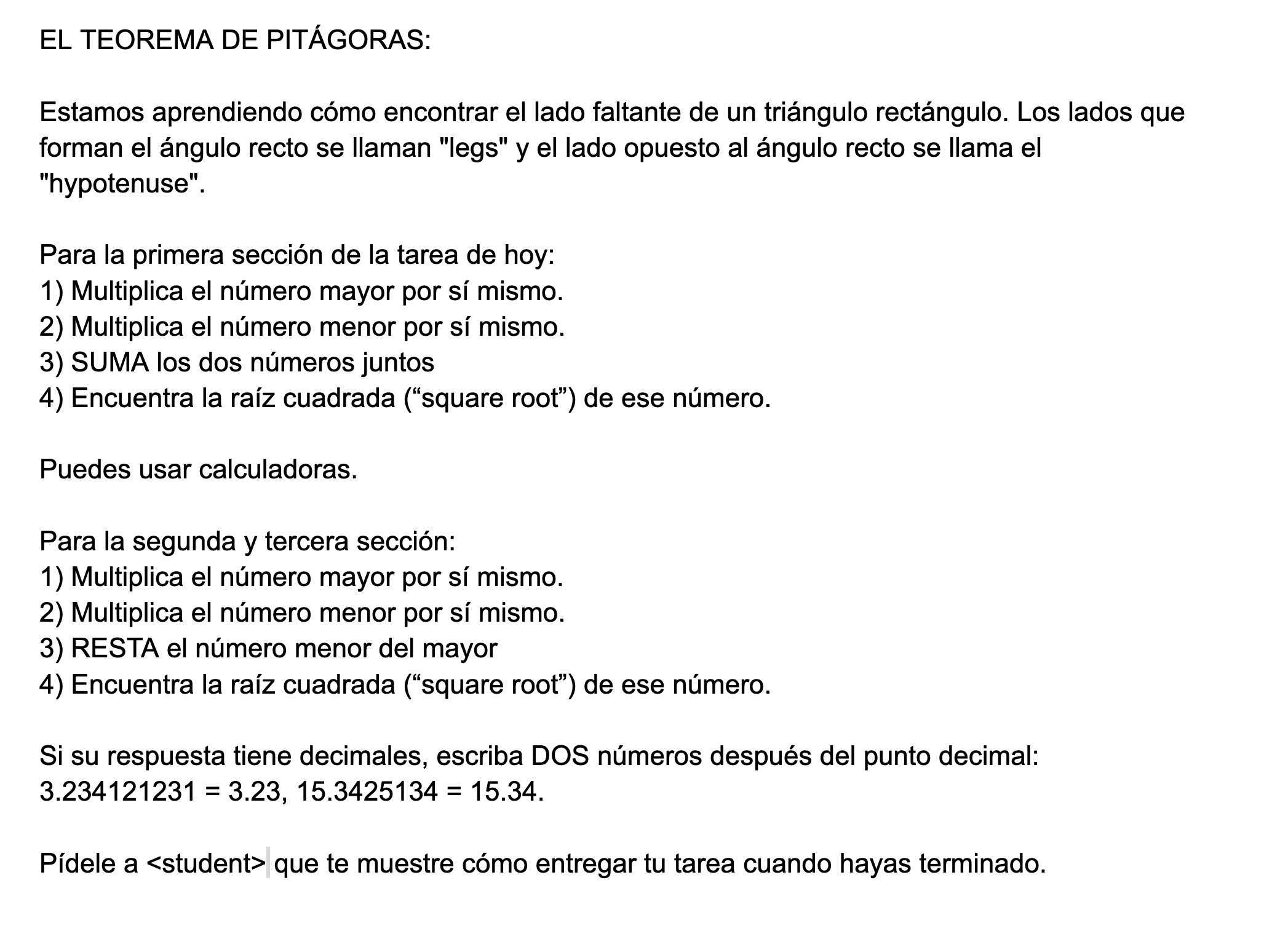
I did something today that I’ve never done in twenty years of teaching– I would estimate, without a shred of exaggeration, that 2/3 of the teaching I did during my fourth hour was in Spanish. It was time to sit down with my newcomers and see where they were at, and the only way to do that was to communicate with them in their own language. To wit, I generated this for them:

And then I banished about half of the class from the room, sending them with my co-teacher to her classroom, mostly to cut down on the number of other kids who might want to talk to me and also to prevent a certain student from getting Valentine’s Day-related harassment, and sat down with the kids and went through a bunch of problems with them. I’m hoping that document is translated well from what I typed; based on my meager Spanish it looked okay, and the kids didn’t have questions. The boy read through it, smiled at me, and proceeded to get nearly a perfect score on his assignment with only a small number of questions, all of which, I’m proud to say, I understood; the girls are a little bit behind for 8th grade but not enough that I’m terribly concerned about it. I have English-speaking kids who, based on this one assignment, have bigger problems than they do. One of them does seem to rely kind of heavily on the other, who did most of the talking and also appeared to do the lion’s share of the work, but we’ll see how that shakes out in a couple of weeks.

You may notice, even if you don’t read Spanish, that the actual Pythagorean Theorem doesn’t appear anywhere in that document. That’s entirely intentional; I generally deemphasize the formula itself in favor of the process of figuring out a missing leg or a missing hypotenuse. They know the formula, but I treat this as mostly calculator work, and I drill the phrases “square-square-add-square root” and “square-square-subtract-square root” into their heads until they’re repeating them in their sleep. Since I didn’t have any real idea where these kids might have been in terms of their math skills I decided I’d leave it out entirely for now.

We are taking it easy tomorrow, across the board. I kinda feel like I’ve worked the kids (all of them, not just the new ones) like dogs this week, and between talking a lot more than usual and the added stress of teaching in a foreign language today, I’m ready for a day where I can wave them vaguely in the direction of a Quizizz or something else that has a chance of being fun rather than being at the board or hunched over someone’s shoulders all day. They’re picking this up pretty well so far so I think if I have a calm Thursday before a four-day weekend God will forgive me.